Mental fog is not a personality flaw. It’s a signal that your brain is overloaded, under-stimulated, or both. The right books for mental clarity do something no productivity app can replicate: they train your attention, regulate your nervous system, and rebuild the cognitive habits that scattered thinking erodes. This guide goes beyond a simple reading list. You’ll learn how to choose the right books, how to read them in a way that actually rewires your focus, and how to build a reading routine that delivers lasting mental wellness rather than a temporary motivational spike.
| Point | Details |
|---|---|
| Reading is a brain workout | Reading simultaneously activates language, memory, attention, and imagination, strengthening cognitive reserve. |
| Book selection matters | Choose titles with evidence-based methods, such as mindfulness or CBT frameworks, over generic self-help. |
| Active reading beats passive scanning | Note-taking, questioning, and summarizing transfer knowledge into long-term memory far more effectively. |
| Timing your sessions counts | Reading at your peak mental hours or before bed amplifies focus and reduces stress hormones. |
| Consistency beats intensity | Short, focused daily sessions build lasting mental clarity better than occasional marathon reading. |
Mental clarity is not simply the absence of distraction. It describes a state where your working memory functions well, your attention holds without constant pulling, and your thoughts connect logically rather than fragmenting under pressure. When that state breaks down, you experience what researchers call cognitive overload. The good news is that reading is one of the most well-documented tools for rebuilding it.
Here is why reading works at a neurological level:
The cumulative effect matters too. A randomized trial found that sustained book exposure over five years produced 52 to 65% better cognitive and literacy outcomes compared to controls. This is not about reading one transformative book. It’s about building a practice.
Not every self-help book for clarity delivers what it promises. Many recycle the same advice in new packaging. Knowing what to look for saves you time and gets you results faster.
What makes a book genuinely useful for mental clarity:
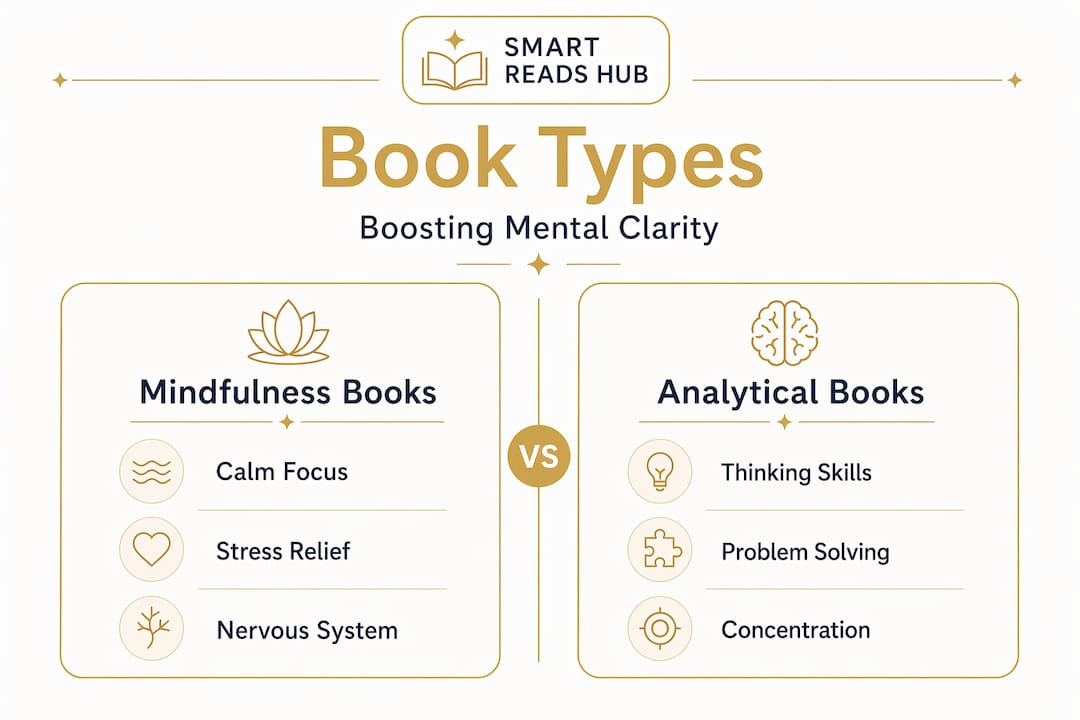
The genre mix matters more than most readers realize. Here is a quick comparison of how different types of books for mindfulness and cognitive health contribute uniquely:
| Book type | Primary benefit | Best for |
|---|---|---|
| Mindfulness and meditation guides | Nervous system regulation, present-moment focus | Reducing anxiety and mental noise |
| CBT-based self-help | Restructuring unhelpful thought patterns | Chronic overthinking, rumination |
| Neuroscience nonfiction | Understanding how your brain works | Building lasting cognitive habits |
| Literary fiction | Empathy, perspective-taking, emotional regulation | Reducing cognitive rigidity |
One category worth your attention is books integrating Mindfulness-Integrated CBT. A structured 10-week MiCBT program aligns mindful awareness with thought restructuring, producing measurable improvements in calm, self-confidence, and mental clarity. Books that follow this model give you a program, not just inspiration.
Pro Tip: When browsing for the best books for mental wellness, check whether the author holds credentials in psychology, neuroscience, or clinical practice. A compelling writing style is great, but it should not substitute for methodological rigor.
You can explore curated book selections at Smartreadshub that filter for exactly these qualities, saving you the guesswork.
Here is the uncomfortable truth about reading for mental focus: passive reading, where your eyes move across the page while your mind drifts, produces almost no lasting cognitive benefit. The text enters short-term memory and evaporates. Active reading is what actually changes your brain.
Active reading requires treating text as a dialogue. You annotate, question, and summarize as you go. That friction is the point. It forces your brain to process information at a deeper level, which is exactly the mental workout that builds clarity over time.
Follow this sequence to shift from passive to active reading:
Active recall after reading transfers knowledge from short-term to long-term memory by strengthening the neural connections formed during reading. Skipping this step is like doing a workout and skipping the recovery. The gains do not stick.
Pro Tip: Keep a dedicated reading notebook, not a digital notes app. The physical act of handwriting engages motor memory and slows your thinking enough to process ideas more deeply.
The biggest mistake people make with reading for mental focus is treating it as something they do when they have time. That framing guarantees it never becomes a real habit. A reading routine works best when it is anchored to an existing behavior and protected like any other appointment.
Here is what a sustainable routine actually looks like in practice:
Balancing difficulty is underrated. If every book you read is a demanding neuroscience text, your brain fatigues and motivation drops. Mixing top books for inner peace, such as meditative fiction or reflective essays, with more technical self-help books for clarity keeps engagement high without sacrificing depth.
Pro Tip: Create a small ritual that signals “reading mode” to your brain. It could be making a specific tea, putting on instrumental music, or sitting in a particular chair. Repetition turns the ritual into a neurological cue that accelerates focus onset.

Signs your reading routine is working include noticing that you can hold focus longer in other areas of life, that you feel less reactive in stressful situations, and that you recall ideas from books days after reading them without reviewing your notes. If those signs are absent after four weeks, the issue is usually either passive reading habits or book choices that do not match your current cognitive state.
Even motivated readers undermine their own results. These are the patterns worth watching for:
“The goal of reading for mental clarity is not to finish books. It is to finish sessions having genuinely engaged with ideas that stretch your thinking.”
Reset your motivation by returning to a book you loved and rereading a single chapter. This reminds your brain why the habit is worth protecting.
I’ve spent years recommending books to people who want to improve mental clarity, and the pattern I keep seeing is this: most readers treat book selection as the hard part. They research titles, build elaborate reading lists, and then read passively and wonder why nothing changes.
In my experience, the book matters far less than how you read it. I’ve seen people transform their focus using a moderately written CBT workbook because they read it actively, took notes, and applied the exercises. I’ve also seen people finish genuinely brilliant books on neuroscience and retain almost nothing because they read them like novels on vacation.
What I’ve learned is that reading for mental clarity is a skill, not a pastime. It requires the same intentionality as physical training. You would not walk into a gym, wander around for an hour, and expect results. The same logic applies here. Pick your book with care, yes. But invest equal energy in how you show up to each session. That shift in mindset is what separates readers who get results from readers who just accumulate books.
— Robert
If you’ve been putting off building a reading habit because you don’t know where to start, the overwhelm is the problem, not you. Smartreadshub exists specifically to solve that. Rather than sifting through thousands of titles, you get hand-picked recommendations filtered for evidence-based content, readability, and genuine mental wellness impact.
At Smartreadshub’s book collection, you’ll find titles spanning mindfulness, CBT, neuroscience, and literary fiction, organized so you can match your current mental state to the right read. Whether you are starting from scratch or looking to deepen an existing practice, the curated selections remove the guesswork and get you reading the books that actually move the needle. Visit Smartreadshub and find your next clarity-building read today.
The best books for mental clarity combine evidence-based psychological techniques with engaging writing. Titles grounded in mindfulness, CBT, or neuroscience tend to produce the most measurable results when read actively.
Reading activates language, attention, memory, and imagination simultaneously, building cognitive reserve and training the focused attention that mental clarity depends on.
Start with 20-minute focused sessions using a timer. Consistent daily practice matters more than session length, and building stamina gradually prevents the burnout that kills long-term reading habits.
Both serve different functions. Nonfiction self-help books for clarity deliver frameworks and techniques, while literary fiction builds empathy and cognitive flexibility. Mixing both genres produces the strongest overall mental wellness benefits.
Morning sessions work best for demanding nonfiction because your prefrontal cortex is at peak performance. Evening reading, particularly fiction or mindfulness titles, activates the parasympathetic nervous system and supports better sleep quality.