Books about rebuilding friendships are practical tools for repairing damaged relationships through proven communication strategies, psychological frameworks, and honest self-reflection. Friendship repair is not a passive process. It requires deliberate effort, the right knowledge, and a willingness to face uncomfortable truths about what went wrong. The best friendship restoration books give you exactly that: structured guidance from psychologists, therapists, and authors who have studied how people reconnect after conflict, distance, or betrayal. This guide shows you which principles matter most, how to choose the right book for your situation, and how to apply what you read.
The best guides for repairing friendships share a consistent foundation. Understanding these principles before you pick up a book helps you read with purpose.
Mutual effort is non-negotiable. Friendship repair requires mutual effort and sincere apologies focused on impact rather than excuses. One person cannot carry the entire repair process. If you are the only one reaching out, adjusting, and apologizing, the friendship is not being rebuilt. It is being maintained by one side.
Apologies must focus on impact, not intent. Most people apologize by explaining why they did something. That approach protects the apologizer and minimizes the other person’s pain. Effective apologies, as described in self-help friendship books, center on what the other person experienced, not what you meant to do.
Here are the core principles you will find across the strongest friendship restoration books:
Pro Tip: Before you start any book on friendship repair, write down what you actually want from the friendship going forward. Not what it used to be. What you want it to become. That clarity shapes how you read and apply every chapter.
Choosing the wrong book wastes time and can even reinforce unhelpful patterns. The right book matches your specific situation, conflict type, and emotional readiness.
Follow these steps to narrow your selection:
| Selection Criteria | What to Look For |
|---|---|
| Conflict type match | Book addresses your specific situation: drift, betrayal, or argument |
| Structured method | Clear step-by-step repair process with timelines |
| Expert authorship | Licensed therapist, psychologist, or credentialed researcher |
| Balanced advice | Includes guidance on when to walk away, not just how to repair |
| Practical tools | Scripts, exercises, or reflection prompts you can use immediately |
Pro Tip: Read the table of contents and the final chapter before buying. If the book ends without addressing when to let go, it is giving you an incomplete picture of friendship repair.
Reading is only half the work. The other half is applying what you learn with consistency and care. Here is how the best books on reconnecting friends translate into real action.
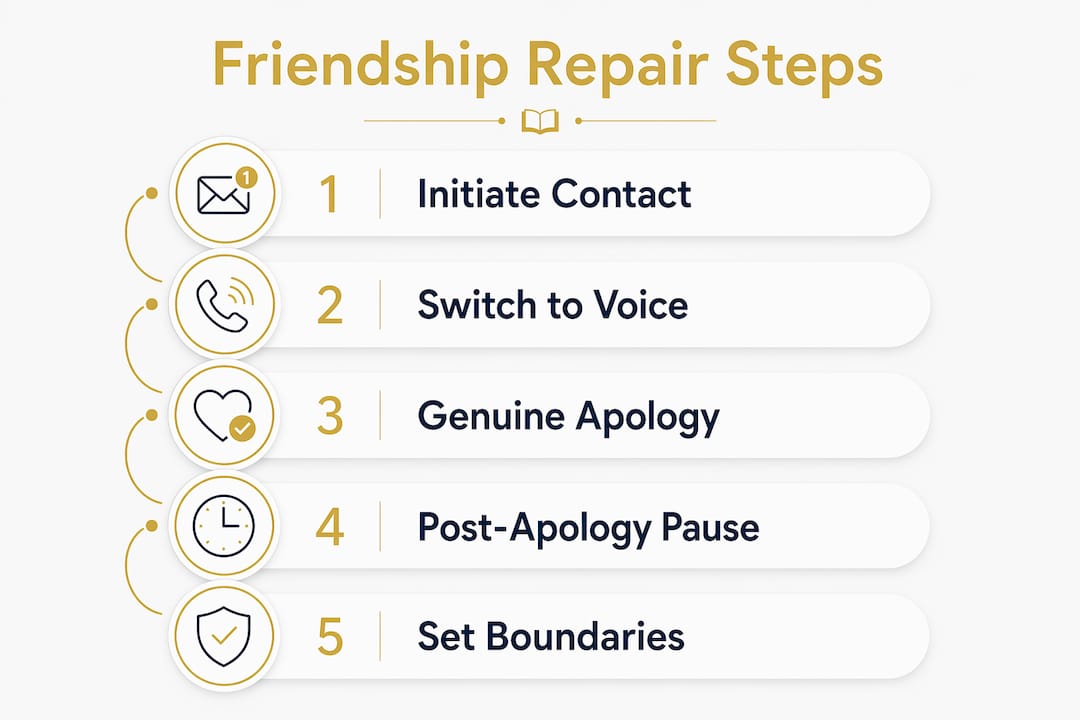
Step 1: Initiate contact with low pressure. A short, genuine message works better than a long emotional letter. Say you have been thinking about the friendship and would like to reconnect. Do not apologize in the first message. That conversation needs space and presence.

Step 2: Move to voice or in-person as quickly as possible. In-person or voice communication is more effective than text for emotional nuance and avoiding misunderstandings during reconciliation. Text strips out tone, facial expression, and timing. These are the exact elements that make an apology land or fall flat.
Step 3: Offer a genuine apology without defensiveness. State what you did, acknowledge the impact, and stop there. Do not follow the apology with “but” or an explanation. That single word undoes everything before it.
Step 4: Practice the post-apology pause. The post-apology pause is critical. Allow the other person to process before moving forward. Silence after an apology is not failure. Filling it with justifications is. Give the other person room to respond on their own timeline.
Step 5: Set new boundaries together. Ask what the other person needs from the friendship going forward. Share what you need. This conversation redefines the relationship and prevents the same patterns from repeating.
Step 6: Engage consistently at low pressure over time. Repair does not end with one good conversation. Follow up with small, genuine gestures over weeks. A shared article, a check-in message, or an invitation to a low-stakes activity all signal that you are committed without being overwhelming.
Here is what consistent re-engagement looks like in practice:
Most people make the same errors when trying to repair a friendship. The best guides for repairing friendships name these mistakes directly so you can avoid them.
“Reconciliation is a process involving redefinition, new boundaries, and accepting friendship transformation rather than restoration.” — Psychology Today
This distinction matters more than most people realize. You are not trying to recover the past. You are deciding whether to build something new with this person.
Stories about friendship rebuilding in literature and memoir do something clinical guides cannot. They show you the emotional texture of repair: the awkward silences, the false starts, the moments of unexpected grace.
Alexandra Elle, in The Company We Keep, advises becoming a better friend to yourself as a prerequisite for repairing other friendships. This is a counter-intuitive starting point. Most people focus outward when a friendship breaks. Elle argues the inward work comes first.
The table below shows what different types of friendship narratives teach and where they are most useful.
| Story Type | Core Lesson | Best For |
|---|---|---|
| Memoir (e.g., Alexandra Elle) | Self-awareness precedes external repair | Readers who contributed to the conflict |
| Literary fiction | Friendships transform, not just restore | Readers expecting things to return to normal |
| Psychological case studies | Patterns repeat without structural change | Readers in recurring conflict cycles |
| Guided narrative workbooks | Step-by-step reflection with real examples | Readers who learn by doing |
The most useful lesson across all these formats is the same: rebuilding friendships often redefines rather than restores the previous relationship. Accepting that truth early makes the entire process less painful and more productive. You can also explore how books explain relationship patterns to understand the deeper dynamics at work in your friendship.
The most effective approach to rebuilding friendships requires mutual effort, honest apologies, and a willingness to redefine the relationship rather than restore it to what it was before.
| Point | Details |
|---|---|
| Mutual effort is required | Unilateral repair attempts consistently fail; both people must commit to the process. |
| Apologies focus on impact | Effective apologies name what the other person experienced, not what you intended. |
| Voice beats text | In-person or phone conversations carry the emotional nuance that text cannot deliver. |
| Redefinition over restoration | Successful repair builds a new version of the friendship, not a copy of the old one. |
| Know when to walk away | Not every friendship is worth repairing; chronic one-sidedness signals it is time to let go. |
Reading dozens of books on friendship repair has shifted how I think about these relationships entirely. The biggest misconception I see is that people treat friendship repair as a retrieval mission. They want the old friendship back. That framing almost always fails.
The books that changed my thinking most were the ones that treated repair as construction, not recovery. You are not digging up something buried. You are building something new with someone you already know. That requires honesty about what went wrong, yes. But it also requires honesty about what you want the friendship to look like going forward.
The self-care piece that authors like Alexandra Elle emphasize is not soft advice. It is structural. If you go into a repair conversation still carrying unprocessed resentment or unexamined guilt, you will recreate the same dynamic. The science of healing through books works precisely because reading forces you to slow down and examine your own patterns before you act.
My honest take: the friendships worth repairing are the ones where both people are willing to be uncomfortable. If only one person is doing the emotional labor, that is not a friendship being rebuilt. That is a friendship being managed. The books that help you see that distinction clearly are the ones worth your time.
— Robert

Smartreadshub curates books specifically for people working through complex relationship dynamics, including friendship repair, emotional recovery, and boundary setting. The site’s expert-reviewed selections go beyond generic self-help to address the psychological patterns that cause friendships to break down in the first place. If you are ready to move from reading about repair to actually doing it, the best books on women’s mental health collection at Smartreadshub includes titles that address friendship, self-worth, and relational healing with clinical depth. Start with one book. Apply one principle. That is how repair actually begins.
The most useful friendship restoration books offer structured frameworks, expert authorship, and guidance on both repair and letting go. Look for books that include reflection exercises and address the emotional work required from both people.
Clinical guidelines describe repair as a process spanning weeks to months, not a single conversation. Consistent, low-pressure engagement over time is more effective than intense short-term effort.
Yes. Forgiveness and reconciliation are different processes. Forgiveness is a personal release of bitterness. Reconciliation requires mutual commitment and behavioral change from both people.
Start with a brief text to open the door, then move to voice or in-person as quickly as possible. Text lacks the emotional nuance needed for sincere apology and conflict resolution.
If the friendship is chronically one-sided, emotionally draining, or built on patterns that caused repeated harm, walking away is the healthier choice. The key question is whether your life is genuinely better with that person in it.