
What are the best alternatives to narcinfohub.com?
The strongest narcinfohub.com alternatives cover more ground than a single site can: licensed therapy referrals, DBT-grounded workbooks, moderated survivor communities, and browser-based safety tools. Here is a structured overview of the leading options.
| Resource | Focus/approach | Resource types offered | Accessibility/usability | Target audience focus |
|---|---|---|---|---|
| Smart Reads Hub | Curated literature and trauma-informed education | Books, guides, boundary-setting content | Free, browser-based, US-focused | Survivors seeking science-backed reading |
| Narcissistic Abuse Recovery Center (narctrauma.com) | Licensed therapy and structured recovery | Therapy, support groups, apps | Online, select US states | Survivors needing clinical care |
| Kerry McAvoy, PhD (kerrymcavoyphd.com) | Stage-based recovery frameworks | Articles, courses, community | Online, broad reach | Survivors and family members |
| New Harbinger Publications | Evidence-based workbooks | DBT workbooks, self-help books | Purchase, widely available | Survivors and clinicians |
| NarcTox Nexus | Forensic emotional pattern tracking | Digital tools, journaling | Browser-based, free | Survivors decoding manipulation |
Table of Contents
- How do these resources compare on features and depth?
- How to choose the right recovery resources for your situation
- Books worth reading for narcissistic abuse recovery
- Recovery strategies that actually move the needle
- Support groups and survivor communities
- Professional therapy options for narcissistic abuse
- Online courses and workshops for recovery
- Apps and digital tools for tracking progress
- Legal resources for abuse survivors in the US
- Smartreadshub: curated reading for every stage of recovery
- Key Takeaways
How do these resources compare on features and depth?
Not every platform serves the same need, and confusing them costs time in recovery.
Therapy and clinical care sit at one end of the spectrum. The Narcissistic Abuse Recovery Center connects survivors with licensed therapists (LPCC, LCSW) who specialize in complex PTSD. Online sessions are available in select US states, so geography still matters. Their SoNA group sessions run around $20 per session with a licensed therapist leading each call.

Stage-based education is where Kerry McAvoy, PhD stands out. Her frameworks map recovery stages so survivors stop cycling through fragmented advice. The platform also hosts a paid interactive community, though users should verify the level of professional moderation before joining, since peer-led groups can lack trauma-informed oversight.
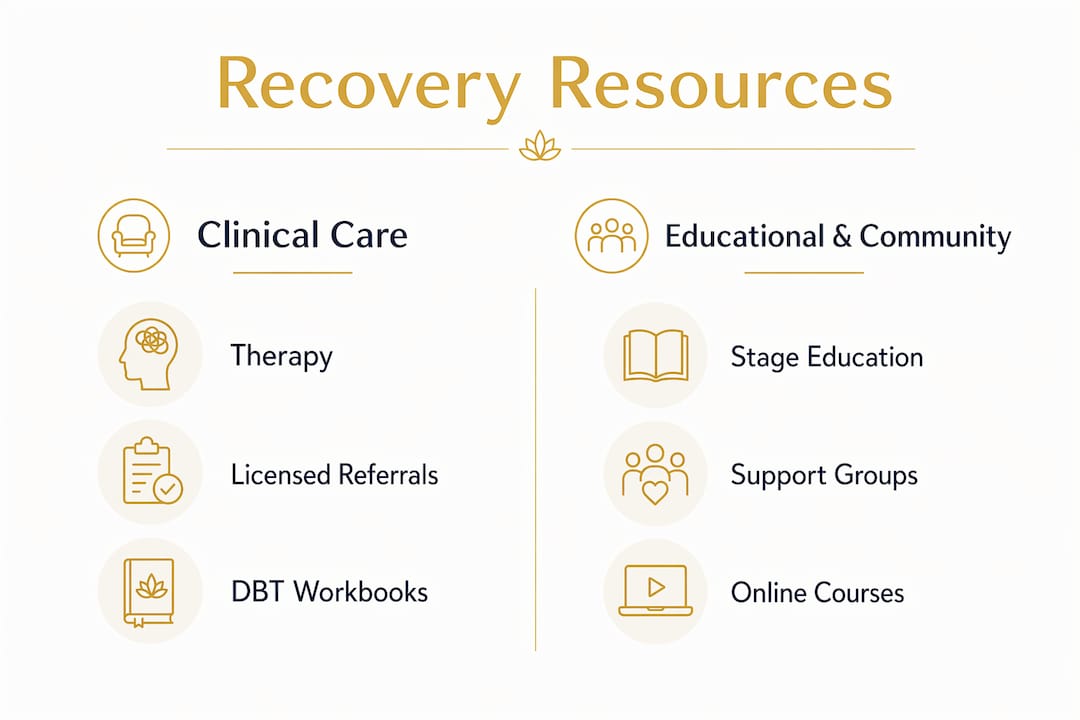
Workbooks and structured self-help fill the gap between therapy sessions. The DBT Workbook for Narcissistic Abuse and Gaslighting from New Harbinger uses dialectical behavior therapy exercises to rebuild emotional balance and boundary skills. It is one of the few resources grounded in a clinically validated treatment model.
Key differences at a glance:
- Clinical reach: narctrauma.com requires state-licensed therapists; coaching platforms and book sites have no geographic limits
- Cost: SoNA groups around $20/session; workbooks are one-time purchases; most educational sites are free
- Moderation quality: professionally led groups offer safer environments than purely peer-run forums
- Safety features: the Trauma Toolbox app at narctrauma.com runs in any browser with no download, which matters when an abuser monitors devices
How to choose the right recovery resources for your situation
Start with one question: are you dealing with active trauma symptoms like flashbacks, dissociation, or severe anxiety? If yes, a licensed therapist is the non-negotiable first step. Educational content and books complement therapy; they do not replace it.
Pro Tip: Check a therapist’s license on your state’s licensing board website before booking. An LPCC or LCSW credential means the provider is regulated and can legally treat trauma, unlike a recovery coach.
When evaluating any platform, run through these criteria:
- Credentials: is content created or reviewed by licensed clinicians?
- Trauma sensitivity: does the platform avoid re-traumatizing framing (e.g., blaming survivors)?
- Community oversight: are forums moderated by professionals, not just volunteers?
- Safety design: can you access the resource without creating an account or downloading an app?
Combining resources works well: a licensed therapist for clinical treatment, a recovery roadmap for stage clarity, and curated books for between-session reinforcement.
Books worth reading for narcissistic abuse recovery
The right book does something a quick article cannot: it gives you a framework to carry into daily life. A few titles stand out for survivors.
The DBT Workbook for Narcissistic Abuse and Gaslighting (New Harbinger) is the most clinically grounded option, with exercises targeting shame, self-esteem, and boundary-setting. The Narcissist in Your Life by Julie L. Hall shifts focus toward the survivor’s healing rather than the abuser’s pathology, which research supports as a more effective recovery orientation. Vanessa M. Reiser’s Narcissistic Abuse offers a clinician’s perspective on the psychological mechanics of the abuse cycle.
Smartreadshub curates science-backed reading lists organized by recovery stage, so you are not guessing which book fits where you are right now.
Recovery strategies that actually move the needle
Healing from narcissistic abuse is not linear, but certain strategies consistently produce results. Setting firm, non-negotiable limits with anyone who violated them is foundational. So is learning to recognize manipulation patterns before they re-hook you.
Trauma bonding is the hardest part. Many survivors intellectually understand the abuse but still feel pulled back. Structured journaling, grounding exercises, and consistent therapy sessions interrupt that cycle more reliably than willpower alone.
Support groups and survivor communities
Moderated online groups offer something books cannot: real-time validation from people who understand the experience. The SoNA groups at narctrauma.com are therapist-led and meet weekly. For broader peer connection, Reddit communities like r/NarcissisticAbuse have large memberships, though moderation varies and professional oversight is minimal.
Interactive, moderated communities are increasingly preferred over static email courses because they provide ongoing engagement rather than one-way information delivery.
Professional therapy options for narcissistic abuse
Licensed therapy remains the most effective clinical treatment for complex PTSD from narcissistic abuse, supported by collaborative therapy activities and visual tools that aid clinicians in trauma recovery. Look for therapists trained in EMDR, somatic therapy, or DBT. Online platforms like BetterHelp and Online-Therapy.com expand access, though verifying that a specific therapist has narcissistic abuse experience matters more than the platform name. A comparison of therapy platforms can help you weigh your options before committing.
Online courses and workshops for recovery
Structured courses give survivors a sequenced path when self-directed reading feels scattered. Kerry McAvoy’s programs walk through recovery stages with video content and community access. The Narcissistic Abuse Recovery Center offers educational modules alongside therapy. Look for courses that distinguish between psychoeducation and clinical treatment, and that are transparent about the instructor’s credentials.
Apps and digital tools for tracking progress
The Trauma Toolbox runs entirely in a browser, no download required, offering S.O.S. grounding, self-care modes, and in-the-moment exercises. This design is deliberate: survivors whose devices are monitored can access support without leaving a digital trail. NarcTox Nexus takes a different angle, using a forensic-style evidence board to help survivors visualize emotional patterns and manipulation timelines.
For general mental health tracking, apps like Daylio (mood journaling) and Calm (nervous system regulation) complement abuse-specific tools without requiring you to disclose your situation to set them up.
Legal resources for abuse survivors in the US
Narcissistic abuse often intersects with legal situations: custody disputes, restraining orders, divorce proceedings, and financial abuse. The National Domestic Violence Hotline (thehotline.org) connects survivors with legal advocates. WomensLaw.org provides state-by-state legal information on protective orders and custody. For financial abuse specifically, the Consumer Financial Protection Bureau (CFPB) has resources on coerced debt and credit repair.
Document everything. Courts respond to evidence, and a visual timeline of events can support legal claims in ways that verbal accounts alone cannot. Consulting a family law attorney with domestic abuse experience is worth the investment before any court filing.
Smartreadshub: curated reading for every stage of recovery
Most narcinfohub.com alternatives focus on one lane: therapy, community, or apps. Smartreadshub takes a different route. It curates books and educational content specifically mapped to where you are in recovery, from first recognizing gaslighting and manipulation to rebuilding self-worth after leaving. No subscription, no account required. The content is organized around what survivors actually need to understand: how abuse works, why leaving is hard, and what healing looks like in practice.
If you are ready to use reading as a structured part of your recovery, start with Smartreadshub’s guide on how books explain relationship patterns and find the titles that match your current stage.
Key Takeaways
The most effective recovery from narcissistic abuse combines licensed clinical therapy with curated educational resources and moderated community support.
| Point | Details |
|---|---|
| Therapy comes first | Licensed therapists (LPCC, LCSW) treat complex PTSD clinically; coaching and books support but do not replace that. |
| Verify credentials | Check state licensing boards before booking any therapist to confirm they can legally treat trauma. |
| Safety-first tools | Browser-based apps like Trauma Toolbox require no download, protecting survivors whose devices are monitored. |
| Books accelerate healing | DBT-grounded workbooks and stage-specific reading lists build skills between therapy sessions. |
| Smartreadshub | Offers curated, science-backed book lists organized by recovery stage, free and browser-accessible for US survivors. |