
The strongest titles on this list are Lab Girl by Hope Jahren, Hidden Figures by Margot Lee Shetterly, The Glass Universe by Dava Sobel, Headstrong by Rachel Swaby, Reflections on Gender and Science by Evelyn Fox Keller, Whistling Vivaldi by Claude Steele, A Lab of One’s Own by Patricia Fara, and the Dorothy Hodgkin biography by Georgina Ferry. Together they cover memoir, biography, history, and structural analysis of gender in science — the four categories that give you both personal story and systemic context.
- Lab Girl (Jahren): the most personal, lyrical memoir on the list; best first read if you want a scientist’s inner life
- Hidden Figures (Shetterly): essential for understanding race and gender in NASA’s history; the most accessible entry point
- The Glass Universe (Sobel): meticulous history of the Harvard women computers; best for astronomy and institutional history
- Headstrong (Swaby): 52 compact profiles; ideal for dipping in or assigning individual chapters
- Reflections on Gender and Science (Keller): the foundational academic text; read this after a memoir to see the structural forces behind individual stories
- Whistling Vivaldi (Steele): explains stereotype threat with research; pairs with any biography to explain why so many women left science
- A Lab of One’s Own (Fara): sweeping history of women scientists in World War I Britain; strong classroom text
- Dorothy Hodgkin (Ferry): the definitive biography of a Nobel laureate; best for chemistry readers and deep-history fans
Pro Tip: If you want to feel something first and analyze later, start with a memoir (Lab Girl or Hidden Figures). If you are building a syllabus or want to understand systemic barriers before reading individual stories, open with Keller or Steele.
Table of Contents
- The best science books about women scientists, organized by category
- Deep dives into the most influential titles on this list
- Why reading about women scientists actually changes things
- How to choose the right book for your goal
- Where to find these books in the United States
- Final verdict and four reading stacks worth building
- Key Takeaways
- Why this list is worth trusting
- Smartreadshub reading guides for women in science
- Useful sources and further reading
The best science books about women scientists, organized by category
These eight titles split cleanly into four reading categories. Knowing which category fits your goal saves you from starting with the wrong book.
Biography
Dorothy Hodgkin: A Life by Georgina Ferry is the most thoroughly researched biography on this list. Ferry spent years in the archives and interviewed colleagues who worked alongside Hodgkin at Oxford. The result is a portrait of the only British woman to win a Nobel Prize in Chemistry (1964), covering her X-ray crystallography work on penicillin, vitamin B12, and insulin. Best for: readers who want depth over breadth, chemistry students, and anyone curious about how a scientist balances political activism with laboratory work.
Hidden Figures by Margot Lee Shetterly recovers the stories of the Black women mathematicians at NASA’s Langley Research Center whose calculations made early spaceflight possible. Shetterly is a journalist, not a scientist, which gives the book a narrative drive that pure biography sometimes lacks. Best for: general readers, high school classrooms, and anyone interested in the intersection of race, gender, and the history of computing.
Memoir
Lab Girl by Hope Jahren is a bestselling memoir by a practicing geobiologist. Jahren writes about plants, soil, and the obsessive love of fieldwork with the same intensity she brings to describing her own mental health struggles and the friendship that sustained her career. It won the National Book Critics Circle Award for autobiography.
Finding the Mother Tree by Suzanne Simard is the ecology memoir that brought the concept of forest communication to a mass audience. Simard, a forest ecologist at the University of British Columbia, describes decades of research showing that trees share nutrients and information through underground fungal networks. The personal and the scientific are inseparable here.
Institutional history
The Glass Universe by Dava Sobel reconstructs the lives of the women hired by the Harvard Observatory in the late 19th and early 20th centuries to classify stars from photographic plates. These women, paid less than unskilled male laborers, produced the stellar classification system still in use today. Sobel’s research is impeccable and the prose is accessible.
A Lab of One’s Own by Patricia Fara examines what happened to women scientists in Britain during World War I: they flooded into laboratories vacated by men, made real contributions, and were largely pushed out again when the war ended. Fara is a historian of science at Cambridge, and her argument about institutional memory is one of the sharpest in the genre.
Headstrong: 52 Women Who Changed Science and the World by Rachel Swaby collects short profiles of scientists from antiquity to the 20th century. Each chapter runs about four pages, which makes it perfect for assigning individual profiles in a classroom or reading one per week as a supplement to other texts.
Gender and science analysis
Reflections on Gender and Science by Evelyn Fox Keller is the book that established the academic field of gender studies in science. Keller, a mathematical biophysicist turned philosopher of science, argues that the language and methodology of science itself carries gendered assumptions. Dense but rewarding.
Whistling Vivaldi by Claude Steele is the accessible, research-grounded explanation of stereotype threat: the measurable performance drop that occurs when a person is reminded of a negative stereotype about their group before a task. Steele’s work applies directly to why girls underperform on math tests in certain conditions and why women leave STEM fields at higher rates than men.
Quick comparison by reading purpose
| Category | Best for | Format | Accessibility | Subject focus |
|---|---|---|---|---|
| Biography (Ferry, Shetterly) | Deep history, classroom | Narrative nonfiction | General to academic | Chemistry, computing |
| Memoir (Jahren, Simard) | Personal inspiration | First-person narrative | General | Botany, ecology |
| Institutional history (Sobel, Fara, Swaby) | Historical recovery, teaching | History/anthology | General to intermediate | Astronomy, physics, broad |
| Gender analysis (Keller, Steele) | Classroom discussion, theory | Academic/research | Intermediate to advanced | Cross-disciplinary |
Deep dives into the most influential titles on this list
Lab Girl — Hope Jahren
Jahren is a geobiologist who has run labs in Georgia, Hawaii, and Norway. The book moves between two registers: lyrical passages about plant biology (a chapter on seeds is genuinely one of the best pieces of science writing published this decade) and raw memoir about bipolar disorder, academic precarity, and the strange intimacy of a long scientific partnership. Penguin Random House describes it as a book that “takes us into a world of wonder and hardship.” It won the National Book Critics Circle Award for autobiography and is available in hardcover, paperback, audiobook, and e-book. Best for: anyone who wants to understand what it actually feels like to be a scientist, not just what scientists discover.
Headstrong — Rachel Swaby
Swaby is a journalist, and the format here is deliberately democratic: 52 profiles, each short enough to read in one sitting, covering scientists from Hypatia of Alexandria to Chien-Shiung Wu. The book corrects a specific failure of most science education: students learn the discoveries but not the discoverers. A chapter on Lise Meitner, who co-discovered nuclear fission and was passed over for the Nobel Prize, is particularly striking. Available in paperback and e-book; individual chapters work well as classroom handouts.
The Glass Universe — Dava Sobel
Sobel previously wrote Longitude and Galileo’s Daughter, so she knows how to make archival history readable. The Harvard women computers, known as “Pickering’s Harem” by their male colleagues, classified hundreds of thousands of stars and created the spectral classification system (OBAFGKM) that astronomers still use. Sobel draws on letters, diaries, and observatory records. The book is available from Viking/Penguin in hardcover, paperback, and audiobook. Best for: astronomy enthusiasts, historians of science, and anyone interested in how institutional sexism shaped what we know about the universe.
Hidden Figures — Margot Lee Shetterly
Shetterly grew up in Hampton, Virginia, where many of the women she writes about lived. That personal connection gives the book an intimacy that a purely journalistic account would lack. The four central figures, Katherine Johnson, Dorothy Vaughan, Mary Jackson, and Christine Darden, worked at NASA during the Space Race under conditions of both racial segregation and gender discrimination. The book was adapted into a major film in 2016, which expanded its reach considerably. Available in adult and young adult editions, hardcover, paperback, audiobook, and e-book.
Reflections on Gender and Science — Evelyn Fox Keller
Keller trained as a physicist at Harvard before turning to the philosophy of science. Her central argument is that science presents itself as objective and gender-neutral while actually encoding masculine values in its methods and metaphors. She uses the career of Barbara McClintock, the geneticist who discovered transposons and won the Nobel Prize in 1983, as a case study in how “feeling for the organism” was dismissed as unscientific until it could no longer be ignored. This is not light reading, but it is the book that makes every other book on this list make more sense.
Whistling Vivaldi — Claude Steele
Steele is a social psychologist, and this book is the clearest explanation of his decades of research on stereotype threat. The title comes from a story told by writer Brent Staples about whistling Vivaldi to signal to nervous white pedestrians that he was not a threat. Steele’s experiments show that simply reminding a woman that she is a woman before a math test measurably lowers her score. The implications for science education are direct and practical. Available in paperback and audiobook.
A Lab of One’s Own — Patricia Fara
Fara’s title echoes Virginia Woolf deliberately. Her argument is that World War I created a brief, anomalous window when women could do real science in British institutions, and that the postwar period erased most of that history. The book is both a recovery project and a structural critique. Fara is a Fellow of Clare College, Cambridge, which gives her access to archives most writers cannot reach. Best for: educators building a unit on women in science and anyone interested in how institutional memory works.
Dorothy Hodgkin: A Life — Georgina Ferry
Hodgkin won the Nobel Prize in Chemistry in 1964 for her X-ray crystallography work. Ferry’s biography covers not just the science but Hodgkin’s political commitments (she was a lifelong peace activist), her marriage, and the specific obstacles she navigated as a woman in mid-20th-century British academia. The science is explained clearly enough for a non-specialist. Available in paperback from Cold Spring Harbor Laboratory Press. Best for: chemistry students, biography readers, and anyone who wants a complete portrait of a scientist rather than just a career summary.
Quick reference table
| Title | Format | Approx. length | Notable reception |
|---|---|---|---|
| Lab Girl | Memoir | ~290 pages | National Book Critics Circle Award |
| Headstrong | Anthology/profiles | ~272 pages | Widely assigned in STEM courses |
| The Glass Universe | Narrative history | ~352 pages | Goodreads Choice nominee |
| Hidden Figures | Narrative nonfiction | ~368 pages | Major film adaptation (2016) |
| Reflections on Gender and Science | Academic | ~193 pages | Foundational academic text |
| Whistling Vivaldi | Research narrative | ~272 pages | Widely cited in education research |
| A Lab of One’s Own | History | ~352 pages | Shortlisted for multiple awards |
| Dorothy Hodgkin: A Life | Biography | ~448 pages | Definitive scholarly biography |
Why reading about women scientists actually changes things
The standard argument for these books is representation: girls need role models. That is true, but it undersells what this literature actually does.
Historical recovery. Most science education presents discovery as a parade of male names. Books like The Glass Universe and Hidden Figures show that this is not an accurate account of how science happened. The Harvard women computers classified the stars. The Black women mathematicians at NASA calculated the trajectories. Removing them from the story is not neutrality; it is a specific editorial choice that these books correct. The New York Public Library’s curated list of books honoring women’s contributions to science was built explicitly around this recovery function.
Structural critique. Keller’s Reflections on Gender and Science and Steele’s Whistling Vivaldi do something different from biography: they explain the forces that shaped individual careers. Once you understand stereotype threat, the pattern of women leaving STEM fields after graduate school stops looking like a series of individual choices and starts looking like a predictable systemic outcome.
Field diversity. This list covers astronomy (Sobel), chemistry (Ferry), ecology (Simard), computing and mathematics (Shetterly), botany and geobiology (Jahren), and physics (Fara, Keller). That breadth matters because the barriers women faced were not identical across fields, and neither were the contributions.
Intersectional perspectives. Hidden Figures is the clearest example here: the women Shetterly writes about navigated both racial segregation and gender discrimination simultaneously. A reading list that includes only white women scientists gives an incomplete picture of who did the work and what they were up against.
Personal role models. Jahren writing about her first fieldwork. Hodgkin solving the structure of penicillin while pregnant. Simard defending her research against a forestry industry that had financial reasons to dismiss it. These are not abstract inspiration; they are specific accounts of how scientists kept going.
How to choose the right book for your goal
Not every book on this list is the right starting point for every reader. Here is a quick decision path.
-
What is your primary goal?
- Personal inspiration → start with a memoir (Lab Girl, Finding the Mother Tree, Hidden Figures)
- Classroom discussion → start with an anthology or history (Headstrong, A Lab of One’s Own, The Glass Universe)
- Understanding systemic barriers → start with analysis (Whistling Vivaldi, Reflections on Gender and Science)
- Deep biography of one scientist → go directly to Dorothy Hodgkin (Ferry) or Hidden Figures (Shetterly)
-
How much prior science knowledge do you have?
- None required: Hidden Figures, Headstrong, Lab Girl, The Glass Universe
- Helpful but not required: Finding the Mother Tree, A Lab of One’s Own, Dorothy Hodgkin
- Some academic background useful: Reflections on Gender and Science
-
What format do you prefer?
- Narrative memoir: Lab Girl, Finding the Mother Tree
- Journalistic nonfiction: Hidden Figures, Headstrong
- Archival history: The Glass Universe, A Lab of One’s Own, Dorothy Hodgkin
- Research-based argument: Whistling Vivaldi, Reflections on Gender and Science
-
How much time do you have?
- One evening per session: Headstrong (read one profile at a time)
- A week of commuting: Lab Girl or Hidden Figures on audiobook
- A month of serious reading: Dorothy Hodgkin, Reflections on Gender and Science
-
Are you assigning this to students?
- High school: Hidden Figures (also available in a young adult edition), Headstrong (individual chapters)
- Undergraduate: Whistling Vivaldi, A Lab of One’s Own, The Glass Universe
- Graduate or professional: Reflections on Gender and Science, Dorothy Hodgkin
First-person scientist voices vs. third-party historians. Memoirs by working scientists (Jahren, Simard) give you the texture of daily research life: the failed experiments, the funding anxiety, the specific joy of a result. Third-party biographies and histories (Ferry, Sobel, Shetterly, Fara) give you context the scientist herself might not have had, including archival material and structural analysis. The most complete picture comes from reading at least one of each. You can find books by women authors across both categories using discovery guides that filter by field and format.
Where to find these books in the United States
All eight titles are in print and widely available. Here is where to look and what to expect.
- Independent bookstores: IndieBound and Bookshop.org let you order from independent stores and direct a portion of the sale to a local shop. Worth using if you want to support women’s bookstores and independent curation.
Pro Tip: For the Dorothy Hodgkin biography and other academic titles that run $30 or more in paperback, check your library system’s interlibrary loan (ILL) service before buying. Most US public libraries can request a copy from a university library within a week or two, at no cost to you.
Penguin Random House maintains a themed page aggregating biographies, histories, and science writing by and about women scientists, which is useful for format notes and publisher summaries when you are deciding between editions.
Final verdict and four reading stacks worth building
If you read only one book from this list, make it Lab Girl or Hidden Figures depending on whether you want ecology or history. Both are accessible, both are gripping, and both will make you want to read more.
For readers who want a short, purposeful mini-syllabus, here are four themed stacks.
Stack 1: Personal scientist memoirs
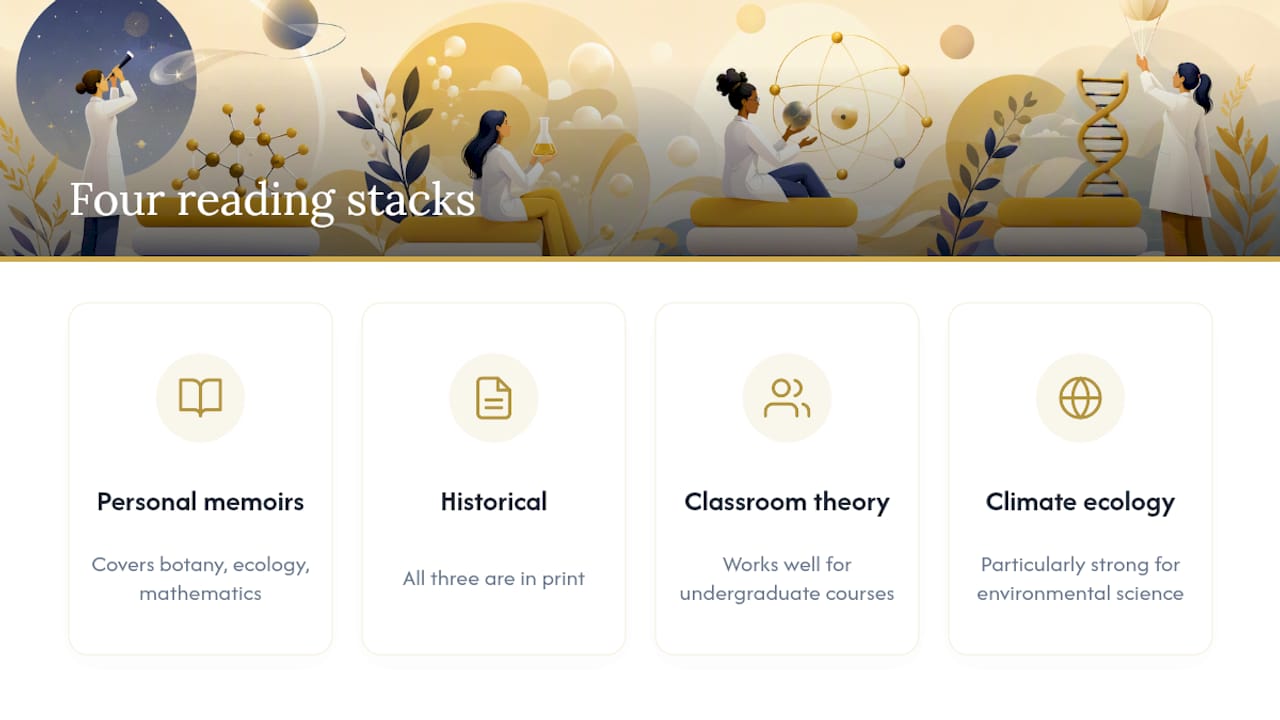
Start with Lab Girl (Jahren) for the most intimate account of a scientist’s inner life. Follow with Finding the Mother Tree (Simard) to see how Simard’s ecology research reached a mass audience. Finish with Hidden Figures (Shetterly) to add a historical and intersectional dimension. These three books together cover botany, ecology, and mathematics across three different eras.
Stack 2: Historical recoveries
Start with Headstrong (Swaby) to get a broad map of who was erased from science history. Follow with The Glass Universe (Sobel) for a deep account of one institution’s hidden workforce. Finish with Dorothy Hodgkin (Ferry) for the most complete portrait of a single scientist’s career. Borrow or buy; all three are in print.
Stack 3: Classroom discussion and gender theory
Start with Whistling Vivaldi (Steele) because it is the most accessible and gives students a research framework. Follow with A Lab of One’s Own (Fara) for historical grounding. Finish with Reflections on Gender and Science (Keller) for the theoretical foundation. This stack works well for undergraduate courses in science studies, women’s studies, or education.
Stack 4: Climate and ecology focus
Start with Finding the Mother Tree (Simard) for forest ecology. Follow with When the Forest Breathes by Simard, her most recent popular title, which extends the research and adds new material. Finish with Lab Girl (Jahren) for a different ecosystem and a different scientific temperament. This stack is particularly strong for environmental science courses or readers drawn to climate and conservation.
Add any of these to your library hold list, your cart, or your classroom reading list today.
Key Takeaways
The most direct path into this literature is to pair a first-person memoir by a working scientist with one analytical text on gender and science, which gives you both lived experience and structural context in a single reading session.
| Point | Details |
|---|---|
| Pick by goal, not by fame | Memoirs suit personal inspiration; histories and anthologies suit classroom use; analytical texts suit structural understanding. |
| Mix memoir and analysis | Reading Jahren or Simard alongside Keller or Steele gives you individual story and systemic context together. |
| The list covers six scientific fields | Astronomy, chemistry, ecology, computing, botany, and physics are all represented, showing the breadth of women’s contributions. |
| US library systems make this affordable | All eight titles are available via Libby, Hoopla, or interlibrary loan at no cost, including audiobook editions. |
| Smartreadshub curates reading paths | Smartreadshub’s guides help readers match books to their specific goals, from personal inspiration to classroom-ready picks. |
Why this list is worth trusting
The books on this list were not chosen because they are famous, though several are. They were chosen because each one does something the others do not. Swaby gives you breadth; Ferry gives you depth. Jahren gives you feeling; Keller gives you framework. Steele gives you the research that explains why the other books are necessary at all.
What strikes me most about this genre is how consistently the women in these books had to argue for the validity of their own observations. Hodgkin’s crystallography was dismissed as too technical for a woman to have done alone. The Harvard computers were called “computers” rather than scientists to avoid acknowledging what they actually were. McClintock’s transposon research was ignored for decades. These are not ancient stories. Steele’s stereotype-threat experiments were conducted in the 1990s, and the effects he documented are still measurable in classrooms today.
The reading path that works best, based on everything this literature offers, is to start with a story and follow it with an explanation. Read Hidden Figures and then read Whistling Vivaldi. The first will make you angry in a specific, personal way. The second will show you exactly why the pattern repeated across so many careers, in so many fields, for so long. That combination, personal story plus structural analysis, is what makes this category of books genuinely useful rather than just inspiring.
Smartreadshub reading guides for women in science
Reading about women scientists is one of the most direct ways to understand how institutions shape individual lives, and how individuals push back. Smartreadshub has built curated reading guides specifically for readers who want that combination of personal story and structural insight, without spending hours sorting through lists that mix genres and reading levels.

The guides on Smartreadshub are built around a single principle: the right book at the right moment changes how you see your situation. That applies whether you are a student looking for a role model, an educator building a syllabus, or a reader who simply wants to understand why so many brilliant women were written out of the scientific record. The site’s science-backed guide to how books empower women readers explains the research behind why curated reading works better than browsing. Start there, then use the reading stacks above to build your list.
Useful sources and further reading
- The Best Books on Women in Science – Five Books Expert Recommendations
- Forgotten History: Books to Honor Women’s Contributions to Science
- Lab Girl by Hope Jahren: 9781101873724 | PenguinRandomHouse.com: Books
- Books About Women in Science | Penguin Random House
- Finding the Mother Tree by Suzanne Simard: 9780525565994 | PenguinRandomHouse.com: Books
- When the Forest Breathes by Suzanne Simard: 9780593318683 | PenguinRandomHouse.com: Books
- UN International Day of Women and Girls in Science