
Philosophy books can help you understand and cope with heartbreak by reframing pain, offering practices to manage emotion, and showing concrete ways to rebuild a sense of self, as explored in Healing inside out and outside in. The role of philosophy books in heartbreak is not to make the hurt disappear but to give it meaning, context, and a path forward. Here are the best starting points:
- Life Is Hard — Kieran Setiya: Best for the first raw weeks. Setiya rejects toxic positivity and walks you through grief, loneliness, and loss with philosophical care. Start with the chapter on grief.
- The Consolations of Philosophy — Alain de Botton: Best for validation and accessible entry. De Botton’s Schopenhauer section speaks directly to the broken heart and reads like a conversation, not a lecture.
- Night Vision — Mariana Alessandri: Best for those who feel their sadness is being pathologized. Alessandri argues that dark emotions deserve respect, not suppression.
- Sad Love — Carrie Jenkins: Best for long-term reflection on what love actually is and why its loss cuts so deep.
- Meditations — Marcus Aurelius: Best for daily grounding. Short entries, Stoic discipline, and a reminder that suffering is part of a shared human experience.
- Selected essays from Arthur Schopenhauer (The World as Will and Representation / On the Suffering of the World): Best for people who need their pain acknowledged at a philosophical level before they can move forward.
For acute relief, start with Life Is Hard and The Consolations of Philosophy. For meaning-making over weeks or months, add Night Vision and Sad Love.
Key Takeaways
Philosophy books give heartbreak meaning and structure, and the most effective ones validate pain rather than dismiss it, making them a genuine complement to therapy and self-reflection.
| Point | Details |
|---|---|
| Start with therapeutic philosophy | Life Is Hard and The Consolations of Philosophy are the best first reads for acute heartbreak. |
| Match the book to your emotional need | Validation needs call for Alessandri or Schopenhauer; identity-rebuilding calls for Jenkins or the existentialist tradition. |
| Pair reading with reflection | Journal prompts tied to each book convert passive reading into active meaning-making. |
| Know philosophy’s limits | Seek professional support for persistent functional impairment, self-harm thoughts, or trauma patterns. |
| Smartreadshub curates by emotional need | The Smartreadshub reading list matches titles to your specific situation with evidence-based notes and exercises. |
Table of Contents
- How does philosophy actually help after heartbreak?
- What do different philosophical traditions say about heartbreak?
- Which philosophy books should you read, and who are they for?
- How do you read philosophy when you are emotionally raw?
- When is philosophy not enough, and when should you seek help?
- Why do some philosophy books work better than generic self-help?
- How have different cultures and eras understood heartbreak philosophically?
- What does philosophy say about forgiveness and moving on?
- An editorial perspective on philosophy as consolation
- Smartreadshub has a curated reading list built for this
- Sources
How does philosophy actually help after heartbreak?
Philosophy helps in ways that generic self-help rarely does, because it works at the level of meaning rather than mood management. The impact of philosophy on heartbreak operates through several concrete mechanisms:
- Permission to feel. Books like Night Vision and Sad Love validate suffering instead of pathologizing it. When a philosopher argues that your pain is philosophically coherent, not a malfunction to fix, the shame around grief tends to loosen.
- Conceptual framing. Philosophical accounts of heartbreak describe what is actually happening: narrative disruption (your story of the future collapsed), identity loss (part of how you defined yourself was relational), and attachment rupture. Naming these processes, as Big Think’s explainer on why heartbreak hurts demonstrates, gives you a map when you feel lost.
- Cognitive tools. Stoic practices, like distinguishing what is in your control from what is not, give you something to do with the mental churn. Schopenhauerian validation gives you something different: permission to stop performing recovery.
- Narrative repair. Philosophical reading helps you rebuild a coherent story about who you are after a relationship ends. Setiya’s work, praised by The New Yorker and The Economist, models this directly by treating hardship as something to be understood rather than overcome.
The key difference from most self-help is that philosophy does not ask you to feel better faster. It asks you to think more clearly about what you are actually experiencing.
What do different philosophical traditions say about heartbreak?
Stoicism
Stoics argue that suffering comes from attaching your wellbeing to things outside your control, including other people’s love. The practice is not emotional suppression but reattribution: recognizing that your capacity for virtue, thought, and growth belongs to you regardless of what the relationship was. Marcus Aurelius’s Meditations offers this in small, daily doses. Read one entry per morning. The effect is cumulative.
Schopenhauerian pessimism
Schopenhauer’s view is that romantic love is largely a biological illusion, and its collapse is painful precisely because it strips away that illusion. This sounds bleak, but de Botton argues convincingly that Schopenhauer functions as a consoling companion for broken hearts because he validates the darkness rather than dismissing it. If you have been told to “look on the bright side” one too many times, Schopenhauer is the philosopher who finally agrees with you.
Existentialism
Existentialists frame heartbreak as an identity crisis, which it often is. When a relationship ends, the self you built around it needs reconstruction. That reconstruction is not a failure; it is the work of becoming. Philosophical research on personal identity after relational loss supports this framing: heartbreak can be an opportunity to reclaim autonomy and rebuild self-concept on your own terms.
Therapeutic modern philosophy
Setiya, Alessandri, and Jenkins write in a mode that blends personal essay, philosophical argument, and practical guidance. This style is easier to absorb during acute pain than purely abstract metaphysics. A Memorial University thesis on therapeutic philosophy argues that Stoicism, Spinozism, and contemporary love ethics each offer tools for “becoming oneself” after heartbreak, with the emphasis on growth rather than suppression.
Kantian respect for love
Kant’s ethics offer a less obvious but genuinely useful angle. His framework insists that persons must be treated as ends in themselves, never merely as means. A LitHub essay on Kant and heartbreak shows how this translates practically: recognizing that you were not treated with full respect, or that the relationship asked you to subsume yourself, can reframe grief as a reasonable response to a real wrong rather than a personal weakness.
Pro Tip: Stoic detachment is useful in measured doses, but pushed too far it can increase loneliness rather than reduce it. If you find yourself using philosophy to avoid feeling rather than to understand feeling, that is a sign to slow down and pair reading with journaling or conversation.
Which philosophy books should you read, and who are they for?
The list below is organized by emotional need. Pick your entry point based on where you are right now, not where you think you should be.
- Life Is Hard — Kieran Setiya | Best for: acute breakup, first weeks. Setiya’s 2022 book rejects positive thinking and uses philosophical contemplation to address grief, loneliness, and failure directly. Conversational tone, short chapters. Start at chapter three.
- The Consolations of Philosophy — Alain de Botton | Best for: philosophical reassurance, accessible entry. De Botton frames philosophy as a “psychic aid” and devotes a full section to the broken heart via Schopenhauer. Read it cover to cover; it is short and moves fast.
- Night Vision — Mariana Alessandri | Best for: validation of dark emotions, long-term grief. Alessandri argues that embracing “sad love” supports healing more effectively than approaches that try to suppress pain, according to scholarly analysis. Academic but readable; start with the introduction.
- Sad Love — Carrie Jenkins | Best for: philosophical reflection on love’s nature. Jenkins examines what love actually is, why it hurts when it ends, and why that hurt deserves philosophical attention rather than dismissal.
- Meditations — Marcus Aurelius | Best for: daily grounding, Stoic practice. Use it as a morning ritual rather than reading it straight through. Any modern translation works; Gregory Hays’s version (Modern Library) is the most readable.
- On the Suffering of the World / The World as Will and Representation — Arthur Schopenhauer | Best for: people who need their pain acknowledged before they can move. Dense in places, but the essays on suffering and love are self-contained and can be read independently.
For books that help you rediscover yourself after a relationship ends, the identity-focused works by Alessandri and Jenkins pair especially well with the Springer research on self-concept reconstruction.
Suggested reading order by scenario:
- Acute shock (days 1–14): Start with Life Is Hard, then The Consolations of Philosophy.
- Validation needed (weeks 2–6): Add Night Vision and selected Schopenhauer essays.
- Meaning-making (months 1–3): Move to Sad Love and Meditations as a daily practice.
- Reclaiming identity (ongoing): Return to the Springer research framework and the Kantian perspective via the LitHub essay.
How do you read philosophy when you are emotionally raw?
Start small. A page of Meditations at breakfast does more than forcing yourself through fifty pages of dense argument when you can barely concentrate. The goal is not to finish books; it is to find sentences that land.
A practical reading plan:
- Week one: Read only short-form pieces. The LitHub Kant essay and the Big Think explainer are both under fifteen minutes. They give you philosophical vocabulary without demanding sustained focus.
- Week two: Open Life Is Hard at the grief chapter. Read for twenty minutes, then stop. Write one sentence in a journal about what resonated.
- Week three: Add The Consolations of Philosophy, one section per sitting. De Botton’s prose is designed to be absorbed in short bursts.
- Week four onward: Introduce Night Vision or Sad Love depending on whether you need validation (Alessandri) or conceptual clarity about love itself (Jenkins).
Journal prompts to pair with readings:
- After Life Is Hard: “What am I actually grieving — the person, the future I imagined, or the version of myself I was in that relationship?”
- After the Schopenhauer section in de Botton: “What illusions was I holding about this relationship, and what is true now that they are gone?”
- After Night Vision: “What would it mean to respect my sadness instead of trying to fix it?”
- After Meditations: “What is genuinely within my control today?”
Therapeutic philosophy, as the Memorial University research on moving on argues, works best when it is paired with behavioral practices rather than used as pure intellectual exercise. That means journaling, conversation, or therapy alongside the reading, not instead of it.
Pro Tip: If you are also navigating books on emotional detachment, be deliberate about sequencing. Detachment-focused reading works better after you have validated the pain, not before. Skipping the validation step tends to produce suppression, not healing.
When is philosophy not enough, and when should you seek help?
Philosophy helps you think through heartbreak. It does not treat clinical depression, anxiety disorders, or trauma responses. The distinction matters.
Seek professional support if you notice any of the following:
- Persistent inability to function at work, in relationships, or in basic self-care for more than two weeks.
- Thoughts of self-harm or suicide. Call or text 988 (the Suicide and Crisis Lifeline) immediately.
- Physical symptoms — significant weight loss, inability to sleep for days, or dissociation — that do not improve.
- A sense that the pain is not about this relationship but about a pattern across multiple relationships (which may signal attachment trauma or deeper relational wounds).
A Cambridge Core analysis of grief and philosophical consolation makes the point directly: impersonal, reductionist philosophical consolations can actually worsen feelings of loss when grief is acute and deeply personal. Abstract metaphysical reframing is not a substitute for human support.
For finding a therapist in the U.S., Psychology Today’s therapist finder (psychologytoday.com/us/therapists) lets you filter by specialty, including grief and relationship issues. The Open Path Collective offers reduced-fee sessions for those without insurance coverage. Philosophy reading works best as a complement to therapy, not a replacement.
Why do some philosophy books work better than generic self-help?
The short answer: therapeutic philosophy meets you where you are instead of telling you where to go.
Generic self-help tends to operate on a deficit model: you are broken, here are steps to fix yourself. Philosophy, at its best, operates on a meaning model: your pain is coherent, here is a framework for understanding it. That shift in framing changes what the reading actually does to you.
- Setiya’s approach was praised by The New Yorker and The Economist precisely because it refuses the “positive thinking” mandate. His therapeutic philosophical mode combines personal essay with practical guidance, making it easier to absorb during crisis than purely abstract work.
- Alessandri’s Night Vision argues that contemporary culture pathologizes sadness and that philosophical validation of dark emotions supports healing more effectively than suppression. The Princeton University Press publication signals its scholarly grounding, but the prose is accessible.
- The Cambridge Core paper on grief found that detached, reductionist consolations often fail because grief is agent-relative and temporally rooted. In plain terms: telling someone their loss is philosophically insignificant does not help. Acknowledging that it is real and meaningful does.
- De Botton’s framing of philosophy as a “psychic aid” is not just a marketing line. It reflects a genuine tradition of philosophy as practical medicine for the mind, traceable from the Stoics through Epicurus to contemporary therapeutic philosophers.
Readers who use Smartreadshub’s curated resources consistently report significant emotional relief and clarity after engaging with evidence-based reading recommendations matched to their specific situation, particularly when the reading is paired with reflection exercises rather than consumed passively.
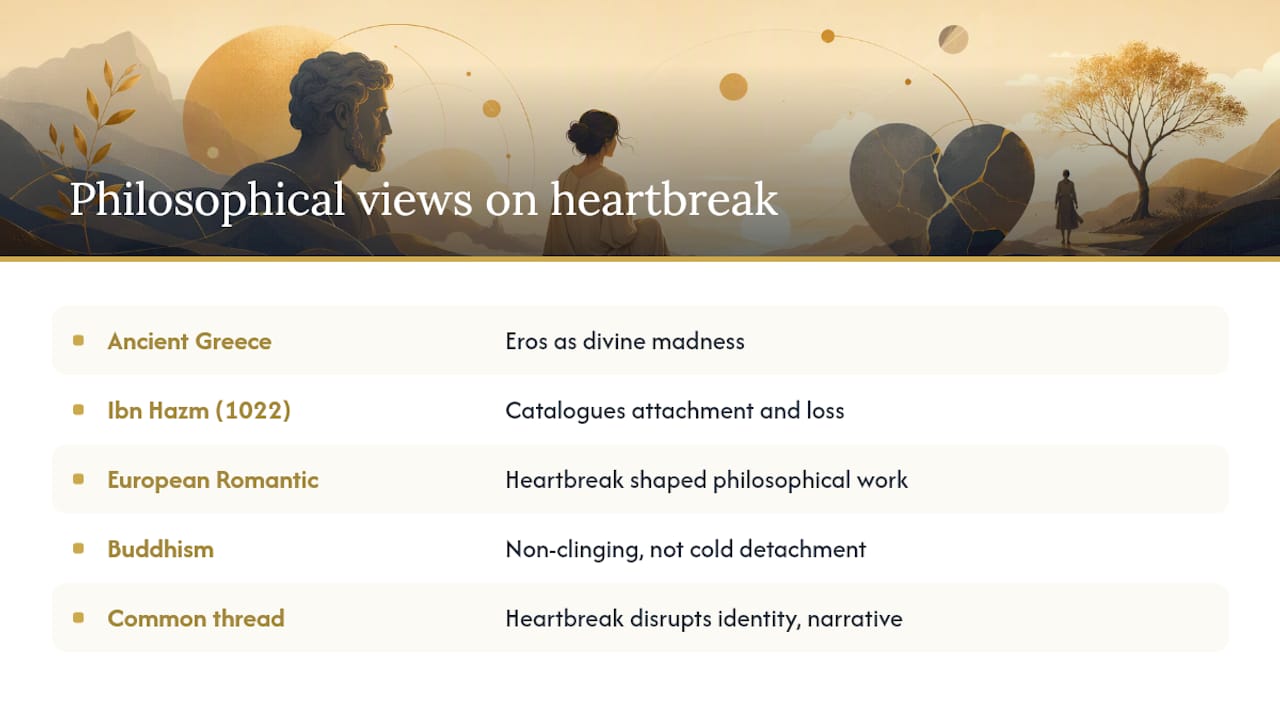
How have different cultures and eras understood heartbreak philosophically?
Heartbreak has never been a private, modern problem. Ancient Greek philosophy treated eros as a form of madness, a divine disruption that could elevate or destroy. Plato’s Symposium frames love as a search for one’s missing half, which means its loss is literally a return to incompleteness. That framing is over two thousand years old and still describes something real.
Medieval Islamic philosophy, particularly Ibn Hazm’s The Ring of the Dove (written around 1022), treated love and its grief with extraordinary psychological precision, cataloging the stages of attachment and loss in ways that anticipate modern attachment theory. In the European Romantic tradition, heartbreak became philosophically productive: Kierkegaard wrote about the “sickness unto despair” partly through the lens of failed love, and his journals suggest the breakup with Regine Olsen shaped his entire philosophical project.
Eastern traditions offer a different frame. Buddhist philosophy does not pathologize attachment so much as it explains why attachment produces suffering, and the practice it recommends is not detachment in the cold sense but non-clinging, a subtle but important distinction. You can love fully and still hold the relationship lightly enough that its ending does not destroy your sense of self.
What connects these traditions across centuries and cultures is a shared recognition that heartbreak is philosophically serious. It is not a minor emotional inconvenience. It disrupts identity, narrative, and the basic sense of how the world works. Every major philosophical tradition has felt the need to address it directly.
What does philosophy say about forgiveness and moving on?
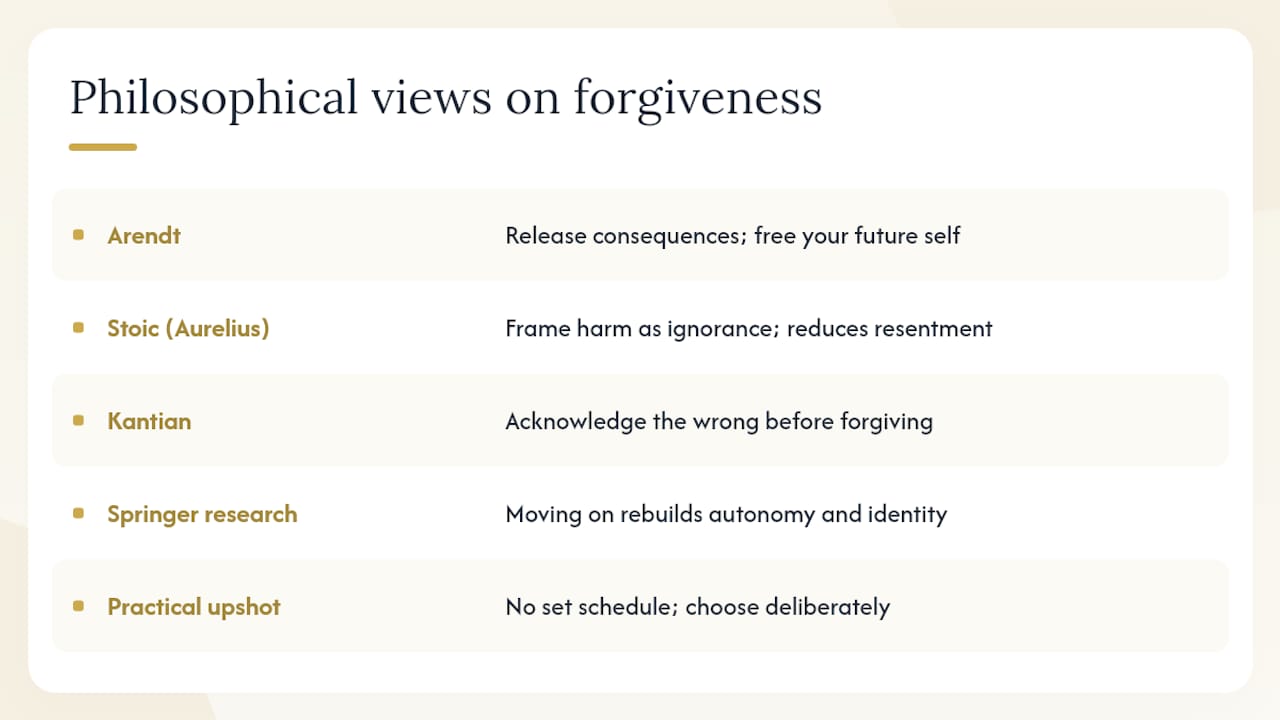
Forgiveness, philosophically, is one of the most contested concepts in ethics. The common cultural script says you must forgive to heal. Philosophy pushes back on that, usefully.
Hannah Arendt argued that forgiveness is an act of releasing someone from the consequences of what they did, and that it is something you do for the sake of the future, not as a verdict on the past. On that view, forgiveness is not about deciding the other person deserves it. It is about freeing yourself from being permanently defined by what happened.
Stoic philosophy offers a different angle. Marcus Aurelius repeatedly returns to the idea that people act badly out of ignorance or weakness, not malice. That framing does not excuse harm, but it shifts the emotional weight. Resentment requires believing the other person could have done otherwise and chose not to. Stoic analysis often dissolves that belief, which dissolves some of the resentment with it.
The Kantian view adds a third layer. If the relationship involved a failure of respect, genuine forgiveness may require first acknowledging that a wrong occurred. Skipping straight to forgiveness without naming the harm can be a form of self-erasure rather than healing.
Moving on, as distinct from forgiving, is addressed most directly by the Springer research on personal identity after relational loss: when a relationship has subsumed your autonomy, moving on is partly an identity-reconstruction project. You are not just getting over a person; you are rebuilding a self. Philosophy, particularly the existentialist and therapeutic traditions, is well-suited to that work because it takes the question of who you are seriously rather than treating it as a side effect of the breakup.
The practical upshot: you do not have to forgive on a schedule, and you do not have to move on before you are ready. What philosophy offers is a set of frameworks for understanding what forgiveness and moving on actually mean, so you can choose them deliberately rather than performing them under social pressure.
An editorial perspective on philosophy as consolation
The conventional wisdom about philosophy and heartbreak is that it is too abstract to be genuinely useful when you are in pain. That view is wrong, but it is wrong in a specific way worth naming.
Abstract metaphysics, the kind that tells you personal identity is an illusion or that your loss is cosmically insignificant, tends to fail precisely when grief is acute. The Cambridge Core research on this point is clear. But that is not what the best philosophy books for heartbreak actually do. Setiya, Alessandri, de Botton, and Jenkins are not asking you to transcend your pain. They are asking you to understand it, which is a different and more achievable request.
What I find most underestimated about this genre is the permission it grants. When a serious philosopher argues that your grief is philosophically coherent, that love’s loss is genuinely disruptive to identity and narrative, something shifts. You stop spending energy on the question of whether you should feel this bad and start spending it on what to do next. That shift is not trivial. It is often the first real movement toward recovery.
The limit worth naming honestly: philosophy is not therapy. It does not regulate the nervous system, process trauma, or provide the relational repair that human connection does. The best use of these books is alongside support, not instead of it. A reading plan paired with journaling and, where needed, professional help will do more than either alone.
Smartreadshub has a curated reading list built for this
If you are looking for philosophy books for emotional healing matched to your specific emotional situation, Smartreadshub’s curated reading list goes further than a generic recommendation roundup.

Every title is selected based on emotional need (acute shock, validation, identity-rebuilding, long-term meaning-making) and paired with evidence-based notes on what to expect from the reading. The list includes:
- Quick-read labels so you know what you can absorb in a single sitting versus what requires sustained focus
- Practical reflection exercises paired with each title
- Guidance on how books explain relationship patterns and support recovery
- Pointers to therapy resources for readers who need more than books can offer
The difference from a standard “best philosophy books” list is curation matched to where you actually are, not where you are supposed to be. Visit Smartreadshub’s emotional recovery reading guide to find your starting point today.
Sources
The sources below back the claims in this guide and offer deeper reading on philosophy, heartbreak, and recovery.
- Night Vision (Princeton University Press)
- Life Is Hard — Kieran Setiya (Penguin)
- Grief and the inconsolation of philosophy (Cambridge Core)
- The Consolations of Philosophy — Alain de Botton (Amazon listing)
- Broken Heart? Immanuel Kant is Here to Help (LitHub)
- Everyday Philosophy: Why does heartbreak hurt? (Big Think)
- The philosophy of moving on: the benefits of therapeutic philosophy (Memorial University thesis)
- Philosophy and personal identity after relational loss (Springer article)