
The fastest way into a 2026 reading challenge for women is to pick one that already exists and start today. Join a free, prompt-driven challenge like She Reads Everything’s 2026 challenge or the Free Black Women’s Library challenge on The StoryGraph, then pick one tracking method and stick with it for a week before deciding if it fits.
- Join now: She Reads Everything (theme-based, free), PopSugar’s 2026 list (50 prompts), or a Goodreads “create your own” thread.
- Track it: Use The StoryGraph’s built-in challenge tracker, a printable, or a simple private note.
Key Takeaways
A women’s reading challenge works best in 2026 when it pairs an existing flexible prompt list with a low-effort tracking habit and permission to skip what doesn’t serve you.
| Point | Details |
|---|---|
| Start with a ready-made challenge | She Reads Everything, the Free Black Women’s Library, and PopSugar all offer free, prompt-based 2026 lists. |
| Match pace to prompt count | Choose 12 prompts if you read under three hours weekly; save 50-prompt lists for faster readers. |
| Let one book fill multiple prompts | This single rule prevents burnout and keeps challenges from feeling like homework. |
| Track with existing tools | The StoryGraph and Goodreads both offer built-in challenge tracking at no cost. |
| Pair heavy reads with recovery guides | Smartreadshub’s curated lists on gaslighting and manipulation fit naturally into memoir and recovery prompts. |
Table of Contents
- Which ready-made 2026 reading challenges are best for women?
- How do you pick the right challenge for your pace and values?
- How do you build your own 2026 reading challenge?
- What tools help you track progress without stress?
- What reading list themes work well for women’s challenges in 2026?
- How do you keep a reading challenge from becoming another chore?
- What does Smartreadshub think about reading challenges done right?
- Frequently Asked Questions
- Sources
Which ready-made 2026 reading challenges are best for women?
Four options cover most reading styles, budgets, and time commitments. None require a purchase to start.
She Reads Everything 2026 Reading Challenge. Twelve monthly prompts built for slow, attentive reading rather than speed. It’s free with no sign-up required, and the prompts are intentionally open-ended, so you can interpret them loosely and read as many or as few books as fit your year.
The Free Black Women’s Library Reading Challenge 2026. Created by ola ronke akinmowo, this challenge sets a 25-book goal centered on books by Black women or Black nonbinary authors. It comes with a community tracking spreadsheet, plus optional Discord and Patreon access for readers who want group accountability. The StoryGraph’s own challenge page lists 272 participants and 1,022 books logged so far, a real signal of an active, ongoing group rather than a static list.
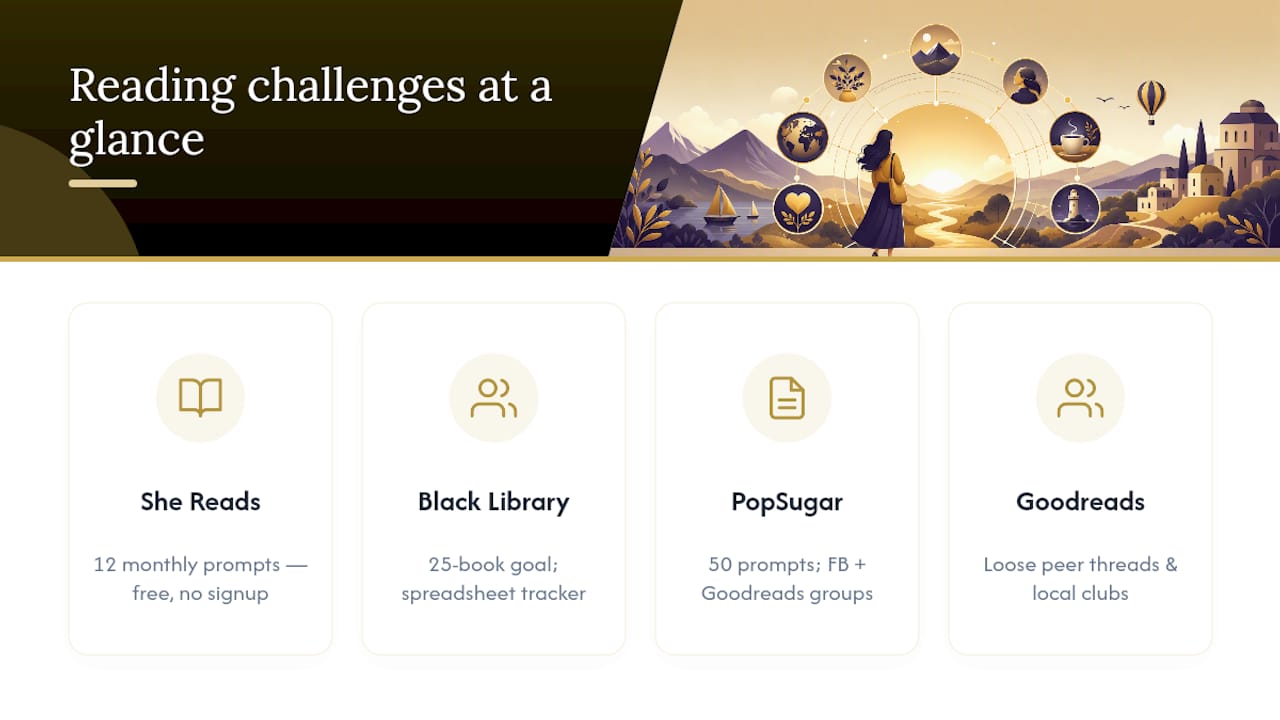
PopSugar Reading Challenge 2026. This one goes big: 50 prompts, downloadable printables, and a Facebook group alongside a Goodreads group for check-ins. It suits readers who like variety and structure over a slower, thematic approach.
Goodreads “Create Your Own” threads and local book clubs. Goodreads hosts long-running community threads where readers post personal goals, swap recommendations, and log updates. It’s the loosest format here and works well if you want peer support without a fixed prompt list.
Cost stays low across the board. Most platforms, including AARP’s The Girlfriend reading challenge, require nothing more than an email address or a free account. Paid extras, like Patreon tiers for deeper community access, are optional add-ons, never entry requirements.
How do you pick the right challenge for your pace and values?
Match the challenge to how you actually read, not how you wish you read. Run through this before committing:
- Pace: Slow and reflective (She Reads Everything) or fast and prompt-heavy (PopSugar)?
- Focus: Author diversity and identity-centered reading, or genre variety?
- Prompt style: Fixed categories you must fill, or open interpretation?
- Community: Public accountability (Discord, Facebook groups) or a private list just for you?
- Access: Do you need audiobooks or heavy library reliance to make this realistic?
A simple rubric: if your free reading time is under three hours a week, start with 12 prompts, not 50. If diversifying your shelf matters more than hitting a number, choose an author-focused list like the Free Black Women’s Library challenge over a count-based one.
Pro Tip: Combine a prompt-style challenge with a soft numeric goal instead of a hard one. Twelve prompts plus an optional 24-book yearly target gives you structure without turning every unread prompt into a failure.
Cost breaks down predictably: the prompt list and basic tracker are free almost everywhere; paid tiers only unlock extra community features like Discord chats or bonus discussion threads.
How do you build your own 2026 reading challenge?
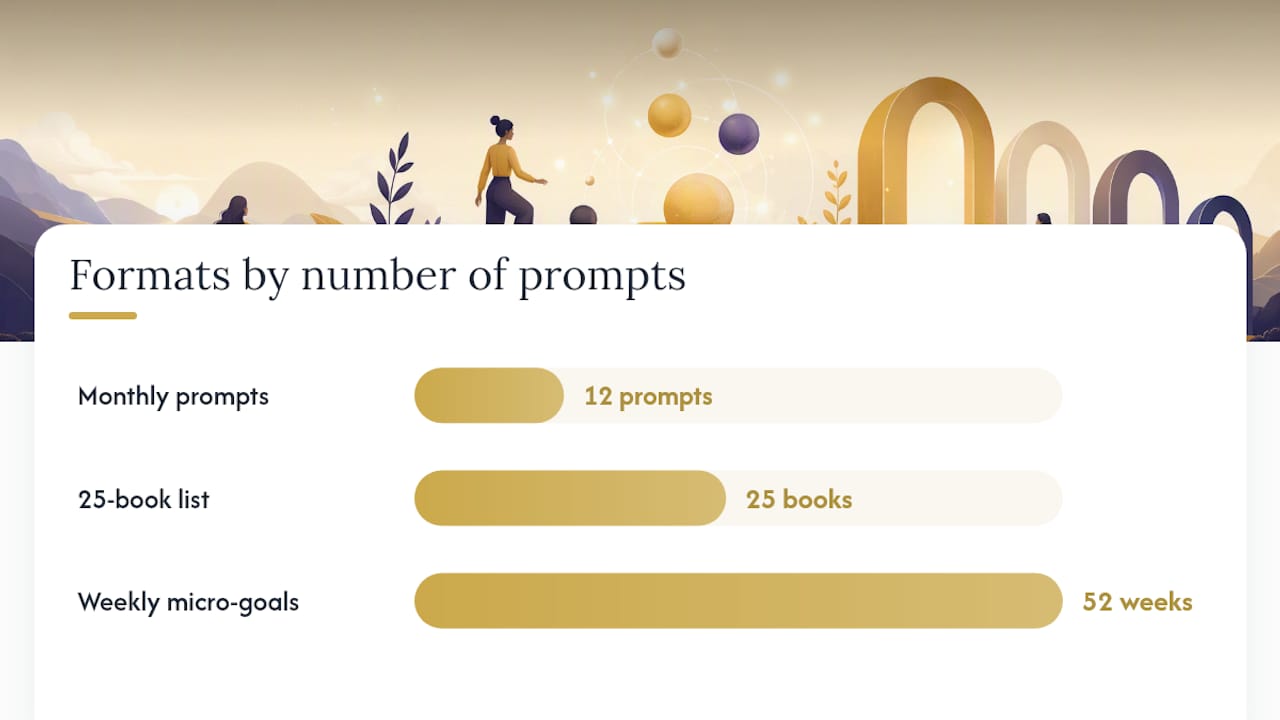
Three formats cover most reading personalities. Copy whichever fits into a note app or printable tracker today.
- Monthly (12 prompts). One theme per month keeps things light. Try: a book by a debut author, a translated book by a woman, a reread from childhood, a book recommended by a friend, a memoir about recovery, a book outside your usual genre, an audiobook, a library-only pick, a book under 200 pages, a book over 400 pages, a banned book, and a book you choose with no rules at all.
- 25-book list (identity and author focused). Modeled on the Free Black Women’s Library approach: 25 slots, each filled with books by women or nonbinary authors from different backgrounds, genres, and decades. No fixed order required.
- 52-week micro-goals. One small prompt per week (a poem, a short story, ten pages of a hard book) for readers who do better with tiny wins than monthly deadlines.
Two rules make any of these sustainable. First, let one book satisfy multiple prompts when it genuinely fits; nobody benefits from reading the same category twice just to follow a rule. Second, keep prompts flexible rather than punitive. If a category doesn’t spark curiosity, swap it.
For accessibility, build in audiobook alternatives from the start, lean on library apps for holds, and consider interlibrary loan or used copies before buying new. This is also where finding books by women authors across genres becomes useful groundwork for filling any of these templates.
What tools help you track progress without stress?
Tracking should take minutes, not hours. Three options cover almost every reading style.
- The StoryGraph has built-in challenge tracking for community challenges like the Free Black Women’s Library entry, so your progress updates automatically as you log books.
- Goodreads works well for the annual reading challenge feature plus its community threads for accountability.
- Printable trackers, like PopSugar’s downloadable prompt sheets, suit readers who prefer paper over apps.
A two-minute weekly check-in beats a daily log for most people: note what you finished, flag anything you listened to instead of read, and see if it maps to an open prompt. Buddy reads, monthly reflections, and mixing audio with print all help sustain motivation without adding pressure. Joining a Discord or Patreon tied to a specific challenge adds light public accountability, useful for readers who thrive on that, optional for those who don’t.
What reading list themes work well for women’s challenges in 2026?
Certain list angles map cleanly onto common 2026 prompts and keep a challenge feeling personal rather than generic.
- Literary fiction that lingers — works for slow-reading months on She Reads Everything’s calendar.
Smartreadshub’s curated Books page leans specifically into this last category, alongside guides on emotional manipulation and recovery that fit naturally into memoir and nonfiction prompts. For sourcing, mix library apps, ebook loans, and used bookstores; none of these lists require full-price purchases to complete.
How do you keep a reading challenge from becoming another chore?
Pace matters more than prompt count. Avoid stacking several trauma-heavy books back-to-back; space them with lighter reads and give yourself explicit permission to skip a prompt that isn’t serving you right now.
- Use content warnings before diving into heavy nonfiction or memoir.
- Switch to audiobooks or shorter reads when focus is low.
- In group discussions, set boundaries upfront: it’s fine to sit out a conversation.
Pro Tip: Pair one emotionally heavy read with one restorative or practical nonfiction title, like a guide on recognizing manipulation patterns, so the challenge doesn’t leave you depleted by month’s end.
What does Smartreadshub think about reading challenges done right?
We built our recommendations around one idea: a reading challenge should support the reader’s emotional work, not compete with it. That’s why we favor prompt-driven, flexible formats over rigid 50-book sprints, and why our own curated lists lean toward books that help readers process real relationship harm, not just fill a category.
Frequently Asked Questions
Do I have to pay for a 2026 reading challenge?
No. Most challenges, including She Reads Everything and PopSugar’s list, are free. Some communities offer optional paid Discord or Patreon tiers for extra interaction, but the core prompts and tracking stay free.
Can I combine two challenges at once?
Yes, and many readers do. A book that fits a “translated author” prompt on one list can often satisfy a “book by a woman writer” prompt on another, cutting your workload in half.
What if I fall behind halfway through the year?
Drop the prompts that no longer interest you and keep the ones that do. Flexible challenges like She Reads Everything are designed for partial completion; a stalled challenge isn’t a failed one.
Are these challenges only for fiction readers?
No. PopSugar’s list and Goodreads threads both include nonfiction categories, and memoir or recovery nonfiction fits naturally into most 2026 prompt sets.
Sources
If you’re using this year’s challenge to work through a difficult relationship, a general prompt list won’t get you there alone. Smartreadshub’s advantage is specificity: instead of generic “memoir” or “recovery” categories, our guides point you to titles that address the exact dynamics you’re untangling, gaslighting, manipulation, emotional invalidation, so each prompt you fill actually moves you forward.
Start with the Books page for curated lists organized by theme, or read what gaslighting actually looks like before picking your recovery-nonfiction prompt for the year. Either page gives you a concrete next title to add to your list today.
- The Free Black Women’s Library Reading Challenge 2026 | The StoryGraph
- Popsugar Reading Challenge 2026 Prompt List | PS Books
- Girlfriend
- Read Women – Read Women Challenge: 2026 Create Your Own Challenge Showing 1-28 of 28