
The grey rock method means making yourself deliberately boring, emotionally flat, and short on information when you talk to someone who feeds on drama or control. It works best as short-term protection when you cannot avoid contact with a manipulative person, such as a co-parent or coworker. It is not a fix for the relationship, and it is not safe to use if there is any history of violence or escalating threats.
- What it is: Minimal engagement, neutral tone, no personal disclosures.
- Best for: Situations where cutting contact entirely isn’t possible yet.
- Skip it if: There’s a history of physical violence, stalking, or threats.
Safety first: Clinicians who study coercive relationships consistently flag one exception to this technique: if you’re at physical risk from the person you’re grey rocking, stop and call a hotline before you do anything else.
Key Takeaways
Grey rocking works by denying a manipulative person the emotional reaction that reinforces their behavior, but it demands total consistency and a prior safety check to use without risk.
| Point | Details |
|---|---|
| Definition and use case | Deliberate emotional neutrality for short-term protection when contact with a manipulative person can’t be avoided. |
| Not stonewalling | Stonewalling punishes; grey rocking strategically redirects while staying functional elsewhere. |
| Consistency is non-negotiable | Partial or inconsistent flatness can teach escalation instead of reducing it. |
| Watch for extinction burst | Expect possible short-term escalation when reinforcement stops; plan for it rather than being surprised. |
| Safety check comes first | A history of violence, control tactics, weapons access, or substance use means prioritizing a safety plan over the technique itself. |
Table of Contents
- What Is the Grey Rock Method, and Where Did It Come From?
- How Do You Actually Grey Rock Someone?
- What Do Grey Rock Scripts Actually Sound Like?
- Does the Grey Rock Method Actually Work?
- When Does Grey Rocking Get Risky?
- What Should You Do If Grey Rocking Doesn’t Work?
- How Do You Recover Emotionally After Grey Rocking?
- Who Curates This Guidance, and Why It Matters
- Where to Verify This and Get Immediate Help
- Why the Standard Advice on Grey Rocking Undersells the Safety Step
- Sources
What Is the Grey Rock Method, and Where Did It Come From?
The grey rock method is a communication strategy built on becoming intentionally uninteresting to someone who thrives on emotional reaction. You give short, factual answers. You reveal nothing about your feelings, plans, or vulnerabilities. The name refers to acting like a rock: gray, unremarkable, nothing worth poking at.
The term traces back to 2012, when it started circulating in online survivor communities as a practical response to narcissistic and abusive behavior. It spread through forums and support groups long before clinicians picked it up, which is part of why it still feels more like folk wisdom than established therapy. That’s changing. Licensed professionals now reference it regularly, though usually with caveats attached.
The psychology behind it comes down to reinforcement and extinction. A manipulative person often escalates because your reactions, anger, tears, defensiveness, function as a reward. Withholding that reward is meant to make the behavior less satisfying over time. Understanding how narcissists control you emotionally helps explain why this works: much of their leverage depends on your visible response.
Grey rocking is not the same as stonewalling. Stonewalling, a term researchers use for shutting down communication entirely as a form of contempt or punishment, is often destructive in healthy relationships and is one of the four communication patterns linked to relationship breakdown. Grey rocking is narrower and more deliberate:
- Stonewalling withdraws to punish or avoid conflict, often in relationships worth repairing.
- Social withdrawal is a broader retreat from people generally, sometimes tied to depression.
- Grey rocking is targeted, temporary, and strategic. You still function normally with everyone else.
It fits situations like co-parenting with a difficult ex, a toxic boss who baits you in meetings, or a family member you can’t avoid at holidays.
How Do You Actually Grey Rock Someone?
Grey rocking looks simple on paper and falls apart fast in practice if you skip the preparation. Here’s the sequence that actually holds up under pressure.

1. Prepare mentally before contact. Decide in advance what you will and won’t discuss. A few slow breaths before a call or a text reply gives you a buffer between provocation and response. Clinicians recommend treating this like rehearsal, not improvisation, because manipulative people are skilled at reading hesitation and using it against you.
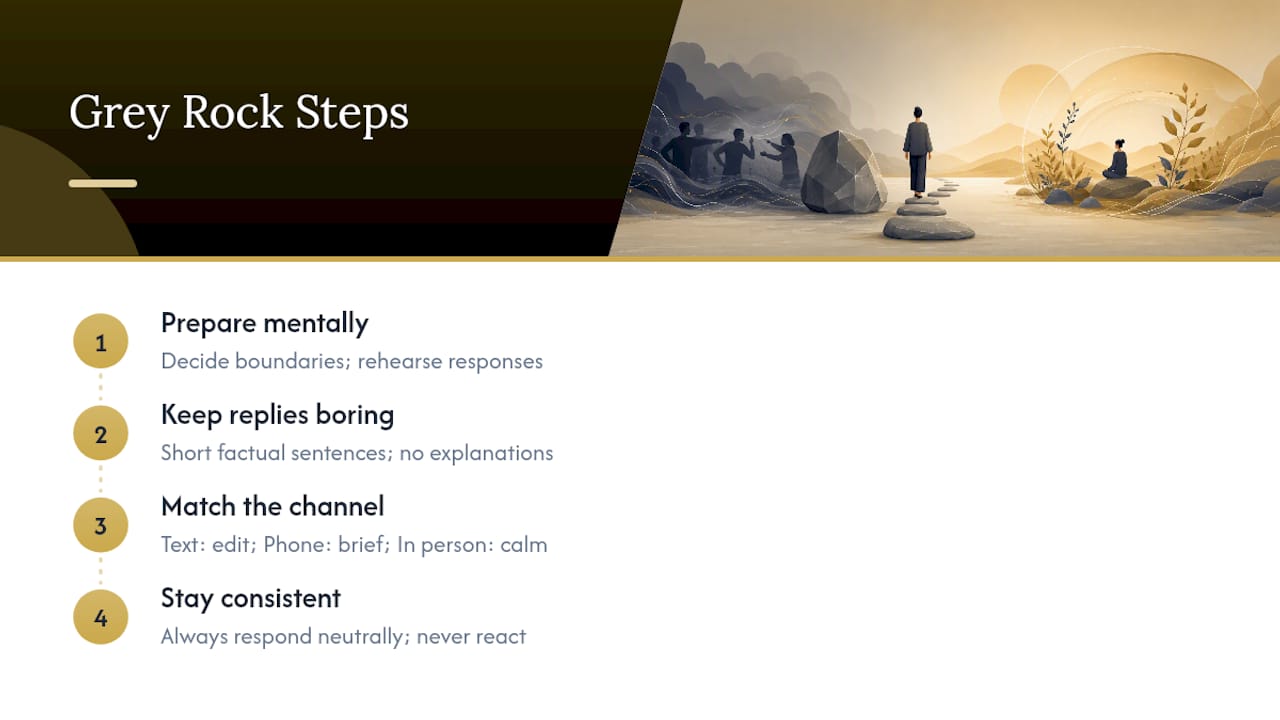
2. Set the behavior rules and keep them boring. Answer in short, factual sentences. Avoid explaining your reasoning, since explanations give a manipulative person material to argue with. Never share new personal details, opinions on their behavior, or anything emotionally revealing. Skip the urge to defend yourself; defense is still engagement.
3. Match your tactics to the channel. Texting and email are easier to control because you can write, wait, and edit before sending. Keep messages short: “Pickup is at 5” or “I’ll send the form Friday.” In person, short verbal replies paired with a calm expression work better than silence, which can read as provocative. On the phone, keep calls brief and end them with a neutral line like “I have to go” rather than explaining why.
4. Stay consistent, every single time. This is where most people fail. Practitioners note that inconsistent grey rocking, reacting emotionally sometimes and staying flat other times, tends to teach a manipulative person to escalate until they get the reaction they’re used to. Partial application is often worse than not trying at all, because it reinforces persistence instead of extinguishing it.
Pro Tip: Keep a small notes app list of three or four “boring” stock replies (“Noted.” “I’ll check and get back to you.” “That doesn’t work for me.”) so you never have to invent a neutral response in the moment.
Written communication tends to outperform live conversation for one simple reason: it removes your face and voice from the equation. If someone consistently escalates in person or on the phone, shift as much necessary contact as possible to text or email, and say so plainly: “I’ll respond to this by email going forward.”
What Do Grey Rock Scripts Actually Sound Like?
Here’s what neutral redirection looks like in practice, not just described in theory. The goal in each example is to deny drama while still handling anything logistically necessary.
Co-parenting text: “Confirmed, pickup at 5 on Friday.” No commentary on the last argument, no defense of your parenting choices.
Workplace baiting in a meeting: “I’ll follow up on that after I check the numbers.” Then move on. Don’t take the bait to justify or explain.
Family gathering confrontation: “I don’t want to get into that today.” Said once, calmly, then a physical walkaway if it continues.
Ex-partner contact: “I got your message. I’ll respond by email.” This shifts the exchange to a channel you control.
Practitioners who work with people managing these dynamics point out that silence alone often backfires, because it can read as a challenge rather than disengagement.
Redirecting to neutral logistics, saying something like “pickup is at 5” instead of going quiet, denies the emotional reaction a manipulative person wants while still handling what actually needs to get done.
That distinction matters for anyone who has to keep functioning around this person, whether that’s 10 toxic relationship behaviors showing up at a shared custody handoff or a coworker fishing for a reaction during a Tuesday status call.
Does the Grey Rock Method Actually Work?
Here’s the honest answer: nobody has run a controlled clinical trial on this. There is no formal, peer-reviewed research proving the grey rock method works long-term in abusive relationships, and clinicians are upfront about that gap.
What exists instead is a plausible mechanism borrowed from broader behavioral science on reinforcement and extinction: withholding an emotional payoff can, in principle, reduce the behavior that payoff was fueling. That’s a reasonable theory, not a proven outcome.
Clinicians who work with survivors describe the method as a defensive adaptation, useful when you can’t avoid someone, not a repair strategy for the relationship itself. Realistic expectations look like this:
- Short-term reduction in the intensity of an interaction, not a permanent personality change in the other person.
- Occasional signs of “boredom” from the manipulative party, sometimes followed by a temporary spike in effort to provoke you.
- No guarantee it resolves the underlying dynamic, since the person’s motivations haven’t changed.
Progress here looks like fewer draining interactions, not a transformed relationship.
When Does Grey Rocking Get Risky?
The single biggest danger is what researchers call an extinction burst: when reinforcement disappears, the behavior that used to work often spikes before it fades. Applied here, that means a manipulative person may escalate, get louder, more manipulative, or more aggressive, when your usual reactions stop coming. That escalation can be verbal. In some cases, it can be physical.
There’s a second, quieter risk: maintaining emotional flatness for weeks or months can blur into genuine numbness or dissociation, especially if you’re using the technique with no outlet for the feelings you’re suppressing elsewhere.
Run this checklist honestly before you start:
- Has this person ever been physically violent, or threatened to be?
- Do they use control tactics like tracking your location, finances, or communications?
- Do they have access to weapons?
- Is substance use a factor in their volatility?
| Risk Level | What It Means |
|---|---|
| No violence history, low control tactics | Grey rocking may be appropriate with basic precautions. |
| Any violence history, weapons access, or substance-fueled volatility | Grey rocking alone is not safe; prioritize a safety plan and professional support first. |
If any answer raises concern, the priority shifts immediately from managing the conversation to managing your physical safety. That means a safety plan, and it can mean calling a domestic violence hotline before your next scheduled contact with this person.
What Should You Do If Grey Rocking Doesn’t Work?
If the interactions keep escalating despite consistent effort, treat that as information, not failure. Here’s the priority order for what comes next.
- Move toward low or no contact where possible. If co-parenting or work requires ongoing contact, route everything through a parenting app, HR, or a mediator instead of direct exchanges.
- Loop in formal structures early. HR for workplace harassment, a family law attorney or mediator for custody disputes, law enforcement if threats or violence occur.
- Document everything. Save texts, emails, and voicemails with dates. Patterns matter far more to HR investigators, mediators, and courts than a single incident.
- Bring in a therapist who understands coercive control. Individual support helps you evaluate whether grey rocking is still the right tool or whether the situation has moved past what any communication technique can manage.
Documentation and outside structure protect you in ways that a calm tone of voice never will.
How Do You Recover Emotionally After Grey Rocking?
Sustained emotional suppression has a cost, and pretending otherwise is how people end up numb without noticing it happened. Processing what you’ve been through with a licensed clinician, particularly one familiar with coercive control or trauma, helps you tell the difference between healthy detachment and dissociation before it becomes a habit.

Approaches worth asking a therapist about include trauma-focused cognitive behavioral therapy and EMDR, both commonly used for relational trauma. Daily grounding practices matter too: a five-minute walk after a difficult exchange, naming three physical sensations you can feel right now, or texting a friend who knows the full context.
Guidance on how to detach emotionally without losing yourself is worth revisiting regularly during this stretch, since the goal is protective distance, not permanent disconnection from your own feelings. Recovery-focused books, structured workbooks, and peer support groups round out the picture. They give language for what you’re experiencing when a clinical session isn’t available, and they remind you the pattern you’re navigating has a name.
Who Curates This Guidance, and Why It Matters
Smart Reads Hub focuses specifically on the mechanics of manipulation, gaslighting, and recovery, curating books and evidence-informed resources for people untangling these dynamics. This piece was compiled and edited under Smart Reads Hub’s editorial process, which cross-checks behavioral claims against clinical sources like Cleveland Clinic and Healthline rather than relying on secondhand summaries. None of this replaces licensed care. If you’re building a safety plan around ongoing abuse, a professional trained in coercive control should be part of that plan, not an afterthought.
If you want to go deeper into the mechanics of manipulation itself, gaslighting is often the pattern running underneath the exact behavior grey rocking is designed to deflect, and understanding it makes the technique easier to apply with intention instead of guesswork.
Where to Verify This and Get Immediate Help
- National Domestic Violence Hotline: confidential support and safety planning if you’re at risk now.
- Clinical grounding: Cleveland Clinic and Healthline on realistic expectations and risks.
- Behavioral basis: The Conversation on escalation dynamics.
- Recovery resources: Smart Reads Hub’s emotional recovery guide.
Why the Standard Advice on Grey Rocking Undersells the Safety Step
Most advice on this topic treats grey rocking as a communication hack, three scripts and you’re done. That framing skips the part that actually determines whether it helps or backfires: the safety assessment has to come first, not as a footnote.
The research is honest about something most casual advice isn’t: this technique has no clinical trials behind it, and the extinction burst is a real, documented risk of trying it at all. Where conventional wisdom oversells this as a fix for the relationship, it isn’t one. It’s a way to survive contact you can’t avoid yet, and it works best paired with documentation, professional support, and an actual exit plan.
If you take one thing from this: consistency beats cleverness. A boring, predictable, unbreakable pattern of neutral replies does more than any perfectly worded script ever will.
— Robert
This article is general information, not a substitute for advice from a qualified doctor. Consult a qualified healthcare professional about your own circumstances before acting on anything here.
Sources
- Grey rock method – Wikipedia
- How the Grey Rock Method Can Protect You From Abusive People and Toxic Interactions — Cleveland Clinic
- What is the ‘grey rock’ method for dealing with narcissists or difficult family members? — The Conversation
- Gray rock method: 6 tips and techniques — Healthline
- The Hotline — National Domestic Violence Hotline