
Start with Beyond Infidelity, The Betrayal Bind, and After the Affair if you’re healing alone, or add Hold Me Tight if you and your partner are working through it together. Begin with individual, trauma-informed reading before couples work. And before you crack open any of these, make sure you have basic emotional stability and support in place. Reading about betrayal while still in acute crisis can do more harm than good.
TL;DR:
- Choose a betrayal trauma book based on your current emotional state, focusing on stabilization first before progressing to frameworks or couples materials.
- Prioritize trauma-informed language, practical exercises, and the credentials of the author to ensure your reading supports safe recovery and validation.
- Books alone cannot regulate your nervous system or replace therapy, so integrate grounding practices and pace your reading to prevent re-traumatization.
- Avoid books that overly dwell on explicit betrayal details, blame the betrayed partner, or pressure reconciliation as the default goal.
- Recognize betrayal trauma symptoms often overlap with PTSD, including intrusive thoughts, hypervigilance, and trust issues, requiring intentional healing phases.
Table of Contents
- Best Betrayal Trauma Books: A Starter Shortlist
- How Do You Choose the Right Betrayal Trauma Book for You?
- What Betrayal Trauma Books Can and Can’t Do for You
- How to Read These Books Safely Without Re-Traumatizing Yourself
- Trigger Warnings and Common Reading Pitfalls to Avoid
- Understanding Betrayal Trauma and Its Psychological Impact
- Key Authors and Experts Shaping Betrayal Trauma Literature
- Why Trauma-Informed Labels Matter More Than Ratings
- Where to Go Next With Smart Reads Hub
- Sources
Best Betrayal Trauma Books: A Starter Shortlist
Every book on this list approaches betrayal from a different angle, so match the description to where you actually are right now, not where you think you should be.
- Not “Just Friends” by Shirley P. Glass — the foundational text on infidelity, still cited by clinicians decades later. Best for understanding why the affair happened and what “walls and windows” means in a relationship. Individual or couples.
- After the Affair by Janis A. Spring — a clear, step-by-step framework for both the betrayed and the unfaithful partner. Best for readers who want a structured path forward, including whether to stay. Individual or couples.
- Hold Me Tight by Dr. Sue Johnson — built on Emotionally Focused Therapy (EFT), this one is squarely for couples ready to rebuild attachment, not for someone still in shock. Couples.
- The Betrayal Bind by Michelle Mays — an attachment-based guide written specifically for betrayed partners, whether they stay or leave. The second edition updates the framework for 2026 readers. Individual.
- Transcending Post-Infidelity Stress Disorder by Dennis C. Ortman — names the trauma response directly and treats it with the same seriousness as PTSD. Best for readers who feel dismissed by “just get over it” advice. Individual.
- Beyond Infidelity by Lauren LaRusso — a clinician-authored, seven-step interactive guide that frames betrayal as a chance to reclaim identity rather than just repair a relationship. Workbook, individual.
- The Body Keeps the Score by Bessel van der Kolk — not written about infidelity specifically, but essential for understanding how betrayal trauma lodges in the body. Somatic background reading, individual.
Pair a framework book (Glass, Spring, Ortman) with a workbook (LaRusso, Mays) once you’ve stabilized. Save the somatic reading and any couples material for later in the process.
How Do You Choose the Right Betrayal Trauma Book for You?
Not every book on that shortlist fits every reader. Run through this before you buy:
- Check the orientation first. Is it written for the betrayed partner alone, for couples, or as a somatic companion? Reading a couples book while your partner refuses accountability will only frustrate you.
- Scan for trauma-informed language. Does the author use terms like “nervous system,” “stabilization,” or “safety” rather than jumping straight to forgiveness?
- Look for exercises, not just theory. Workbooks with journaling prompts or checklists tend to produce more concrete progress than narrative-only books.
- Verify the author’s credentials. A licensed therapist (LPC, LMHC, LMFT) writing from clinical experience carries more weight than an anonymous blogger turned author.
- Read the sample chapter on Amazon or the publisher’s page before buying. If the tone pressures reconciliation or hints at victim-blaming in the first ten pages, skip it.
Pro Tip: If a book’s introduction spends more time convincing you to save the relationship than validating what you’re feeling right now, put it down. Trauma-informed work always starts with you, not the marriage.
What Betrayal Trauma Books Can and Can’t Do for You
Books excel at giving you language, validation, and frameworks. They cannot regulate your nervous system for you, and they’re not a substitute for a trained therapist watching your reactions in real time.
Clinicians generally describe recovery as moving through stabilization, then processing, then integration, rather than jumping straight to resolution or forgiveness. GoodTherapy frames this as a phased approach that prioritizes nervous-system regulation before deeper emotional work begins. Stanford Psychological Services echoes this, recommending that betrayed partners name the experience, learn how trauma functions in the body, and prioritize safety before anything else.
Healing from betrayal trauma tends to be transformative rather than restorative. Most people don’t return to who they were before. They become someone new, and the good books on this topic are honest about that.
Psychology Today notes that trauma-informed therapies like EFT, EMDR, and somatic work are commonly recommended alongside psychoeducation, not instead of it. A book can teach you the map. It can’t walk the terrain for you.
How to Read These Books Safely Without Re-Traumatizing Yourself
Reading order matters more than most people expect. Going straight to a couples book, or binge-reading five titles in a weekend, tends to backfire.
- Start with a stabilization primer. Ortman’s book or the opening chapters of Mays’ The Betrayal Bind are built for the acute phase.
- Move to a framework book like Glass or Spring once you can read without spiraling for hours afterward.
- Add a workbook such as LaRusso’s Beyond Infidelity when you’re ready for structured exercises, not just narrative.
- Only introduce a couples book like Hold Me Tight if both partners are engaged and safety is established.
Pair reading sessions with grounding practices like using tarot for healing to support emotional processing. Somatic gaps in bibliotherapy are common. Many books cover the cognitive work well but barely touch nervous-system regulation, so a few minutes of breathwork or a short walk after a heavy chapter helps more than people assume. Set a 30-minute cap per session and journal one question afterward: “What did I just learn about myself?”
Trigger Warnings and Common Reading Pitfalls to Avoid
Graphic detail about the affair itself, and any framing that pushes forgiveness as the only “healthy” outcome, are the two biggest red flags in this genre. Watch for:
- Books that dwell on explicit details of the betrayal rather than the recovery process
- Language implying the betrayed partner somehow caused the affair
- A structure that assumes staying in the relationship is the default goal
Binge-reading four books in a week is its own trap. It feels productive but often just re-exposes you to trauma without processing time in between. If you notice flashbacks, dissociation, or panic while reading, stop immediately. The 988 Lifeline is available by call or text for anyone in crisis, and it’s worth saving that number before you start, not after.
Understanding Betrayal Trauma and Its Psychological Impact
Betrayal trauma describes the specific injury that happens when the person you depended on for safety becomes the source of harm. It’s not a diagnosis in the clinical manuals, but therapists increasingly treat it with the same seriousness as other trauma responses, including intrusive thoughts, hypervigilance, and disrupted trust in your own perception.
Infidelity is the most commonly discussed form, but the same pattern shows up in family betrayal, such as a parent’s long-hidden affair or a sibling’s financial deception, and in institutional betrayal, where an organization you trusted, like a workplace or religious community, covers up harm instead of addressing it. The mechanism is similar across all three: your internal alarm system, built to detect danger from strangers, gets confused when the danger comes from someone inside your circle of safety.

That confusion often produces symptoms overlapping with PTSD, including sleep disruption, obsessive replaying of events, and a shaken sense of identity. If your relationship also involved manipulation or gaslighting, the psychological impact compounds, because you’re recovering from both the betrayal and the erosion of your ability to trust your own read on reality.
Key Authors and Experts Shaping Betrayal Trauma Literature
Shirley P. Glass, a clinical psychologist, did much of the foundational research on infidelity that later authors still build on. Her “walls and windows” concept, describing how emotional intimacy shifts away from a primary partner toward an outside person, remains a reference point across the field decades after she introduced it.
Janis A. Spring brought a practical, decision-focused lens, helping readers work through whether to stay or leave without moralizing either choice. Dr. Sue Johnson, the developer of Emotionally Focused Therapy, approaches betrayal through attachment science, which is why Hold Me Tight reads so differently from the individual-focused titles. Michelle Mays and Dennis C. Ortman both write from direct clinical work with betrayed partners, and their books reflect a trauma-first lens rather than a relationship-repair lens.
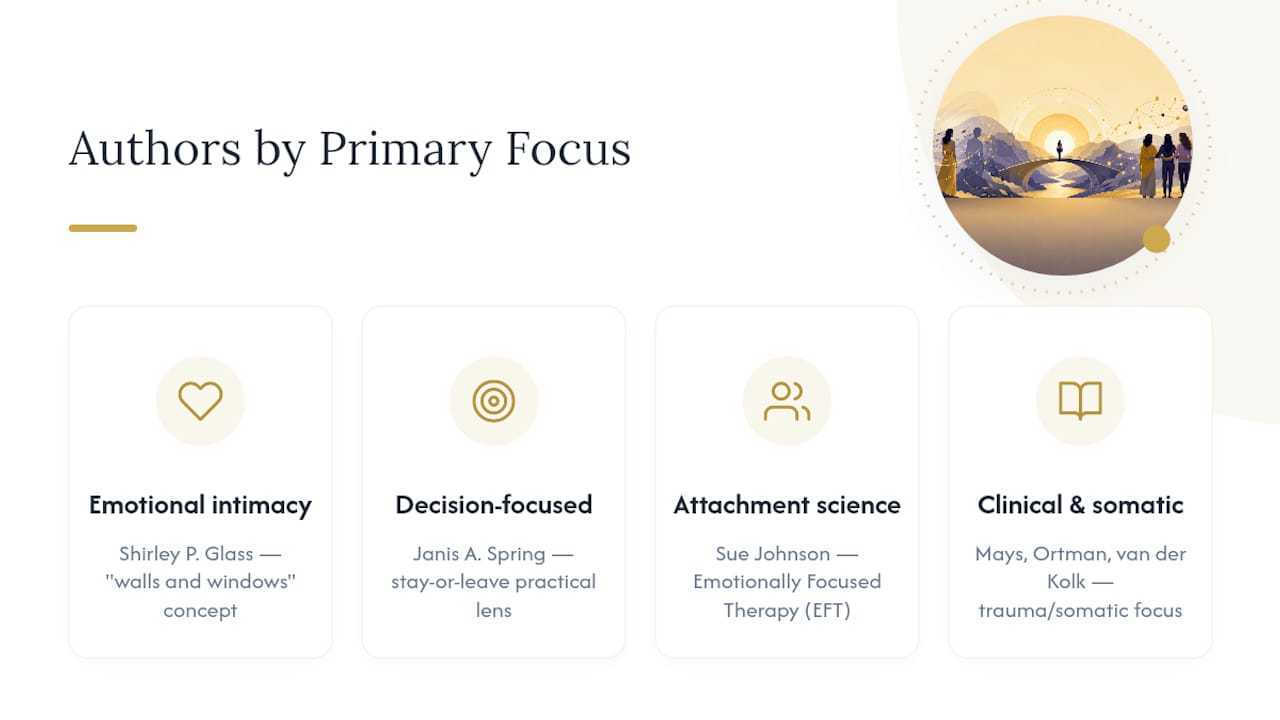
Lauren LaRusso, a licensed professional counselor, represents a newer generation of authors treating betrayal recovery as identity work first. Bessel van der Kolk sits slightly outside this group. He didn’t write about infidelity specifically, but his research on how trauma imprints on the body underpins nearly every somatic recommendation in this space.

Why Trauma-Informed Labels Matter More Than Ratings
Smart Reads Hub built this list around one question: does this book meet a betrayed partner where they actually are, or does it assume they’ve already decided to forgive? That distinction shapes every label attached to the titles above, from “individual” to “somatic” to “workbook.”
Readers who write in after working through a stabilization primer before a couples book consistently report feeling steadier going into that harder conversation, rather than blindsided by exercises they weren’t ready for. That’s the whole reason the labeling system exists. A book that’s brilliant for someone six months into processing can be genuinely harmful to someone three days out from discovery.
— Robert
Where to Go Next With Smart Reads Hub
You’ve got the shortlist. Now the harder part: figuring out if what you’re recovering from is “just” an affair, or if there’s a pattern of manipulation underneath it that no betrayal-trauma book fully addresses. Smart Reads Hub exists for exactly that gap. Where the books above cover the trauma of discovery, our guides help you name the dynamics that came before it, gaslighting, silent treatment, and control tactics that often accompany infidelity but rarely get labeled clearly in mainstream recovery literature.

If part of what you’re processing includes confusion about your own perception of events, start with our breakdown of what gaslighting actually looks like in a relationship. And if you want a next step beyond books, our guide on signs you’re healing from a toxic relationship gives you concrete markers to track instead of just hoping you feel better eventually. Browse either page now and see which one matches where you are today.
Sources
- GoodTherapy — therapist resources and articles on betrayal trauma
- Beyond Infidelity — Penguin Random House
- Recovering From Betrayal Trauma — Stanford Psychological Services