
The most useful approach isn’t picking one perfect book. It’s pairing a practical, therapist-backed guide like Toxic In-Laws with a shorter memoir or covert-narcissism primer for validation. Start there, pick one exercise from the practical book, and practice it this week. A curated shortlist and a simple way to choose between them follows.
TL;DR:
- Pair a therapist-backed guide like Toxic In-Laws with a shorter memoir or covert narcissism primer for validation and practical strategies.
- Focus on identifying your mother-in-law’s archetype or manipulation style before choosing and practicing one specific script or exercise.
- Prioritize reading books with clear, concrete scripts or exercises, and practice them with your partner before applying them to your mother-in-law.
- Seek professional therapy if symptoms like chronic anxiety, sleep issues, or distrust in your perception significantly worsen or persist beyond initial boundary-setting.
- Select books based on your specific goals, partner involvement, time availability, and author credentials to ensure relevant and effective support.
Table of Contents
- Best books on narcissistic mother-in-law dynamics right now
- How to choose the right book for your mother-in-law situation
- Common strategies these books teach, and why they hold up
- Turning a book into an actual plan
- Why we recommend these specific books
- How a difficult mother-in-law affects the whole family
- When a book isn’t enough: therapy and professional support
- Robert’s perspective: what actually moves the needle
- Start with the right first book, and don’t stop at reading
- Where these recommendations come from
- Sources
Best books on narcissistic mother-in-law dynamics right now
Some of these books were written by therapists. Others come from writers who lived through the exact situation you’re in right now. Both have a place on your shelf, and the strongest reading plan usually includes one of each.
Toxic In-Laws by Susan Forward is the closest thing this category has to a foundational text. Forward, a therapist whose earlier work on toxic parents shaped how a generation talked about family dysfunction, organizes difficult in-laws into five archetypes: The Critics, The Controllers, The Engulfers, The Masters of Chaos, and The Rejecters. Her core message is blunt and, for many readers, a relief: you probably can’t change your mother-in-law, but you can change how much power she has over your peace. The book is widely available in paperback and Kindle formats, and it reads more like a field guide than a memoir.
You, Your Husband, and His Mother by Dr. Tracy Dalgleish takes a different angle: it’s written specifically for couples, not just the person struggling with the in-law relationship. Dalgleish is a clinical psychologist, and her VAULT method is built to pull couples out of the exhausting “who’s the victim, who’s the villain” loop that so many marriages get stuck in over a difficult mother-in-law. If your spouse minimizes what’s happening or you feel like you’re fighting this battle alone, this is the book that speaks directly to that gap.
Handling a Covert Narcissistic Mother-in-law is an independently published short guide, and it fills a real need: covert narcissism doesn’t look like yelling or obvious control. It looks like guilt trips, backhanded compliments, and boundary-pushing disguised as concern. Because covert manipulation is subtle by design, a focused, shorter guide often does more good than a dense general text. It’s available on Kindle and in paperback, and its length makes it a realistic same-week read.
The Toxic Mother-in-Law by Amber Bray and The Narcissistic Mother-In-Law by J.J. Stanway round out the shortlist as accessible entry points. Both lean toward practical, situation-specific advice rather than academic theory, which makes them a reasonable starting point if you want something faster than Forward’s book but more structured than a memoir. Neither replaces a therapist-authored framework, but both are useful for naming what’s happening in your own words.
For readers who want validation as much as strategy, memoirs and lived-experience narratives on toxic in-law dynamics reduce the self-doubt that comes with this kind of slow-burn conflict, even when they don’t offer a step-by-step plan. That’s exactly why pairing one with a therapist-authored guide tends to work better than reading either type alone.
How to choose the right book for your mother-in-law situation
Not every book fits every situation. Before you buy, run through a few questions.
- What’s your actual goal? Coping day-to-day, repairing a marriage strained by in-law conflict, or simply understanding what you’re dealing with are three different goals that call for three different books.
- Is your partner involved or checked out? If your spouse minimizes the conflict, a couples-focused book like Dalgleish’s does more than a solo self-help guide.
- Do you want therapist-backed frameworks or lived experience? Forward and Dalgleish bring clinical credentials. Memoirs bring validation. Neither is “better,” but they solve different problems.
- How much time do you have? A 500-page deep dive won’t help someone who needs a script for Thanksgiving dinner in four days. Short indie guides exist for exactly that reason.
Watch for red flags while browsing descriptions: vague promises to “fix” your mother-in-law, no stated author credentials, or a book that never mentions boundaries at all. If an author has no clinical background and no lived-experience framing, treat the advice as one opinion among many, not a proven method.
Pro Tip: Read the sample chapter or table of contents before buying. If a book doesn’t include at least one concrete script or exercise, it’s likely long on theory and short on anything you can use this week.
Common strategies these books teach, and why they hold up
The strongest books in this category don’t treat “narcissistic mother-in-law” as one problem with one fix. They break it into types and match tactics to type.
- Susan Forward’s five-archetype system works because identifying which type you’re dealing with changes what response actually helps. A script that works on a Controller can backfire on an Engulfer.
- Dalgleish’s VAULT method reframes the goal entirely: instead of trying to change your mother-in-law, the couple learns to protect their own relationship first, which often reduces conflict as a side effect.
- Covert-focused guides teach detection first, because subtle manipulation tactics like guilt trips and passive-aggressive comments are easy to dismiss as “just how she is” until you have language for them.
Therapist-authored books tend to include reproducible scripts you can use verbatim, while indie and memoir titles are stronger on emotional validation than on step-by-step tactics.
Turning a book into an actual plan
Reading alone rarely changes a dynamic this entrenched. A simple four-step approach works better than finishing the book and hoping something shifts.
- Read with a highlighter. Mark the one archetype or pattern that matches your situation exactly.
- Pick one exercise or script. Not five. One.
- Practice it with your partner first, if you have one, before using it on your mother-in-law.
- Reflect after a week. Did the tension drop, stay flat, or escalate? Adjust from there.
Pro Tip: If a tactic from a book makes things noticeably worse or you feel unsafe, stop and treat that as a signal to bring in a therapist rather than push harder on your own.
Why we recommend these specific books
Credentials matter more in this category than most, because bad advice on family conflict can cost years of unnecessary tension.
- Susan Forward built her reputation on decades of clinical work on toxic family patterns before writing Toxic In-Laws.
- Dr. Tracy Dalgleish is a practicing clinical psychologist whose VAULT method is grounded in actual couples work, not just personal opinion.
- Smart Reads Hub curates picks based on author credentials, reader reviews, and whether a book delivers usable scripts, not just relatable stories.
How a difficult mother-in-law affects the whole family
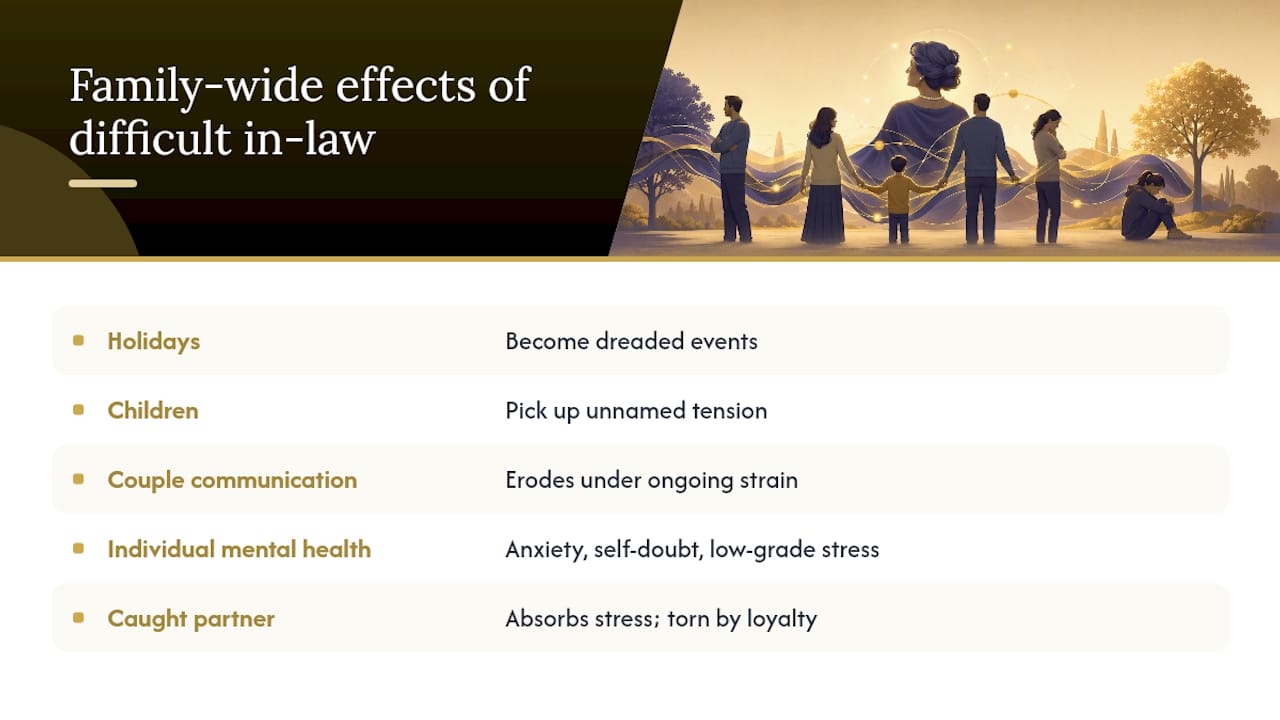
The damage rarely stays contained to one relationship. When one partner’s parent consistently criticizes, guilt-trips, or undermines the marriage, the strain moves through the whole household: holidays become dreaded events, children pick up on tension they can’t name, and the couple’s own communication starts eroding under the weight of managing one difficult person.
Chronic exposure to this kind of conflict is linked to anxiety, self-doubt, and a persistent low-grade stress that outlasts any single argument. Many readers describe a specific and disorienting symptom: starting to question their own perception of events after repeated dismissal or gaslighting from an in-law. That’s not an exaggeration. It’s a documented pattern in how covert manipulation from parents or in-laws erodes confidence over time, and it’s exactly why detection language from a book matters as much as boundary scripts.
The partner caught in the middle often absorbs the most stress, torn between loyalty to a parent and protecting a spouse. This is precisely the gap Dalgleish’s couples-focused framework targets, and it’s worth reading with your partner rather than alone if that dynamic sounds familiar.
When a book isn’t enough: therapy and professional support
Books give you language and scripts. They don’t replace a trained clinician when the situation is severe, longstanding, or affecting your mental health beyond what journaling and boundary scripts can fix.
Several of these books gesture toward this limit themselves. Forward’s work draws on family-systems therapy concepts, and Dalgleish’s clinical background means her book often reads like a bridge into actual couples counseling rather than a replacement for it. If you notice symptoms stacking up, chronic anxiety around family gatherings, sleep disruption, or a persistent sense that you can’t trust your own read on situations, that’s a signal to look into a licensed family therapist or a couples counselor, not just another book.
A therapist can also help when the mother-in-law’s behavior overlaps with patterns of manipulation that extend beyond the in-law relationship itself, including into your marriage or your own sense of self-worth. Reading about how narcissists control people emotionally can help you name what’s happening, but a professional can help you build a longer-term plan for your specific family.

Robert’s perspective: what actually moves the needle
Readers consistently tell us the same thing: a practical guide alone leaves them informed but stuck, and a memoir alone leaves them validated but no closer to a plan. Pairing both, plus one exercise practiced with a partner, is what turns a book into an actual shift in the relationship… If you only do one thing this month, pick one archetype from Forward’s book and one script, then use it once.
— Robert
Start with the right first book, and don’t stop at reading
There are other places to find these titles, general bookstores, library apps, secondhand marketplaces, but none of them help you figure out which book actually fits your situation before you buy it. That’s the gap Smartreadshub closes. We curate reading lists specifically for people dealing with manipulation and toxic family dynamics, so you’re not gambling $15 on a book that turns out to be all theory and no scripts.

If your mother-in-law’s behavior includes making you question your own memory of events or conversations, start with our short guide on signs of gaslighting before you even pick a book. It’ll help you name the pattern faster than most 200-page guides do, and it takes ten minutes. From there, come back and choose your first title with a clearer sense of exactly what you’re dealing with.
Where these recommendations come from
- Toxic In-Laws by Susan Forward (publisher page)
- You, Your Husband, and His Mother (publisher page)
- Handling a Covert Narcissistic Mother-in-law (Amazon listing)
Sources
- Toxic In-Laws by Susan Forward (publisher page)
- You, Your Husband, and His Mother by Dr. Tracy Dalgleish (publisher page)
- Handling a Covert Narcissistic Mother-in-law (Goodreads entry)