
Gaslighting phrases are the specific words someone uses to make you doubt your memory, your perception, or your feelings, and naming them is the fastest way to stop the pattern from working on you. Once you can recognize a line like “that never happened” for what it is, the fog lifts, at least a little. This guide gives you the phrase categories, ready-to-use responses, and the record-keeping steps that make gaslighting harder to pull off.
TL;DR:
- Recognizing common gaslighting phrases, especially denial and dismissive comments, allows you to identify manipulation tactics early and respond effectively.
- Keeping written records of gaslighting incidents creates concrete evidence that can challenge denial and help rebuild trust in your memory.
- Gaslighting patterns involve repeated tactics such as denial, blame-shifting, and false consensus, which gradually erode your perception of reality over time.
- Responding with calm, factual statements that name specific behaviors can prevent escalation and protect your mental clarity in real time.
- Rebuilding confidence after gaslighting requires structured reading and support, as remembering and trusting your perceptions takes ongoing reinforcement.
Table of Contents
- What Gaslighting Phrases Actually Do
- Common Gaslighting Phrases by Category (With Response Scripts)
- How Do You Respond to Gaslighting in the Moment?
- Is This a Pattern, or Just One Bad Conversation?
- Should You Keep Written Records of Gaslighting?
- Why Smart Reads Hub Treats This as a Recovery Starting Point
- Where to Go Next After Reading This List
- Sources
What Gaslighting Phrases Actually Do
Gaslighting is a pattern of psychological manipulation aimed at making another person question their own perception of reality, according to Medical News Today. The phrases themselves aren’t random insults. Each one usually performs a specific job in that larger campaign, and once you learn the job, the line stops landing the same way.
Researchers and clinicians tend to group the tactics into a handful of repeatable moves:
- Countering: directly disputing your memory of an event, even one they witnessed.
- Withholding: refusing to engage or pretending confusion to dodge accountability (“I don’t know what you’re talking about”).
- Trivializing: shrinking your emotional reaction down to something petty or oversensitive.
- Denial: flatly rejecting that something happened, sometimes despite evidence.
- Diverting: redirecting the conversation to your credibility or state of mind instead of the actual issue.
None of these tactics work in isolation. They accumulate. The Cleveland Clinic notes that this kind of manipulation can cause real confusion, anxiety, and a gradual loss of trust in your own memory, which is exactly why the phrase list below matters. You’re not being oversensitive for noticing a pattern in the words themselves.
Common Gaslighting Phrases by Category (With Response Scripts)
Some phrases are loud and cruel. Others sound almost caring. Both kinds do damage, just on different timelines. Below are the phrases that show up most often in relationships, family systems, and workplaces, organized by what they’re actually trying to accomplish, with a short response you can adapt to your own voice.
Dismissive phrases (designed to shrink your reaction)
- “You’re too sensitive.” → “I’m allowed to have a reaction. Let’s talk about what actually happened.”
- “You’re overreacting.” → “I don’t think I am, and I’d like us to address the actual issue.”
- “Everyone thinks you’re overreacting.” → “That’s not something you can prove, and it’s not the point right now.”
- “It’s not a big deal.” → “It’s a big deal to me, and that’s reason enough to talk about it.”
- “You’re being dramatic.” → “Calling this dramatic doesn’t change what I saw.”
- “Calm down.” → “I am calm. I’m also serious.”
Denial phrases (designed to erase the event itself)
- “That never happened.” → “I remember it clearly, and I’m not going to pretend I don’t.”
- “You’re imagining things.” → “I know what I experienced. I’m not going to argue myself out of it.”
- “You’re making that up.” → “I have no reason to invent this. Let’s look at what was actually said.”
- “I never said that.” → “I remember it differently, and I’m not willing to rewrite it.”
- “You’re being paranoid.” → “Noticing a pattern isn’t paranoia.”
Blame-shifting phrases (designed to make the reaction your fault)
- “You made me do it.” → “My behavior doesn’t cause yours. Those are two separate things.”
- “If you hadn’t provoked me…” → “I’m not responsible for how you choose to react.”
- “You’re the reason I’m like this.” → “I’m not going to take responsibility for your choices.”
- “Look what you made me do.” → “You made your own choice there.”
- “You always start this.” → “Let’s talk about what happened this time, specifically.”
Guilt and loyalty bait (designed to make boundaries feel like betrayal)
- “If you loved me, you’d…” → “Love doesn’t require me to ignore my own limits.”
- “I’m only telling you this because I love you.” → “I hear you, but this still doesn’t feel okay to me.” This reflects the pattern the WebMD piece describes as passive gaslighting wrapped in concern.
- “After everything I’ve done for you…” → “I’m grateful for what you’ve done, and I still get to set this boundary.”
- “Nobody else would put up with you.” → “That’s not something I need to hear right now.”
- “You’ll regret this.” → “I’ll take that risk.”
Ridicule and insult phrases (designed to make you feel unstable)
- “You’re being crazy.” → “Calling me crazy doesn’t answer the question.”
- “You need help.” → “Maybe. That’s a separate conversation from the one we’re having.”
- “I was just joking.” → “It didn’t land as a joke, and I’d like you to take that seriously.” This exact phrase shows up on the shortlist a Harvard-trained psychologist flags as one of the most common lines gaslighters use.
- “You can’t take a joke.” → “I can. This wasn’t one.”
- “Relax, it was nothing.” → “It wasn’t nothing to me.”
Consensus-faking phrases (designed to make you feel outnumbered)
- “Everyone agrees with me.” → “I’d need to hear that from them directly.”
- “Ask anyone, they’ll say the same thing.” → “I’m talking to you about this, not anyone else.”
- “Your friends think you’re difficult too.” → “That’s not something I can verify, and it doesn’t change my experience.”
- “Even your family says you’re the problem.” → “I’m not going to accept a claim I can’t confirm.”
Pro Tip: Keep your responses short on purpose. A long rebuttal gives a gaslighter more material to twist. One clear sentence, said calmly, does more work than a paragraph of justification.
You don’t need to memorize every line above word for word. What matters is recognizing the six functions: dismiss, deny, blame, guilt, ridicule, and fake consensus. Once you can sort an unfamiliar phrase into one of those buckets, you’ll know how to answer it even the first time you hear it.
How Do You Respond to Gaslighting in the Moment?
The goal of any response isn’t to win the argument. It’s to protect your own grip on what’s real without escalating things further. A few structured approaches work better than winging it.
- Name the behavior calmly. Say something like: “That statement makes me question my memory, and I know what I saw on Tuesday.” Naming it out loud, without heat, takes away some of its power. Therapists who study this pattern recommend exactly this kind of short, non-engaging reply because it names the tactic and sets a limit without inviting a debate.
- Draw a factual line and stop. “I will not discuss this further until we can both be factual about what happened” ends the loop before it spirals.
- Use gray-rock when direct confrontation isn’t safe. Give flat, minimal, uninteresting answers (“Okay.” “Noted.” “I hear you.”) so there’s nothing for the other person to grab onto and twist.
- Delay instead of engaging live. “I need some time before I respond to that” removes you from a conversation designed to disorient you in real time.
- Move sensitive topics to text or email. Written communication creates a record and removes the ability to later claim you said something different.
- Bring a third party into recurring situations. A witness in a family meeting or a workplace conversation changes the dynamic, since denial is much harder when someone else was in the room.
- Preserve messages as they happen. Screenshot or save texts and emails immediately, not after the relationship has already cooled off enough to feel unsafe doing it.
Pro Tip: If a conversation ever turns from confusing to threatening, drop the scripts and prioritize physical safety first. Documentation matters, but it’s never worth staying in a dangerous situation to get it.
Factual records make gaslighting measurably harder to sustain, because a gaslighter’s leverage depends on you being the only source of the story, and written proof breaks that monopoly. That’s worth remembering the next time you’re tempted to skip saving a text because “it’s not that big a deal.”
Is This a Pattern, or Just One Bad Conversation?
One rude comment doesn’t automatically mean you’re being gaslit. Overusing the term for any disagreement or insensitive remark waters down what’s actually a serious, repeated form of abuse, and Medical News Today makes this distinction explicitly. Gaslighting is defined by repetition, not a single bad night.
Watch for these signs that phrases have become a system instead of an occasional slip:
- The denials increase in frequency, not just severity, over weeks or months.
- You’re gradually cut off from friends or family who used to validate your version of events.
- The person never accepts responsibility, even when evidence directly contradicts their version.
- They invoke “everyone agrees with me” or similar claims regularly, not once.
- You’ve started rehearsing conversations in your head or apologizing preemptively, just in case.
Context changes what the pattern looks like without changing its function. Workplace gaslighting often runs through a manager rewriting the history of a project or denying instructions they gave in writing, and institutional authority can make it feel even harder to challenge than a personal relationship, according to peer-reviewed research on gaslighting in professional settings. If this sounds like your job, emotional manipulation at work covers workplace-specific red flags in more depth.
Medical gaslighting shows up when a provider repeatedly dismisses or minimizes physical symptoms, often telling a patient the pain or issue is “in their head.” If you want a fuller symptom checklist for relationship contexts specifically, 7 signs of gaslighting in arguments walks through the behavioral tells in more detail.
Should You Keep Written Records of Gaslighting?
Yes, and it’s one of the more effective countermeasures available to you. A dated record turns “that never happened” into a claim you can actually check against something concrete, instead of a memory you’re left defending on your own.
Keep it simple:
- Note the date, time, and a brief factual description of what was said or done.
- Save texts, emails, or voicemails exactly as they were sent, without editing or paraphrasing.
- Back up screenshots somewhere outside a shared or monitored device.
- Write down how you felt at the time too. Emotional context matters later, even if it seems secondary in the moment.
If the pattern feels serious or you’re unsure whether you’re safe, a licensed therapist can help you process what’s happening, and peer-reviewed research backs therapy referrals for measurable improvements in mental health outcomes after psychological abuse. The National Domestic Violence Hotline is a confidential option if you need support figuring out next steps. Setting firm limits, even small ones, is part of what protects you going forward, a point echoed in guidance on how boundaries support recovery. For a broader look at the tactics behind these patterns, 11 subtle manipulation tactics in relationships is a useful next read.
Why Smart Reads Hub Treats This as a Recovery Starting Point
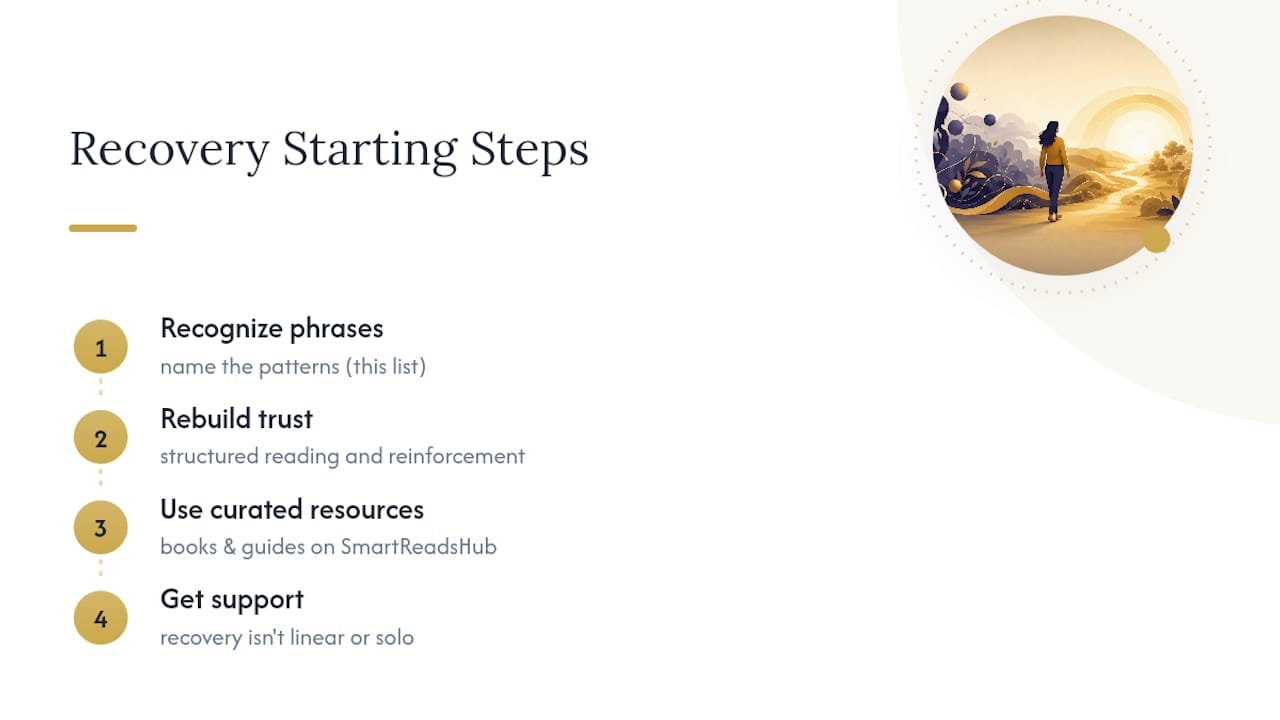
I’ve spent enough time in this material to notice something most gaslighting content misses: naming the phrases is only half the job. The other half is rebuilding trust in your own memory, and that takes more than a checklist. It takes structured reading and repeated reinforcement, which is exactly why Smartreadshub exists in the first place. We built this resource around curated books and guides because a single article, however thorough, rarely undoes months or years of doubt on its own.
If this list felt familiar, what is gaslighting goes deeper into the mechanics, and signs of gaslighting in arguments helps you evaluate specific incidents against a broader pattern. Recovery isn’t linear, and it isn’t a solo project either.
— Robert
Where to Go Next After Reading This List
Recognizing the phrases is step one. Rebuilding the parts of yourself that gaslighting wore down is the longer project, and that’s where Smartreadshub earns its keep as more than an information site.

This resource offers curated reading paths built around various situations, whether that’s understanding what just happened to you or actively working through recovery. Start with what is gaslighting if you’re still piecing together whether what you experienced fits the pattern. If you already know the answer and want a full symptom breakdown, 7 signs of gaslighting in arguments lays it out clearly. And when you’re ready to move from identifying the problem to actively healing from it, best books for emotional recovery after a breakup offers a curated shortlist instead of an endless, overwhelming search through book reviews. Some of these links are affiliate links, which means Smartreadshub may earn a small commission if you purchase through them, at no extra cost to you. Pick one resource that fits where you are right now and start there.
Sources
This guide draws on clinical and journalistic sources that specialize in psychological abuse and manipulation patterns. Medical News Today provided the core definition and commonly cited phrase examples. The Cleveland Clinic supplied guidance on documentation and the mental health effects of sustained gaslighting. WebMD detailed the subtler, “helpful-sounding” version of controlling language. A Harvard-trained psychologist’s analysis via CNBC shaped the response scripts throughout this piece, and peer-reviewed research on institutional gaslighting informed the workplace and medical context sections.
- Gaslighting: Definition & How To Spot It — Medical News Today
- Signs of controlling behavior — WebMD
- Gaslighting: Definition & How to Spot It — Cleveland Clinic
- Harvard psychologist shares 9 toxic phrases ‘gaslighters’ always use—and how to respond — CNBC