
Yes, empaths and narcissists can and often do form relationships, and those relationships are typically one-sided, exhausting, and trauma-bonded rather than mutual. The pull between them is real and explainable, not a personal failing on the empath’s side. If you recognize this pattern in your own relationship, the first move isn’t confrontation. It’s a private safety check: write down three recent incidents where you felt confused or blamed after being kind, and notice whether a pattern emerges.
TL;DR:
- Empaths often absorb blame and stay longer in narcissistic relationships because they seek to repair early idealization through devaluation.
- Narcissistic manipulation tactics, such as gaslighting and smear campaigns, disproportionately target empaths’ self-examination tendencies.
- Leaving a narcissist triggers a trauma bond, with an initial phase of longing and persistent hoovering efforts before emotional detachment can take hold.
- Recovery requires establishing small, consistent boundaries and practicing nervous-system regulation, not reducing emotional sensitivity or caring less.
- Tracking repeated behaviors and documenting incidents provide crucial protection against gaslighting and facilitate clarity during the healing process.
Table of Contents
- What Is an Empath and What Is a Narcissist, Really?
- Why Empaths and Narcissists Keep Finding Each Other
- The Idealize, Devalue, Discard, Hoover Cycle
- Manipulation Tactics That Target Empathy Specifically
- Genuine Empathy vs. Fawning: Know the Difference
- Boundaries and Nervous-System Work: Where Recovery Actually Starts
- What Happens When an Empath Leaves: The Withdrawal Timeline
- Therapy and Evidence-Based Support That Actually Helps
- Our Take: Why Recovery Isn’t About Becoming Less Sensitive
- Where to Start: Practical Resources for Recovery
- Sources
- FAQ
What Is an Empath and What Is a Narcissist, Really?
An empath is someone with unusually high sensitivity to other people’s emotional states, often described on a spectrum rather than as a fixed diagnosis. Empaths pick up on tone shifts, unspoken tension, and micro-expressions faster than most people, and they tend to absorb that emotional information as if it were their own. This isn’t a clinical label. It’s a trait cluster, similar to introversion, and it exists in degrees rather than a yes-or-no category.
Narcissist is trickier, because the word gets used casually for anyone self-centered or annoying, when the clinical picture is narrower. Narcissistic Personality Disorder involves a persistent pattern of grandiosity, a deep need for admiration, and a real deficit in empathy that shows up across relationships, work, and family life, not just in one bad breakup. Most people who display narcissistic traits, entitlement, image management, difficulty apologizing, never meet the threshold for a formal NPD diagnosis, and that distinction matters when you’re trying to figure out what you’re actually dealing with.
A few things worth separating before you label anyone:
- High sensitivity is not weakness, and it is not the same as being a pushover.
- Narcissistic traits exist on a spectrum; occasional selfishness is not NPD.
- Overlapping presentations (attention differences, anxiety-driven people-pleasing) can look similar from the outside, which is one reason the CDC’s guidance on diagnosis stresses clinical evaluation over self-diagnosis.
- A clinical evaluation from a licensed therapist is the only reliable way to confirm NPD, not an online quiz or a partner’s behavior checklist.
Why Empaths and Narcissists Keep Finding Each Other
The attraction isn’t random. Narcissists are often skilled, sometimes unconsciously, at mirroring: reflecting back exactly what a potential partner wants to hear and feel in the early stages of a relationship. For an empath, who already reads emotional cues closely, that mirroring can feel like being deeply understood for the first time. It’s manufactured intimacy that arrives fast and feels enormous.
Attachment history plays a role too. Many empaths grew up managing a parent’s moods, an unstable household, or a caregiver who was emotionally unavailable, and they learned early that love is something you earn through vigilance and giving. A narcissistic partner who initially showers attention and praise can feel like the correction to that old wound, even though it’s the same dynamic wearing a different face.
And then there’s supply. Narcissists need a steady stream of admiration, attention, and emotional labor to maintain their self-image, and empaths are efficient at providing exactly that:
- Empaths tend to give without being asked, which reduces the effort a narcissistic partner has to expend.
- Empaths often absorb blame to keep peace, which protects the narcissist from accountability.
- Empaths stay longer through devaluation because they keep believing the early idealization was the “real” person.
Research on pathological narcissism within intimate relationships backs this up, finding significantly more disharmony and devaluation in these pairings than in relationships without narcissistic dynamics.
The Idealize, Devalue, Discard, Hoover Cycle
This cycle isn’t a metaphor. It’s a repeating structural pattern that shows up in the narcissistic abuse cycle described by clinicians, and once you can name each stage, the relationship stops feeling like random chaos and starts looking like a system.
- Idealization. Intense attention, flattery, and a sense of being “chosen.” Fast declarations of love, constant contact, mirrored interests.
- Devaluation. Criticism creeps in, often disguised as jokes or “honesty.” Warmth becomes conditional. Small mistakes get treated as character flaws.
- Discard. The partner withdraws affection or ends things abruptly, sometimes coldly, sometimes with blame heaped on the empath.
- Hoovering. After distance or a breakup, the narcissist reappears with apparent remorse, nostalgia, or crisis, pulling the empath back into contact.
The engine underneath all four stages is intermittent reinforcement, the same mechanism that makes slot machines addictive. Unpredictable rewards (a good day, a loving text, one moment of the old idealization) are more powerful at creating attachment than consistent rewards, because the brain keeps chasing the next unpredictable hit. That’s a documented feature of trauma bonding, and it explains why leaving feels less like ending a relationship and more like breaking a dependency.
A 2021 study of 436 people in relationships with partners high in narcissistic traits found elevated anxiety, depression, and self-aggression among respondents, with 57.3% still in the relationship and 21.1% having already left. Leaving doesn’t automatically resolve the psychological toll. That’s worth sitting with if you assume distance alone will fix things.
Manipulation Tactics That Target Empathy Specifically
Narcissistic manipulation isn’t random cruelty. It’s a set of repeatable tactics, and therapists interviewed for Parade’s breakdown of narcissistic manipulation identify the same handful showing up again and again across cases.
- Gaslighting. Denying things that happened, rewriting shared history, insisting your memory or perception is wrong.
- Guilt-tripping. Framing your boundaries or needs as selfish or cruel, so you back down to avoid feeling like a bad person.
- Isolation. Slowly discouraging contact with friends or family, often framed as “they don’t understand us” or “they’re jealous.”
- Mirroring. Reflecting your values and interests early on to build fast trust, then abandoning that persona once you’re attached.
- Smear campaigns. Telling mutual friends or family a version of events that casts you as unstable or overreacting, pre-emptively discrediting you.
Each of these lands harder on an empath because empaths default to self-examination first. Told “you’re too sensitive,” an empath’s instinct is to check whether that’s true rather than reject the framing outright, which is exactly the opening gaslighting needs to work.
Pro Tip: Keep a simple dated log, texts, incidents, your reaction, on your phone or a private notebook. One confusing conversation is a bad night. The same pattern showing up five times in three months is data, and data is much harder to gaslight yourself out of than memory alone.
If a behavior only happens once during a stressful week, that’s human. If it repeats across unrelated situations and always ends with you apologizing, that’s systematic, and it deserves closer attention. For more detail on how these behaviors show up day to day, Smart Reads Hub’s guide to narcissistic abuse tactics walks through specific examples and coping responses.
Genuine Empathy vs. Fawning: Know the Difference
Fawning is a trauma response, not a personality trait, and it’s easy to confuse with empathy because both look like accommodation from the outside. Fawning is an involuntary survival strategy where a person appeases, agrees, and self-erases specifically to avoid conflict or punishment, often learned in childhood around an unpredictable or critical caregiver.
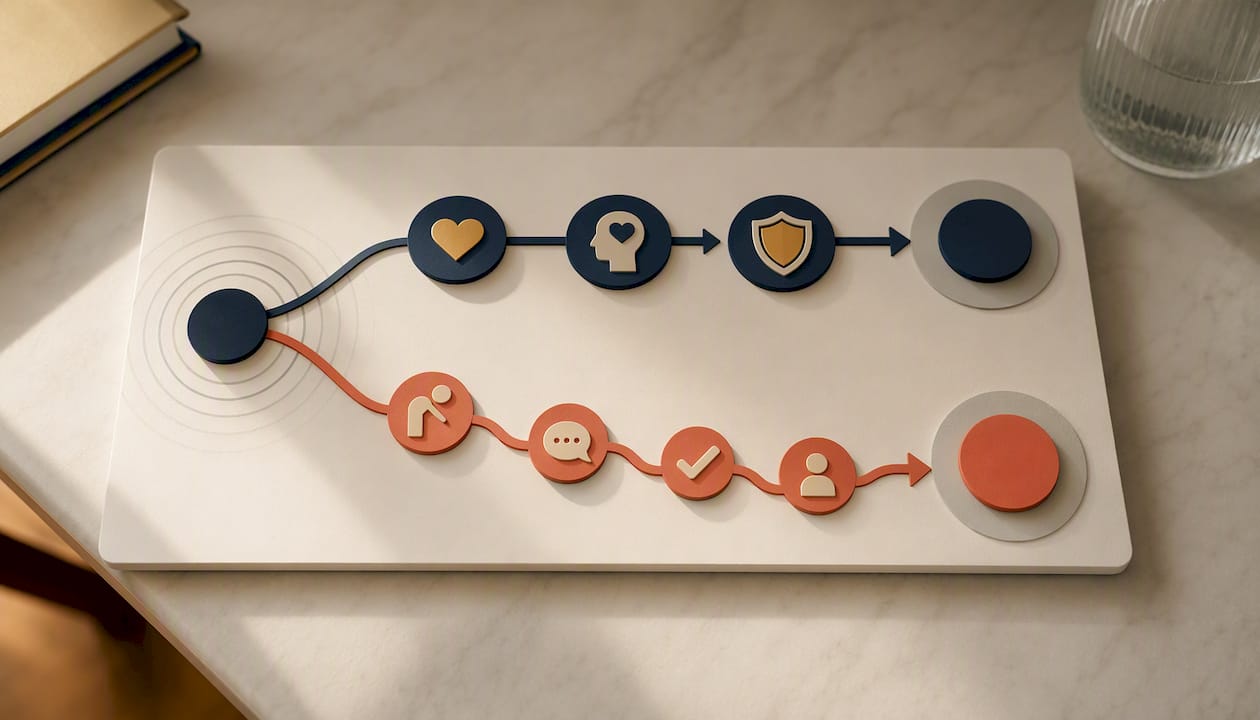
Genuine empathy is chosen and flexible. It can say no. Fawning is automatic and rigid, kicking in before you’ve consciously decided anything.
Quick signs you’re fawning rather than choosing empathy:
- You agree before you’ve actually processed whether you agree.
- Saying no produces a spike of physical dread, not just mild discomfort.
- You rehearse conversations in your head to preempt someone else’s anger.
Pro Tip: Try a tiny, low-stakes test: decline something small this week, a coffee order, a plan, a favor, and notice your body’s reaction. If genuine empathy is driving you, you’ll feel calm dissent. If fawning is driving you, you’ll feel disproportionate fear. That gap is diagnostic.
Boundaries and Nervous-System Work: Where Recovery Actually Starts
Recovery doesn’t mean becoming less sensitive. It means protecting the sensitivity you have instead of letting it be exploited, and that starts with boundaries built in stages rather than one dramatic confrontation.
- Low-stakes boundary. Practice on something small and safe: “I can’t talk right now, I’ll call you back later.” Notice the discomfort and let it pass without apologizing three extra times.
- Medium-stakes boundary. Name a pattern directly and calmly: “When you bring up my past mistakes during arguments, I need us to stop and revisit it later.” No justification required.
- High-stakes boundary. State a consequence and follow through: “If you continue to contact my friends about our private conversations, I’m going to limit contact.” Then actually limit contact if it happens again.
Alongside boundary work, your body needs regulation, because chronic hypervigilance doesn’t shut off just because you understand the psychology intellectually. Paced breathing, four seconds in, six seconds out, calms the nervous system faster than most people expect. A grounding anchor, a specific object, scent, or phrase you associate with safety, gives you something concrete to return to mid-spiral.
Pro Tip: Rebuild support before you need it in a crisis. One trusted friend who believes you without needing convincing is worth more during a hoovering attempt than any amount of solo journaling.
Practical resilience practices, like those outlined in this guide to building emotional resilience, can run alongside therapy rather than replacing it. Smart Reads Hub’s blog also collects recovery-focused articles for the days when reading something short is all you have capacity for.
What Happens When an Empath Leaves: The Withdrawal Timeline
Leaving triggers something closer to withdrawal than relief, at least at first. Expect an early phase of intense longing, sometimes called frustrated dependency, where you miss the idealized version of the person even while knowing intellectually what happened. That longing is a documented feature of pathological narcissistic attachment, not a sign you made a mistake leaving.
A basic safety plan matters more than most people expect going in:
- Save screenshots and dated notes of concerning messages somewhere the other person can’t access.
- Tell at least one person your plan and check in with them regularly.
- Decide your no-contact rules in advance, before an emotional moment tests them.
Hoovering will likely happen. It works best on people who haven’t decided in advance how they’ll respond, so script it now: “I’m not available to discuss this. I wish you well.” No debate, no re-litigating the relationship, no explaining yourself again. Smart Reads Hub’s guide to healing after narcissistic abuse breaks the recovery timeline down further, stage by stage.
Therapy and Evidence-Based Support That Actually Helps
Several therapeutic approaches show consistent value for recovering from this specific kind of relational harm, and it’s worth naming them rather than settling for generic “talk to someone” advice.
- Trauma-informed CBT helps identify and interrupt the self-blame loops that gaslighting installs.
- EMDR is often used to process specific traumatic memories that keep intruding, particularly around the discard phase.
- Schema therapy targets the deeper attachment patterns that made the relationship feel familiar in the first place.
- Attachment-focused work helps rebuild a sense of secure connection that doesn’t depend on intermittent reinforcement.
The clinical literature on interpersonal dysfunction in these relationships is consistent: partners and even adult children of people with pathological narcissism show measurably worse relational security and higher psychological distress than comparison groups, according to research on core conflictual relational themes in these dynamics. That’s clinical confirmation that what you experienced wasn’t an overreaction.
If you’re in crisis right now, the 988 Suicide and Crisis Lifeline is available immediately, free, and confidential. Finding a trauma-informed clinician usually means searching specifically for those words, “trauma-informed,” in directory filters, rather than assuming every licensed therapist has that specific training.
Our Take: Why Recovery Isn’t About Becoming Less Sensitive
Most advice aimed at empaths quietly implies the sensitivity itself is the problem, that if you just cared less, felt less, noticed less, you’d stop attracting this dynamic. That framing is backwards, and it does real damage. The trait that makes you a target isn’t a flaw to sand down. It’s a capacity that got hijacked by someone who learned to exploit it efficiently.
What actually distinguishes people who recover well from those who cycle through repeat versions of the same relationship is not less empathy. It’s better discrimination, the ability to tell chosen compassion apart from fawning, and the willingness to hold a boundary even when it produces short-term guilt. That skill is learnable, but it’s rarely taught alongside “how to spot a narcissist” content, which tends to focus entirely on the other person’s behavior and leaves the reader’s own patterns unexamined.
The uncomfortable part: understanding narcissism intellectually, knowing the cycle, naming the tactics, doesn’t automatically protect you. Plenty of people can describe hoovering in clinical detail and still answer the text. Real change happens in the body, in the moment dissent produces fear, and that’s slower, less satisfying work than reading another red-flags list.
— Robert
Where to Start: Practical Resources for Recovery
If you’re looking for something concrete to work through this week, there are curated specific starting points rather than a generic reading list. The 5 emotional abuse books recommended by therapists and survivors collection is built for exactly the stage where you need language for what happened before you can act on it. For readers who keep second-guessing what they experienced, the gaslighting phrases and record-keeping guide offers scripted short responses plus a documentation method you can start using today, useful for the boundary work covered earlier. And if you’re preparing to talk to a therapist for the first time about this relationship, the emotional recovery after abuse guide maps out what to expect from that process. Start with whichever one matches where you are right now, not where you think you should be.
Sources
The clinical claims here draw on peer-reviewed research into narcissistic relational dysfunction and conflictual relational themes in intimate relationships, alongside therapist-sourced tactic breakdowns and consumer mental-health guidance. If you’re in crisis, contact the 988 Suicide and Crisis Lifeline any time, day or night. To find a trauma-informed clinician, most national therapist directories let you filter by specialty, search specifically for trauma or narcissistic abuse experience rather than general relationship counseling.
This article is general information, not a substitute for advice from a qualified doctor. Consult a qualified healthcare professional about your own circumstances before acting on anything here.
- Living with pathological narcissism: core conflictual relational themes within intimate relationships
- 11 narcissistic manipulation tactics, according to therapists (Parade)
FAQ
Can an Empath Be With a Narcissist Long-Term?
Yes, and many do stay for years, but research on these relationships consistently finds higher disharmony, devaluation, and psychological distress than in non-narcissistic pairings, not the mutual growth empaths often hope for.
What Happens When an Empath Leaves a Narcissist?
Expect an early period of intense longing sometimes called frustrated dependency, followed by hoovering attempts and, if no-contact holds, a gradual reduction in intrusive thoughts over weeks to months as the trauma bond weakens.
What Is the One Question to Identify a Narcissist?
There’s no single question that reliably diagnoses NPD, but asking “how do you talk about people you’ve had conflict with in the past?” often reveals a pattern, consistent blame externalized onto others rather than any accountability, that’s worth paying attention to.
Who Is the Best Partner for an Empath?
Someone capable of reciprocal empathy, who notices your needs without you having to advocate loudly for them and who responds to a stated boundary with respect rather than guilt or withdrawal.