
Stonewalling is emotional withdrawal during conflict, and it comes in two distinct forms. One is involuntary: a nervous system so overwhelmed it simply shuts down. The other is deliberate, a form of the silent treatment used to punish or control a partner. Both erode trust, but the involuntary kind is usually manageable through self-regulation and agreed break rules, while the intentional kind often needs firmer boundaries or professional support.
TL;DR:
- Flooding stonewalling occurs when the nervous system becomes overwhelmed, requiring patience and self-soothing to recover, while weaponized silence is a deliberate tactic that needs boundaries.
- Attachment styles, trauma history, and stress levels influence whether someone involuntarily floods or strategically withholds, but deliberate silence is always a form of emotional control.
- Healthy pauses involve explicitly stating the need for a break, setting a time limit, and returning to finish the conversation, unlike silent withdrawal which leaves issues unresolved.
- Chronic stonewalling combined with contempt or used as a control tactic predicts relationship decline and often requires outside intervention or therapy to change.
- Effective responses include naming the shutdown, taking a real break, and returning on schedule, with practice recommended during low-stakes conflicts to build skills.
Table of Contents
- What Is Stonewalling, and Why the Distinction Matters
- What Causes Stonewalling: Flooding, Attachment, and Trauma
- Signs of Stonewalling vs. a Healthy Time-Out
- How Stonewalling Damages Relationships Over Time
- How to Respond to Stonewalling in the Moment
- When Stonewalling Crosses Into Emotional Abuse
- Getting Professional Help for Chronic Stonewalling
- A Straight Answer on Why Stonewalling Keeps Winning
- Books and Resources That Help You Work Through This
- Sources
- FAQ
What Is Stonewalling, and Why the Distinction Matters
Stonewalling is one of the four behaviors relationship researcher John Gottman labeled the “Four Horsemen,” a set of communication patterns that predict relationship breakdown when left unaddressed. Alongside criticism, contempt, and defensiveness, stonewalling shows up when one partner stops engaging entirely. That can mean silence, monosyllabic answers, or physically walking away mid-argument.
What most people miss is that stonewalling sits on a spectrum, not a single behavior. On one end is reactive flooding: a partner’s body goes into a fight-or-flight state, and their brain temporarily loses the capacity to process what’s being said. On the other end is strategic silence, a calculated choice to withhold engagement as leverage or punishment. The Cleveland Clinic notes that stonewalling ranges from involuntary physiological shutdown to deliberate, weaponized silence. The two forms are common among people with anxiety, depression, trauma histories, or avoidant attachment traits.
This distinction changes everything about how you should respond:
- Flooding calls for patience, a pause, and self-soothing before reengaging.
- Weaponized silence calls for a direct conversation about impact and, in some cases, a boundary.
- Confusing the two leads partners to either demand engagement from someone who is neurologically incapable of it at that moment, or excuse manipulation as a “bad day.”
Getting this right is the difference between repair and resentment.
What Causes Stonewalling: Flooding, Attachment, and Trauma
Physiological flooding is a real, measurable state. Heart rate spikes, often past a threshold commonly observed in lab settings, and the part of the brain responsible for reasoning and language starts to lose ground to the part wired for survival. Gottman’s research documents this pattern directly, which is why yelling “just talk to me” rarely works. The person isn’t choosing silence at that instant; their body has decided the conversation is a threat.
Attachment style plays a major role in who reaches this point and how often. People with avoidant attachment tend to associate conflict with loss of independence or safety, so withdrawal feels protective. People with anxious attachment can also stonewall, usually after repeated attempts to get a response fail and they shut down out of exhaustion rather than strategy. Family history matters too. Someone raised in a household where conflict meant slammed doors or days of cold silence often learned that withdrawal is simply what people do when things get hard. It’s not a character flaw so much as an inherited script.
Mental health adds another layer. Anxiety and depression both lower a person’s tolerance for conflict-driven stress, making flooding more likely to occur and harder to recover from. Trauma histories, especially those involving unpredictable or volatile caregivers, can make ordinary relationship tension feel dangerous at a level that bypasses conscious thought. Fatigue, illness, and unrelated stress (a bad day at work, a sleepless night) also lower the threshold. None of this excuses chronic, deliberate silence used to control a partner. But it does explain why the same behavior, silence, can come from two completely different places.
Signs of Stonewalling vs. a Healthy Time-Out
Stonewalling looks different depending on the couple, but a few markers show up consistently: short, clipped answers (“fine,” “whatever”), physically leaving the room without explanation, checking a phone instead of responding, avoiding eye contact, or going quiet for hours or days without any indication of when the conversation will resume.
Healthy pauses look similar on the surface but differ in three specific ways:
- Named: The partner taking space says so out loud (“I need a break”) rather than just disappearing.
- Time-limited: There’s a rough window attached, even an informal one like “give me twenty minutes.”
- Committed to return: The person comes back to finish the conversation instead of letting it dissolve into silence.
A short example makes the difference concrete. Partner A says, “I’m getting overwhelmed, I need a short break, then let’s keep talking,” and comes back on schedule. That’s regulation. Partner B goes quiet mid-sentence, leaves the house, and doesn’t respond to texts for six hours, offering no explanation when they return. That’s stonewalling, whether it’s driven by flooding or by intent. The Cleveland Clinic points out that stonewalling can resemble the silent treatment but differs in intent: one is dysregulation, the other is a tactic. If you’re trying to figure out which one you’re facing, read our breakdown on the psychology behind why people use the silent treatment.
How Stonewalling Damages Relationships Over Time
Stonewalling rarely stays a one-time event. It tends to trigger a pursue–withdraw cycle: one partner pushes for engagement, the other retreats further, which makes the first partner push harder, which drives more retreat. Psychology Today describes this dynamic as a near-inevitable byproduct of stonewalling, and it tends to leave the pursuing partner feeling rejected, isolated, and increasingly resentful.
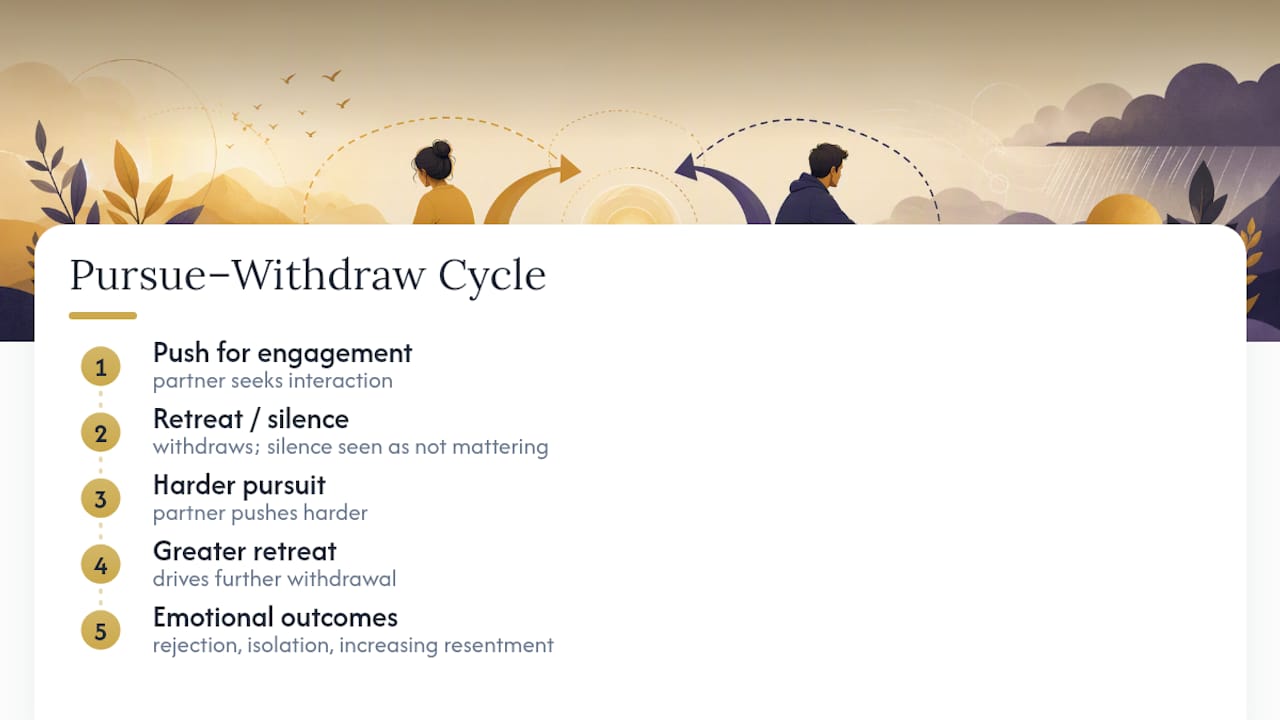
The emotional toll compounds on both sides. The withdrawn partner often feels flooded, ashamed, or trapped, while the pursuing partner starts to interpret silence as confirmation they don’t matter. Over months or years, this cycle teaches both people that conflict isn’t safe to have, so issues stop getting addressed at all. Couples in this pattern often describe feeling more like roommates than partners.
The long-term risk is well documented. Occasional stonewalling during a heated argument is common and usually recoverable. Chronic stonewalling, especially when it pairs with contempt or criticism, is a different story. SimplyPsychology notes that persistent stonewalling combined with other toxic patterns strongly predicts relationship deterioration, though therapy can shift that trajectory when both partners engage with it. The key distinction isn’t whether stonewalling ever happens. It’s whether it happens once in a while under stress or every single time a hard topic comes up.
How to Respond to Stonewalling in the Moment
The first move isn’t a conversation. It’s a pause, and both partners need to agree on how that pause works before the next argument starts.
The in-the-moment protocol:
- Name it out loud. “I think I’m flooding, I need to stop” works better than silently walking away, because it signals this is regulation, not rejection.
- Request an explicit break, with a rough return time attached. “Give me twenty minutes and I’ll come back” is a commitment, not an exit.
- Actually take the break. Gottman recommends at least 20 minutes of calming activity before returning to a hard conversation, since that’s roughly how long it takes a flooded nervous system to settle.
- Self-soothe deliberately. Walking, deep breathing, or even just sitting somewhere quiet works better than replaying the argument in your head, which just re-triggers the flooding.
- Honor the return. The break only works as a trust-building tool if the person actually comes back. Skipping the return turns a healthy pause into stonewalling by another name.
If you’re the partner who tends to pursue, your job during the break is different but just as important. Resist the urge to keep texting, knocking, or repeating your point. A simple script helps: “I’ll be here when you’re ready, let’s pick this back up in twenty.” That single sentence does two things at once. It de-escalates the moment, and it signals the conversation isn’t being dropped, just delayed.
Pro Tip: Practice the break-and-return sequence during a low-stakes disagreement, not your worst fight. Couples who rehearse this when the stakes are low tend to actually use it correctly when things get heated.
Longer-term change takes more than a good break protocol. Post-conflict repair talks, revisiting what happened once both people are calm, help build the emotional vocabulary that makes future flooding less likely. Naming the pattern directly, something like “when you go quiet, I feel abandoned,” turns an accusation into information the other partner can actually use. Over time, this kind of practice, paired with couples therapy when the pattern is entrenched, is what actually shifts a chronic dynamic rather than just managing it fight by fight.
When Stonewalling Crosses Into Emotional Abuse
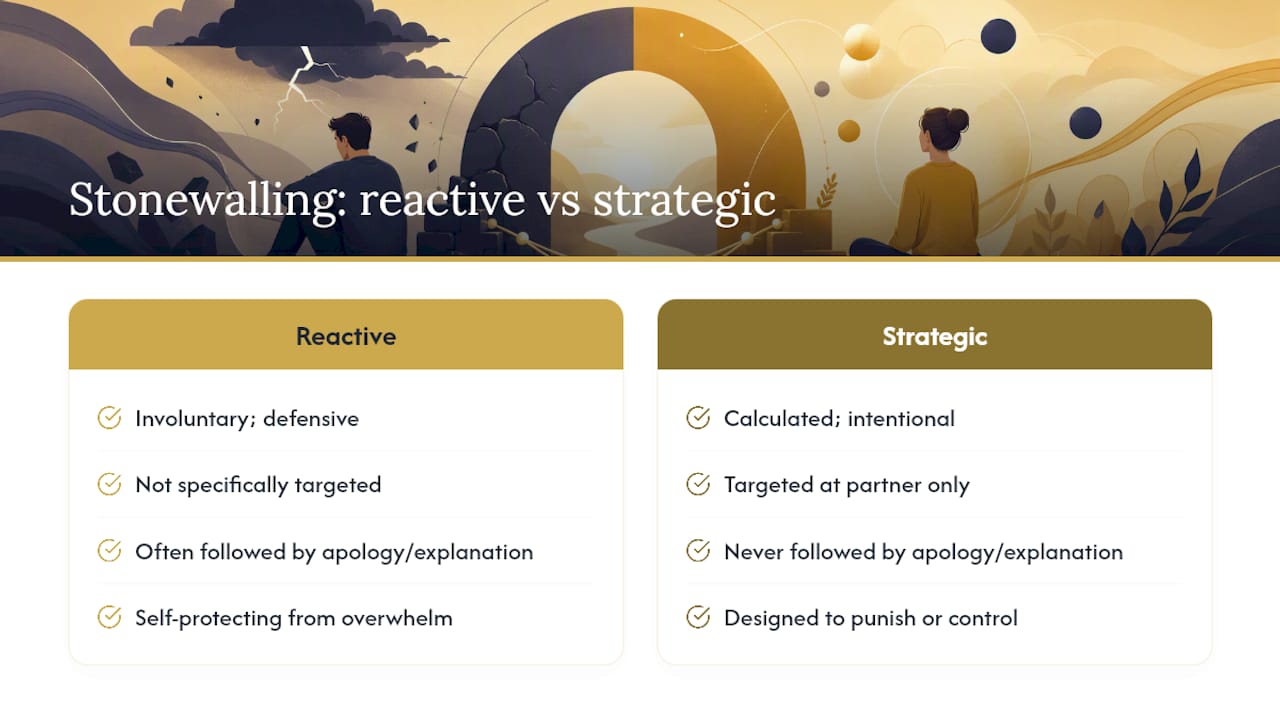
Not all silence is dysregulation, and pretending otherwise puts people at risk. A few patterns separate flooding from weaponized silence: the silence is calculated rather than involuntary, it’s applied inconsistently (used against one partner but never a boss or friend), it never comes with an eventual apology or explanation, and it seems designed specifically to punish rather than to self-protect. SimplyPsychology draws this line clearly: reactive stonewalling is defensive and involuntary, while strategic stonewalling is intentional and often a component of broader emotional abuse.
Weaponized silence rarely travels alone. It tends to show up alongside other controlling behaviors: gaslighting about what was actually said or agreed to, isolating a partner from friends or family during the silent stretch, or using the silence as leverage to get concessions once it ends. If you’re seeing this pattern, it’s worth reading through common toxic relationship behaviors to see how many overlap with what you’re experiencing.
Practical safety steps matter here. Document the pattern (dates, duration, what triggered it), avoid escalating by chasing the silence, and lean on trusted friends or family rather than isolating further. If the silence is being used as a tool of control rather than a symptom of overwhelm, that’s a signal to bring in outside support. Our guide on how to respond to silent treatment walks through specific scripts for exactly this situation, and it’s worth reading alongside material on how manipulative partners maintain emotional control if the silence feels like part of a bigger pattern.
Getting Professional Help for Chronic Stonewalling
Couples therapy targets the cycle itself: the pursue–withdraw loop, the triggers, and the repair skills that keep a hard conversation from turning into a shutdown. Individual therapy, by contrast, targets what’s underneath the stonewalling for the person doing it, often attachment wounds, unresolved trauma, or an anxiety response that’s bigger than the argument itself.
If breaks and communication scripts aren’t reducing the frequency or length of stonewalling after a few months of real effort, that’s a sign the pattern needs professional support rather than more self-help. For people whose stonewalling is rooted in trauma, trauma-informed individual therapy that builds interoceptive awareness and uses gradual exposure to difficult conversations is often necessary before couples work sticks at all. When choosing a therapist, ask directly whether they work with the Gottman Method or another evidence-based approach to conflict cycles, and go in with a specific, shared goal rather than a vague hope that “communication improves.”
A Straight Answer on Why Stonewalling Keeps Winning
Most advice about stonewalling treats it as a communication failure to be fixed with better phrasing. That misses the point entirely. The real failure usually happens earlier, before anyone opens their mouth, when a nervous system decides a conversation is unsafe and shuts the door. No script fixes that in the moment. What actually works is deceptively unglamorous: naming the state you’re in, taking a real break instead of a fake one, and coming back on time. Couples who treat that sequence as a skill to rehearse, not a crisis to survive, are the ones who stop having the same fight every six months.
Some platforms add value not just by offering tips, but by pointing readers toward material that goes deeper than a blog post can, including books and structured resources that help people recognize their own patterns instead of just reacting to their partner’s.
— Robert
Books and Resources That Help You Work Through This
Reading alone won’t fix a pursue-withdraw cycle overnight, but the right book gives you language for what’s happening and a framework for the repair work therapy alone sometimes moves through too fast. Smartreadshub curates recovery and relationship psychology titles specifically for readers untangling patterns like stonewalling, chosen for depth over generic advice.

Our curated collection of recovery and relationship psychology books covers everything from attachment theory to trauma-informed repair, giving you material to work through between sessions or instead of them if therapy isn’t accessible yet. If you’re also weighing whether structured therapy makes sense for your situation, our resource hub compares therapy platforms and planning tools so you’re not guessing which option fits your budget or schedule. Start with one book that matches where you are right now, whether that’s understanding your own withdrawal or learning how to approach a partner who shuts down, and build from there.
This article is general information, not a substitute for advice from a qualified doctor. Consult a qualified healthcare professional about your own circumstances before acting on anything here.
Sources
- Stonewalling in a relationship | Cleveland Clinic
- The Four Horsemen: Stonewalling | The Gottman Institute
- What is stonewalling — and why it damages relationships | Psychology Today
- Stonewalling in relationships | SimplyPsychology
FAQ
How Do You Beat Stonewalling?
You don’t “beat” it so much as interrupt the cycle: name the shutdown out loud, agree on a real break with a return time, and use that time to actually calm down rather than stew. Gottman’s research points to at least 20 minutes of calming activity as the minimum needed for a flooded nervous system to reset before productive conversation is possible.
What Should I Do if My Partner Stonewalls Me?
Resist the urge to chase them for a response, since pursuing usually deepens the withdrawal. Instead, use a short script like “I’ll be here when you’re ready,” give them the space they need, and revisit the conversation once things are calm using emotional vocabulary that names the impact rather than assigning blame.
What Kind of Person Stonewalls?
People with avoidant attachment styles, high anxiety, depression, or unresolved trauma histories are especially prone to involuntary stonewalling, according to the Cleveland Clinic. Some people also stonewall deliberately as a control tactic, which is a different issue entirely and often overlaps with other manipulative behaviors.
Can a Relationship Survive Stonewalling?
Occasional stonewalling during heated moments is common and usually recoverable with the right break-and-return habits. Chronic stonewalling paired with contempt or criticism is harder to reverse without outside help, though SimplyPsychology notes therapy can meaningfully change the trajectory when both partners are actively engaged in the work.
Is Stonewalling the Same as the Silent Treatment?
Not exactly. Stonewalling can be involuntary, a nervous system shutdown during conflict, while the silent treatment is typically a deliberate choice to withhold engagement as punishment or leverage. The Cleveland Clinic distinguishes these clearly, and knowing which one you’re dealing with changes whether the right response is patience or a boundary.