
A narcissist smear campaign is a deliberate effort to damage your reputation through lies, half-truths, and a network of recruited messengers, and the safest first move is not to argue back. It’s to document everything and assess who has actually seen the claims before you respond to anyone. Public rebuttals usually backfire. What works instead is quiet, methodical evidence preservation, paired with a clear read on when the situation crosses into HR, legal, or custody territory.
TL;DR:
- Focus on documenting all evidence, including screenshots, messages, and a timeline, before responding or engaging with others about the smear campaign.
- Recognize that a pre-emptive victim story often triggers the campaign, emphasizing the importance of timing and controlling the narrative early.
- Avoid public rebuttals; instead, keep responses brief, factual, and directed only at decision-makers like HR, legal authorities, or clinicians.
- In safety-threatening situations, use a separate, secure device to change passwords and limit digital access, involving advocates if necessary.
- Escalate to legal, HR, or law enforcement channels only if there is a credible threat to safety, employment, custody, or measurable financial harm.
Table of Contents
- Signs and Tactics: How a Smear Campaign Looks in Real Life
- Why Narcissists Run Smear Campaigns, and What DARVO Really Does
- Responding Safely: Evidence, Communication, and Digital Security
- When to Escalate: HR, Legal Action, and Formal Complaints
- Recovery and Support: Boundaries, Therapy, and Rebuilding Trust
- What I Learned Watching a Friend Go Through This
- Where Smart Reads Hub Fits Into Your Recovery
- Where to Go for Deeper Safety Planning
- Sources
- FAQ
Signs and Tactics: How a Smear Campaign Looks in Real Life
Most people don’t recognize a smear campaign while it’s happening to them. They notice pieces of it: a friend acting cold, a coworker who suddenly won’t make eye contact, a family member repeating a story that sounds almost right but isn’t. By the time the full pattern is visible, the narrative has usually already spread.
The tactic almost always starts before the target knows anything is wrong. A pre-emptive victim story lets the narcissist frame themselves as the injured party first, so that any later explanation you offer sounds like a defensive reaction rather than the truth. This is the single most important thing to understand about how these campaigns work: timing beats accuracy. Whoever tells the story first usually gets believed, regardless of what actually happened.
From there, the tactics tend to follow a familiar pattern:
- Selective disclosure: sharing a private text, medical detail, or old mistake stripped of context, so it reads far worse than reality.
- Distortion of real events: taking something that genuinely happened and reshaping the sequence, tone, or intent to cast you as the aggressor.
- Recruiting mutual contacts, sometimes called “flying monkeys,” who repeat the narrative to others without independently verifying it.
- Social media subliminals: vague posts about “toxic people” or “finally cutting off users” timed suspiciously close to your falling out.
- Public sympathy performances: crying at gatherings, appearing visibly distressed in front of shared friends or coworkers, or asking for check-ins that keep the narrative alive.
- Staged professional complaints: filing HR reports, licensing board complaints, or even police reports built on exaggerated or fabricated claims.
These show up differently depending on the setting. In a personal breakup, it might be a string of Instagram stories and a sudden wave of friends going quiet. In divorce or custody disputes, it often escalates into affidavits, coordinated testimony from relatives, or claims filed with a family court. At work, it can look like a formal complaint to HR that omits key context, or a manager hearing “concerns” from three people who all happen to use the same three phrases.
That repetition is actually one of the clearest tells. If multiple people suddenly describe you using near-identical language, phrases that don’t sound like something they’d naturally say, that’s usually a sign someone briefed them first. Combine that with sudden social distancing from people who were close to you a month earlier, and you’re likely looking at a coordinated narrative rather than an organic shift in how people feel about you.
Pro Tip: Keep a simple running list of who said what and when, even before you’re sure a smear campaign is underway. If it turns out to be nothing, you’ve lost five minutes. If it’s real, you’ll already have a timeline instead of scrambling to reconstruct one from memory.
For a deeper look at how these behaviors connect to broader manipulation patterns, narcissistic abuse tactics often overlap directly with smear campaign mechanics, particularly the recruitment of mutual contacts and the use of partial truths.
Why Narcissists Run Smear Campaigns, and What DARVO Really Does
The motive is rarely about you specifically. It’s about control and image management. A person prone to narcissistic behavior tends to experience criticism, rejection, or exposure as an intolerable threat to a fragile self-image, and a smear campaign functions as damage control. It preempts the narrative, secures sympathy, and often generates what’s sometimes called narcissistic supply: attention, validation, and reassurance from an audience that now sees them as the wronged party.
Shame plays a bigger role here than most people expect. Rather than sit with the discomfort of having done something wrong, the person reframes the story so someone else carries the blame. That reframing has a name.
DARVO stands for Deny, Attack, Reverse Victim and Offender. It’s a well-documented response pattern where someone accused of wrongdoing denies it happened, attacks the credibility of the person raising the concern, then flips the narrative so the accuser looks like the actual aggressor. Research from the University of Oregon found that DARVO measurably shifts how observers judge a situation. It reduces how believable the real victim seems and increases how believable the person using the tactic seems, even when the underlying facts don’t support that shift. The same research found something genuinely useful for targets of this behavior: simply teaching people about DARVO ahead of time weakens its effect. Once someone recognizes the pattern, “deny, then attack, then reverse the roles,” they’re less likely to fall for it the next time they see it play out.
That matters because a smear campaign doesn’t need to be logically airtight to succeed. It just needs to exploit how people naturally process social information. Bystanders default to social proof: if three people repeat the same claim, it starts to feel true regardless of evidence. They also default to the path of least resistance, believing whoever seems more confident and less defensive in the moment. A narcissist running a smear campaign often appears calm and composed precisely because they prepared the narrative in advance, while the actual target looks rattled and reactive because they’re hearing the accusation for the first time. Observers read that composure gap as a signal of guilt, when it’s really just a difference in preparation.
Responding Safely: Evidence, Communication, and Digital Security
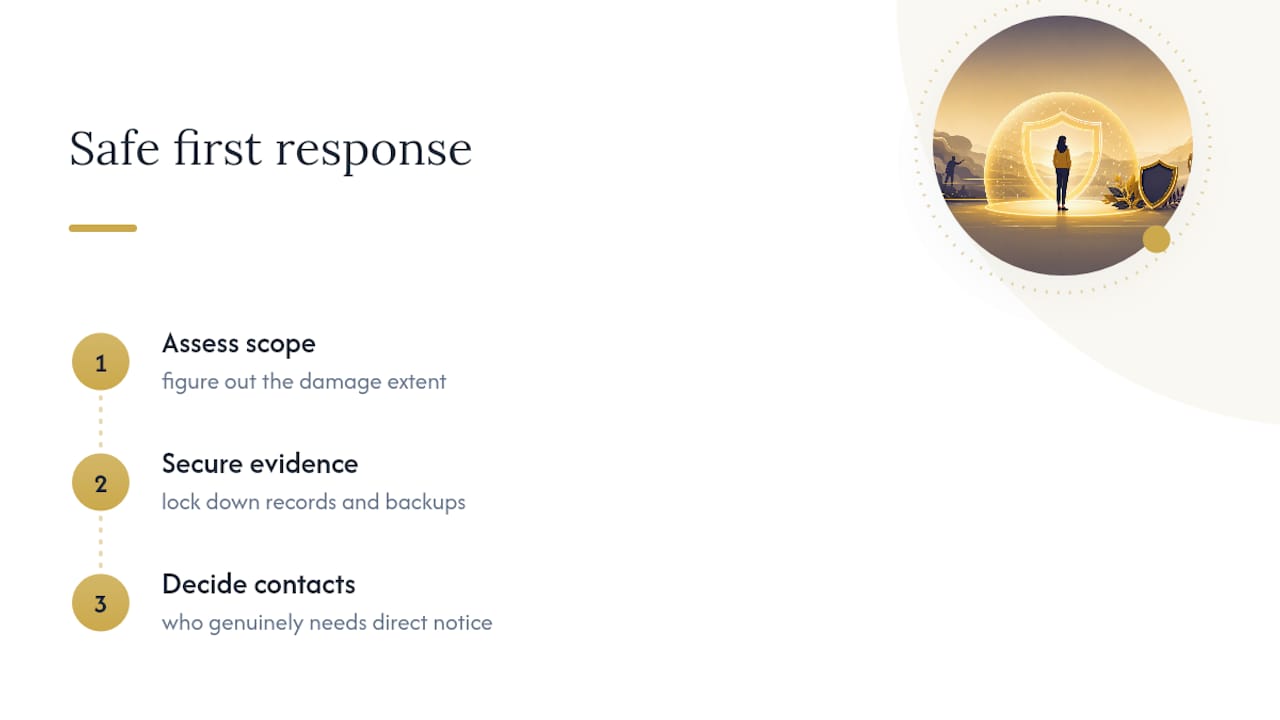
Your instinct might be to correct the record loudly and immediately. Resist that. The most effective first response is triage, not public rebuttal: figure out the scope of the damage, lock down your evidence, and only then decide who genuinely needs to hear from you directly.
Build your evidence log first
Before you respond to anyone, spend an hour creating a factual record. This isn’t about building a case to “win.” It’s about protecting yourself if things escalate later, and about keeping your own memory of events accurate once stress starts distorting it.
- Capture full-page screenshots, not cropped snippets, so usernames, timestamps, and URLs are all visible in the same image.
- Save the exact wording of any messages, posts, or comments, including the platform, date, and who else could see them.
- Build a dated incident timeline listing what happened, when, who was involved, and any witnesses who can corroborate it.
- Store copies somewhere the other person cannot access, such as a personal cloud folder, an external drive, or a trusted friend’s email, rather than only on a shared device or account.
- Note who has actually seen the claims versus who you suspect might have, since your response should scale to real exposure, not worst-case assumptions.
- Do not delete anything, even messages that feel embarrassing or incriminating out of context, since deleted material can undercut your credibility if this becomes a legal or HR matter later.
That last point trips people up constantly. The instinct to scrub your own digital footprint feels protective, but it often reads as evasive later if someone else already has copies.
Set communication rules before you need them
When contact is unavoidable, brevity is your friend. Keep replies factual, short, and preferably in writing, and skip the point-by-point rebuttal entirely. Arguing every detail invites the other person to keep the exchange going, and a long emotional reply gives them more material to selectively quote later.
A few short, de-escalating phrases can cover most situations without inviting a debate:
- To a family member repeating the story: “I’m not going to relitigate this over text. If you want the facts, I’m happy to talk once.”
- To a mutual friend: “That’s not accurate, but I’m not interested in a public back-and-forth about it.”
- To an employer or clinician who needs the actual facts: a short, dated written statement limited to what’s relevant to their decision, without emotional framing.
Notice the pattern: correct the people who need accurate information to make a real decision, and decline to engage the people who are just curious or already convinced. That distinction, between decision-makers and spectators, should drive almost every choice you make about who gets a response.
Secure your accounts, carefully
Digital safety needs its own separate pass, because the wrong move here can escalate risk instead of reducing it. Tech-facilitated abuse includes account monitoring, location tracking, impersonation, and harassment through shared platforms, and any safety plan has to account for the possibility that the other person still has access to your devices or accounts.
If there’s any chance the person running the smear campaign can see your screen, your login activity, or your location through a shared device or family plan, do not change passwords or settings from that device. Use a separate device you’re confident is clean, and if the situation involves genuine safety risk, loop in a domestic violence advocate before making visible changes. A password reset that pings a monitored account can tip someone off faster than it protects you.

Pro Tip: If you’re not sure whether an account or device is still shared or monitored, treat it as if it is until you can confirm otherwise from a separate, secure device. That assumption costs you nothing extra and could prevent a serious safety misstep.
Bring in trusted third parties selectively. A single close friend who agrees to be your point of contact for updates can absorb a lot of the social noise, so you’re not fielding the same conversation with a dozen different people while trying to hold a job or care for kids.
When to Escalate: HR, Legal Action, and Formal Complaints
Not every smear campaign needs a lawyer. Most day-to-day social fallout resolves on its own once the narrative loses momentum and people move on. But certain thresholds change the calculation entirely, and recognizing them early keeps you from either overreacting to gossip or underreacting to something genuinely dangerous.
Escalate when any of the following apply:
- Employment or licensure is at risk: a formal HR complaint, a professional board inquiry, or claims made directly to your employer or clients.
- Custody or parental rights are implicated: false statements introduced in a family court filing or custody evaluation.
- There’s a credible threat to your physical safety: stalking, doxxing, or threats layered on top of the reputational attack.
- The false statements cause measurable material harm: lost income, a rescinded job offer, or a terminated contract tied directly to the claims.
If you hit any of those, document everything with specific dates and, where possible, named witnesses, then submit a factual, unembellished report to HR or the relevant authority rather than a narrative-driven account. Consult an employment attorney or one familiar with defamation law before you make any public statement, and hand over your preserved evidence log rather than trying to summarize it from memory in the moment. When briefing counsel or HR, stick to dates, statements, and documented impact. Resist the urge to editorialize about the other person’s character. A concise, evidence-backed report is far more persuasive than an emotional one, and it keeps you from accidentally amplifying the very claims you’re trying to counter.
Recovery and Support: Boundaries, Therapy, and Rebuilding Trust
The reputational damage usually fades faster than the internal aftermath. Being on the receiving end of a coordinated smear campaign tends to produce a specific kind of exhaustion: hypervigilance about what people are saying, difficulty trusting anyone who was even peripherally involved, and a nagging urge to keep explaining yourself long after most people have stopped listening.
Start with the basics your nervous system actually needs. Grounding techniques, slow breathing, physical movement, and enough sleep sound almost too simple to matter, but they’re what let you think clearly enough to make good decisions instead of reactive ones. If the abuse pattern has been going on for a while, a therapist who understands narcissistic abuse dynamics specifically, not just general relationship stress, can help you process it faster than trying to work through it alone.
When you do need to brief someone important, keep it short:
- To an employer: “There’s a personal dispute affecting my reputation right now. I want to flag it so you’re not caught off guard, and I’m happy to answer factual questions.”
- To a clinician: a brief written summary of relevant dates and events, without asking them to referee the underlying relationship.
- To close friends or family: the facts you’re comfortable sharing, plus a clear statement that you’re not looking for a public defense campaign on your behalf.
Public rebuilding, posting your side, correcting the record broadly, or hiring outside reputation help, is sometimes appropriate, but usually only after the situation has stabilized and the damage is concrete and ongoing rather than speculative. In most cases, staying quiet publicly while working privately removes fuel from the situation rather than feeding it. There’s less new material for anyone to twist, and it puts the energy where it actually helps: your safety, your job, your relationships with people who matter.
Pro Tip: Give yourself a real timeline for this. Reputational fallout from a smear campaign rarely resolves in weeks. Most people see the social noise fade over several months as new information, or simply time, replaces the old narrative.
Long-term, this usually comes down to boundaries you didn’t need before: limiting contact with mutual connections who keep relaying messages, being selective about what you share going forward, and accepting that a handful of people may never update their view of you. That’s a loss worth grieving, not a failure on your part. For a broader look at recurring narcissistic behaviors and how to recover from them beyond the smear campaign itself, these seven narcissist patterns cover the ground this article doesn’t have room for.
What I Learned Watching a Friend Go Through This
A close friend found out about her smear campaign secondhand, through a coworker who casually mentioned “hearing she’d had some issues” at her last job. Her first instinct was to call everyone she could think of and explain her side immediately. That backfired. It made her look defensive to people who hadn’t even heard the original claim yet, and it spread the story further than it had already traveled.
What actually worked was pulling back, writing down every detail she could remember with dates, and reaching out only to the two people whose opinions carried real consequences for her career. Everyone else, she let it sit. Most of the noise died down within a few months once there was nothing new to feed it.
If there’s one thing worth taking from her experience, it’s this: the urge to explain yourself to everyone is almost never as useful as it feels in the moment.
— Robert
Where Smart Reads Hub Fits Into Your Recovery
Understanding the tactic is one thing. Rebuilding your sense of self after living through it is another project entirely, and that’s where Smartreadshub focuses its work. Rather than generic self-help advice, Smartreadshub curates books and resources specifically chosen for people recovering from narcissistic abuse, gaslighting, and manipulation, matched to the actual patterns you just read about rather than broad relationship advice that doesn’t fit your situation.

Two starting points are worth your time. The 10 Best Books on Narcissistic Abuse and Recovery collection breaks down titles by what they cover, whether that’s understanding manipulation tactics, rebuilding self-trust, or processing the aftermath of a smear campaign specifically. The broader Recovery & Psychology Books collection covers adjacent needs, including therapy platform links and audiobooks for people who process better by listening than reading. Browse either page for picks that match where you are right now.
One honest note: if you’re dealing with a credible safety threat or severe trauma symptoms, books are a supplement to professional support, not a replacement for it. A licensed therapist should always be your first call in those situations.
Where to Go for Deeper Safety Planning
- New York State OPDV’s tech-facilitated abuse guide covers safety planning around monitored devices and accounts.
- PsychCentral’s coverage offers practical examples of smear tactics across different settings.
- The DARVO research summary explains why bystanders believe the tactic and how awareness weakens it.
This article is general information, not a substitute for advice from a qualified doctor. Consult a qualified healthcare professional about your own circumstances before acting on anything here.
Sources
- New York State Office for the Prevention of Domestic Violence — Tech-facilitated abuse guidance
- PsychCentral — Narcissist smear campaign coverage
- Psychology Today — Dealing with the narcissist’s smear campaign
- DARVO research summary — University of Oregon / Freyd et al.
- OPDV — Tech-facilitated abuse guide
FAQ
How Do You Respond to a Narcissist’s Smear Campaign?
Prioritize evidence preservation over public rebuttal: save screenshots, timestamps, and messages before responding to anyone. When contact is necessary, keep replies short, factual, and limited to people who need accurate information to make a real decision, like an employer or clinician, rather than a wide audience.
What Are the 4 D’s of Narcissistic Abuse?
The concept most people mean here is DARVO: Deny, Attack, Reverse Victim and Offender, a pattern where someone accused of wrongdoing denies it, attacks the accuser’s credibility, then flips the roles so they appear to be the victim. Research on DARVO shows this shift measurably changes how believable observers find each party.
How Do You Tell a Narcissist They Are Wrong?
Direct confrontation over facts usually escalates the conflict rather than resolving it, since the goal of a smear campaign is narrative control, not truth. A brief, non-engaging statement like “That’s not accurate, but I’m not debating it,” tends to work better than a detailed correction.
Are There Phrases That Shut Down a Narcissist’s Attacks?
Short, non-engaging statements work better than long explanations. Lines like “I’m not discussing this further” or “That’s not how it happened, and I’m not going to argue about it” de-escalate contact without inviting debate, which matters far more than winning any single exchange.
When Should I Involve HR or a Lawyer?
Escalate once the smear campaign threatens your employment, licensing, custody rights, or physical safety, or once false statements cause measurable financial harm. Bring a documented timeline and preserved evidence rather than a narrative account, and consult an employment or defamation attorney before making any public statement.