
Vulnerable narcissism, not grandiose narcissism, is the one reliably tied to insecure adult attachment. A meta-analysis of 33 studies and 10,675 participants found preoccupied attachment carries the strongest correlation (r≈0.43), with fearful attachment close behind (r≈0.31). Grandiose narcissism showed no meaningful attachment link at all. That split matters for how you assess a partner, a client, or yourself: vulnerable and grandiose narcissism are different animals, wired to different relational histories, and they call for different responses.
TL;DR:
- Vulnerable narcissism is strongly linked to insecure attachment patterns, especially preoccupied and fearful styles, while grandiose narcissism shows no meaningful connection.
- Preoccupied and fearful attachment styles often manifest as constant reassurance-seeking or approach-avoidance cycles, contributing to relationship instability.
- Shame mediates the attachment-narcissism link, driving behaviors like validation-seeking or withdrawal through negative self and other models.
- Attachment-based therapies, such as emotion-focused and schema therapy, effectively target the underlying fears and shame associated with vulnerable narcissism.
- Most research relies on self-report studies with Western samples, and the causal relationship between attachment and narcissism remains unproven, highlighting the need for more longitudinal research.
Table of Contents
- What the Research on Attachment Theory and Narcissism Actually Shows
- How Each Attachment Style Maps Onto Narcissistic Presentations
- The Mechanisms: Shame, Working Models, and Emotional Reactivity
- What This Means for Therapy and Relationship Strategy
- How the Studies Measure Attachment and Narcissism, and Where They Fall Short
- How Smart Reads Hub Turns This Research Into Practical Steps
- Early Caregiving and the Roots of These Attachment Patterns
- Narcissism at Work and in Friendships, Not Just Romance
- The Biology Behind Attachment and Narcissistic Traits
- Does Culture Change the Attachment-Narcissism Picture?
- Where Ordinary Narcissistic Traits End and a Disorder Begins
- Why This Distinction Changes How You Read a Relationship
- Curated Resources for Readers Ready to Go Deeper
- Sources
What the Research on Attachment Theory and Narcissism Actually Shows
The clearest picture yet comes from a systematic review and meta-analysis covering 33 studies and 10,675 people. It found:
- Preoccupied attachment correlated with vulnerable narcissism at r≈0.43, the strongest link in the dataset.
- Fearful attachment followed at r≈0.31, still a moderate and consistent effect.
- Dismissive attachment showed a weaker connection, and secure attachment moved in the opposite direction from vulnerable traits.
- Grandiose narcissism showed no meaningful association with any insecure attachment category.
That last finding is the one most people miss. Grandiosity looks like confidence from the outside, so it seems intuitive that it would spring from secure early bonds. The data doesn’t support a tidy story either way. Some samples show grandiose traits tracking with self-reported security; others find no pattern at all. Vulnerable narcissism is the more attachment-anchored construct, full stop.
Supporting studies add texture to the meta-analytic headline. Experimental work using rejection paradigms found that people high in vulnerable narcissism react to social rejection with sharper negative affect than those high in grandiose traits, a pattern consistent with insecure attachment’s hallmark hypervigilance to abandonment. Separately, research into narcissistic traits in adolescents and young adults found that shame functions as the connective tissue between vulnerable narcissism and negative models of self and others, while higher grandiose traits actually correlated with more secure self-models in the same samples.
Pro Tip: When you read “narcissism” in a study, check which subtype the authors measured. A finding about grandiose narcissism and a finding about vulnerable narcissism can point in opposite directions on the same variable.
How Each Attachment Style Maps Onto Narcissistic Presentations
Understanding narcissistic behavior through attachment starts with mapping each of the four adult attachment styles, defined by the Bartholomew and Horowitz model, onto the vulnerable/grandiose split. The mapping isn’t symmetrical, and the exceptions are as informative as the rules.
Preoccupied (anxious) attachment shows the tightest link to vulnerable narcissism. People in this quadrant often chase external validation aggressively, monitor a partner’s mood for signs of withdrawal, and interpret ordinary distance as rejection. In relationships, this shows up as constant reassurance-seeking dressed up as devotion, and it can curdle into resentment when the reassurance never feels like enough.
Fearful attachment produces a moderate but distinct pattern: approach-avoidance conflict. Someone here wants closeness and dreads it simultaneously, so they might pull a partner in during a vulnerable moment, then withdraw sharply once that closeness starts to feel exposing. Watch for hypervigilance followed by sudden emotional shutdown after a perceived slight. That whiplash is a bigger predictor of relationship instability than the neediness of preoccupied patterns, because it’s harder for a partner to anticipate or soothe.
Dismissive (avoidant) attachment is where the data gets genuinely messy, and honest reporting requires saying so. Some samples link dismissive attachment to vulnerable narcissism expressed as emotional distancing rather than clinginess. Other samples associate avoidant strategies with grandiose defensive displays, an inflated self-presentation that keeps intimacy at arm’s length. Clinical perspectives on adult attachment and narcissistic vulnerability argue both clinginess and distancing serve the same underlying function: managing a fragile sense of self-worth through opposite behavioral strategies.
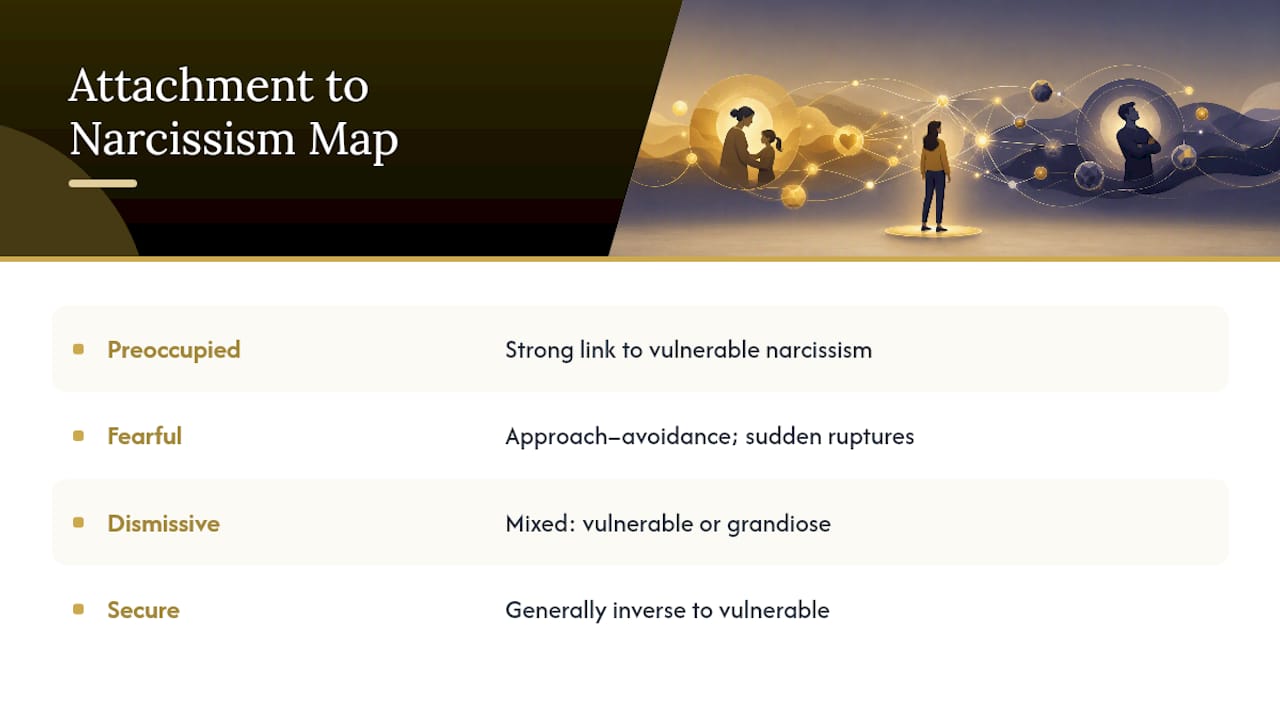
Secure attachment runs generally inverse to vulnerable narcissism. This population reports less rejection sensitivity and less need for external validation. Interestingly, some cross-sectional grandiose-narcissism samples self-report secure-seeming attachment models, which likely reflects an inflated self-view more than genuine security.
The relationship-stability signal worth remembering: reassurance-seeking (preoccupied) tends to erode a relationship slowly through exhaustion, while approach-avoidance cycling (fearful) tends to produce sudden ruptures that blind side a partner.
The Mechanisms: Shame, Working Models, and Emotional Reactivity
Attachment doesn’t cause narcissistic behavior directly. Something happens in between, and that something is largely shame.
Research on shame and attachment in young people with narcissistic traits found shame mediates the path from vulnerable narcissism to negative models of both self and others, the exact models that produce preoccupied and fearful attachment patterns. Shame widens the gap between who someone feels they should be and who they believe they actually are. That gap has to go somewhere. It often surfaces as either desperate validation-seeking or preemptive withdrawal, both defensive maneuvers against exposure.
- Negative internal working models of self (“I am fundamentally unworthy”) tend to produce compensatory validation-seeking, the engine behind preoccupied presentations.
- Negative internal working models of others (“people eventually leave or hurt me”) tend to produce distancing and hypervigilance, the engine behind fearful and some dismissive presentations.
- Emotion dysregulation compounds both patterns. Rejection-sensitivity experiments show vulnerable narcissism predicting sharper spikes in negative affect after social exclusion than grandiose narcissism, which sometimes shows a blunted or entirely different affective signature.
The 0.43 correlation between preoccupied attachment and vulnerable narcissism isn’t just a number describing two co-occurring traits. It describes a mechanism: shame generates a working model, the working model generates an attachment strategy, and the attachment strategy generates the behaviors a partner or friend eventually experiences as narcissistic.
What This Means for Therapy and Relationship Strategy
Attachment-focused interventions have real support for addressing vulnerable narcissism, though the evidence base is still developing.
- Emotionally focused therapy (EFT) targets the attachment fears underneath reactive behavior, useful when preoccupied patterns dominate the clinical picture.
- Schema therapy addresses the negative self and other models directly, often a good fit when shame and early deprivation are prominent themes.
- Mentalization-based therapy builds the capacity to reflect on one’s own and others’ mental states, which can interrupt the hypervigilance loop common in fearful attachment.
For therapists, the priority order matters: build the alliance before confronting the defenses, since vulnerable narcissism carries high rejection sensitivity and premature challenge tends to trigger dropout. Addressing shame directly, rather than the surface behavior it drives, tends to produce more durable change. Scaffold self-compassion early, because it works against the same shame that mediates the attachment link in the first place.
Pro Tip: If you’re the partner rather than the clinician, the goal isn’t to fix the other person’s attachment style. It’s to keep your own footing while they do that work, if they choose to.
For partners and friends, the practical guidance is simpler but harder to execute: set boundaries before resentment builds, not after. Preserve your own safety and support network rather than merging your sense of stability with their validation needs. Recognize the point where consistent reassurance-seeking or withdrawal cycles need professional support beyond what a relationship alone can absorb. Understanding toxic relationship patterns rooted in attachment helps clarify where the line sits.
How the Studies Measure Attachment and Narcissism, and Where They Fall Short
Most research in this space relies on self-report instruments: the Pathological Narcissism Inventory (PNI) for vulnerable traits, various NPI versions for grandiose traits, and adult attachment questionnaires built on the Bartholomew and Horowitz framework.
- Instrument variety across studies contributes directly to inconsistent grandiose-narcissism findings, since a review of narcissism, attachment, and psychopathology notes that different PNI and NPI subscales don’t always capture the same underlying construct.
- The overwhelming majority of this evidence is cross-sectional and correlational. Nobody has established that insecure attachment causes narcissistic traits to develop, only that they co-occur.
- Sample composition skews toward young adults and Western, English-speaking populations, which limits how far these correlations generalize.
Longitudinal and experimental designs remain the clear gap. Until more of that work exists, treat every correlation here as a real pattern worth taking seriously, not a proven developmental pathway.
How Smart Reads Hub Turns This Research Into Practical Steps
The site curates books and guides for readers exploring narcissistic dynamics in relationships, drawing on evidence-based research rather than pop-psychology shortcuts. If the shame-mediation research above resonated, psychoeducation is the logical next move: understanding your own attachment history before deciding how to respond to someone else’s.
Start with attachment styles and toxic relationship patterns for the relational side, then work through a complete guide to healing after narcissistic abuse for structured recovery steps. Journaling prompts that track your own reassurance-seeking or withdrawal patterns can surface which attachment strategy you default to under stress. If patterns feel entrenched, a licensed therapist trained in attachment-based modalities is the appropriate next step beyond self-study.
Early Caregiving and the Roots of These Attachment Patterns
Attachment styles don’t appear in adulthood from nowhere. They form in the first few years of life, largely through how consistently a caregiver responds to a child’s distress.
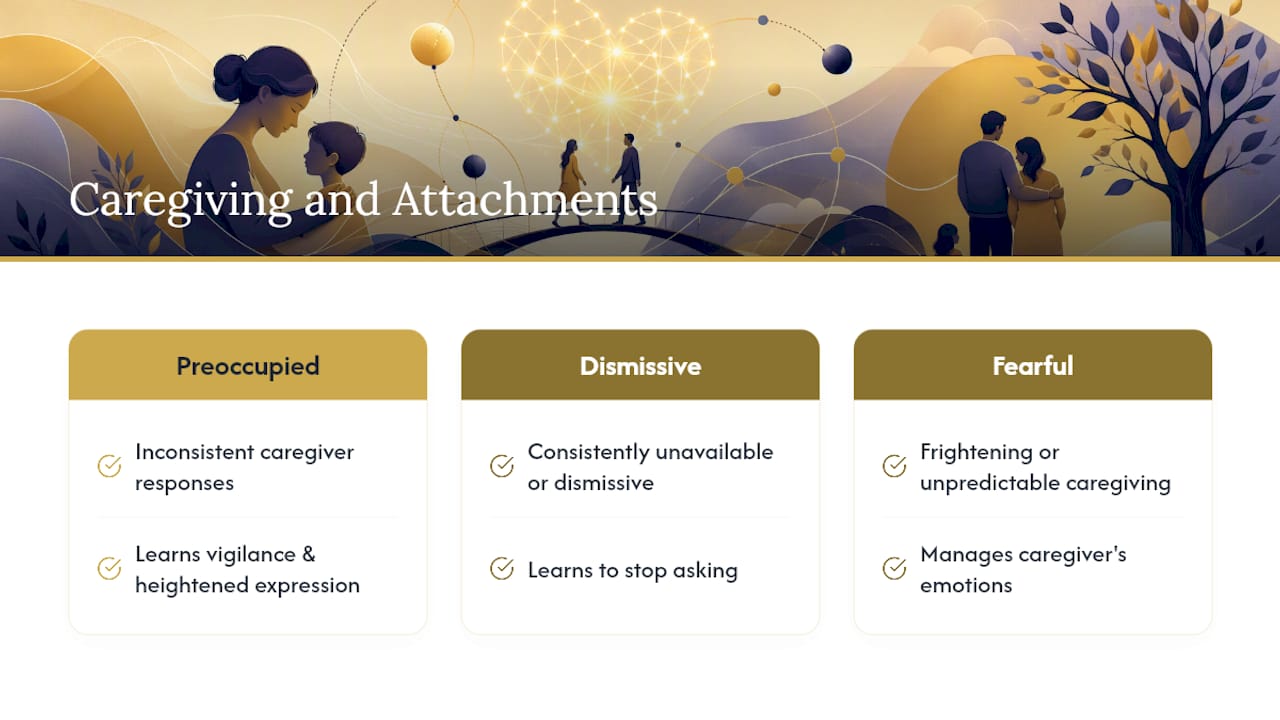
A caregiver who responds inconsistently, warm one day and unavailable the next, tends to produce preoccupied attachment: the child learns that vigilance and heightened emotional expression are what eventually get a response. A caregiver who is consistently unavailable or dismissive of emotional needs tends to produce dismissive attachment: the child learns to stop asking. Fearful attachment often traces to caregiving that was frightening or unpredictable in a more direct sense, sometimes involving neglect or reversals where the child had to manage the caregiver’s emotions rather than the other way around.
These early patterns don’t determine narcissism outright. They establish the internal working models, discussed earlier as mediated by shame, that later interact with temperament, later relationships, and cultural context to produce a narcissistic presentation or something else entirely. A child with an anxious attachment history doesn’t automatically become an adult with vulnerable narcissism. But the raw material, sensitivity to abandonment, a self-worth contingent on others’ responses, is laid down early and tends to persist unless something interrupts it.
This is why clinicians treating vulnerable narcissism in adults often spend real time on developmental history rather than only present-day symptoms. The behavior in front of them is frequently a decades-old survival strategy still running on autopilot.
Narcissism at Work and in Friendships, Not Just Romance
Narcissism in relationships gets most of the research attention on the romantic side, but the same attachment-linked patterns show up in workplaces and friendships with different surface behavior.
A preoccupied-leaning colleague with vulnerable narcissistic traits often over-invests in feedback and approval from managers, taking neutral feedback as rejection and becoming visibly anxious about standing. That’s a very different picture from the confident self-promotion typically associated with narcissism in professional contexts, and it’s frequently misdiagnosed as simple insecurity rather than a narcissistic presentation.
Fearful attachment patterns at work tend to produce inconsistency that colleagues find confusing: intense engagement on a project followed by sudden withdrawal or disengagement once the person feels exposed to judgment. In friendships, this often reads as someone who seems deeply invested for weeks, then goes quiet without explanation.
Dismissive-leaning presentations, whether tied to vulnerable distancing or grandiose defense, show up as a friend or coworker who avoids vulnerability entirely, deflects personal questions, and maintains a controlled emotional distance even in long-term relationships. That distance can look like confidence or professionalism from the outside, which is part of why it’s often the hardest attachment-narcissism pattern to identify in non-romantic settings. Friends of someone with dismissive tendencies frequently describe the relationship as “fine but never quite close,” without being able to name why.
The Biology Behind Attachment and Narcissistic Traits
The link between attachment and narcissism isn’t purely psychological in the sense of existing only in thought patterns. Early attachment experiences shape stress-response systems, and those systems influence how someone reacts to relational threat for the rest of their life.
Chronic activation of the body’s stress-response system during early inconsistent or frightening caregiving is associated with heightened baseline vigilance to social threat, the same hypervigilance that shows up behaviorally as fearful attachment and, downstream, some vulnerable narcissistic presentations. The affective reactivity findings mentioned earlier, where vulnerable narcissism predicts sharper negative responses to rejection, likely reflect this kind of nervous-system calibration rather than a purely cognitive interpretation of events.
Research connecting attachment and narcissism at the neurobiological level is younger and thinner than the behavioral and self-report literature covered elsewhere in this piece. Most of what’s known comes from adjacent research on attachment and stress physiology rather than studies designed specifically around narcissism. That’s a real gap, and it means claims about “narcissism and brain chemistry” circulating online usually outrun what the evidence supports. The honest summary: biology plausibly reinforces the attachment-narcissism connection, but the mechanism isn’t mapped with the same precision as the shame-mediation pathway.
Does Culture Change the Attachment-Narcissism Picture?
Most of the meta-analytic and experimental evidence covered here comes from Western, English-speaking samples, and that’s a real limitation for a global claim about attachment styles and narcissism.
Cultural context shapes both how attachment develops and how narcissistic traits get expressed and perceived. In cultures that prize interdependence and collective identity over individual achievement, grandiose self-promotion may be socially discouraged even in people who would score high on grandiose narcissism measures in a Western sample, making the trait harder to detect through the same instruments. Vulnerable narcissism’s core features, shame sensitivity and validation-seeking, may translate more consistently across cultures because shame itself is a near-universal emotional experience, even though its social display rules vary widely.
Preoccupied and fearful attachment styles likely interact with cultural norms around family closeness and independence in ways the current research hasn’t fully mapped. A pattern read as anxious attachment in an individualist culture might function differently, or carry different social costs, in a culture where family enmeshment is the norm rather than the exception. Until more cross-cultural replication exists, the strongest claim available is that the vulnerable/grandiose distinction itself likely holds across cultures, while the specific effect sizes and behavioral expressions probably don’t transfer cleanly.
Where Ordinary Narcissistic Traits End and a Disorder Begins
Almost everyone shows narcissistic traits at some point: a burst of self-focus after an achievement, a need for recognition after a hard project, a defensive reaction to criticism. That’s not pathology. It’s a normal, situational personality feature.
Pathological narcissism, whether the vulnerable or grandiose type, differs by rigidity and cost. The traits show up consistently across contexts rather than situationally, they resist adjustment even when they’re clearly damaging relationships or a career, and they’re tied to the personality-disorder-level attachment patterns described throughout this article, particularly preoccupied and fearful attachment for the vulnerable subtype. Someone with normative narcissistic traits and secure attachment can usually take feedback, recover from a bruised ego within a day, and adjust behavior. Someone with pathological vulnerable narcissism and preoccupied attachment often can’t do either without significant distress or defensive escalation.
Attachment theory and personality disorders intersect most clearly here: the Diagnostic and Statistical Manual’s narcissistic personality disorder criteria describe a persistent pattern, and the attachment research explains part of why the pattern persists rather than resolving with maturity or good luck. The takeaway for readers trying to assess a partner or themselves isn’t “does this person show narcissistic traits,” because nearly everyone does sometimes. It’s “how rigid, how costly, and how tied to an unshakeable attachment strategy is the pattern.”
Why This Distinction Changes How You Read a Relationship
The vulnerable/grandiose split isn’t academic hairsplitting. It changes what you’re actually looking at when someone’s behavior doesn’t add up, and it changes what kind of help actually fits. Use the framework as a lens, not a diagnosis you hand someone else, and bring in a licensed clinician when the patterns involve real risk or entrenched distress. If any of this mapped onto your own relationship, Smart Reads Hub’s guides are a reasonable place to keep reading.
— Robert
Curated Resources for Readers Ready to Go Deeper
There’s no substitute for a licensed therapist when attachment and narcissistic patterns are actively disrupting your life, but between sessions, or before you’re ready to book one, the right reading does real work.

The recovery guides available are built around the research covered here: the vulnerable/grandiose distinction, the shame mechanism, the attachment mapping. This approach offers an advantage over generic self-help content that treats “narcissism” as one undifferentiated thing. Start with the complete guide to healing after narcissistic abuse if you’re untangling your own relationship right now, or browse curated book recommendations for unhealthy attachment patterns for structured, evidence-aligned reading. If a co-parenting dynamic is part of your situation, practical strategies for communicating with a narcissistic co-parent covers scripts worth having on hand. And if gaslighting is tangled up with the attachment patterns you’re seeing, the core signs of gaslighting is worth reading next.
This article is general information, not a substitute for advice from a qualified doctor. Consult a qualified healthcare professional about your own circumstances before acting on anything here.
Sources
- The relationship between attachment styles and narcissism: a systematic and meta-analytic review
- Narcissistic traits in young people and how experiencing shame relates to current attachment challenges
- Pathological narcissism and emotional responses to rejection: The impact of adult attachment