
Yes, you can date again after narcissistic abuse, but sequence matters. Start with a basic safety plan, pick one small boundary to test on someone new, and check in with a trusted friend or therapist before you swipe. If a date leaves you shaking, dissociating, or replaying old scripts in your head, pause and get support before you try again.
TL;DR:
- Trauma bonding causes survivors to mistake chaotic relationship patterns for genuine connection, increasing the risk of repeating narcissistic abuse with new partners.
- Early dating red flags include love bombing, entitlement, inconsistent stories, and pushy boundary-pushing behavior, which signal high risk or insincerity.
- Testing boundaries through small, low-stakes actions like postponing intimacy or asking for space can reveal whether a new partner respects your limits.
- Safety measures such as meeting in public, telling a friend your plans, and having an exit line help maintain control and assess respect for boundaries during early dates.
- If symptoms like flashbacks or increased substance use worsen, or if a partner coerces or monitors you, pausing dating and seeking professional support is essential.
Table of Contents
- How Do You Know You’re Ready to Date Again?
- Why Does Dating Feel So Hard After Narcissistic Abuse?
- What Should You Do Before You Start Dating Again?
- What Are the Green Flags and Red Flags to Watch For?
- How Do You Test Whether Someone Respects Your Boundaries?
- What Are the Basic Safety Rules for Early Dates?
- When Should You Stop Dating and Get Professional Help?
- What Resources and Exercises Can Support Your Recovery?
- A Closing Note on Patience and Pace
- Tools That Make Safe Dating Easier to Practice
- Where This Guide’s Information Comes From
- Sources
- FAQ
How Do You Know You’re Ready to Date Again?
Readiness isn’t a feeling. It’s a set of behaviors you can actually check off, and most survivors can run through this in about ten minutes with a notebook or a quiet walk.
Ask yourself these questions honestly:
- Can you feel angry, sad, or anxious without spiraling into panic or numbness for hours afterward?
- Have you said “no” to a friend, family member, or coworker in the last month without over-explaining or apologizing three times?
- Do you have at least one person who knows the outline of what happened to you and checks in regularly?
- Is contact with your former partner fully cut off, or tightly managed if children or shared property require it?
- Can you sit with silence on a first date without needing to fill it to avoid feeling exposed?
If you answered yes to most of these, you likely have enough emotional regulation and boundary capacity to start slowly. If you checked fewer than three, that’s not a failure. It’s data. It means the next right move is targeted self-work, maybe a few more months of therapy, or rebuilding your support network before you add a new relationship into the mix. Signs you’re healing from a toxic relationship often show up in small, boring ways long before you feel “ready” in some dramatic sense.
Pro Tip: Write your answers down and reread them in three weeks. Readiness shifts fast after abuse, and a written record stops you from second-guessing progress you’ve already made.
Why Does Dating Feel So Hard After Narcissistic Abuse?
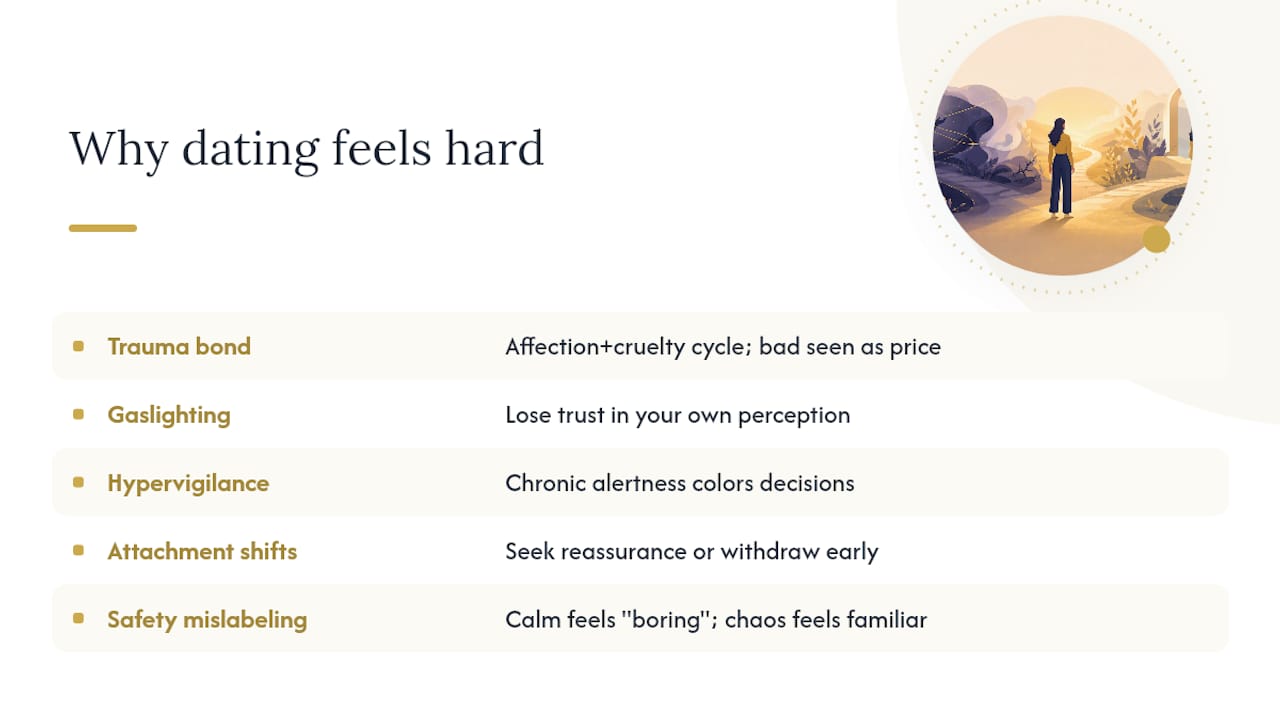
Because your nervous system learned the wrong lesson. It learned that love and danger arrive together, and that chaos means connection. Narcissistic abuse rewires how you read intimacy, and that rewiring doesn’t undo itself just because the relationship ended.
A trauma bond forms through an unpredictable cycle of affection and cruelty. Your brain, chasing the reward of the good moments, starts treating the bad ones as the price of admission. This is why survivors often describe missing an abuser even when they can list every terrible thing that person did. Trauma bonding isn’t a character flaw. It’s a conditioned response, and it can make chaotic new relationships feel oddly familiar instead of alarming, which raises the risk of repeating the same pattern with someone new.
Gaslighting compounds the problem. When someone repeatedly denies your reality, insists your memory is wrong, or reframes their cruelty as your overreaction, you stop trusting your own perception. Narcissistic abuse specifically damages this internal compass, increases hypervigilance, and leaves survivors second-guessing decisions that should be simple, according to Simply Psychology’s analysis of how abuse shapes future relationships.
That confusion explains a strange pattern many survivors notice: intense chemistry on an early date can be a warning sign, not a green light. Instant, overwhelming pull toward someone often mirrors the highs of a trauma bond rather than genuine compatibility. Meanwhile, a date that feels “boring,” calm, low drama, nobody performing, can actually be the nervous system recognizing safety for the first time in years and mislabeling it as dull.
Clinical research on interpersonal trauma backs this up at a biological level. Studies indexed in PubMed document how trauma exposure alters stress response systems and can keep people in a state of chronic alertness that colors every new relationship decision. Separate research on attachment and trauma shows abuse can shift attachment styles, making some survivors anxiously seek reassurance and others withdraw before anyone gets close.
Healing from this isn’t a straight line. You might feel steady for weeks and then get flattened by a trigger you didn’t see coming, and that doesn’t mean you’ve gone backward.
What Should You Do Before You Start Dating Again?
Preparation isn’t about becoming a different person. It’s about giving yourself tools you didn’t have last time.
- Find a trauma-informed therapist. Ask directly whether they have experience with narcissistic abuse or coercive control, and whether they offer EMDR (Eye Movement Desensitization and Reprocessing), which many clinicians use specifically for trauma that lives in the body, not just the memory. A therapist who minimizes what happened or wants to rush you toward “moving on” is the wrong fit.
- Build a daily regulation practice. Grounding exercises, consistent sleep, and a predictable morning or evening routine sound unglamorous, but they retrain a nervous system that’s been stuck in alert mode. Five minutes of naming five things you can see, four you can hear, three you can touch, works better than people expect.
- Rehearse boundary language before you need it. Practice saying, out loud, “I’m not comfortable sharing that yet” or “I need to head out now.” Advocacy resources like Loveisrespect recommend rehearsing these scripts in low-stakes settings, like with a friend, so they come out steady instead of shaky when you actually need them on a date.
- Draft a simple safety plan. Decide who you’ll text before and after a date, where you’ll meet, and what your exit line is if something feels wrong.
- Build a debrief habit. After every date, call or text someone and talk through what happened. Not to analyze the other person to death, but to catch your own thinking before it spirals into self-doubt.
Pro Tip: Keep a short “gut check” note in your phone with three questions: Did I feel free to disagree? Did I feel curious instead of anxious? Would I tell my best friend everything that happened? If any answer worries you, that’s worth sitting with before date two.
None of this requires perfection. How to date again after an abusive relationship makes a point worth repeating: you don’t have to be fully healed to start. Healing and dating can happen at the same time, as long as safety comes first.
What Are the Green Flags and Red Flags to Watch For?
Early dating is where old patterns either repeat or finally break. Knowing what to watch for turns vague unease into something you can actually act on.
Green flags tend to show up in small, unglamorous moments:
- They accept “no” the first time, without sulking, negotiating, or asking why.
- Their story stays consistent across conversations, no shifting details or unexplained gaps.
- They treat waitstaff, rideshare drivers, and strangers with basic courtesy when they think it doesn’t matter.
- They ask questions about your life and actually remember the answers later.
- Their affection builds gradually instead of arriving all at once.
Red flags deserve just as much attention, especially the early ones:
- Love bombing: constant compliments, “soulmate” talk, or gift-giving within days of meeting.
- Entitlement, expecting you to change plans, answer texts instantly, or prioritize their schedule by default.
- Subtle reality-twisting, like insisting you said something you didn’t, or “joking” in ways that leave you unsure if you’re overreacting.
- Pushing past a stated boundary and reframing your discomfort as you being “too sensitive.”
Mixed signals are where survivors get stuck. One warm date and one unsettling comment don’t automatically mean walk away, and they don’t automatically mean stay, either. Give someone more time when the good moments are consistent and the concerning ones are rare and met with real accountability. End contact when a red flag repeats, when your gut stays uneasy after multiple dates, or when their explanation for a red flag sounds more polished than sincere.
How Do You Test Whether Someone Respects Your Boundaries?
The safest way to learn someone’s character early is to give them small, low-stakes chances to show it. You’re not manipulating them. You’re just watching how a real limit gets handled.
- Postpone physical intimacy. Say you’d rather wait, and watch what happens next. Respect looks like an easy “of course.” Pressure, sulking, or repeated asking is your answer.
- Cancel a date once, with a real but ordinary reason. A secure person adjusts. Someone who guilt-trips you or accuses you of losing interest is showing you their baseline.
- Ask for a day of space without explaining exactly why. Watch whether they respect it or flood you with messages demanding reassurance.
How they respond tells you almost everything. A polite, unbothered reaction is the best sign you can get. An apologetic overcorrection, “I’m so sorry, I didn’t mean to push,” followed by genuinely backing off, is also healthy; nobody’s perfect on the first try. A defensive reaction, where your boundary somehow becomes a conversation about their hurt feelings, is a warning. Mockery or dismissiveness about a limit you’ve stated clearly is a reason to stop seeing that person.
Keep these tests real and simple. Don’t manufacture a crisis or lie to see how someone reacts. You’re not running an experiment on a stranger. You’re paying attention to ordinary moments that happen naturally in early dating anyway.
What Are the Basic Safety Rules for Early Dates?
Safety on early dates isn’t paranoia. It’s structure that lets you actually relax enough to evaluate someone clearly.
- Meet in a public place for at least the first several dates, and skip anyone who pushes hard for your home address or theirs.
- Drive yourself or arrange your own rideshare instead of relying on a date for transportation.
- Tell a trusted friend where you’re going, who you’re meeting, and roughly when you expect to be done, before you leave the house.
- Limit how much you share about your daily routine, workplace, or living situation until trust has actually been earned over time, not just claimed.
- Keep your phone charged and easy to reach, and agree on a check-in text with a friend partway through the date.
- Have an exit line ready, something as simple as “I have an early morning” works fine, and use it without guilt if you need to.
These aren’t just precautions. Survivor-focused resources note that safety steps like meeting in public and keeping independent transportation double as informal tests of a partner’s respect for boundaries, since someone who bristles at these basics is telling you something important early.
Debrief afterward the same way every time. Call the friend who knew your plans, say how it went, and let them ask questions. That habit catches distorted thinking before it takes root.
Pro Tip: If a date pressures you to skip a safety step, “why do you need to tell your friend, don’t you trust me yet?”, treat that pressure itself as the answer to whether you should keep seeing them.
When Should You Stop Dating and Get Professional Help?
Some signs mean it’s time to step back from dating entirely and focus on recovery first, and that’s not giving up. It’s protecting the progress you’ve already made.
Clinical signs worth taking seriously include:
- Flashbacks or dissociation that intensify rather than ease as you keep dating.
- Escalating self-harm thoughts or behaviors.
- A noticeable increase in alcohol or substance use to get through dates or manage anxiety afterward.
Situational red flags matter just as much:
- A new partner pushing you to cut off friends or family, even gradually.
- Coercion around sex, money, or decisions, dressed up as “just being close.”
- Signs of monitoring, like showing up somewhere unannounced or knowing details you didn’t share.
If any of this applies, pause dating and reach out for support immediately. The 988 Suicide and Crisis Lifeline is available for acute mental health crises, and The Hotline offers guidance specific to survivors navigating dating after abuse. A therapist directory search focused on trauma or domestic violence specialization is worth doing before you’re in crisis, not after.
What Resources and Exercises Can Support Your Recovery?
Recovery moves faster with the right tools next to your therapy sessions, not instead of them.
Practical exercises worth building into your week:
- A two-minute grounding practice before any date: name five things you see, breathe out slower than you breathe in.
- A written boundary script you can adapt: “I appreciate that, but I’m not ready for that yet.”
- A nightly journaling prompt: “What did I feel today that I would have dismissed a year ago?”
Several guides pair well with the steps in this article. Rebuilding trust after abuse walks through the boundary tests covered above in more depth. How to detach emotionally without losing yourself helps when you notice yourself over-attaching too fast, a common pattern after trauma bonding. For a fuller recovery framework, healing after narcissistic abuse covers the ground this article can’t in one sitting.
Outside resources matter too. Domesticshelters offers survivor-specific dating guidance, and a therapist-backed roadmap like Dewy Counselling’s recovery guide lays out practical steps that complement the preparation work above.
| Resource type | Example | Best used for |
|---|---|---|
| Trauma-informed therapy | EMDR-trained clinician | Processing flashbacks and body-based trauma responses |
| Crisis support | 988 Lifeline | Acute distress or safety emergencies |
| Survivor advocacy | The Hotline, loveisrespect.org | Safety planning and boundary scripts |
| Self-guided reading | Smart Reads Hub recovery guides | Ongoing work between therapy sessions |
A Closing Note on Patience and Pace
Healing doesn’t move in a straight line, and dating again will test that truth more than almost anything else. You’ll have a great date and then feel shaky for no clear reason the next morning. That’s not regression. That’s a nervous system doing the slow work of relearning what safe feels like.
Give yourself permission to set the pace, even if it’s slower than friends expect or faster than some guide recommends. Boundaries you set today don’t have to be perfect. They just have to be yours. If you want a deeper look at how these patterns take hold in the first place, relationship patterns psychology explains why so many of us repeat familiar dynamics without meaning to.
Setbacks are part of the process, not proof it isn’t working.
— Robert
Tools That Make Safe Dating Easier to Practice
Reading about boundary testing is one thing. Actually recognizing manipulation in real time, mid-conversation, on an actual date, is harder, and that’s the gap Guides exist to close the gap between theory and practical use, providing specific scripts and pattern breakdowns you can reference the night before a date or the morning after one leaves you rattled.
If gaslighting is part of what you survived, 7 signs of gaslighting in arguments helps you name it faster next time, and 30 gaslighting phrases, short responses, and record-keeping steps gives you exact language to use when something feels off but you can’t articulate why yet. Both work well alongside therapy homework or a support group discussion, giving you concrete material to bring instead of just a vague sense that something’s wrong. For readers who process better through story than checklist, the relationship book genre explains how to pick titles that actually match where you are in recovery. Start with the gaslighting phrases guide tonight and keep it open on your phone before your next date.
Where This Guide’s Information Comes From
- The Hotline’s guidance on dating after domestic violence informed the safety checklist and boundary-testing sections, drawing on survivor-focused practical advice.
- Simply Psychology’s breakdown of narcissistic abuse grounded the trauma bond and gaslighting explanations in psychological research.
- Psyche’s guide to dating after an abusive relationship shaped the readiness framing, particularly the point that healing doesn’t have to be finished first.
- PubMed’s clinical trauma literature supported the nervous-system explanations throughout the guide.
- 988 Lifeline is listed as the emergency contact for acute mental health crises.
This article is general information, not a substitute for advice from a qualified doctor. Consult a qualified healthcare professional about your own circumstances before acting on anything here.
Sources
- How does narcissistic abuse affect future relationships? — Simply Psychology
- How to date again after an abusive relationship — Psyche
- Dating after domestic violence — The Hotline
- PubMed entry — related trauma literature
FAQ
Why is it hard to date after narcissistic abuse?
Narcissistic abuse damages self-trust through gaslighting, keeps the nervous system hypervigilant, and creates trauma bonds that make chaos feel more familiar than calm, which distorts how new relationships get read.
Is it okay to start a new relationship after narcissistic abuse?
Yes. Therapists generally agree survivors don’t need to be fully healed before dating again, as long as basic safety measures and boundary skills are in place first.
Can you have a healthy relationship with someone who has narcissistic traits?
It’s difficult and often unsafe long term, since narcissistic traits tend to include resistance to accountability and boundary-pushing that rarely resolves without sustained, genuine change on their part.
What are the signs that someone has suffered narcissistic abuse?
Common signs include chronic self-doubt, hypervigilance in new relationships, difficulty trusting your own perception, and a tendency to mistake intensity or chaos for genuine connection.
How long should you wait before dating after narcissistic abuse?
There’s no fixed timeline. Readiness depends on emotional regulation, a stable support system, and full separation from the former partner, not a set number of months.