

Most people who’ve been in a painful relationship reach for a label. “They were toxic.” It feels clarifying, even empowering. But how books explain toxic relationships tells a more complicated and ultimately more useful story. Rather than diagnosing one person as the problem, the most credible literature frames toxicity as a pattern, a cycle, a system that two people get locked into together. That shift in framing changes everything, including how you recover.
Table of Contents
- Key takeaways
- How books explain toxic relationships: patterns, cycles, and dynamics
- Common myths about toxic relationships
- Emotional and physical effects of toxic relationships
- Practical recovery tools from books on toxic love
- My take on why framing matters more than labels
- Find your next read at Smartreadshub
- FAQ
Key takeaways
| Point | Details |
|---|---|
| Toxicity is a pattern, not a person | Books describe toxic relationships as recurring harmful cycles, not fixed character flaws in one partner. |
| The cycle has predictable stages | Love bombing, mask slipping, and discard phases repeat over months or years in identifiable patterns. |
| Labels can block healing | Calling someone “toxic” focuses blame outward and delays the internal work that actually leads to recovery. |
| Your body keeps score too | Chronic stress from emotional abuse causes real physical symptoms, and books address somatic healing alongside psychological recovery. |
| Recovery starts with self-awareness | The most effective books teach readers to recognize patterns, rebuild intuition, and restore their sense of self-worth. |
How books explain toxic relationships: patterns, cycles, and dynamics
The first thing serious books on unhealthy love do is dismantle the idea that toxicity is a personality trait. It is not something one person simply “has.” It is something that happens between people, in the space of a relationship, through repeated interactions that erode trust, safety, and self-worth.
Books on toxic relationships describe abuse as a cycle with distinct, recognizable stages. It typically begins with love bombing, an overwhelming flood of affection, attention, and idealization that feels extraordinary. Then comes the mask slipping, where cracks appear: criticism, withdrawal, or control. Finally, the discard phase arrives, often followed by a return to love bombing, which restarts the cycle. This pattern is intermittent and incremental, unfolding over months or even years, which is exactly why it is so disorienting to live through.
What separates a toxic relationship from a difficult but healthy one? Literature exploring toxic dynamics draws a clear line. Healthy relationships have conflict, but they also have repair. Toxic ones feature recurring patterns like gaslighting, contempt, stonewalling, and isolation without any genuine attempt to restore connection. According to research, 20 specific patterns characterize toxicity, and they repeat without real change.
Here is a comparison that books frequently use to help readers tell the difference:
| Stage or behavior | Toxic relationship | Healthy relationship |
|---|---|---|
| Conflict | Escalates, no resolution | Addressed, then repaired |
| Affection | Used as reward or withdrawal | Consistent and unconditional |
| Accountability | Deflected or denied | Acknowledged and worked on |
| Power dynamic | Unequal, controlling | Mutual and respectful |
| After a rupture | Silence, blame, or cycling back | Reconnection and understanding |
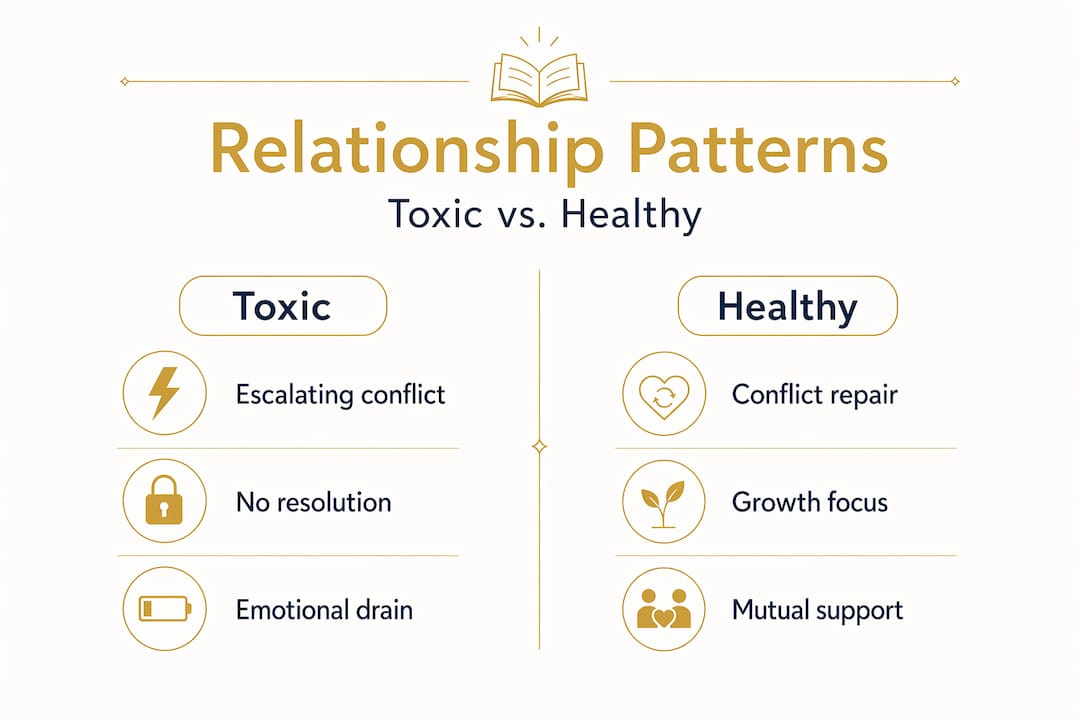
One concept that appears across literature about toxic love is mutual contribution. This is not about blaming both people equally, especially in cases of abuse. It is about recognizing that relationship systems have two participants, and understanding your own patterns is part of how you break free from them.
Common myths about toxic relationships
One of the most persistent myths is that once you correctly identify someone as a “toxic person,” you have solved the problem. You have named the villain, and now you can either fix them or leave. Books that discuss toxic love push back hard on this.
Labeling a partner as toxic is counterproductive because it frames the entire problem as residing inside one person. Therapists who specialize in this area consistently point out that this framing blocks systemic change. It also has an unintended side effect: it can trap you in a cycle of blame that feels satisfying but does not move you forward.
There is also the myth that staying means you are weak or foolish. Books on unhealthy love address this directly by explaining the psychological mechanisms that keep people in harmful relationships. The trauma bond, the intermittent reinforcement of the cycle, the erosion of self-trust. These are not character flaws. They are predictable responses to a specific type of relational stress.
A third myth worth naming is that “toxic” automatically means the other person has a diagnosable personality disorder. Experts emphasize that healing requires systemic rather than individual focus. Trying to diagnose your partner keeps your attention on them, not on your own healing.
Pro Tip: When you catch yourself asking “why are they like this?” try replacing it with “what does this pattern ask of me, and what do I want to do about it?” That small reframe shifts your energy from analyzing someone else to reclaiming your own clarity.
The most grounded books on this subject use what therapists call the “toxic = we” framework. Toxicity is a relational quality, not a personal one. That does not mean both people are equally at fault. It means the path forward runs through understanding the dynamic, not just the person.
Emotional and physical effects of toxic relationships
Most people in toxic relationships know something is wrong long before they can name it. They feel it in their bodies first. Fatigue that does not lift. Digestive problems. A constant low-grade anxiety that makes ordinary tasks feel heavy.

This is not coincidence. Chronic fight-or-flight stress in toxic relationships causes real physical symptoms, including fatigue and weakened immunity. Books explaining somatic connections validate what survivors have been experiencing and often dismissing as personal weakness. Your nervous system is responding to a genuine threat. That is not fragility. That is biology.
The psychological effects are equally well-documented in literature exploring toxic dynamics. Here are the most commonly described impacts:
- Eroded self-trust. Repeated gaslighting, which you can read more about in this explanation of gaslighting, causes people to doubt their own perceptions and memory.
- Shame and self-blame. When someone you love consistently implies that problems are your fault, that message gets internalized.
- Hypervigilance. Survivors often develop a constant scanning of their environment for signs of danger, even after leaving the relationship.
- Grief and confusion. Because toxic relationships often begin with genuine connection, leaving means grieving something real, not just escaping something bad.
One of the most clarifying concepts in books on this subject is the “double bind.” The double bind traps victims psychologically: every response the person makes leads to punishment or shame. Speak up and you are “too sensitive.” Stay quiet and you are “passive-aggressive.” There is no correct move. This explains the paralysis that many survivors describe, the sense that no matter what they did, it was wrong.
“The double bind effect traps victims psychologically, leading to internalized shame and behavioral paralysis, a subtle but powerful form of coercive control.”
Books that address somatic healing encourage readers to reconnect with their bodies as a path back to self-trust. Physical symptoms like digestive issues and fatigue are common outcomes of chronic emotional stress, and trauma-informed approaches treat the body as part of the recovery, not just the mind.
Practical recovery tools from books on toxic love
Recovery from a toxic relationship is not a single decision. It is a process, and the best books on unhealthy love treat it that way. They offer tools, not just validation.
Here is what the most grounded literature recommends:
- Name the pattern, not just the person. When you can identify the cycle you were in, you stop seeing yourself as uniquely broken and start seeing the dynamic for what it was. This is one of the first steps toward how to identify toxic relationships in the future.
- Rebuild somatic awareness. Recovery tools including somatic awareness help heal trauma and rebuild intuition. Practices like breathwork, body scanning, and gentle movement help reconnect you to physical cues your nervous system learned to suppress.
- Prioritize internal validation. One of the most common patterns in toxic relationships is outsourcing your sense of reality to your partner. Recovery means learning to trust your own perceptions again.
- Understand mutual repair. Repairing emotional rupture precedes resolving conflict. Books that focus on the “we” mindset help readers understand what healthy repair actually looks like, so they can recognize it in future relationships.
- Grieve the relationship honestly. Many books on navigating unhealthy relationships make space for the grief that comes with leaving. Acknowledging what was real and good, alongside what was harmful, is part of complete healing.
Pro Tip: If you are reading books about toxic relationships and finding yourself only looking for evidence to confirm what your partner did wrong, pause. The most healing reads are the ones that also ask what you want your next relationship to look like.
Books on this subject also address the question of whether toxic relationships can change. The honest answer most authors give is: sometimes, but only when both people recognize the pattern and commit to changing it. That requires a level of mutual accountability that many toxic dynamics never reach. Knowing that is not pessimism. It is clarity.
You can also explore patterns that show up in other contexts, like this breakdown of narcissistic boss patterns, which often mirror the same dynamics found in personal relationships.
My take on why framing matters more than labels
I’ve read a lot of books on this subject, and the ones that actually help readers heal share one quality: they resist the urge to make the story simple.
The books that tell you “here’s how to spot a toxic person and get out” feel satisfying. I understand the appeal. But in my experience, those are the books people read, feel briefly validated by, and then find themselves in the same dynamic six months later with someone new.
The books that change people are the ones that ask harder questions. What drew you to this relationship? What did you tell yourself when the warning signs appeared? What do you need to understand about your own patterns to make a different choice next time?
That is not victim-blaming. It is the opposite. It is treating readers as capable adults who can grow, not just as people who need to be rescued from bad partners.
I’ve also noticed that the most honest books on unhealthy love acknowledge that leaving is not always the immediate answer, and that staying does not always mean you are in denial. Context matters. Safety matters. And the internal work of understanding toxic relationship warning signs matters just as much as the external decision of what to do next.
The framing shift from “they are toxic” to “this dynamic is toxic, and here is what I want to understand about my role in it” is not comfortable. But it is where the real healing lives.
— Robert
Find your next read at Smartreadshub
If this article gave you clarity, the right book can take that clarity much further.
At Smartreadshub, we curate reading recommendations specifically for people working through relationship patterns, emotional recovery, and self-awareness. Whether you are looking for clinical insight, personal narrative, or practical workbooks, the books collection at Smartreadshub is organized to help you find exactly what you need. You can also browse the full blog for articles that go deeper on specific dynamics, from gaslighting to trauma bonding. Start with one book. It can reframe everything.
FAQ
What do books say toxic relationships actually are?
Books define toxic relationships as recurring harmful patterns and cycles rather than fixed traits in one person. The focus is on the dynamic between partners, not a diagnosis of either individual.
How do books help you identify toxic relationship warning signs?
Literature about toxic love teaches readers to recognize specific patterns like gaslighting, love bombing, and stonewalling. Recognizing these patterns in context helps readers distinguish toxic dynamics from ordinary relationship conflict.
Can a toxic relationship be fixed?
Some books suggest change is possible, but only when both partners recognize the pattern and commit to mutual accountability. Without that shared awareness, the cycle typically continues.
Why do books say labeling someone “toxic” can be harmful?
Labeling blocks clarity by placing the entire problem inside one person, which removes the relational context needed for genuine healing. It can also keep survivors focused on their partner’s behavior rather than their own recovery.
What physical symptoms do books connect to toxic relationships?
Books on this subject connect chronic stress from emotional abuse to physical symptoms including fatigue, weakened immunity, and digestive issues. Somatic healing approaches are increasingly recommended alongside psychological recovery.