
Narcissistic triangulation is when someone pulls a third person into a two-person conflict on purpose, using that outside voice to control the story and dodge blame. It matters because targets end up second-guessing their own memory, competing for approval, and feeling isolated from the people who should be easiest to trust. Below, you’ll find the exact patterns to watch for, real-world examples, and steps that actually shut the tactic down.
TL;DR:
- Narcissistic triangulation is a deliberate tactic used to manipulate, control, and dodge accountability by involving a third party in a conflict.
- It creates constant validation for the narcissist, shifts blame, and erodes the target’s trust in their own perception and memory over time.
- Common signs include secondhand reports, deflected questions, and internal doubt, often leading to long-term anxiety and isolation.
- To disrupt triangulation, refuse to act as the messenger, verify claims directly, and set firm boundaries with short, factual responses.
- Outside support from a therapist or trusted resources is essential for recovery, especially when emotional safety or trust has been compromised.
Table of Contents
- What Is Narcissist Triangulation, Exactly?
- Why Narcissists Rely on Triangulation
- What Narcissist Triangulation Looks Like in Real Life
- Signs You’re Being Triangulated
- The Real Cost: How Triangulation Damages Targets
- How to Stop or Disrupt Triangulation
- Where to Get Help: Therapy and Support Resources
- Triangulation vs. Ordinary Conflict: What’s Actually Different
- How to Support Someone Being Triangulated
- An Editorial Take on Naming the Pattern
- Rebuilding Clarity: Books and Resources That Help
- Sources
- FAQ
What Is Narcissist Triangulation, Exactly?
The word “triangulation” originated in family systems theory. Murray Bowen used it to describe how a two-person relationship under stress often pulls in a third person to ease the tension, usually without anyone planning it that way. That version is mostly unconscious, a pressure valve rather than a weapon, according to Wikipedia’s overview of triangulation).
Narcissistic triangulation borrows the structure but changes the intent entirely. It’s deliberate. The person with narcissistic traits (call them Person A) brings in a third party (Person C) specifically to manage or manipulate their target (Person B), rather than letting a conflict stay between the two people who actually own it.
- Person A: the narcissist, running the show from the center.
- Person B: the target, usually left confused about what’s actually happening.
- Person C: an ex, a coworker, a child, or a friend, used as a prop, messenger, or comparison point.
The difference between the two versions comes down to purpose. A stressed family unconsciously leans on a third person to cope. A narcissist consciously stages one to win.
Why Narcissists Rely on Triangulation
Triangulation solves three problems for someone with narcissistic traits at once, which is exactly why it shows up so often in these dynamics.
First, it generates supply. Comparing you unfavorably to an ex, a coworker, or even a stranger online gives the narcissist a steady stream of attention and validation, and it puts you in the position of chasing their approval instead of evaluating whether the relationship works for you.
Second, it hands them control without the effort of a direct argument. Whoever controls the flow of information between two people controls the narrative. If every conversation about a conflict passes through the narcissist first, they get to edit, exaggerate, or invent whatever version serves them.
Third, it lets them dodge accountability entirely. Instead of answering for their own behavior, they redirect the conversation toward a rival, a critic, or a supposed consensus of people who agree with them. Manufactured competition keeps you working to win them back rather than questioning why you’re in that position at all, according to Healthline’s breakdown of narcissistic triangulation.
What Narcissist Triangulation Looks Like in Real Life
Triangulation shows up almost identically across romantic relationships, families, and workplaces. Once you know the pattern, the examples start looking less like isolated incidents and more like a playbook.
- The ex-comparison move. A partner brings up a former girlfriend or boyfriend, praising how “easygoing” or “supportive” they were, timed right after you’ve raised a legitimate concern.
- Kids as go-betweens. A parent going through a separation tells a child to “let your mom know” something instead of contacting the co-parent directly, turning the child into a courier and sometimes an ally.
- The phantom critic. A coworker or friend supposedly said something negative about you, but you never hear it firsthand. Whether it’s true or invented, you’re now managing a conflict with someone who was never actually part of it.
- The false consensus. “Everyone thinks you’re overreacting” is a classic line, according to Healthline, and it works because most people don’t want to argue against an invisible jury.
Each version does the same job: it shifts your attention off the real issue and onto damage control.
Signs You’re Being Triangulated
Some signs are behavioral. Others live entirely in your own head, which is what makes this tactic so disorienting.
Watch for these behavioral patterns:
- You’re constantly hearing secondhand reports of what someone “said” about you.
- The same one or two people keep getting cited as neutral judges, even though they were never asked.
- Direct questions get deflected with “well, so-and-so agrees with me.”
- Conversations about a conflict always seem to loop through a third person instead of happening between the two people involved.
Then there’s the internal fallout, which is arguably more telling. Persistent competition anxiety, where you feel like you’re being measured against someone else you’ve never met, is common. So is a low hum of self-doubt that shows up even when nothing specific has happened recently. Hypervigilance, that sense of scanning every comment for hidden meaning, tends to follow.
Long-term exposure to this kind of manipulation produces what researchers describe as a reality-distorting effect, where victims start doubting their own perception and memory of events, according to Psychology Today. That’s not a character flaw. It’s a predictable response to being fed a manipulated version of reality over and over.
The Real Cost: How Triangulation Damages Targets
Triangulation and gaslighting overlap more than most people realize. Both attack your confidence in your own reading of events, and when a third party keeps “confirming” the narcissist’s version, your internal compass gets harder to trust. You can read more about that overlap in our explainer on gaslighting.
The psychological toll builds gradually. Anxiety spikes around routine interactions that used to feel neutral. Isolation creeps in, partly because the narcissist has positioned themselves as the sole reliable narrator of your relationships, and partly because you start pulling away from people rather than risk becoming the next triangle. Simple decisions, like whether to bring up a concern at all, start to feel loaded with risk.
Left unaddressed, the damage extends beyond the immediate relationship. Peer reviewed research on family systems links pathological triangulation to lasting effects on children caught in parental conflict, including confusion about loyalty and long term difficulty trusting their own judgment, according to a PMC review on family dynamics. In workplaces, chronic triangulation corrodes trust between teams long after the original conflict fades.
How to Stop or Disrupt Triangulation
You can’t out argue a narcissist’s narrative, but you can stop feeding the triangle. That shift, refusing to play your assigned role, is where most of the actual power in this situation lives.
Start with these steps:
- Refuse to be the messenger. If someone tries to relay information through you, redirect it: “You’ll need to talk to them directly about that.”
- Verify before you react. If you hear that someone said something about you, ask that person directly rather than confronting the narcissist’s version of events.
- Don’t confront the third party. Escalating toward the person being used as a prop usually deepens the triangle instead of resolving anything, according to SimplyPsychology’s analysis of triangulation.
- Name the pattern out loud, once, calmly. “I’ve noticed conversations about us keep going through other people. I’m not doing that anymore.” Then stop explaining yourself repeatedly.
- Set the boundary and hold it. State what you will and won’t participate in, and let the boundary do the work instead of arguing every time it’s tested. Our guide on setting boundaries with narcissists walks through specific scripts.
- Document interactions when things escalate. A dated record protects your own memory of events when someone is actively trying to rewrite them.
Pro Tip: Keep your responses short and factual instead of emotional when someone tries to triangulate you. Manipulators often rely on a big reaction to keep the drama going; a flat, boring response starves it.
If safety becomes a concern, whether that’s emotional safety at home or professional risk at work, prioritize an exit plan and professional support over trying to win the situation on your own.
Where to Get Help: Therapy and Support Resources
Recognizing the pattern is step one. Getting outside validation is often what actually restores your footing, according to Psychology Today. It’s time to bring in a professional when self-doubt is interfering with daily decisions, when you’re isolating from people who used to feel safe, or when the situation involves a child being used as a go-between.
When you’re vetting a therapist, ask directly:
- Do you have experience with narcissistic abuse dynamics specifically?
- How do you approach rebuilding trust in a client’s own perception?
- What does a realistic recovery timeline look like for this kind of pattern?
National organizations like The Hotline offer guidance on abusive relationship dynamics, including narcissistic patterns, and can connect you to local support groups if a triangulation situation overlaps with broader abuse. Pairing that professional support with structured reading, something Smart Reads Hub focuses on, gives you both outside perspective and a private space to process what you’re learning.
Triangulation vs. Ordinary Conflict: What’s Actually Different
Not every third party mention is manipulation. Two coworkers venting to a manager about a scheduling conflict, or a couple asking a marriage counselor to help mediate, both involve a third person, and neither one is narcissistic triangulation.
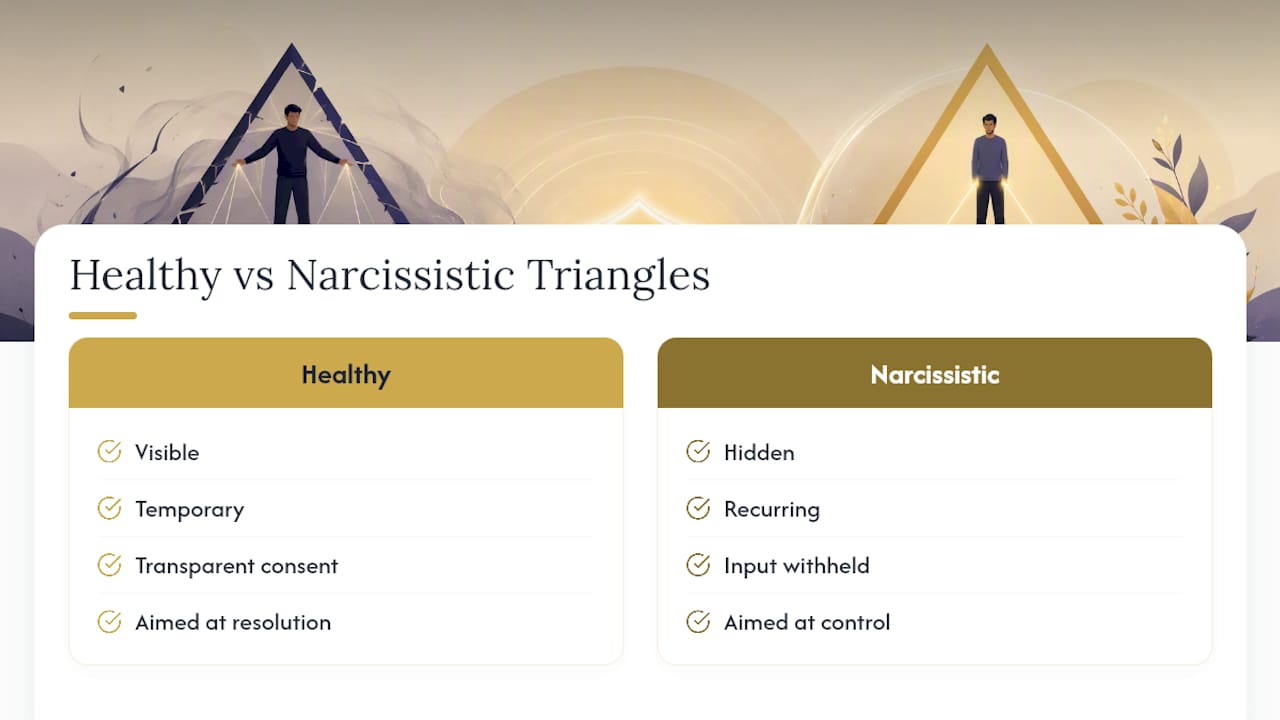
The difference is intent and direction. Ordinary conflict resolution brings in a third party to solve a problem transparently, usually with everyone’s knowledge and consent. A mediator’s job is to close the gap between two people, not widen it. Family systems triangles, the unconscious Bowen version, form the same way: a stressed relationship leans on a third person for relief, but nobody’s doing it strategically to gain leverage.
Narcissistic triangulation flips the goal. The third party isn’t there to help resolve anything. They’re there to be compared against you, to relay information the narcissist doesn’t want to deliver directly, or to serve as a manufactured audience that makes the narcissist look reasonable. The conversation about you happens without you, by design, and it stays that way even when you ask for it to stop.
That’s the tell. Healthy triangles are visible, temporary, and aimed at resolution. Narcissistic ones are hidden, recurring, and aimed at control. If a third party keeps getting inserted into the same conflict without your input and the same conflict never actually gets resolved, that’s a strong signal you’re looking at the manipulative version, not the ordinary kind.
How to Support Someone Being Triangulated
Watching someone you care about get pulled through this pattern is frustrating, mostly because the advice that feels obvious from the outside, “just talk to them directly” or “why do you believe that,” rarely lands the way you’d expect.
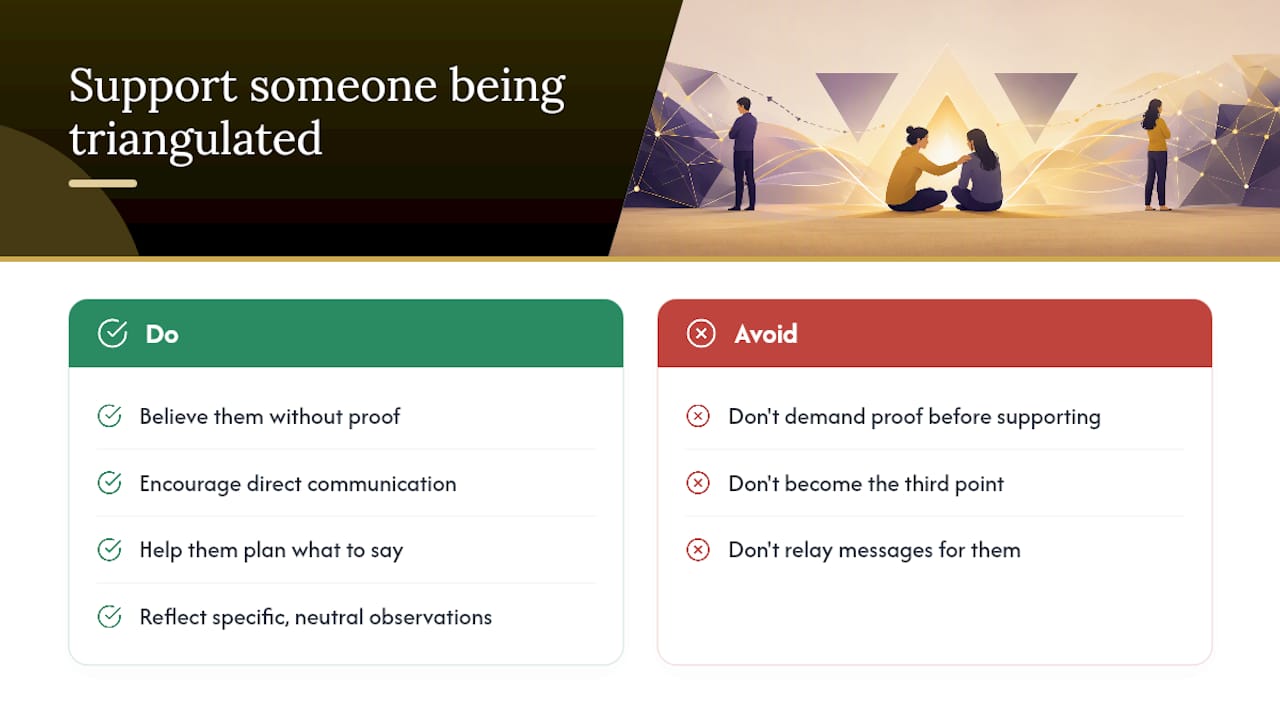
Start by believing them without requiring proof. Triangulation thrives on secondhand information, so someone in the middle of it often doesn’t have a clean, provable story yet. Pushing for evidence before you offer support can echo the same doubt the narcissist is already creating.
Avoid becoming a third point in a new triangle yourself. It’s tempting to offer to “talk to the other person” or relay a message on your friend’s behalf, but that just adds another link to the same chain. Instead, encourage them to communicate directly and offer to help them plan what to say, not deliver it for them.
Reflect back what you’re actually observing, in concrete terms: “I’ve noticed you seem anxious every time their ex comes up in conversation.” That kind of specific, judgment free observation helps counteract the self-doubt triangulation creates, without you having to render a verdict on the whole relationship.
Finally, point them toward resources rather than trying to be their only support. A therapist, a support group, or a well-researched book can offer a kind of steady, outside perspective that a friend, however well-meaning, usually can’t sustain alone.
An Editorial Take on Naming the Pattern
Most people don’t need convincing that something is wrong. They need permission to trust that instinct. Once you can name what’s happening, “this is triangulation, not my imagination,” the fog usually starts to lift, even before anything else changes. Safety and your own mental health come first, always, ahead of trying to fix the dynamic or win the narcissist over. Lean on outside validation, whether that’s a therapist, a support group, or a trusted friend who isn’t tangled in the triangle themselves. You don’t have to sort this out alone, and you shouldn’t have to.
— Robert
Rebuilding Clarity: Books and Resources That Help
Reading with intention does something therapy alone sometimes can’t: it gives you language for what happened at 2 a.m., on your own schedule, without having to explain the backstory first. The site curates recovery and psychology books aimed at people dealing with manipulation, helping avoid generic self-help material.

A practical reading order works well here: start with a clear overview of manipulation tactics, move into boundary-setting material, and finish with something that helps you rebuild trust in your own judgment. Our book recommendations are organized to make that progression easy to follow, and our resources page rounds out the picture with therapy platform comparisons and other recovery tools. If you’re specifically working through the aftermath of a relationship where triangulation played a role, our breakup recovery book list is a solid place to start.
None of this replaces a therapist. But pairing structured reading with professional support gives you a private space to process what you’re learning between sessions, which speeds up the whole process for a lot of readers. Start with one book from the recovery collection this week and see how far it gets you.
This article is general information, not a substitute for advice from a qualified doctor. Consult a qualified healthcare professional about your own circumstances before acting on anything here.
Sources
FAQ
What Are Examples of Triangulation?
Common examples include bringing up an ex to spark jealousy, using a child as a messenger between separated parents, and claiming a coworker or friend said something critical about you that you never hear directly. Each example shifts your focus away from the real conflict and onto a manufactured third party, according to Healthline.
What Are the Four D’s of Narcissistic Abuse?
Definitions of this framework vary across sources, and there isn’t one standardized clinical version. Rather than force a specific list, it’s more useful to focus on documented tactics like triangulation, gaslighting, and blame-shifting, all covered in our guide to narcissistic abuse tactics.
How Does a Narcissist React When Cornered?
Narcissists typically deflect accountability rather than engage directly with a valid concern, often redirecting to a third party’s supposed opinion or a past grievance. This deflection is part of why triangulation works so well for them. It lets them avoid ever answering the actual question.
What Are the Signs of Triangulation?
Signs include repeated message-relaying through a third person, unexplained comparisons to someone else, and a persistent sense of competing for approval or doubting your own memory of events. If the same one or two people keep showing up as “proof” in unrelated conflicts, that’s a strong indicator you’re dealing with triangulation rather than ordinary disagreement.
Does Smart Reads Hub Offer Books Specifically About Triangulation?
The site curates recovery and psychology books that address manipulation tactics like triangulation as part of broader narcissistic abuse recovery collections. Current titles and pricing information is available on the books page.