
Post-separation abuse is the continuation of coercive control after a relationship ends, carried out through the courts, finances, children, or surveillance instead of physical proximity. If you’re in immediate danger, call 911 or the National Domestic Violence Hotline now. Once you’re safe, documentation and outside support become your next priorities.
TL;DR:
- Abusers often escalate tactics such as legal harassment, economic sabotage, stalking, and manipulation of children long after separation.
- Warning signs include threats to children, persistent stalking, false police or CPS reports, and sudden interest in your personal life, especially during custody disputes.
- Building a tailored safety plan involves securing trusted safe locations, changing passwords, using coded communication, and choosing neutral custody exchange points.
- Document all harassment and court filings meticulously with time-stamped records, screenshots, and logs to support future legal action or protective orders.
- Immediate support from the National Domestic Violence Hotline and turning to trauma-informed legal and mental health resources are critical for safety and recovery.
Table of Contents
- What Is Post-Separation Abuse, Exactly?
- What Tactics Do Abusers Use After Separation?
- What Warning Signs Signal Rising Danger?
- How Do You Build a Safety Plan After Leaving?
- How Should You Document Post-Divorce Harassment?
- How Do Abusers Weaponize Family Court?
- Where Can You Get Immediate Help Right Now?
- How Do You Rebuild Agency After Leaving?
- What I Want You to Take Away From This
- Where to Find Recovery Reading That Actually Helps
- Sources
What Is Post-Separation Abuse, Exactly?
Post-separation abuse is a pattern, not a single bad fight. It’s marked by coercive control, persistence over months or years, and a clear intent to dominate a former partner even after the legal relationship has ended. That distinguishes it from situational conflict, where two people argue about custody logistics or money and then move on. Abuse escalates and repeats; ordinary post-divorce friction doesn’t.
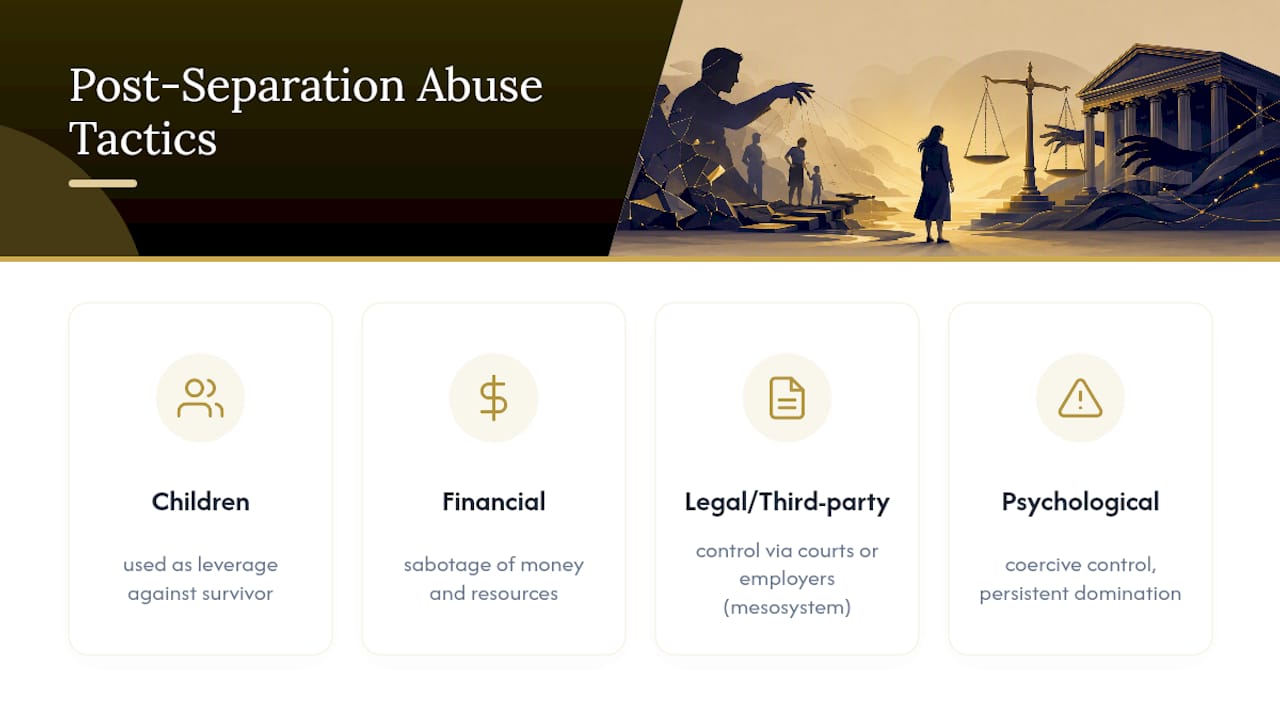
The Duluth Post-Separation Power and Control Wheel gives advocates and survivors a practical map of these tactics, from using children as leverage to financial sabotage. A literature review published in PMC backs this up, tying legal, economic, psychological, and mesosystem abuse (control exercised through third parties like courts or employers) to measurable harm.
What Tactics Do Abusers Use After Separation?
Abusers who lose direct access to a partner often shift tactics rather than stop. The behaviors tend to cluster into a few recognizable categories:
- Legal or judicial abuse: filing repeated, meritless motions, dragging out custody litigation, or making false abuse allegations to drain your money and time.
- Economic abuse: withholding child support, sabotaging your job through harassing calls to your employer, or racking up joint debt in your name.
- Stalking and digital surveillance: tracking your location through shared apps, showing up uninvited, or monitoring your social media through mutual friends.
- Weaponizing children: coaching kids against you, violating custody schedules, or accusing you of parental alienation to flip the narrative in court.
Legal abuse and economic abuse frequently overlap. One analysis of family court litigation notes that court delays and mounting legal fees are often intentional, designed to exhaust a survivor’s resources until they give up or settle on unfavorable terms.
What Warning Signs Signal Rising Danger?
Not every post-divorce conflict is dangerous, but certain patterns should raise your guard immediately:
- Threats aimed at your children, even framed as jokes or hypotheticals.
- Stalking behavior that intensifies rather than fades, especially unexpected appearances at your home or work.
- Repeated false police reports or CPS calls meant to destabilize you.
- Sudden interest in your new relationships or daily schedule from someone who previously showed none.
Separation itself is a documented risk factor for escalation. Research cited in the PMC literature review identifies separation and custody disputes as precursors in a large share of intimate partner homicides. That single fact should shape how seriously you treat any threat made during or after a breakup.
How Do You Build a Safety Plan After Leaving?
Safety planning after separation needs to be specific to your situation, not generic advice pulled from a checklist. Start with these building blocks:
- Identify a safe place to go on short notice, and share it only with people your ex-partner doesn’t know or trust.
- Set up a code word with a friend or family member that signals you need help without alerting anyone nearby.
- Route communication with your ex through email or a co-parenting app rather than phone calls, so there’s a record and less opportunity for verbal manipulation.
- Change passwords on email, banking, and cloud accounts, and check your phone for unfamiliar tracking apps.
- For custody exchanges, use a public location or a third party, and keep a written log of every interaction.
Pro Tip: Individualize everything. Advocates at the National Domestic Violence Hotline stress that blanket safety advice can backfire if it leads you into unguarded contact your specific abuser will exploit.
How Should You Document Post-Divorce Harassment?
Good documentation is quiet, consistent, and dated. Every entry should note the date, time, what happened, and who witnessed it, even if the witness is just your own written account.
- Save texts and voicemails as screenshots and originals, since screenshots alone can lose metadata that proves timing.
- Keep a separate log of missed support payments, canceled visitations, and harassing calls to your workplace.
- Store everything in a cloud folder your ex-partner cannot access, and back it up somewhere physical too.
- Loop in law enforcement for anything involving stalking or threats, and consult an attorney before major custody filings.
This record becomes the backbone of any protective order request or custody modification down the line.
How Do Abusers Weaponize Family Court?
Family court can become an extension of the abuse itself. Some abusers file motion after motion, not to win, but to force their ex-partner into constant legal defense. Others levy false allegations of parental alienation or unfitness, knowing that even unfounded claims cost time, money, and credibility to disprove.
This works because courts don’t always see the pattern. A 2025 legal analysis argues that judges need pattern-based risk assessments, not case-by-case snapshots, to tell coercive control apart from a genuinely contentious but mutual dispute. Without that lens, a court can mistake calculated harassment for two parents who simply disagree.
If you’re facing this, document every filing and its outcome, work with an advocate who understands coercive control (not just general family law), and ask the court directly for protective conditions like supervised exchanges when contact itself is the risk.
Where Can You Get Immediate Help Right Now?
You don’t have to sort this out alone, and you shouldn’t try to. The National Domestic Violence Hotline offers 24/7 phone, chat, and text support, along with safety planning tailored to your situation.
- Call or text the National Domestic Violence Hotline for immediate crisis support and local shelter referrals.
- Search for teen-specific, Native community, or Deaf survivor helplines if those apply to you.
- Contact your local legal-aid office for a family-court advocate trained in trauma-informed practice.
How Do You Rebuild Agency After Leaving?
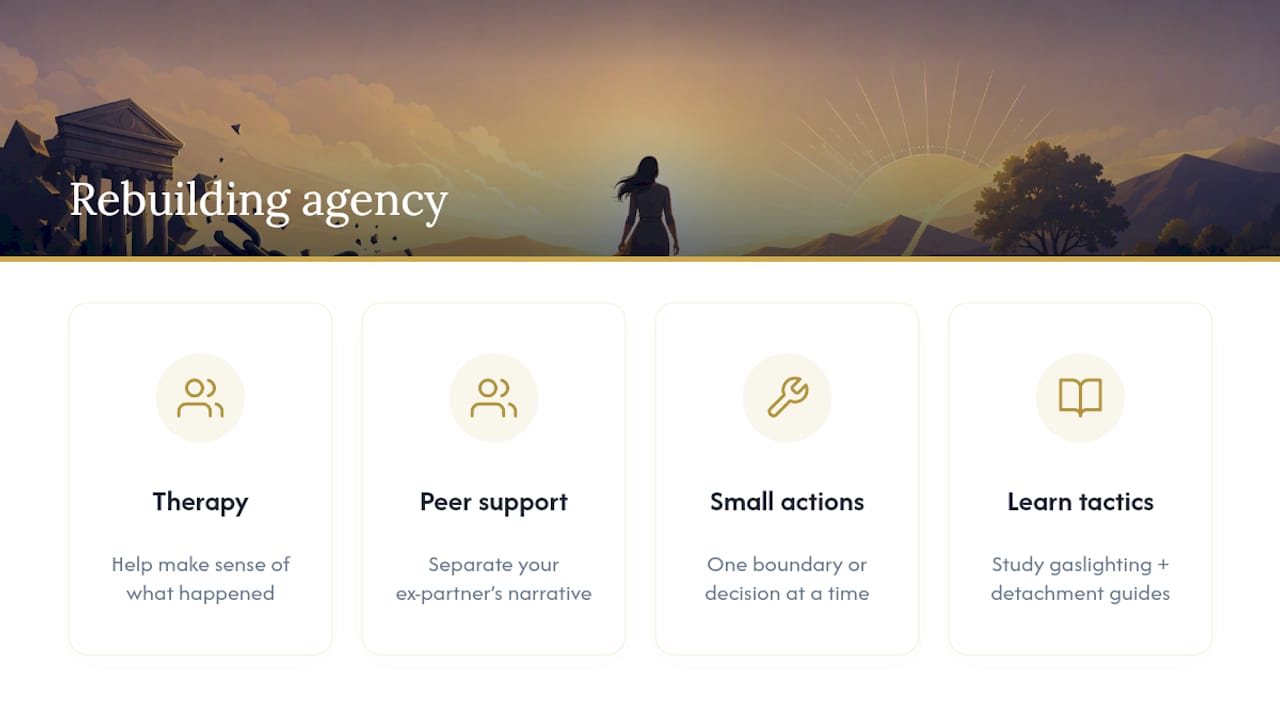
Recovery isn’t just about surviving the immediate threat. It’s about rebuilding a sense of control that the abuse tried to erase. Therapy, peer support groups, and structured reading can all help you make sense of what happened and separate your ex-partner’s narrative from reality.
Small, consistent actions work better than dramatic overhauls: practicing one boundary at a time, making a decision entirely on your own, or setting a daily routine no one else influences. Understanding manipulation tactics also helps you see the pattern clearly, which is where guides like what gaslighting actually looks like can be useful. If custody battles are still ongoing, emotional detachment strategies can help you stay grounded without losing your resolve. For a broader roadmap, The Broken Seam’s guide to rebuilding after divorce offers a practical, workbook-style approach.
What I Want You to Take Away From This
The hardest part of post-separation abuse is that it rarely looks like the abuse you left. It looks like paperwork, missed pickups, a strange car outside your building. That confusion is real, and it doesn’t mean you’re overreacting. Trust the pattern you’re seeing, prioritize your safety over being believed by everyone around you, and lean on people trained for this, not just people who love you.
— Robert
Where to Find Recovery Reading That Actually Helps
Books won’t replace a lawyer or a hotline call, but they can help you name what happened and stop questioning your own memory. Smartreadshub curates guides and reading lists built specifically for people recovering from manipulation, gaslighting, and coercive control, not generic breakup advice. These are educational tools, not legal counsel, and they work best alongside an advocate or therapist.

Start with what gaslighting actually looks like to understand how your ex-partner may still be distorting reality even after separation. If you want structured, research-backed reading to support longer-term healing, 15 best self-help books for relationships is a solid place to start today.
This article is general information, not a substitute for advice from a qualified lawyer. Consult a qualified legal professional about your own circumstances before acting on anything here.
Sources
- Post-separation abuse: A literature review connecting tactics to harm – PMC
- Endless litigation in family court as a method of post-separation coercive control
- Post Separation Power and Control Wheel (Duluth Model PDF)
- National Domestic Violence Hotline: Domestic Violence Support