
State your memory or feeling in one short sentence, keep your tone flat and unemotional, and set a boundary or walk away if the person keeps pushing. Say something like, “I remember it differently, and I’m not going to argue about it,” then stop talking. Don’t defend, don’t escalate, don’t try to win. Calm and brief works better than detailed and convincing.
TL;DR:
- Using brief, neutral statements to affirm your reality without engaging in arguments helps prevent gaslighters from gaining leverage.
- Maintaining a calm, flat tone and employing techniques like gray rocking or the broken record method minimizes escalation risks.
- Recognizing when to disengage early, such as when conversations become repetitive or unsafe, preserves your energy and safety.
- Keeping detailed written records of interactions provides external proof and protection against self-doubt manipulation.
- Sharing your experiences with a trusted person or a therapist supports emotional resilience and reinforces your judgment.
Table of Contents
- How Do You Respond to Gaslighting in the Moment?
- Tone and Body Language That Keep the Exchange From Escalating
- When to Disengage and How to Hold the Boundary
- Documenting Interactions: What to Save and Why
- Getting Support: Who to Tell and What Help Looks Like
- Why These Scripts Actually Work
- A Note From Robert
- Where to Go Next for Recovery Resources
- Sources
How Do You Respond to Gaslighting in the Moment?
The goal of any script is to state your reality without opening a debate. Gaslighters thrive on drawn-out arguments where they can pick apart every detail, so the shortest true sentence wins. Verywell Mind offers direct example phrases built around this same idea: assert, don’t argue.
For memory disputes, try one of these:
- “I remember it differently, and that’s okay. We don’t have to agree.”
- “Here’s what I remember happening. I’m not going to keep debating it.”
- “That’s not how I recall it, but I’m not interested in re-litigating the past.”
- “I trust my memory of that conversation.”
For minimization and dismissal, when someone tells you’re “too sensitive” or “making things up”:
- “My feelings are valid, whether or not you agree with them.”
- “I’m not overreacting. This matters to me.”
- “You don’t have to understand my feelings for them to be real.”
When you need to pause or end the exchange, a boundary phrase closes the loop cleanly: “I’m done discussing this right now,” or “We can talk again when we’re both calmer.” Time notes that experts recommend brief, neutral statements over long explanations, because gaslighters often want a reaction more than a resolution.
Pick the phrase that matches the stakes. A minor memory disagreement with a coworker might only need one calm sentence. A pattern of repeated dismissal from a partner calls for the boundary phrases, used consistently, every time it happens.
Tone and Body Language That Keep the Exchange From Escalating
Delivery matters as much as wording. A flat, even tone with short sentences signals that you’re not available for an argument. Long explanations invite counterarguments; short ones don’t give a gaslighter much to grab onto.
When it’s safe, steady eye contact and relaxed, open posture reinforce that you’re calm, not combative. When it isn’t safe, skip the eye contact and keep your body language neutral instead. Physical safety always outranks how convincing you look.
Two techniques help here. “Gray rocking” means becoming as uninteresting and unreactive as a rock, giving one-word or short answers so there’s nothing to escalate. The “broken record” technique means repeating the same short line no matter what new argument gets thrown at you: “I remember it differently,” again and again, without variation.
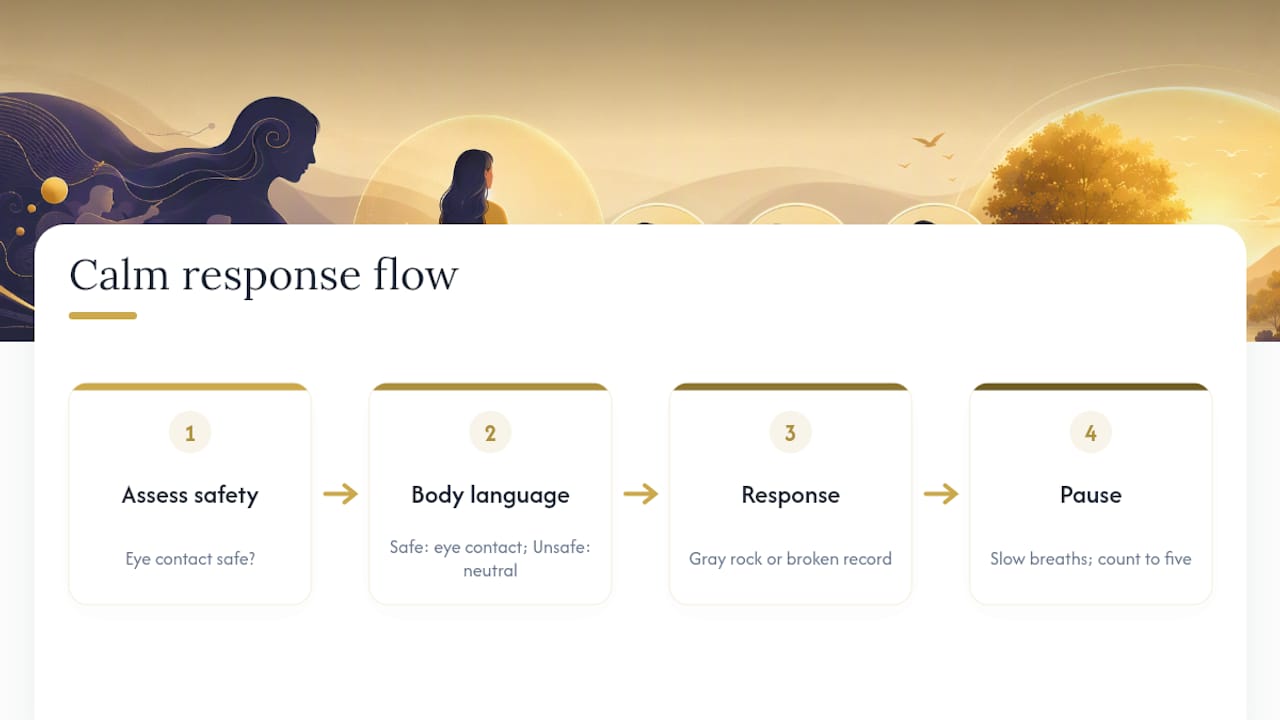
If you feel your heart racing or your thoughts scrambling, Psychology Today points out that noticing physiological cues like a tight chest or shaky hands is often the first sign you need a pause. A few slow breaths or a quick mental count to five can steady you enough to stay on script instead of getting pulled into a fight you can’t win by arguing harder.
When to Disengage and How to Hold the Boundary
Some conversations aren’t worth finishing. If the person keeps circling back to the same denial, mocks your feelings, or the exchange starts feeling unsafe, that’s your cue to leave rather than keep pushing your point.
Psychology Today’s guidance is blunt on this: don’t try to win, and don’t get drawn into proving your case over and over. Recognizing that futility early saves you hours of exhausting back and forth.
- “I’m stepping away from this conversation. We can revisit it later.”
- “I’ve said what I needed to say. I’m leaving now.”
- Physically remove yourself: a different room, a walk outside, ending the call.
- If it keeps happening, name the pattern once, calmly, and follow through with consequences (less contact, shorter conversations, or professional mediation).
At work, keep it procedural: “I’ll follow up in writing,” then send a short, factual email recapping the conversation. That email becomes your record without you having to accuse anyone of anything in the moment.
Documenting Interactions: What to Save and Why
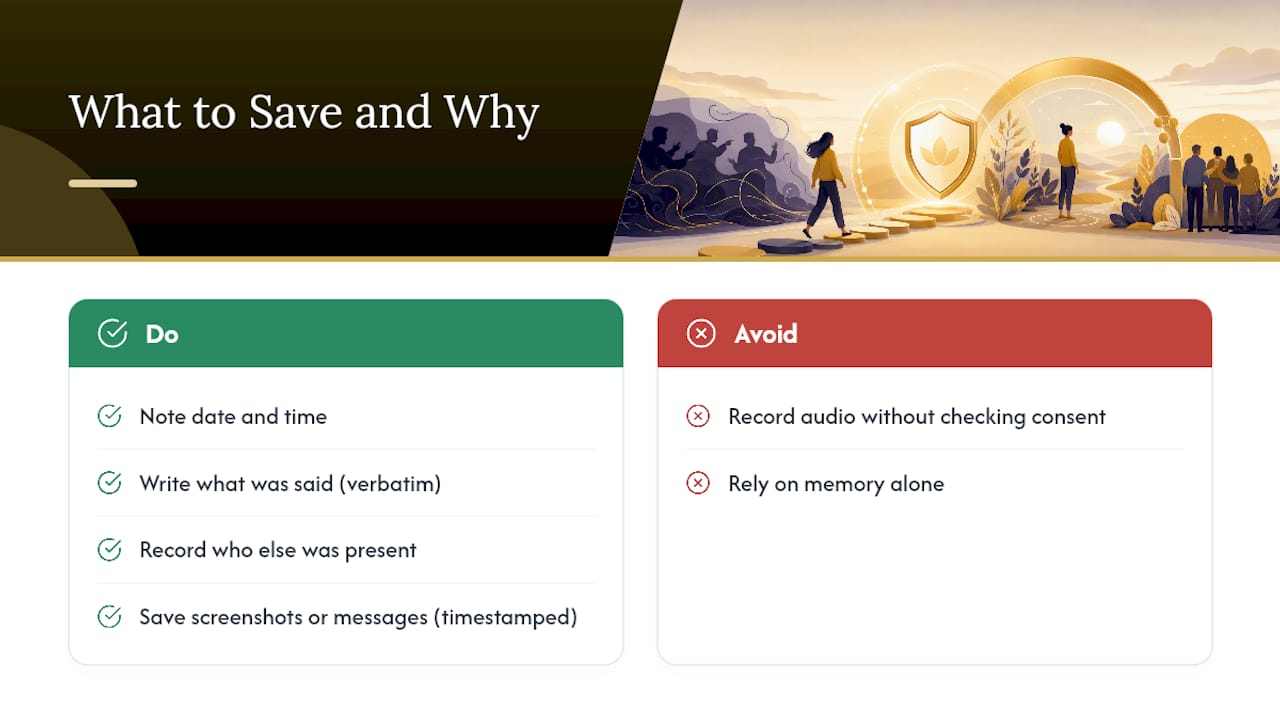
A written record protects you from the self-doubt gaslighting is designed to create. Note the date, what was said (as close to verbatim as you can manage), and who else was present. Screenshots of texts or messages work well because they’re timestamped automatically.
A short daily summary, even two sentences, adds up over weeks and shows patterns a single incident can’t reveal. Avoid recording audio without checking your state’s consent laws first, since many require all parties to agree; a written log sidesteps that risk entirely.
Healthline recommends this kind of evidence collection specifically because it creates what amounts to an external memory, something to point to when you start questioning your own recall. That record becomes useful later, whether you’re talking to a therapist, a trusted friend, or HR.
Getting Support: Who to Tell and What Help Looks Like
Tell one trusted person first, someone who has no stake in the relationship: a friend, sibling, or colleague. A third-party witness makes gaslighting far harder to sustain, since HelpGuide notes that gaslighters rely on isolating a single person’s version of events.
A therapist can help you rebuild trust in your own judgment and practice these scripts in a lower-stakes setting before you use them at home. If the situation involves fear, control, or threats, The Hotline and LoveIsRespect offer confidential, immediate support and safety planning, including for teens and young adults navigating dating relationships.
Why These Scripts Actually Work
Short, neutral phrases work because gaslighters look for an emotional reaction; calm delivery removes their leverage. Documentation matters for the same reason, giving you proof outside your own head. Psychology Today also cautions against labeling the behavior as “gaslighting” mid-argument. It’s usually more productive to just assert your experience and hold the boundary. Smart Reads Hub builds its recovery guides around this same evidence, curated by author Robert for readers who want scripts they can actually rehearse.
A Note From Robert
These moments are exhausting, and doubting your own memory in real time is one of the hardest things a person can go through. Readers who practice these scripts and start a written log consistently report feeling steadier within weeks, less because the other person changes and more because their own footing does. Smart Reads Hub’s guides exist to help you build that footing one script at a time.
— Robert
Where to Go Next for Recovery Resources
Recognizing gaslighting in the moment is only half the work. The other half is understanding the pattern well enough that it stops catching you off guard, which is exactly what our guide on what gaslighting is walks through in plain language.

Smart Reads Hub built its resources for exactly this gap between knowing something is wrong and knowing what to do about it. If you want to check your situation against real patterns first, our breakdown of signs of gaslighting lays out the specific language and behaviors to watch for. Beyond the articles, our curated book picks pair well with therapy and script practice, giving you longer-form guidance to return to when a five-minute read isn’t enough. If you’re also navigating manipulation outside of gaslighting specifically, our guide to manipulation tactics covers related patterns worth recognizing. Start with the gaslighting overview, then pick a book that matches where you are in the process.
Sources
- Gaslighting: Turning Off the Gas on Your Gaslighter
- 7 Things to Say When Someone Gaslights You
- How to Respond When Being Gaslit
- 9 Things to Say When Someone Is Gaslighting You
This article is general information, not a substitute for advice from a qualified doctor. Consult a qualified healthcare professional about your own circumstances before acting on anything here.