Most people pick up a self-discovery book hoping it will answer the big question: Who am I? The role of self-discovery books, though, is more nuanced than delivering that answer on page one. These books don’t hand you a finished portrait of yourself. They hand you a mirror, a set of questions, and a vocabulary you didn’t have before. If you’re coming out of a breakup, a job loss, or just a long period of feeling disconnected from yourself, understanding what these books can and can’t do will save you a lot of frustration and point you toward what actually works.
| Point | Details |
|---|---|
| Self-discovery is ongoing | Reading builds self-knowledge gradually; expect a process, not a single revelation. |
| Active engagement matters most | Journaling, reflection, and practicing techniques produce better outcomes than passive reading. |
| Genre shapes the benefit | Non-fiction builds skills; memoirs and fiction develop empathy and emotional processing. |
| Structure beats format | Whether you read print or digital, a clear behavioral structure drives real change. |
| Books complement, not replace, therapy | Self-discovery reading works best alongside other supports during major life transitions. |
Self-discovery is not a destination you reach after finishing a particularly good chapter. Self-discovery is a gradual, iterative process that requires returning to ideas, sitting with discomfort, and noticing patterns across time. Books assist this process by doing something therapy sessions and conversations can’t always provide: they give you space to think slowly, without an audience.
When you read a book that names a feeling you’ve carried for years without language, something shifts. Suddenly you can talk about it, write about it, and recognize it when it shows up in your behavior. That’s the real mechanism at work. Books provide prompts, frameworks, and vocabulary that make the invisible visible.
There’s an important distinction worth understanding here: self-discovery and self-improvement are not the same thing. Self-improvement is about changing a behavior or building a skill. Self-discovery is about understanding what you value, how you think, and why you respond the way you do. The best self-discovery books blend both, but you’re reading them for insight first, change second.
Pro Tip: When a passage in a book stops you cold, don’t just highlight it. Write two sentences in the margin: what it made you think, and what it made you feel. That’s where the real self-knowledge lives.
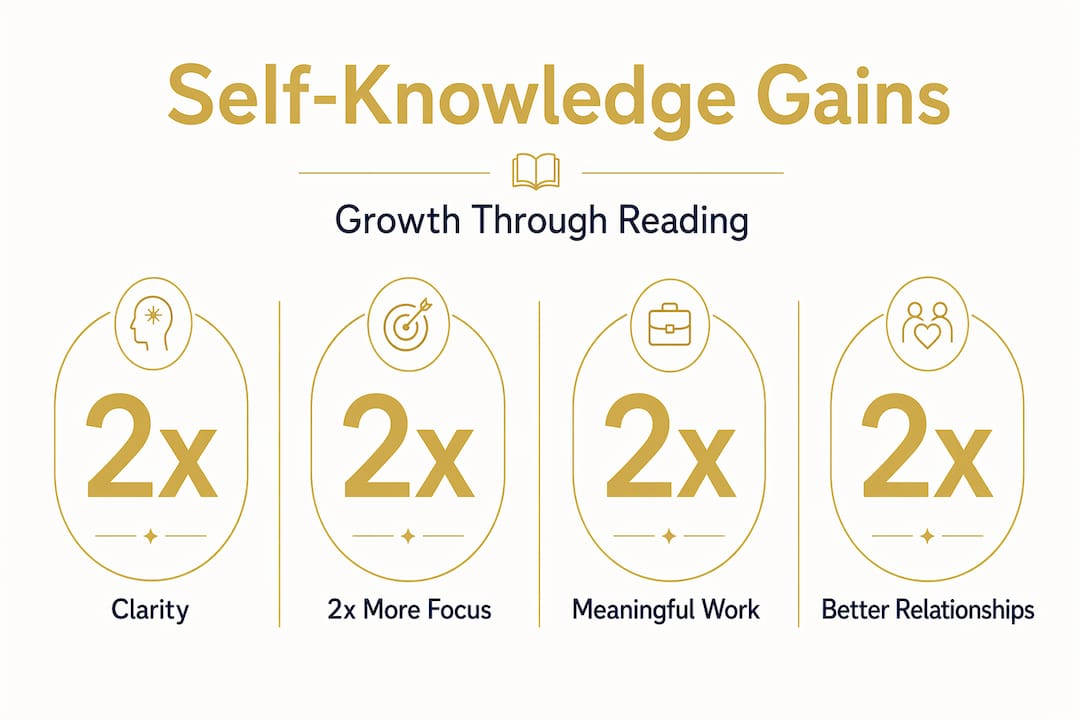
People with strong self-knowledge are more likely to find meaningful work and act with clarity in their careers and relationships. That’s not a small return for the time you invest in reading.
Here’s where honesty matters more than hype. The science on self-help books is genuinely mixed, and you deserve the full picture.
| Study type | Finding | Implication |
|---|---|---|
| RCT with trauma literature | Largest reduction in PTSD symptoms over 8 weeks (p<0.001) | Structured bibliotherapy works for specific conditions |
| Longitudinal Swiss study | No significant personality change linked to self-help use over 2 years | Casual reading alone doesn’t rewire who you are |
| Pragmatic RCT on self-compassion | Print and digital formats showed similar stress reduction | Format matters less than structure and guidance |
The pattern across these studies is consistent. When reading is structured, goal-directed, and paired with behavioral exercises, it produces measurable change. When it’s passive, even enthusiastic, it tends not to.
“Self-help books and therapies share core psychological techniques reducible to roughly 12 high-level strategies, including reframing and emotion regulation.” — Spencer Greenberg, Psychology Today
That quote reframes how you should approach your reading list. The books aren’t magic. They’re delivery vehicles for techniques that have real clinical backing. Your job is to extract those techniques and use them, not just admire them.
Research also shows that self-help users often score higher on openness but lower on emotional stability. That’s not a criticism. It means the people drawn to these books are already motivated for change. The missing ingredient is almost always intentional practice, not desire.
Not all self-discovery books work the same way, and choosing the wrong genre for your current emotional state can actually slow you down.

Research distinguishes two major categories of bibliotherapy in mental health settings. The first is developmental or skills-based bibliotherapy: non-fiction, workbooks, and structured programs that teach concrete techniques like cognitive reframing or values clarification. The second is creative bibliotherapy: novels, memoirs, and poetry that work through emotional resonance, identification, and narrative processing.
Neither is better than the other. They target different needs:
One underrated strategy: revisit books at different life stages. A book you read at 25 after a breakup will read entirely differently at 35 after a career shift. The book hasn’t changed. You have. And that difference is the clearest evidence of your own growth.
Pro Tip: If you’re in acute emotional pain right after a major life change, start with a memoir rather than a self-help workbook. Your nervous system needs to feel understood before it can absorb new frameworks.
Knowing the right strategies separates readers who close a book feeling temporarily inspired from those who actually change. Here’s how to use self-discovery books as real tools during a life transition or recovery period:
Avoid the most common trap: collecting books as a proxy for doing the work. Buying the next highly recommended title feels productive. Actually sitting with one difficult chapter and writing through your resistance is where the growth happens.
Understanding why these books help makes you a smarter, more intentional reader. The psychological mechanisms aren’t mysterious once you see them clearly:
These mechanisms mirror what you’d encounter in structured therapy. Books are not a replacement when serious mental health support is needed. They’re a complementary tool that extends the work into daily life, on your own schedule and at your own pace.
I’ve read well over a hundred books in this space, some as personal reads, some for research, and some because a reader needed a thoughtful recommendation during a painful season of their life. What I’ve learned is that the people who get the most from self-discovery books share one trait: they treat the book as a conversation, not a verdict.
The biggest misconception I see is that people expect a book to tell them who they are. When it doesn’t, they conclude the book didn’t work. But a book that makes you sit with an uncomfortable question for three days, one you keep returning to while making coffee or driving to work, that book worked. You just didn’t recognize it.
What I’ve found genuinely matters: pace. Most people read self-discovery books the way they binge a show. Fast, continuous, and without space to absorb. The books I’ve seen create lasting change are the ones people read slowly, sometimes one chapter a week, with deliberate pauses.
I also want to say something about uncertainty. If you’re in the middle of a hard transition and you don’t know who you are anymore, that’s not a broken state to fix. It’s an honest starting point. The books that honor that uncertainty, rather than promising to resolve it quickly, tend to be the ones worth your time.
The goal of self-exploration through reading isn’t to arrive at a fixed, permanent identity. It’s to build a clearer, more honest relationship with yourself that can evolve as your life does.
— Robert
If you’re ready to move from knowing you should read more intentionally to actually finding the right books for where you are right now, Smartreadshub is built for exactly that moment.
At Smartreadshub, every recommendation is curated with your growth phase in mind. Whether you’re processing a breakup, rebuilding after a major life shift, or simply ready to understand yourself better, you’ll find books chosen for real impact rather than just bestseller rankings. The platform also covers emotional health topics that complement your reading, including resources on recognizing signs of emotional invalidation, which many readers find deeply clarifying when they’re untangling complicated relationships. Take a few minutes to explore and see what lands for you right now.
Self-discovery books build self-knowledge gradually by providing vocabulary, frameworks, and reflection prompts. They work best when read actively alongside journaling and behavioral practice rather than as passive inspiration.
Yes, particularly when reading is structured and goal-directed. Randomized controlled trials show significant benefits from bibliotherapy for stress and trauma reduction when paired with active engagement.
It depends on your current need. Non-fiction and workbooks build concrete skills; memoirs normalize your experience; fiction develops empathy and perspective-taking. Matching genre to your emotional readiness produces the best outcomes.
No. Books are a complement to professional support, not a replacement. They extend self-reflection into daily life, but serious mental health needs require qualified professional care alongside any reading practice.
Self-discovery is a gradual, iterative process with no fixed timeline. Expect to revisit books and insights over months or years rather than after a single read. Progress often looks like asking better questions, not having all the answers.