
Women entrepreneurship books are works of memoir, practical guidance, or research that examine how women start, run, and grow businesses while navigating gender-specific obstacles like unequal access to capital and biased inheritance laws. The category spans three broad formats: memoirs that read like case studies (Lean In), how-to toolkits built around exercises (Everything Is Figureoutable), and research handbooks that translate data from groups like the Global Entrepreneurship Monitor into policy-relevant insight. Understanding this distinction matters because a reader picking up a memoir expecting a step-by-step fundraising plan is going to be disappointed, and a founder looking for encouragement won’t get much out of an academic handbook.
The term itself is a hybrid. It borrows credibility from the more established academic phrase “women’s entrepreneurship,” which the OECD defines around structural barriers women face when starting businesses, and applies it loosely to a bookshelf that ranges from Sheryl Sandberg’s boardroom memoir to a peer-reviewed research volume. Both belong in the category. Neither tells the whole story alone.
Books in this space typically fall into one of these buckets:
- Memoirs and personal accounts — founder stories that double as informal case studies, like Girlboss.
- Practical how-to guides — frameworks and exercises for building confidence or a business, like Everything Is Figureoutable.
- Mindset and psychology titles — books that address the internal obstacles to launching or leading, like You Are a Badass.
- Academic and policy handbooks — research-driven works that connect gender, institutions, and economic outcomes, such as the Routledge series edited by Maura McAdam.
Key Takeaways
Women entrepreneurship books work because they pair personal narrative with structural evidence, helping readers convert inspiration into strategy suited to their specific stage.
| Point | Details |
|---|---|
| Clear definition | These books span memoirs, how-to toolkits, and research handbooks addressing gendered business barriers. |
| Evidence-backed importance | The OECD estimates 24.8 million missing women entrepreneurs, showing these books address a real economic gap. |
| Match book to need | Choose memoirs for inspiration, toolkits for skills, and handbooks for strategy and policy insight. |
| Access varies by format | Trade titles are widely available; academic handbooks and GEM reports often require library or institutional access. |
| Start with Smart Reads Hub | Smart Reads Hub curates reading paths by need, pairing business mindset titles with resources on emotional clarity and recovery. |
Table of Contents
- What Themes and Formats Show Up in Women Entrepreneurship Books?
- Why Do These Books Actually Matter?
- Which Books Should You Actually Read First?
- How Do You Pick the Right Book for Your Stage?
- Where Can You Find These Books?
- How Should Editors Curate These Reading Lists?
- How Smart Reads Hub Helps You Choose the Right Book
- Sources
What Themes and Formats Show Up in Women Entrepreneurship Books?
Most books in this category cluster around six recurring themes, and recognizing them helps you scan a table of contents and know instantly whether a book fits your need.
- Mindset and leadership — confidence building, imposter syndrome, and decision-making under uncertainty, often framed through personal anecdote.
- Fundraising and finance — pitching investors, bootstrapping, and navigating a funding landscape where women historically receive a smaller share of venture capital.
- Marketing and growth — building an audience or customer base, frequently written by founders who scaled a direct-to-consumer brand.
- Networks and community — the role of mentorship, peer groups, and accelerators in helping women entrepreneurs avoid isolation.
- Memoir and lived experience — first-person accounts that function less as instruction manuals and more as emotional validation.
- Sectoral and contextual case studies — books focused on a specific setting, like digital microenterprise or social enterprise in a particular region.
The format usually signals the depth you’re getting. A memoir moves fast and reads like fiction, a workbook slows you down with exercises meant to be completed rather than skimmed, and an academic synthesis takes longer to get through but rewards you with data you can cite in a pitch deck or grant application. Regional framing is a quieter differentiator that’s easy to miss: a book written for the American startup scene assumes access to angel investors and accelerator networks that simply don’t exist in the same form elsewhere, so a founder outside that ecosystem needs to read selectively and adapt the advice rather than copy it wholesale.
Why Do These Books Actually Matter?
They matter because they translate structural, hard-to-see barriers into something a reader can act on, whether that reader is a first-time founder or a policymaker designing a loan program. The best books in this category don’t just tell an inspiring story. They connect that story to the economic reality documented by organizations tracking entrepreneurship at scale.
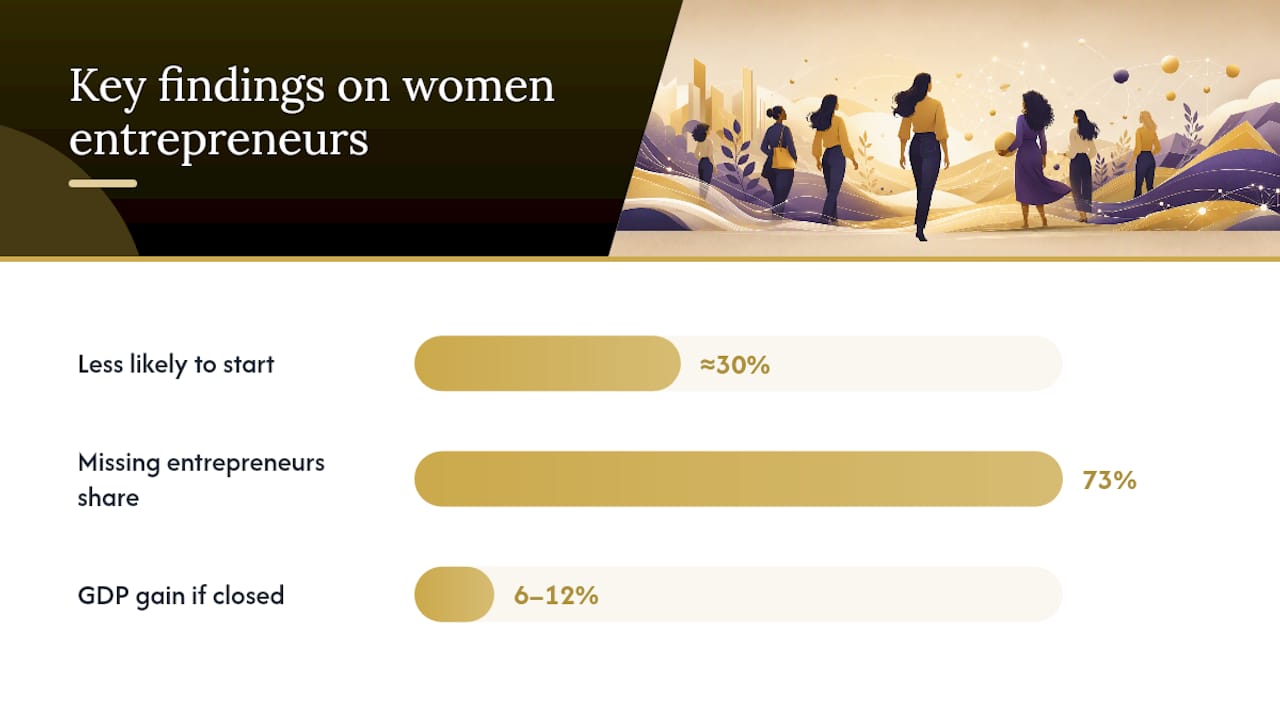
That reality is stark. Women were nearly 30% less likely than men to start a business across OECD countries between 2018 and 2022, and the same research points to discriminatory inheritance laws and restricted access to formal financing as root causes, not personal shortcomings. A book that only addresses mindset misses half the picture; a book that only addresses policy misses the emotional weight of actually starting something.
The OECD estimates 24.8 million “missing” women entrepreneurs across its member countries, a gap that represents 73% of all missing entrepreneurs in those economies. Closing it could lift GDP by 6 to 12%.
That single statistic reframes the entire genre. These books aren’t a self-help niche. They’re one of the few accessible entry points into an economic conversation that otherwise lives in policy briefs and academic journals. Reading one shifts how you see yourself, from an individual working through personal doubt to a participant in a documented, quantifiable gap the global economy is actively trying to close.
The scale numbers back this up. Women-owned firms in the United States grow at more than double the rate of other businesses, according to World Bank research, which makes the case that supporting women entrepreneurs isn’t charity. It’s one of the more reliable levers for local job creation. GEM’s most recent Women’s Entrepreneurship Report adds nuance here, finding steady global growth in women starting businesses alongside persistent barriers once those businesses try to scale, particularly around capital access and caregiving responsibilities.
| Source | Finding |
|---|---|
| OECD | Women nearly 30% less likely than men to start a business (2018 to 2022) |
| OECD | 24.8 million “missing” women entrepreneurs; potential GDP gain of 6 to 12% |
| GEM | Steady global growth in women’s entrepreneurship, but scaling barriers persist |
Which Books Should You Actually Read First?
The short answer: pick based on your immediate need, not the book’s popularity. Here’s a curated list covering the five needs readers most often show up with.
For mindset and confidence:
You Are a Badass by Jen Sincero tackles the internal resistance that keeps people from starting anything, using humor and blunt exercises rather than clinical psychology. Best for: mindset. Book type: how-to/self-help.
The Gifts of Imperfection by Brené Brown isn’t a business book at all, but its research on shame and vulnerability underpins how a lot of founders talk about failure and resilience today. Best for: mindset. Book type: research-informed memoir.
For starting and early-stage growth:
Everything Is Figureoutable by Marie Forleo gives readers a repeatable framework for solving problems without a roadmap, which is essentially the daily condition of early-stage entrepreneurship. Best for: starting. Book type: how-to/toolkit.

Girlboss by Sophia Amoruso traces her own scrappy path building Nasty Gal from an eBay store, offering a messy, honest counterpoint to polished founder narratives. Best for: starting. Book type: memoir.
For scaling and leadership:
Lean In by Sheryl Sandberg remains the most widely cited title in this genre for a reason: it names the specific ways women self-select out of leadership opportunities and offers concrete counter-strategies. Best for: leadership. Book type: memoir with practitioner framework.
For fundraising and building a scalable operation:
She Means Business by Carrie Green focuses on turning a business idea into a systemized, revenue-generating operation, with more tactical marketing and mindset content than pure fundraising mechanics. Best for: fundraising and growth. Book type: how-to.
| Best for | Book type | Author perspective | Practical takeaways | Format/length |
|---|---|---|---|---|
| Mindset | Memoir/self-help | Practitioner or memoirist | Inspirational, some exercises | Print, ebook, audiobook |
| Starting | How-to/toolkit | Practitioner | Actionable frameworks | Print, ebook, workbook sections |
| Scaling/leadership | Memoir with framework | Practitioner | Mixed: narrative plus strategy | Print, ebook, audiobook |
| Research/policy | Academic handbook | Academic | Data-driven, contextual | Print, ebook, often longer |
Readers building a side income alongside a day job often gravitate toward more tactical resources; a partner resource like Profitomics’ guide to scaling a side hustle covers similar ground from an income-first angle rather than a mindset-first one.
How Do You Pick the Right Book for Your Stage?
Match the book type to your immediate need: inspiration calls for a memoir, skill-building calls for a toolkit or how-to, and strategic decision-making calls for a research handbook or practitioner playbook written with real data behind it. Trying to get all three from a single title usually leaves you underserved on at least one front.
Before buying, run the book against this checklist:
- Author credentials — has the author actually built or studied what they’re writing about, or are they repackaging generic advice?
- Recency and edition — a book on fundraising written before 2020 may not reflect current investor behavior or capital availability.
- Concrete frameworks or exercises — does the book give you something to do, or only something to feel?
- Regional and sectoral relevance — does the advice assume an ecosystem (accelerators, angel networks) that exists where you operate?
- Endorsements from credible sources — GEM, the World Bank, or academic reviewers carry more weight than a celebrity blurb.
Researchers like McAdam argue the strongest books in this genre contextualize entrepreneurship rather than hand out one-size-fits-all prescriptions, which is worth remembering before you treat any single founder’s playbook as gospel.
Pro Tip: Read memoirs as case studies, not blueprints. Annotate each chapter with one question specific to your own stage, like “what would this look like with $2,000 instead of $2 million?” That single habit turns a passive read into a working document.
If entrepreneurship coexists with recovery from a difficult relationship or burnout, pairing a business book with a resource on emotional detachment can help separate personal healing work from professional strategy so neither gets shortchanged.

Where Can You Find These Books?
Most titles in this category are widely available through standard bookstores, public library apps, and audiobook platforms, though access varies by format. Trade titles like Lean In or Girlboss show up everywhere, in print, ebook, and audiobook. Academic works and GEM reports are a different story.
Research handbooks, including the Research Handbook of Women’s Entrepreneurship and Value Creation, often sit behind institutional paywalls or carry a higher price point than trade paperbacks, since they’re published for academic and policy audiences rather than general readers. GEM’s own reports, by contrast, are free and downloadable directly from its site, which makes them one of the better entry points if you want data without an academic library card.
A few practical shortcuts:
- Check your public library’s digital lending app (Libby or Hoopla) before buying, since most trade titles in this category are stocked.
- Use preview chapters on retailer sites to confirm the book’s framework matches your stage before committing.
- Bookmark GEM’s open reports directly rather than relying on summaries, since secondhand paraphrases of research often lose the nuance around scaling barriers.
- For discovering additional titles by women authors across genres, a curated discovery guide can widen your search beyond the usual bestseller lists.
How Should Editors Curate These Reading Lists?
I look for one thing above all when selecting a title for this genre: does the author back their claims with something beyond personal anecdote? A founder’s story is valuable, but it becomes genuinely useful when it’s paired with credentials, current data, or a framework the reader can actually apply.
That standard rules out a lot of forgettable business memoirs and elevates books that might otherwise get overlooked. It’s why a research-grounded title from an academic like McAdam belongs on the same list as a mass-market memoir like Lean In. Each serves a different reader at a different stage, and pretending one format is universally superior does a disservice to whoever’s reading the list.
Intersectional and regional coverage matters here too, and it’s an area where a lot of curated lists fall short. A book written for a founder with access to Silicon Valley venture capital doesn’t translate cleanly to someone building a microenterprise in a different economic context, and pretending otherwise sets readers up to feel like they’re failing at advice that was never designed for their situation in the first place. Good curation means naming that mismatch instead of hiding it behind a five-star rating.
How Smart Reads Hub Helps You Choose the Right Book
Smart Reads Hub gives you curated, evidence-based reading paths instead of a generic bestseller list, so you spend less time guessing which title actually fits your stage.
Our collections group titles by what you’re actually dealing with, whether that’s building confidence after a setback, untangling a difficult relationship that’s draining your energy, or figuring out which business book will move you forward instead of just making you feel good for an afternoon. If you’re navigating entrepreneurship while also recovering from a relationship that left you second-guessing your own judgment, our guide on gaslighting and self-doubt pairs well with the mindset titles covered above, since clarity in one area of life tends to support clarity in the other. Browse our curated reading guides to find the next book that actually matches where you are right now, not where a bestseller list assumes you should be.
Sources
These are the go-to references for readers who want to go beyond a single book and study the data behind the genre.
- Female entrepreneurship resource point: introduction and module 1 — Why gender matters
- GEM 2024/2025 Women’s Entrepreneurship Report
- Women’s Entrepreneurship — Maura McAdam (Routledge)