
Mindful reading is the practice of giving a text your full, nonjudgmental attention, noticing both the words and your own reactions to them, instead of racing toward the last page. Try it right now: take one slow breath, then read the next sentence you see at half your normal speed, noticing any image or feeling it stirs. Do that for even 30 seconds and you get a small taste of what this practice delivers:
- Sharper, more sustained focus on the page
- Deeper comprehension and recall of what you read
- A calmer, less reactive state of mind
Key Takeaways
Mindful reading works because it pairs slow, present-moment attention to a text with nonjudgmental awareness of your own reactions, which research links to measurable gains in focus and wellbeing.
| Point | Details |
|---|---|
| Definition | Mindful reading means paying full, nonjudgmental attention to a text and your reactions to it. |
| Start small | A single slow paragraph with three centering breaths is enough to begin the practice. |
| Expect wandering | Mind-wandering is normal; noting it and returning to the page is the practice itself. |
| Evidence is broad, not narrow | Wellbeing research covers reading for pleasure generally more than mindful reading specifically. |
| Pair practice with the right book | Smartreadshub curates recovery-focused titles that make mindful reading sessions more purposeful. |
Table of Contents
- What Is Mindfulness Reading, Exactly?
- What Are the Benefits of Mindful Reading?
- How Do You Practice Mindful Reading?
- What Short Exercises Can You Try Today?
- How Do You Prepare to Practice Mindful Reading?
- What If Your Mind Keeps Wandering?
- What Does Research Say About Reading and Wellbeing?
- When Should You Avoid Mindful Reading?
- How Do You Turn Mindful Reading Into a Habit?
- Why This Practice Matters After Relationship Harm
- Where to Go Next With Your Reading Practice
- Sources
What Is Mindfulness Reading, Exactly?
Mindful reading means paying attention to a text moment by moment, including your own thoughts and feelings as they surface, without rushing to judge or fix them. It borrows its core structure from mindfulness generally, which Mindful as being fully present and aware of your current experience without judgment. Applied to a book or an article, that means noticing when your mind drifts, noticing what a sentence makes you feel, and gently returning to the words on the page.
That is a different mode entirely from how most of us read by default.
- Ordinary reading often means skimming for information, multitasking with a phone nearby, or speed-reading to finish faster.
- Mindful reading slows the pace deliberately, treats the text as an anchor for attention, and treats your reactions as information rather than distractions.
Practitioners at Greater Good Science Center point to Jon Kabat-Zinn’s framing that mindfulness does not require formal meditation. It can be cultivated through ordinary activities.
Mindfulness is paying attention, on purpose, in the present moment, and without judgment. Applied to reading, that means the book becomes the anchor and your wandering mind becomes the practice itself.
What Are the Benefits of Mindful Reading?
The payoffs show up quickly, often within a single slow session. Readers who try this consistently report:
- Longer stretches of undistracted focus
- Better retention of plot, argument, or detail
- Improved emotional regulation when reading about difficult material
- Greater empathy toward characters or authors
- A calmer nervous system after even a short session
A 2025 literature review of 43 papers on reading for pleasure found that reading interventions boosted wellbeing through seven overlapping mechanisms, including stress reduction, perspective taking, and memory reawakening. Readers who already viewed reading positively benefited the most, which suggests mindset matters as much as method.
Here is what that looks like on the page. Reread a single paragraph from a novel slowly, out loud if you can, and you will often catch a detail, a rhythm, or an emotional beat you missed the first time through. That is not a coincidence. It is the direct result of giving the sentence the attention it was written with.
How Do You Practice Mindful Reading?
You do not need a retreat or a special app. A ten-minute window and one paragraph are enough to start.
- Prepare your space. Sit somewhere quiet, put your phone on do not disturb, and choose a short passage rather than an entire chapter.
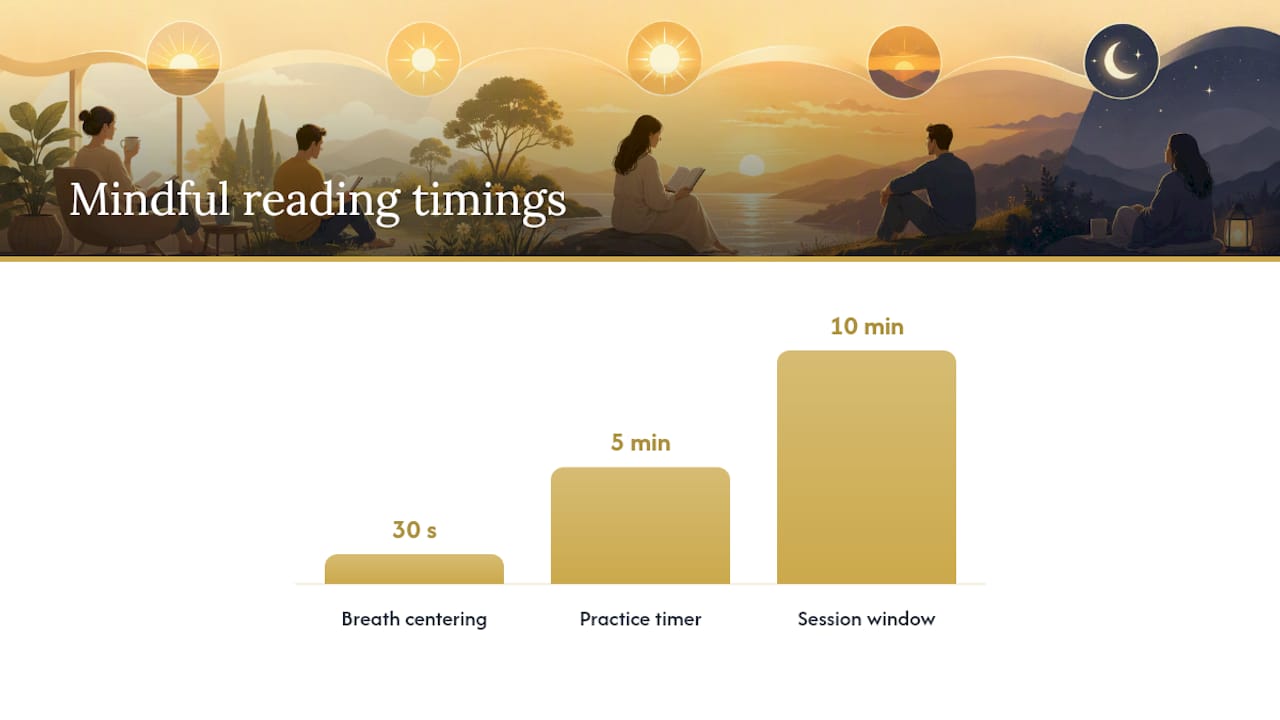
- Center with your breath. Take three slow breaths before you open the book. This settles your nervous system and signals to your brain that this reading session is different from scrolling.
- Read at half speed. Move through sentences more slowly than feels natural. Let words land instead of skimming toward the next paragraph.
- Notice your reactions. When a sentence triggers a memory, a feeling, or a judgment, name it silently and let it pass, the way you would in seated meditation.
- Return attention when it drifts. Your mind will wander. When you notice it has, bring your focus back to the same sentence or the one after it, without criticizing yourself for drifting.
Pro Tip: Set a five-minute timer instead of a page count. Reading toward a clock rather than a finish line removes the urge to rush and makes the practice easier to repeat daily.
A short walkthrough helps make this concrete. Say you sit down with a single page of a memoir. You breathe for thirty seconds, then read the first paragraph slowly, twice. On the second pass, you notice a phrase about loss that catches in your chest. You pause, name the feeling (“this reminds me of my own grief”), and let it settle before continuing to the next paragraph. By the end of ten minutes, you have read maybe a page and a half, but you remember nearly all of it, and you feel steadier than when you started. That density of attention, practice guides on mindful reading note, tends to improve both absorption and enjoyment compared to reading on autopilot.
What Short Exercises Can You Try Today?
Classroom mindfulness instructors have built a handful of short, repeatable exercises that translate well to solo practice. Mindful.org’s guide to simple daily practices includes several that work directly with text.
- Savoring a phrase: Pick one sentence that resonates and reread it three times, sitting with the feeling it produces. Two to three minutes.
- Wrap-around attention: Read a paragraph, then close your eyes and notice bodily sensations before opening them to continue. Five minutes.
- Slow re-read: Read a page at normal speed once, then read it again at half speed, comparing what you notice the second time. Eight to ten minutes.
- Paragraph savor: Choose a single dense paragraph in nonfiction and spend a full five minutes on it alone, pausing after each sentence.
Fiction lends itself to savoring emotional beats and character moments, while nonfiction rewards the slow re-read, since arguments often reveal structure on a second pass. Screen reading works, but print tends to reduce the temptation to switch tabs, so if you are just starting out, a physical book removes one layer of friction.
How Do You Prepare to Practice Mindful Reading?
A few small setup choices make the difference between a session that sticks and one that fizzles.
- Dim overhead lighting or use a reading lamp instead of harsh overhead light
- Put your phone on do not disturb, screen down, out of reach
- Sit upright in a supportive chair rather than lying down, which invites drowsiness
- Set a small timer for five or ten minutes so you are not watching the clock
Pro Tip: Start with short, tactile books written in plain language rather than dense academic texts. A physical paperback with wide margins gives your hands and eyes something to settle into, which matters more than people expect.
Audiobooks can support mindfulness too, but reading with your eyes engages a different kind of attention. The physical act of tracking words on a page tends to anchor wandering focus more effectively than listening passively.
What If Your Mind Keeps Wandering?
Mind-wandering is not a sign you are doing this wrong. It is the most common experience reported by people who try mindful reading, and treating it as expected rather than a failure is what makes the practice sustainable.
- Mind keeps drifting? Gently note “wandering” and return to the last sentence you clearly remember.
- Feeling rushed? Shorten the session to five minutes rather than pushing through irritation.
- Comparing your pace to others? Remind yourself the goal is attention, not speed. Speed-reading actively works against mindful reading because it reinforces the same automatic, passive processing this practice is meant to interrupt.
Pro Tip: Keep a physical bookmark and a single index card nearby. When your mind wanders somewhere important, jot one word on the card instead of following the thought, then return to the page.
What Does Research Say About Reading and Wellbeing?
The strongest evidence comes from reading-for-pleasure research broadly, not from mindful reading as a narrowly studied practice. The 2025 review of 43 papers found seven mechanisms connecting reading to wellbeing, from stress reduction to collective meaning-making, and noted that people’s attitude toward reading shaped how much they benefited. Baylor College of Medicine adds that using a text as a structured anchor can be easier for many people than silent meditation, since the narrative gives wandering attention something concrete to return to.
What the research does not yet show is how mindful reading specifically, as a distinct technique, compares to reading for pleasure generally. Most findings come from broader reading interventions rather than controlled studies of slow, present-moment reading exercises.
- Reading for pleasure and wellbeing review: the seven-mechanism synthesis behind most benefit claims
- Mindful reading and mental health, Baylor College of Medicine: practical framing and the structured-anchor concept
- Mindful: the foundational definition this practice builds on
When Should You Avoid Mindful Reading?
Mindful reading is generally low-risk, but sitting with your reactions can occasionally surface intense emotions if a passage touches on trauma. If reading brings on flashbacks, dissociation, or acute distress, stop and reach out to a mental health professional rather than pushing through alone.
- Pause immediately if a passage triggers overwhelming distress
- Use a grounding technique, like naming five things you can see, before deciding whether to continue
How Do You Turn Mindful Reading Into a Habit?
Small, anchored routines outlast ambitious ones.
- Start tiny. Commit to one paragraph, not one chapter.
- Schedule it. Pick a fixed slot, like right after your morning coffee.
- Pair it with an existing routine. Attach the practice to something you already do daily.
- Track small wins. A single checkmark on a calendar is enough motivation.
A simple checklist covers the essentials: a set time, a consistent place, a clear cue, and a tiny version of the habit you cannot talk yourself out of. One workable implementation intention: “After my morning coffee, I will read one paragraph mindfully for five minutes.” Journaling tools like The Stillness Practice can also give this kind of daily anchor a structured place to live.
Why This Practice Matters After Relationship Harm
I keep coming back to mindful reading because it gives people recovering from gaslighting or manipulation something rare: a slow, structured way to trust their own perceptions again. When someone has spent months doubting what they saw or felt, sitting with a sentence and naming your honest reaction to it is quietly radical. It will not replace therapy, but as a gentle, repeatable anchor for rebuilding clarity, it holds real weight. Books that explore attachment styles often work especially well as a starting text for this kind of practice.

Where to Go Next With Your Reading Practice
Mindful reading works best paired with the right material, and that is where a curated approach helps more than an open-ended reading list. Smartreadshub builds its book recommendations specifically for readers processing relationship harm, so you are not stuck guessing which title will actually support your recovery instead of just distracting you from it.

If gaslighting or manipulation is part of your story, start with what is gaslighting and why you start doubting yourself, then browse the book pairings on how books explain relationship patterns and help you heal to find your first mindful-reading text.
Sources
- Reading for pleasure and wellbeing review (PubMed entry)
- Mindful reading and mental health | Baylor College of Medicine
- What Is Mindfulness? – Mindful
- Mindfulness definition – Greater Good Science Center
- Mindfulness and Reading: Enhance Focus and Enjoyment – Mindfulness Meditation Hub