
Why books uniquely address burnout in women
Books written specifically for women’s burnout do something generic stress guides cannot: they name the system. Not your habits, not your attitude, not your failure to meditate. The system.
Burnout affects women disproportionately because of workplace inequities, gendered emotional labor, and relentless pressure to over-perform in every role simultaneously. Generic burnout resources treat exhaustion as a personal productivity problem. Books written for women recognize it as a structural one, and that distinction changes everything about how recovery feels.
Here is what the best of these books actually do:
- Name the invisible. Concepts like “Human Giver Syndrome” (the cultural pressure on women to give their time, attention, and energy without limit) give readers language for something they have felt but never been able to articulate. Naming it externalizes the cause, which immediately reduces internalized shame.
- Apply gender-specific science. Emily and Amelia Nagoski’s framework for completing the stress cycle address how women’s nervous systems process unresolved stress, not as a metaphor but as a biological mechanism.
- Reject performative self-care. Rather than recommending bubble baths, these books focus on nervous system regulation, genuine rest, and connection as evidence-based recovery tools.
- Shift the blame. When a book argues that the “Bikini Industrial Complex” contributes to women’s chronic stress, it redirects energy away from self-criticism and toward systemic understanding.
- Offer practical exercises. Mental load audits, stress-cycle worksheets, and boundary-setting frameworks give readers something to do with the insight, not just sit with it.
- Validate what medicine often minimizes. Women’s exhaustion is frequently dismissed as anxiety or hormonal fluctuation. These books treat it as a legitimate, diagnosable condition with real causes.
Pro Tip: If you are reading about burnout and the book keeps suggesting you need better time management, put it down. The most effective mental health books for women locate the problem in culture and biology, not in your calendar.
Understanding why books address burnout in women so effectively starts with recognizing that women need resources built around their actual experience, not adapted from research conducted primarily on men.

Top books addressing women’s burnout and their unique contributions
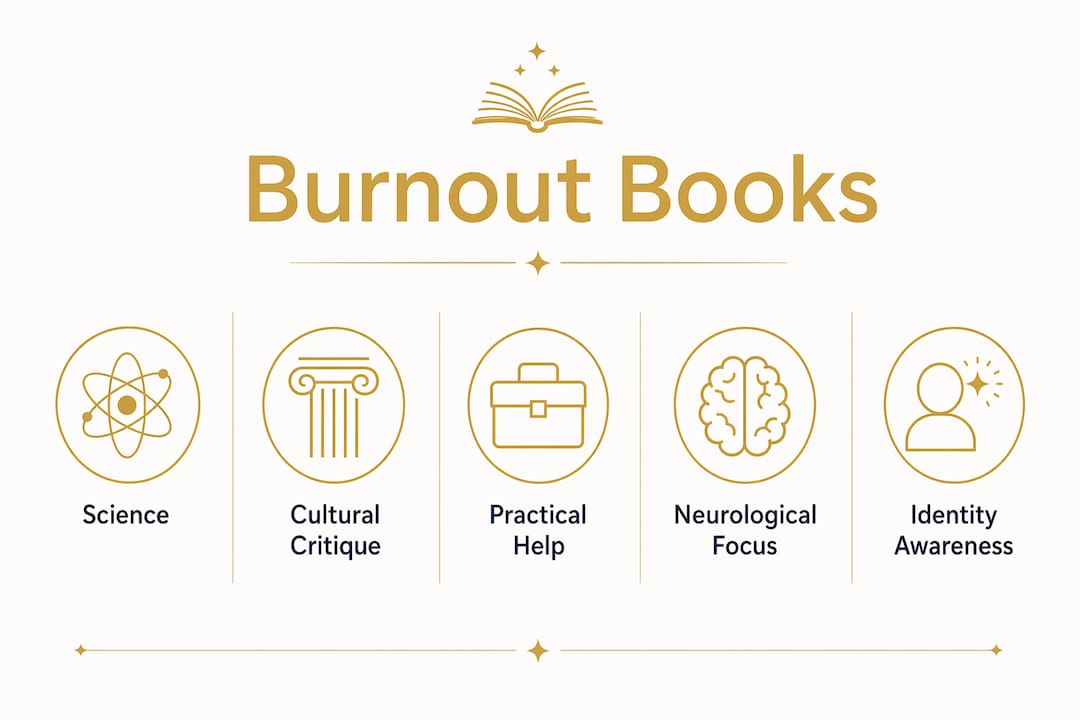
Each of the books below approaches women’s burnout from a distinct angle. Some lead with neuroscience, others with labor economics or cultural critique. The table maps the key differences, and the notes that follow add texture where the table cannot.
| Book | Focus area | Approach | Best for | Unique contribution |
|---|---|---|---|---|
| Burnout: The Secret to Unlocking the Stress Cycle | Stress biology and gender | Scientific + practical | Women wanting a physiological framework | Completing the stress cycle; Human Giver Syndrome |
| Can’t Even: How Millennials Became the Burnout Generation | Generational and cultural critique | Cultural + narrative | Millennial women seeking systemic context | Links burnout to economic precarity and hustle culture |
| Work Won’t Love You Back: How Devotion to Our Jobs Keeps Us Exploited, Exhausted, and Alone | Labor economics and emotional labor | Cultural + critical | Women burned out by workplace devotion | Exposes the myth of “passion work” as exploitation |
| Digital Minimalism: Choosing a Focused Life in a Noisy World | Digital overload | Practical | Women overwhelmed by constant connectivity | Addresses how digital habits compound burnout |
| An Ordinary Age: Finding Your Way In a World That Expects Exceptional | Social expectations and identity | Cultural + reflective | Women pressured by exceptionalism culture | Reframes ordinary life as enough |
| The Good Enough Job: Reclaiming Life from Work | Work-life balance | Practical + cultural | Women reclaiming time from career pressure | Challenges the identity-work merger driving burnout |
Burnout: The Secret to Unlocking the Stress Cycle by Emily and Amelia Nagoski is the book most frequently cited by therapists working with burned-out women, and for good reason. Emily Nagoski holds a PhD in health behavior; her sister Amelia holds a doctorate in musical arts and spent years managing performance-related burnout in musicians. Together they built a framework grounded in stress physiology rather than motivational advice. The central insight: stress is a biological cycle that must be completed, not suppressed. When women chronically interrupt that cycle (because the meeting runs long, because dinner still needs cooking, because rest feels selfish), the incomplete stress response accumulates in the body. The book provides specific, research-backed ways to complete the cycle, from physical movement to creative expression to human connection.
Can’t Even by Anne Helen Petersen reads more like investigative journalism than self-help. Petersen, a former BuzzFeed culture writer, traces millennial burnout to student debt, precarious employment, and the internalization of productivity as identity. For women in their 30s who feel perpetually behind despite doing everything right, this book is less a recovery guide and more a permission slip to stop blaming themselves.
Work Won’t Love You Back by Sarah Jaffe goes further into labor theory. Jaffe argues that the cultural glorification of “doing what you love” functions as a mechanism for extracting unpaid emotional labor, particularly from women, teachers, caregivers, and artists. The book is dense but rewarding, especially for women who have poured themselves into careers that left them empty.
The Good Enough Job by Simone Stolzoff is the most practically oriented of the cultural critiques. Stolzoff interviewed dozens of workers across industries and found a consistent pattern: people who had built their entire identity around their job were the most vulnerable to burnout when that job disappointed them. His prescription is not to care less, but to diversify where meaning comes from.
Digital Minimalism by Cal Newport addresses a burnout factor the other books mostly sidestep: the neurological cost of constant connectivity. Newport’s argument that digital habits compound exhaustion is especially relevant for women who manage family logistics, social obligations, and professional communication across multiple platforms simultaneously.
An Ordinary Age by Rainesford Stauffer targets a specific and underserved source of burnout: the pressure to be exceptional. Stauffer writes for women who feel like they are failing at a standard nobody actually agreed to, and her reframe of ordinary life as genuinely sufficient is quieter than the other books here but no less useful.
Pro Tip: Start with the Nagoski book if you want science. Start with Petersen or Jaffe if you want to understand why you feel this way culturally. Start with Stolzoff if you need to make a practical change at work right now.
Why reading actually works: psychology and expert insights on women’s burnout
Reading is not just a mental break. It builds the capacity to process overwhelming personal narratives, which is exactly what burnout recovery requires.
The clinical term for using books therapeutically is bibliotherapy. It works through several mechanisms: validating emotions that feel too large or too shameful to name aloud, expanding emotional vocabulary so women can identify what they are actually experiencing, and offering structured exercises that create forward momentum. Libraries across the United States now maintain curated reading lists specifically for stress and burnout recovery, which reflects how seriously the mental health field has come to take this approach.
The research on reading and burnout is more specific than most people expect. A study published in BJU International Journal and covered by the American Medical Association found a measurable dose-response relationship between reading nonmedical books and lower burnout rates. Residents who read no nonmedical books each month were the most likely to show burnout symptoms. As reading frequency increased, burnout levels fell. Physical books, notably, are preferred over digital reading to avoid compounding the digital strain that already contributes to exhaustion.
That narrative capacity matters beyond medicine. Women navigating burnout are often dealing with stories they have told themselves for years: that they are not doing enough, that they should be able to handle more, that their exhaustion is a personal flaw. Reading books that offer a different story, one grounded in biology and cultural critique, builds the cognitive tools needed to rewrite those internal narratives.
Interactive tools inside books like Drained by Leah Ruppanner take this further. Ruppanner, a sociologist, identifies eight distinct types of mental load that burden women specifically, including anticipatory labor (thinking ahead so others don’t have to) and emotional management (regulating everyone else’s feelings). Her mental load audit gives readers a structured way to see, for the first time, exactly how much invisible work they are carrying. That visibility alone is therapeutic. The interactive frameworks in books like this one enable women to recalibrate their energy and set boundaries with far more precision than a single piece of advice ever could.
Women also benefit from reading about caregiver burnout specifically, since the caregiving role compounds professional and domestic exhaustion in ways that most workplace-focused books do not fully address.
The neuroscience behind burnout books points to the same conclusion: solutions that emphasize nervous system regulation, genuine human connection, and self-compassion outperform those built on performative positivity. A book that tells you to “practice gratitude” is not the same as one that explains why your nervous system is stuck in a stress response and gives you a physiological exit ramp.
How race, class, and identity shape burnout differently for women
Burnout is not a uniform experience, and the books that address it most honestly say so directly.
A Black woman managing microaggressions at work while carrying the “strong Black woman” cultural expectation faces a burnout load that is categorically different from a white woman in the same job title. The chronic stress of navigating racism, code-switching, and hypervisibility adds layers of physiological and psychological strain that generic burnout frameworks simply do not account for. Books that acknowledge intersectionality recognize that the systemic causes of burnout are not identical across all women.
Class compounds this further. Women in low-wage jobs often cannot access the recovery strategies that burnout books recommend: rest, therapy, reduced hours, or the luxury of setting boundaries with an employer. Anne Helen Petersen’s Can’t Even addresses this directly, noting that millennial burnout is inseparable from economic precarity. The financial stress of student debt, housing costs, and stagnant wages is not a backdrop to burnout. It is a primary driver. For women managing financial stress after 40, resources that connect financial planning to stress reduction can be as relevant as any self-help book.
Identity adds another dimension. LGBTQ+ women, immigrant women, and women with disabilities each carry specific stressors that mainstream burnout literature has historically underrepresented. The most current books in this space are beginning to name these gaps explicitly, acknowledging that a one-size approach to recovery fails the women who need support most. Reading about women’s mental health through an intersectional lens is not a niche interest. It is the only way to get an accurate picture of what burnout actually looks like across real women’s lives.
Key Takeaways
Books written for women’s burnout succeed because they combine gender-specific science, cultural critique, and practical tools in a way that generic stress resources never do.
| Point | Details |
|---|---|
| Gender-specific frameworks work | Books like Burnout by the Nagoskis apply stress biology to women’s actual nervous system patterns, not adapted male-centered research. |
| Naming the system reduces shame | Concepts like Human Giver Syndrome shift blame from personal failure to cultural pressure, which is the first step toward recovery. |
| Reading has a dose-response effect | Research shows burnout levels fall as reading frequency increases, with physical books preferred to avoid digital strain. |
| Intersectionality changes the burnout picture | Race, class, and identity create layered stressors that require books acknowledging those specific experiences, not universal prescriptions. |
| Smartreadshub curates for this gap | Smartreadshub offers evidence-backed book recommendations tailored to women navigating psychological harm, exhaustion, and relational stress. |
What the burnout book conversation is still getting wrong
The genre of women’s burnout books has done something genuinely useful: it moved the conversation from “you need better habits” to “the system is broken.” That shift matters. But there is a version of this conversation that has started to feel like its own kind of pressure.
When every burnout book tells you to complete your stress cycle, audit your mental load, and set firm boundaries, the implicit message can become: if you are still burned out, you are not doing the recovery correctly. That is the same logic the genre was supposed to dismantle. The best books in this space, Stolzoff’s The Good Enough Job and Stauffer’s An Ordinary Age in particular, resist that trap. They do not promise a protocol. They offer a reframe.
The other thing worth saying plainly: reading about burnout is not the same as recovering from it. Dr. Marchalik, whose research established the dose-response link between reading and burnout reduction, was careful to note that reading is not the antidote. Systemic change in work hours, mentorship, and mental health support matters more. Books are a tool for building the narrative capacity to understand your situation and advocate for yourself. They work best alongside therapy, community, and structural change, not instead of those things.
What the Nagoski framework gets right that most others miss is the insistence on completion. Not management. Not coping. Completion. The stress cycle has to finish somewhere in the body, and for women who have spent years interrupting it, that is a genuinely new idea. The books that will matter most in the next decade are the ones that take that insight further into the specific contexts of race, class, and identity, where the stress cycles are longest and the recovery resources are fewest.
Smartreadshub offers a different path into these conversations
The books covered here are a strong starting point. But burnout in women rarely exists in isolation. Exhaustion, self-doubt, and the erosion of personal boundaries often intersect with dynamics in relationships that are harder to name, including gaslighting, emotional manipulation, and patterns of narcissistic behavior that leave women questioning their own perception.
Smartreadshub is built specifically for that overlap. Rather than broad wellness advice, it offers curated book recommendations and evidence-backed guides focused on the psychological harm that often underlies or worsens burnout: how books explain relationship patterns, how to recognize manipulation, and how to rebuild trust in your own judgment. For women who have read the burnout books and still feel stuck, the missing piece is often relational. Smartreadshub’s guide to empowering women through reading is a practical next step for anyone ready to go deeper.