
Most people assume reading is something you do to pass time. The science says otherwise. Research into why psychology books aid healing reveals something genuinely surprising: the act of reading and writing about emotional experiences can speed up physical wound recovery, strengthen your immune system, and reduce symptoms of anxiety and depression. This is not self-help hype. These are measurable, peer-reviewed outcomes. If you are going through something hard right now, this guide will show you exactly how healing through mental health books works, what the research actually says, and how to get the most out of it.
| Point | Details |
|---|---|
| Books are active healing tools | Psychology reads engage your brain in emotional processing, not just passive entertainment. |
| Guided reading outperforms solo reading | Structured bibliotherapy with some professional support matches face-to-face therapy for mild to moderate conditions. |
| Physical benefits are real | Expressive writing linked to reading has been shown to accelerate wound healing and improve immune markers. |
| Pacing and mindset matter | Expecting discomfort early in the process is normal and a sign the work is happening. |
| Pairing books with journaling deepens results | Writing alongside reading amplifies the emotional regulation benefits significantly. |
When you read a psychology book that speaks to your experience, something specific happens in your brain. You start naming what you feel. That act of labeling an emotion, putting language to something that felt shapeless and overwhelming, actually calms your nervous system. Neuroscience calls this “affect labeling,” and it reduces activity in the amygdala, the part of your brain responsible for fear and stress responses.
Psychology books go further than just naming feelings. The best ones teach concrete skills: how to challenge distorted thinking patterns, how to sit with discomfort without being consumed by it, how to regulate your nervous system during a panic spiral. These are the same techniques used in cognitive behavioral therapy and dialectical behavior therapy. The difference is that a book makes them available at 2 a.m. when no therapist is reachable.
The benefits of psychology books extend into your body as well. Writing about trauma leads to measurably higher T-cell counts and lower blood pressure, according to expressive writing research. When you read content that mirrors your experience and then write about your reaction to it, you are essentially doing a form of expressive therapy at home.
Pro Tip: After each chapter that resonates with you, spend five minutes writing freely about what came up. You do not need structure or complete sentences. Just let it out. This pairing of reading and writing is where the deepest emotional regulation tends to happen.
Here is what that looks like in practice:
This process transforms reading from a passive activity into something closer to self-guided therapy. The importance of self-help literature lies precisely in this: it gives you a structured framework for understanding your own mind when professional support is not immediately available.
There is an important distinction that most articles skip over. Reading a psychology book on your own and participating in guided bibliotherapy are not the same thing. Both have value, but they produce different outcomes.
Bibliotherapy, in its clinical form, involves selecting specific texts for a patient and pairing that reading with structured sessions, either with a therapist, counselor, or trained facilitator. The reader is not just consuming information. They are applying it, discussing it, and being held accountable to the process. Guided self-help programs matched psychotherapy effectiveness for mild to moderate depression and anxiety, with results lasting up to one year, according to a published meta-analysis.
Solo reading, by contrast, depends entirely on your own motivation and self-awareness. It can still be transformative. But dropout rates are higher, and the risk of misapplying concepts or avoiding the most uncomfortable material is real.
Here is a comparison to help you decide which approach fits your situation:
| Approach | Best for | Limitations |
|---|---|---|
| Guided bibliotherapy | Mild to moderate depression, anxiety, phobias | Requires access to a professional or structured program |
| Solo self-help reading | Personal growth, building coping skills, mild stress | Higher dropout risk, no accountability |
| Therapist-recommended books | Complement to ongoing therapy | Depends on therapist’s familiarity with literature |
| Reading groups or peer support | Social connection alongside healing | Varies in quality and focus |
One thing worth understanding: three guided sessions can help patients plan and apply self-help reading far more effectively than reading alone. Even a single conversation with a counselor about what you are reading can change how you engage with the material.
There are also important cautions. Bibliotherapy is not recommended as a standalone treatment for eating disorders, where detailed content can inadvertently reinforce harmful behaviors. For recent trauma or acute crisis, professional support should come first. Books work best as a complement, not a replacement, for clinical care in serious cases.
This is where the science gets genuinely surprising. Most people accept that reading might reduce stress. Fewer people know that it can accelerate physical healing.
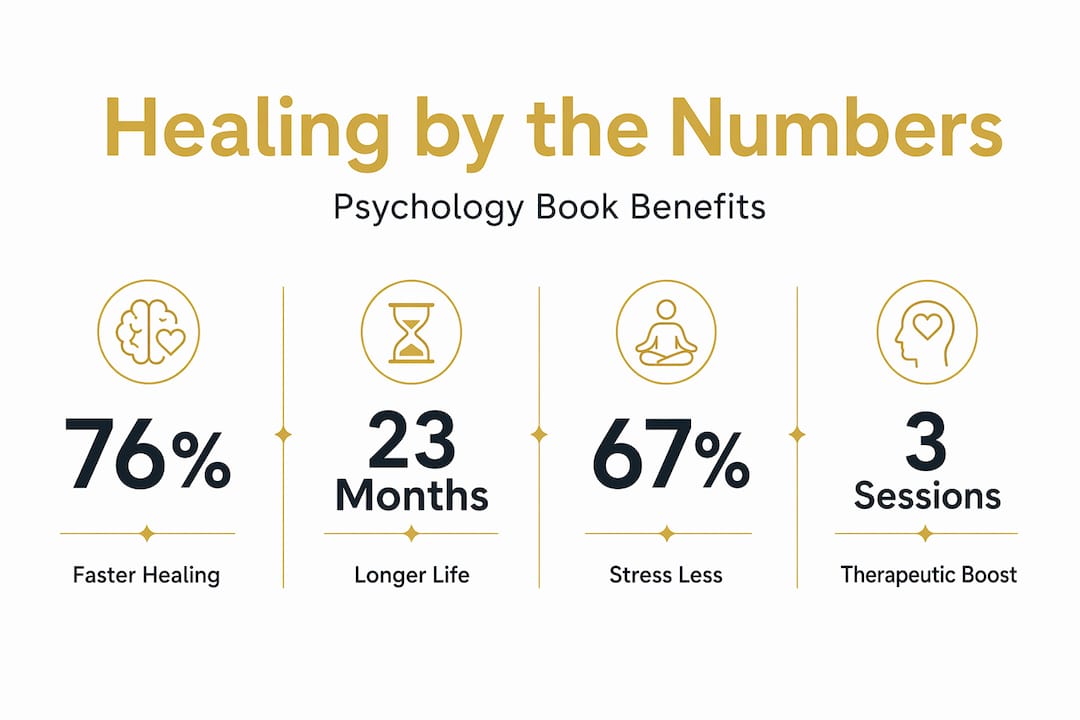
In one striking study, 76% of expressive writing participants healed biopsy wounds within 11 days, compared to only 42% in the control group. The act of processing emotions through writing created measurable changes in how the body repaired itself. That is not a metaphor. That is biology.
The role of books in emotional healing connects directly to this. When you read content that helps you construct a narrative around painful experiences, you are doing the same cognitive work that expressive writing does. Constructing a narrative around trauma is a crucial step toward emotional processing, and psychology books provide the scaffolding for that narrative.
The longevity data is equally striking. Reading daily for 30 minutes is linked to an average of 23 months of longer life. Researchers believe this is partly due to cognitive engagement and partly due to stress reduction. Both matter enormously for people in emotional distress, where chronic stress accelerates physical decline.
One nuance worth knowing: the immune benefits of expressive writing are not permanent without continued engagement. This is not a one-and-done intervention. The healing that comes from psychology reads for personal growth requires ongoing practice, not a single weekend with a book.
Not every psychology book will help you heal. Some will frustrate you. Some will feel irrelevant. A few will feel like they were written specifically for your situation. Knowing how to find those is half the battle.
Start with these criteria when selecting a book:
Once you have selected a book, your reading mindset matters as much as the content. Go slowly. Give yourself permission to stop when something hits hard and sit with it before moving on. Fiction immerses readers and helps process emotions without avoidance, which is why alternating between psychology books and emotionally resonant fiction can actually support the healing process.
Pro Tip: Set a reading pace of no more than one chapter per sitting when working through emotionally heavy material. Your nervous system needs time to integrate what it is processing. Rushing through a book on grief or trauma is like trying to sprint through physical therapy.
The most common pitfall is using reading as avoidance rather than engagement. If you find yourself consuming book after book without ever doing the exercises, reflecting on what you read, or changing anything in your daily life, the reading has become a comfort habit rather than a healing practice. The goal is application, not accumulation.
Smartreadshub has curated a range of psychology and healing books organized by topic, making it easier to find titles matched to your specific situation rather than browsing blindly.
I have watched a lot of people approach self-help reading the wrong way, and I have done it myself. The instinct is to find the book that will explain everything and fix everything. You read it fast, highlight half the pages, and feel a surge of clarity. Then two weeks later, nothing has changed.
What I have learned is that the discomfort that comes up during expressive reading is not a sign something is wrong. It is a sign the work is actually happening. Emotional distress often surges initially before mood improves significantly within weeks. Most people quit during that surge and conclude the book did not work. They were actually right at the threshold of a breakthrough.
The other thing most people miss about guided bibliotherapy is the “guided” part. Reading combined with professional guidance maximizes benefit and reduces dropouts. Even one session with a therapist, a counselor, or a knowledgeable friend who has read the same book can change everything. You stop reading passively and start reading with intention.
My honest opinion: psychology books are one of the most underused mental health resources available. They are accessible, affordable, and backed by real science. But they require you to show up for them, not just open them. The healing is in the engagement, not the reading itself.
— Robert
If this article has you thinking about which psychology book to pick up next, Smartreadshub is built exactly for that moment.
Smartreadshub curates psychology and self-help book recommendations organized by condition, theme, and therapeutic approach. Whether you are working through anxiety, processing grief, or simply building better emotional tools, the curated book collection at Smartreadshub gives you a starting point that is already filtered for quality and relevance. You will not spend an hour reading reviews on a book that turns out to be vague or unhelpful. The site also maintains an affiliate disclosure so you always know how recommendations are made. Browse the categories, find a title that matches where you are right now, and start reading with purpose.
Psychology books teach evidence-based coping skills, help readers name and process emotions, and provide structured frameworks for understanding difficult experiences. Research shows that reading and expressive writing both produce measurable improvements in mental and physical health.
For mild to moderate depression and anxiety, guided bibliotherapy has been shown to match face-to-face therapy in effectiveness, with results lasting up to one year. Professional support enhances outcomes further, especially for more serious conditions.
Mood improvements from expressive writing and structured reading typically emerge within a few weeks, though initial discomfort is common and normal. Consistency matters more than speed.
Yes, and that is expected. Confronting difficult emotions through reading or writing often causes a temporary increase in distress before improvement occurs. This is a recognized phase of the healing process, not a reason to stop.
Books grounded in CBT, ACT, or DBT, especially workbook-style editions with exercises and reflection prompts, tend to produce the strongest outcomes for people working through anxiety, depression, grief, or trauma.