
Women are the primary consumers of self-help literature. Women purchase approximately 74% of all self-help books sold in the United States, making them the cornerstone of a global self-improvement market estimated at over $40 billion annually. That figure is not a coincidence. It reflects a deliberate industry strategy built on psychological, cultural, and market forces that have shaped female-focused self-help into its own genre. Understanding why self-help books target women reveals both the real pressures women face and the mechanisms publishers use to keep them buying.
Why self-help books target women: the data behind the dominance
The numbers tell a clear story. Women represent roughly 60% of all self-help readers, and their engagement extends well beyond books. Podcast listenership among women tripled from 15% in 2015 to 45% in 2025. That shift shows women are not just reading self-help content. They are consuming it across every available format.
The self-help industry recognized this pattern early. Publishers, podcast producers, and wellness brands all followed the same audience. The result is a media ecosystem built almost entirely around women’s self-improvement needs.

The table below shows how female and male consumption of self-help content compares across key formats.
| Format | Female readers/listeners | Male readers/listeners |
|---|---|---|
| Self-help books | ~74% of purchases | ~26% of purchases |
| Self-help podcasts | ~45% listenership (2025) | Lower engagement |
| Self-help readers overall | ~60% of total readership | ~40% of total readership |
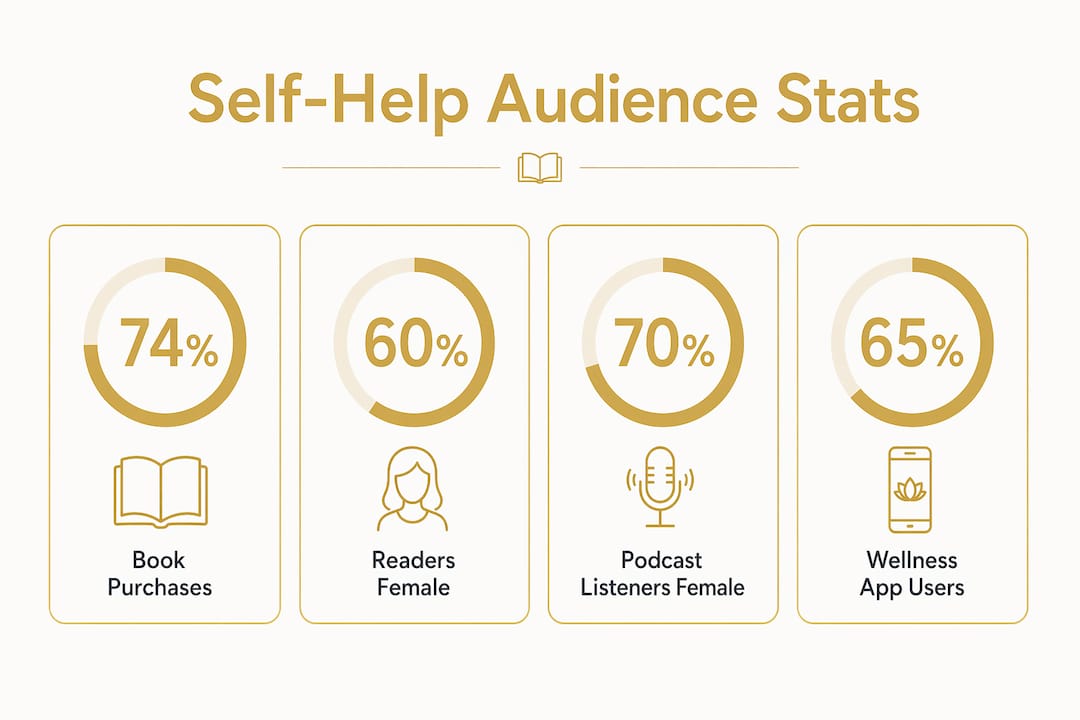
The concentration of women in every column reflects a self-reinforcing cycle. Publishers produce more content for women because women buy more. Women buy more because the content speaks directly to their experiences. That cycle is worth examining closely.
Pro Tip: If you notice that most self-help books on your shelf are written for women, you are not imagining it. The genre was built around you, for better and for worse.
What psychosocial challenges do self-help books address for women?
Self-help content for women frequently focuses on perfectionism, people-pleasing, and imposter syndrome. These are not random topics. They reflect real pressures that high-achieving women face in professional and personal settings. Publishers know this, and they build entire catalogs around it.
The most popular themes in female-focused self-help include:
- Boundary setting: Teaching women to say no without guilt, particularly in relationships and workplaces.
- Burnout recovery: Addressing the physical and emotional cost of overextending in caregiving and professional roles.
- Emotional labor: Helping women recognize and reduce the invisible work they carry in relationships.
- Self-worth and confidence: Countering the internal critic that many women develop through social conditioning.
- Relationship healing: Supporting women navigating toxic dynamics, gaslighting, or narcissistic abuse.
These themes resonate because they map directly onto women’s lived experiences in ways that mainstream psychology and healthcare often miss. A book that names your exact struggle feels like a lifeline. That emotional recognition is a powerful sales driver.
Pro Tip: When choosing a self-help book, look for one that names the systemic pressure, not just the personal symptom. Books that only tell you to “do better” without acknowledging what you are up against will leave you feeling like the problem.
How cultural narratives shape the targeting of women in self-help
The industry does not just respond to women’s needs. It actively shapes how women perceive those needs. The self-help industry frames women’s challenges as personal emotional regulation issues, diverting attention from systemic inequality. That framing keeps the focus on internal change while external systems stay untouched.
This is not accidental. Four cultural mechanisms drive the targeting of women in self-help:
- “Good girl” conditioning. Women are socialized to see themselves as ongoing projects needing constant improvement. This creates a reliable repeat-purchase cycle for publishers rooted in psychological and cultural conditioning.
- The “broken woman” narrative. Books for men focus on external performance and optimization. Books for women frame their audience as needing preparation and refinement before they can achieve success. That framing ensures ongoing demand.
- The individualistic trap. Self-help’s individualistic approach traps women into blaming themselves for systemic or relational problems. When change does not come, the reader assumes she did not try hard enough, and buys the next book.
- “Priv-lit” culture. Many female-focused self-help books incorporate high-cost lifestyle elements, promoting wellness aesthetics tied to spending rather than lasting change. The empowerment is real, but it comes with a price tag.
The women’s self-help curriculum is a product of cultural conditioning that frames women’s lives as needing preparation and fixing before success or fulfillment can be achieved. This is not empowerment. It is a market strategy dressed as one.
Understanding this does not mean self-help books are worthless. It means you read them with your eyes open. The emotional labor in relationships that these books address is real. The systemic pressure that creates it is also real. The best books acknowledge both.
What are the real benefits and pitfalls of self-help for women?
Women turn to self-help for a specific reason. Conventional healthcare often dismisses complex symptoms like hormonal shifts and chronic fatigue as stress or aging. That dismissal leaves women seeking answers and validation outside traditional systems. A well-chosen book fills that gap in ways a 15-minute doctor’s appointment cannot.
Self-help literature works best when it does three things. First, it names the reader’s experience accurately. Second, it offers concrete behavioral shifts rather than expensive lifestyle overhauls. Third, it acknowledges that the reader is not the sole source of her problems. Books that do all three produce real, lasting change.
The pitfalls are equally real:
- The blame cycle. When a book frames every problem as a mindset issue, readers internalize failure when change does not happen fast enough.
- Spending as healing. “Priv-lit” titles promote retreats, supplements, and coaching programs that most readers cannot sustain. Sustainable change comes from simple behavioral shifts, not expensive aesthetics.
- Isolation instead of community. Self-help positions healing as a solo project. Real recovery, especially from toxic relationships, requires connection and community.
- Ignoring systemic factors. A book on confidence does not fix a workplace that punishes assertive women. Reading without systemic awareness can increase frustration rather than reduce it.
The most effective approach treats self-help as one tool among many. Pair a book on boundary setting with actual conversations, therapy, or community support. The book opens the door. You still have to walk through it with other people beside you.
Pro Tip: Before buying a self-help book, read the first chapter. If the author blames your mindset without acknowledging the world you live in, put it down. The best books for women hold both truths at once.
Key Takeaways
Women are the self-help industry’s primary audience because cultural conditioning, systemic dismissal, and deliberate market targeting have made them both the most engaged readers and the most profitable consumer base in the genre.
| Point | Details |
|---|---|
| Women dominate the market | Women purchase approximately 74% of self-help books sold in the United States. |
| Engagement spans formats | Podcast listenership among women tripled from 15% in 2015 to 45% in 2025. |
| Themes reflect real pressures | Perfectionism, people-pleasing, and burnout are the most common topics in female-focused self-help. |
| Cultural framing drives demand | “Good girl” conditioning and the “broken woman” narrative create a repeat-purchase cycle for publishers. |
| Read critically for best results | Books that acknowledge systemic factors alongside personal change produce more lasting results. |
What I have learned from watching women read self-help
The self-help genre has done something genuinely useful for women. It gave language to experiences that medicine and culture spent decades ignoring. Words like “gaslighting,” “emotional labor,” and “people-pleasing” entered everyday conversation through books, not therapy offices. That matters.
What concerns me is the next layer. When a woman reads her fifth book on confidence and still feels stuck, the problem is rarely her. The problem is that the book sold her a personal solution to a structural problem. The workplace that punishes her assertiveness did not change. The relationship that drains her did not change. Only her self-perception shifted, temporarily.
The future of female-focused self-help is moving toward community and systemic awareness. The books I find most credible now are the ones that say plainly: “This is not all your fault, and reading alone will not fix it.” That honesty is rare, and it is worth seeking out. Approach self-help with the same critical eye you would bring to any other information source. Take what names your experience accurately. Leave what tells you the world is fine and only you need fixing.
— Robert
Curated reads for women ready to go deeper
Smartreadshub exists for exactly the moment when a book recommendation feels like it could change everything. The site curates book recommendations for women navigating emotional healing, toxic relationships, and the hard work of rebuilding self-worth. Every list is built around real emotional experiences, not bestseller charts.
If you are recovering from a relationship that left you questioning your own reality, the emotional recovery resources on Smartreadshub point you toward books that address gaslighting, narcissistic abuse, and manipulation with clarity and compassion. You will also find guides on books by women authors who write from lived experience, not theory. The right book at the right moment does not fix everything. It gives you a foundation to stand on while you do the rest.
FAQ
Why do women buy more self-help books than men?
Women purchase approximately 74% of self-help books in the United States. Cultural conditioning, systemic dismissal by healthcare, and content specifically designed around women’s psychosocial challenges all drive this purchasing pattern.
What topics do self-help books for women focus on most?
The most common themes are perfectionism, people-pleasing, imposter syndrome, boundary setting, and burnout recovery. These topics reflect real social pressures that women face in both professional and personal relationships.
Is the self-help industry actually helping women?
Self-help books provide real value when they name women’s experiences accurately and offer concrete behavioral shifts. The risk is that the individualistic framework can lead women to blame themselves for systemic problems rather than recognizing external factors.
What is “priv-lit” and why does it matter for women readers?
“Priv-lit” refers to self-help books that tie empowerment to high-cost lifestyle choices like retreats, supplements, or coaching programs. Sustainable change comes from simple behavioral shifts, not expensive wellness aesthetics, so readers should approach these titles with caution.
How can women use self-help books more effectively?
Choose books that acknowledge both personal and systemic factors. Pair reading with community support, therapy, or real-life conversations. A book that only addresses mindset without recognizing structural inequality will produce limited, short-term results.