
Workplace gaslighting, as this guide defines it, describes the same manipulation tactics playing out when a partner, family member, or ex distorts your reality rather than a colleague or boss. If you feel like you’re constantly apologizing for things that aren’t your fault, The Hotline confirms that’s a recognized pattern, not a personal failing. Start tonight: open a private note on your phone or a notebook only you can access, and write down exactly what happened, with the date. This resource is built to provide that exact starting point.
TL;DR:
- Document incidents immediately with dates, exact words, and screenshots to build evidence for safety and legal protection.
- Use trusted outside perspectives, such as friends or therapists, to counteract the mental fog created by gaslighting.
- Rely on trauma-informed therapy and structured recovery books that focus on practical exercises rather than just reading material.
- Separate personal safety issues from workplace concerns, and keep records of any manipulation affecting your professional life for HR or legal actions.
- Recognize that long-term recovery involves consistent journaling, therapy, and support, not quick fixes or single resources.
Table of Contents
- What Are the Common Signs of Gaslighting You Might Be Living With?
- How Does Gaslighting Erode Your Ability to Trust Yourself?
- What Should You Do Right Now to Stay Safe and Keep Evidence?
- Which Books Actually Help, and How Should You Use Them?
- What Kind of Therapy Actually Helps With Gaslighting Recovery?
- What Tactics Show Up When Gaslighting Follows You Into Work?
- Personal Gaslighting vs. Workplace Bleed-Through: What’s Different?
- Can Personal Gaslighting Actually Hurt Your Career?
- How Do You Address This Kind of Manipulation When It Touches Your Job?
- What Legal Protections Exist if Manipulation Affects Your Job?
- What Can Employers Do to Prevent This Spillover Into the Workplace?
- Robert’s Take: Why Books Alone Rarely Finish the Job
- Where to Find Practical Scripts and Recovery Tools Right Now
- Where Else Can You Turn for Immediate Support?
- Sources
What Are the Common Signs of Gaslighting You Might Be Living With?
Gaslighting rarely announces itself. It shows up as a slow accumulation of small moments where your version of events gets overwritten by someone else’s, until you stop trusting your own memory. Verywell Mind documents the red flags that survivors most often describe tend to cluster into a few repeating patterns.
- Flat denial that something happened, even when you have a clear memory of it.
- Trivializing your feelings (“You’re too sensitive,” “It was just a joke”).
- Rewriting shared history to make you look unstable or unreasonable.
- Intermittent warmth that keeps you hoping things will go back to “normal.”
- Isolating comments that make friends or family seem unreliable or biased against you.
Picture this exchange: you mention a conversation from last week, and the response is, “That never happened. You’re remembering it wrong again.” Or you bring up a broken promise, and it becomes a lecture about your “bad memory.” Or you get the silent treatment for three days, then sudden affection with no explanation. If your stomach tightens before you even finish a sentence, or you’re apologizing before you know what you did wrong, that physical reaction is information. Start keeping evidence now, even informally.
How Does Gaslighting Erode Your Ability to Trust Yourself?
Gaslighting works differently than an argument or a lie. It’s a gradual, insidious process that specifically targets your perception of reality, not just a single fact, according to The Hotline. Over time, that targeting produces mental fog, memory doubt, and a growing dependency on the gaslighter to tell you what’s “true.”
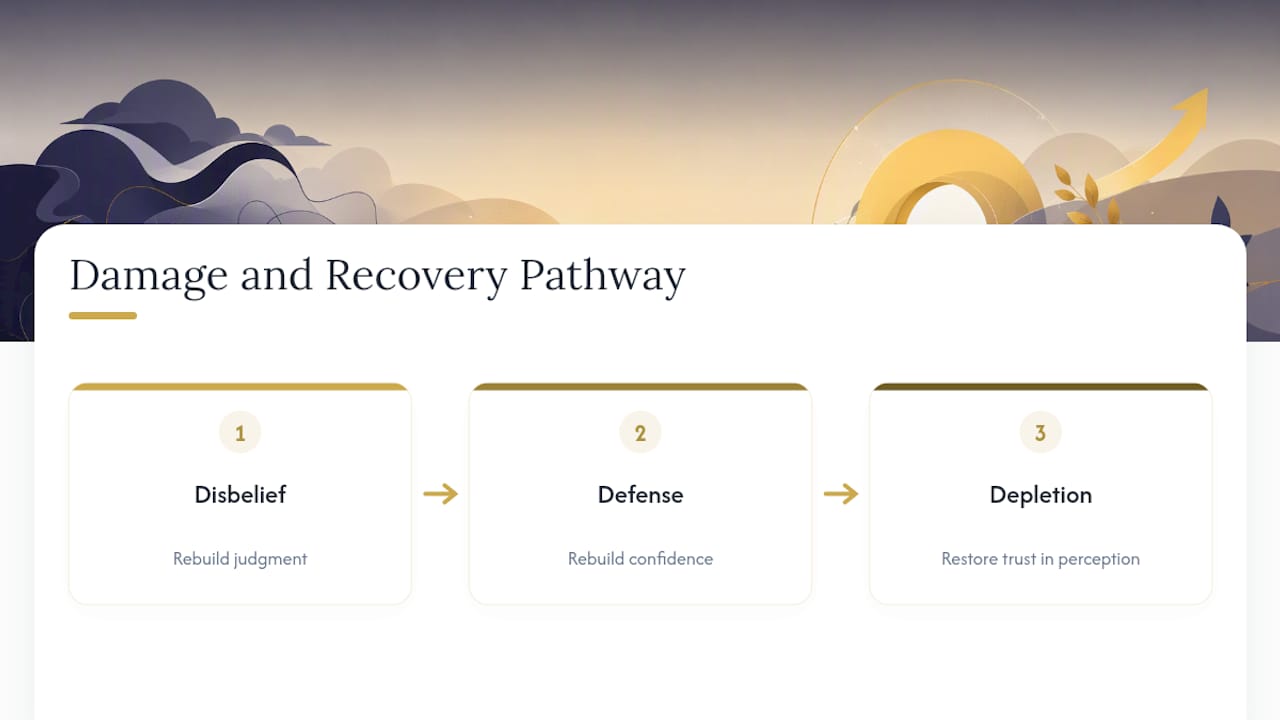
Clinicians and recovery writers generally describe the damage in three overlapping stages: disbelief (you notice something is off but dismiss it), defense (you start over-explaining and justifying yourself constantly), and depletion (you stop trusting your own judgment entirely and defer to theirs). Recovery tends to mirror those stages in reverse, rebuilding judgment first, then confidence, then trust in your perception again.
This is also why generic relationship advice, like “communicate better” or “see both sides,” can actually cause harm here. Standard conflict-resolution tools assume both people are operating in good faith. When one person is intentionally distorting reality, “compromise” just hands them more leverage.
What Should You Do Right Now to Stay Safe and Keep Evidence?
Safety comes before analysis. If you are ever in immediate danger, call 911 or your local emergency number first, then use these steps.
- Save trusted phone numbers, including a friend, family member, or a local shelter, somewhere the other person can’t access.
- Write down what happened as soon as possible, with the date, time, and exact words if you remember them.
- Screenshot texts, emails, or messages and back them up somewhere outside the shared device, like a personal email account or cloud folder.
- If leaving the situation is part of your plan, quietly gather essential documents, a spare set of keys, and some cash before you need them.
- Call a trusted friend and describe what happened in plain terms, then ask, “Does that sound reasonable to you?”
That last step matters more than people expect. Outside perspective is often the fastest way to break the fog gaslighting creates, and HelpGuide recommends exactly this kind of reality check as part of recovery.
Pro Tip: Keep a second, low-key journal in a note-taking app disguised under a boring name, like “Grocery List,” in case device privacy is a concern.
If you want ready-made language for these moments, a guide to scripts and safe responses offers exact phrasing you can adapt without freezing in the moment.
Which Books Actually Help, and How Should You Use Them?
Not every self-help book earns a place on this list. The ones that do are chosen because they give you something to do, not just something to read.
- The Gaslight Effect Recovery Guide by Dr. Robin Stern: This works best as a workbook, not a straight read. Its prompts and checklists are built for journaling and identifying gaslighting patterns in real time, so keep it open beside your notebook rather than finishing it cover to cover.
- Gaslighting Recovery for Women by Amelia Kelley, PhD: Treat this as a three-part program rather than a single sitting. It leans on structured, trauma-informed exercises with DBT and mindfulness techniques, so pace it over weeks, not days.
- A title focused on nervous-system repair through somatic exercises, useful once you’ve named the pattern and need to calm your body’s stress response, not just your thoughts.
- A book centered on trauma processing, better suited for later in recovery when you’re ready to work through the emotional weight rather than just the facts.
- A book built around anger work, which matters because anger that gets suppressed during a gaslighting relationship often surfaces later and needs somewhere safe to go.
Pair whichever book you start with a therapist check-in, even monthly, and don’t rush the reading. Guided journaling gives you immediate reality-testing practice you can use before therapy even starts, which is often the fastest way to feel steadier day to day. A full curated book list breaks these down further by use case.
What Kind of Therapy Actually Helps With Gaslighting Recovery?
Trauma-informed individual therapy is generally the safest starting point, often paired with EMDR, somatic approaches, or DBT-informed techniques to work through both the mental and physical impact. GoodTherapy notes that a good therapist functions almost like a flight attendant during turbulence, stabilizing your sense of reality rather than treating the conflict as two equally valid sides.
That’s exactly why standard couples therapy can backfire when gaslighting is active. It’s built around symmetrical conflict, and a skilled manipulator can use that structure to reframe the abuse as “miscommunication.” Couples therapy may become appropriate later, only after individual work and clear accountability.
Ask any prospective therapist: “How do you handle situations involving coercive control or gaslighting specifically?” Realistic progress often involves gradual restoration of trust in your own memory over time, with full reconnection to your instincts requiring longer periods.
What Tactics Show Up When Gaslighting Follows You Into Work?
The manipulation doesn’t stop at your front door. When you’re recovering from gaslighting by a partner, family member, or ex, the same tactics often bleed into how you interact at work, especially if the person has any connection to your job, your income, or your professional reputation.
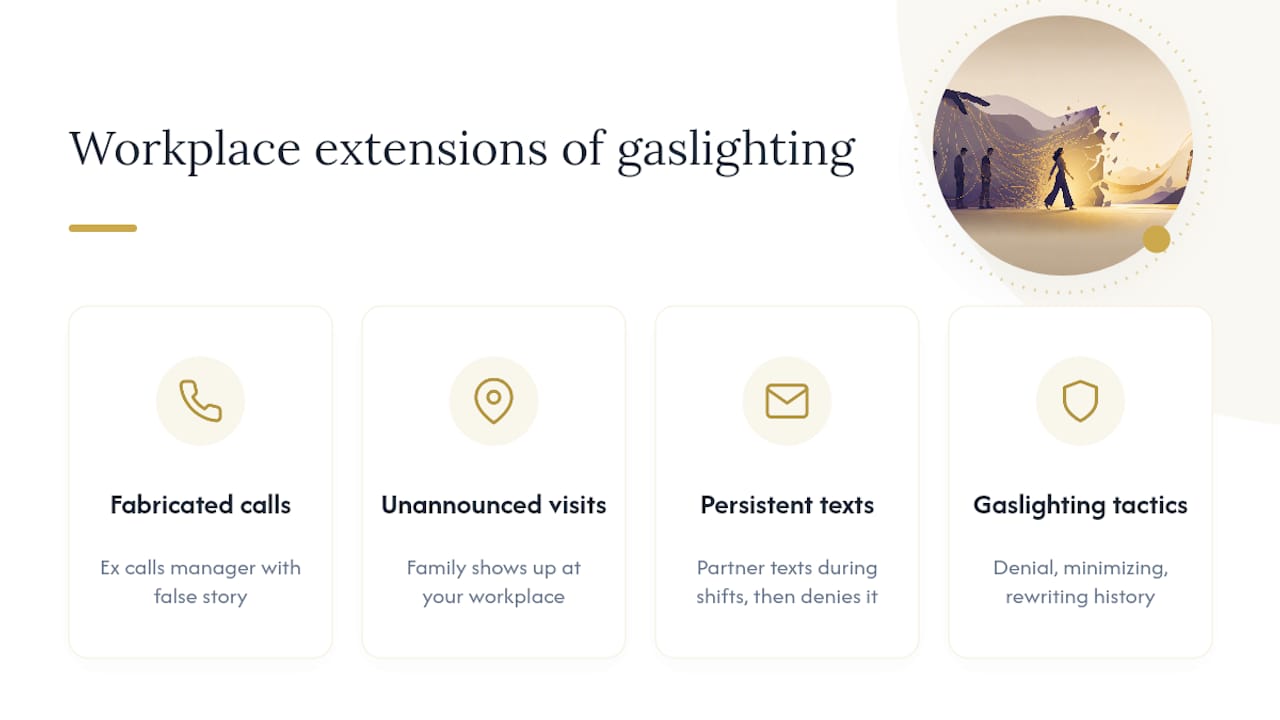
An ex who calls your manager with a fabricated story. A family member who shows up unannounced at your workplace to “check in.” A partner who texts constantly during your shift, then denies doing it when you mention feeling distracted or unsafe. These aren’t separate problems from the relationship gaslighting itself. They’re extensions of it, designed to keep you destabilized in every part of your life, not just at home.
The tactics show familiar patterns such as denial, minimizing, and rewriting history about what was actually said or agreed to. What makes this version harder to name is that it often gets misread as a “workplace conflict” rather than what it actually is: personal manipulation extending into a space where you’re supposed to feel competent and safe.
If a partner or ex’s behavior is affecting your ability to function at your job, that’s worth naming clearly to a trusted friend or therapist, using language like, “This isn’t a work problem. This is the same manipulation following me here.”
Personal Gaslighting vs. Workplace Bleed-Through: What’s Different?
The core mechanism is identical: someone distorts your reality until you stop trusting your own judgment. What changes is the setting, and that changes your options.
At home, you might have privacy, distance, or the ability to leave a room. At work, you often can’t excuse yourself from a shared email thread or a mutual acquaintance who reports back to your ex. The stakes also shift. Gaslighting from a partner threatens your sense of self and safety in intimate spaces; when it bleeds into your job, it threatens your income and professional reputation too, which raises the pressure to just “get through it” instead of addressing it.
There’s also a trust gap. Coworkers and managers usually don’t know your relationship history, so manipulation tactics that would be obvious to a close friend, like a sudden bad mood after a call from your ex, can look like unrelated personal drama at work. That gap is exactly why documentation matters even outside the relationship itself. If a partner’s behavior starts affecting your professional life, treat it with the same seriousness as any other safety concern, and keep a record the same way you would at home.
Can Personal Gaslighting Actually Hurt Your Career?
Yes, and the damage is often underestimated because it doesn’t look like a performance problem on the surface. Chronic self-doubt from gaslighting shows up as second-guessing decisions you used to make confidently, over-apologizing to coworkers, or freezing during feedback conversations that used to feel routine.
Sleep disruption, hypervigilance, and constant mental replay of arguments all pull cognitive resources away from your actual job. You might notice yourself rereading emails five times before sending them, or feeling disproportionately shaken by ordinary criticism from a manager. That’s not a work ethic issue. It’s the same reality-testing damage described earlier, showing up in a new context.
Long-term, this can quietly stall promotions or project opportunities, not because your skills declined, but because gaslighting drains the confidence needed to advocate for yourself. Recognizing that connection matters, because it reframes career struggles as a symptom of the abuse, not a separate personal shortcoming to fix on your own.
How Do You Address This Kind of Manipulation When It Touches Your Job?
Start by separating what’s actually a workplace issue from what’s personal manipulation showing up in a professional setting. If an ex is contacting your job directly, that’s a boundary and safety issue your HR department or manager can help address, even without disclosing every relationship detail.
A simple, factual script works better than a full explanation: “I’m dealing with a personal situation, and I need [specific contact] to stop reaching me at work.” Document each incident with dates and exact details, the same way you would for any evidence-keeping practice. If the behavior escalates, a workplace safety plan through HR can include options like call screening or altered building access.
For readers navigating harassment that has moved into legal or workplace-formal territory, understanding documented examples of workplace harassment can help clarify which behaviors cross a legal threshold versus which stay in the realm of personal conflict resolution. Keep your language with HR specific and behavioral, not emotional; describe what happened, not how it felt, since that framing tends to move faster through formal channels.
What Legal Protections Exist if Manipulation Affects Your Job?
Legal protection generally depends on what form the manipulation takes once it reaches your workplace. If a partner or ex is stalking, harassing, or threatening you at your job, most states allow protective orders that can specifically restrict contact at your workplace address, and many employers will honor a copy of that order for security purposes.
Separately, if a manager or coworker is participating in isolating or undermining you because of a personal relationship connection, that may fall under broader workplace harassment protections depending on your state and employer policy, though this varies significantly by jurisdiction. A documented pattern, dates, screenshots, and witness names, makes any legal or HR process move faster and carries more weight than a verbal complaint alone.
This isn’t a substitute for legal advice specific to your state, but the evidence habits described earlier in this guide double as the foundation for any future legal action, personal or professional.
What Can Employers Do to Prevent This Spillover Into the Workplace?
Employers play a real role here, even when the root cause is a personal relationship outside work. Clear policies on workplace safety, including protocols for handling contact from an employee’s personal relationships, give managers a script instead of leaving them to improvise.
Training that helps managers recognize the signs of an employee struggling with outside manipulation, missed deadlines paired with visible anxiety, sudden defensiveness, or unexplained absences, can prompt a supportive conversation instead of a disciplinary one. A confidential HR channel where employees can flag personal safety concerns without full disclosure also matters, since many survivors aren’t ready to explain the full situation but still need practical accommodations like schedule flexibility or building security awareness.
None of this replaces the personal recovery work described throughout this guide. But an employer who treats safety concerns seriously, rather than dismissing them as “personal drama,” removes one more place where the manipulation can follow you.
Robert’s Take: Why Books Alone Rarely Finish the Job
The biggest misconception I see is that recovery resources and therapy compete for a survivor’s time. They don’t. The readers who make the fastest progress treat a workbook exercise, a daily journaling habit, and a therapy check-in as three parts of the same routine, not three separate options to choose between.
A simple version looks like this: five minutes of journaling each morning using prompts from a recovery workbook, one therapy session every week or two, and one deeper exercise from a book like Kelley’s program each week, not every day. That pacing matters more than intensity. Rushing the workbook exercises tends to produce the same over-explaining pattern gaslighting created in the first place, just aimed at your own recovery process now.
Curated resources, matched to where someone actually is in recovery, tend to produce clearer insight than reading everything at once. That’s the whole premise behind the book lists available.
— Robert
Where to Find Practical Scripts and Recovery Tools Right Now
If you’re not ready to sit down with a full workbook yet, Smartreadshub gives you a faster entry point: short, specific tools you can use today instead of waiting until you’ve read an entire book. Our guide to gaslighting phrases and record-keeping steps hands you thirty short responses and a simple template for documenting incidents, the exact evidence-keeping habit described earlier in this guide.

These pages work best alongside the books and therapy approaches covered above, not instead of them. Use the scripts for responding to gaslighting when you need calm, ready language in the moment, then bring what happened to your journal or your next therapy session for deeper processing. If you’re still working out whether what you’re experiencing fits the pattern, our breakdown of gaslighting signs can help you name it clearly. Browse the full curated book list on Smartreadshub and pick one title to start this week.
Where Else Can You Turn for Immediate Support?
- The Hotline: Confidential support for anyone navigating coercive control or abuse, available around the clock.
- SAMHSA National Helpline: Free, confidential referrals for mental health and substance use support, including situations tied to relationship trauma.
- GoodTherapy: A directory to find trauma-informed therapists who understand gaslighting dynamics specifically, not just general couples counseling.
If you are ever in immediate danger, call 911 or your local emergency number before reaching out to any of these resources.
Sources
- The Hotline | What is gaslighting?
- The Gaslight Effect Recovery Guide — Penguin Random House
- GoodTherapy | Gaslighting in relationships: How it works and why therapy has to change
- HelpGuide | Gaslighting: Turning off the gas on your gaslighter