
The relationship book genre is defined as a category of literature where human relationships serve as the central subject, either as the primary plot engine in romance fiction or as the focus of practical guidance in nonfiction and self-help books. Most readers searching for the best relationship books encounter two very different types of content under one label. Romance fiction, as Britannica defines it, centers on a love story with an emotionally satisfying ending. Nonfiction relationship books, like How to Understand Your Relationships by Meg-John Barker, cover friendships, family dynamics, workplace bonds, and self-understanding. Knowing which type you are looking for changes everything about how you choose and use these books.
The relationship book genre splits into two distinct branches: romance fiction and nonfiction relationship literature. These branches share a subject but serve completely different reader goals. Romance fiction delivers narrative entertainment built around a love story. Nonfiction relationship books deliver frameworks, exercises, and psychological insight to help readers understand and improve their real-world connections.
Romance Writers of America and publishing experts define romance fiction by two non-negotiable structural rules. The romantic relationship must be the primary plot driver, and the story must end with an emotionally satisfying, optimistic resolution. This is called a Happily Ever After (HEA) or Happy For Now (HFN) ending. Without both elements, a book with romantic content is not technically a romance novel, regardless of how it is marketed.
Nonfiction relationship books draw from psychology, sociology, and neuroscience. The SAGE Encyclopedia of Human Relationships documents how relationship science covers attachment, communication, conflict, jealousy, and infidelity across diverse relationship types. This multidisciplinary foundation means nonfiction relationship books are grounded in research, not just personal opinion. That distinction matters when you are reading to solve a real problem rather than to enjoy a story.
The confusion between these two branches is common and understandable. Both live in the same section of many bookstores and online catalogs. Treating them as separate categories, each with its own standards and reader expectations, is the clearest way to find what you actually need.
Romance fiction is defined by a specific narrative contract between the author and the reader. The couple’s relationship is not a subplot or a reward at the end of the story. It is the story. Every major plot event, conflict, and character decision connects back to the central romantic relationship.
Writers in the Storm identifies the most common reader frustration in this genre: picking up a book marketed as romance only to find the love story is secondary to a thriller plot, a family drama, or a career arc. That book may be excellent, but it is not a romance. The relationship must be the engine, not the passenger.
The HEA/HFN ending is equally non-negotiable. Romance readers enter each book with what Under the Covers Book Blog calls an emotional contract. They expect chemistry, a plot built around the couple, and a hopeful conclusion. Delivering that payoff is not a formula. It is the genre’s fundamental promise. Breaking it produces reader frustration, not literary credibility.
Key structural features of romance fiction include:
Pro Tip: When evaluating whether a book is true romance fiction, ask one question: if you removed the love story entirely, would the plot collapse? If yes, it is a romance. If the story would still function, the romance is a subplot.
Contemporary romance authors like Talia Hibbert and Helen Hoang have pushed the genre’s emotional depth significantly, writing protagonists with neurodivergent identities and complex family systems. Their work still meets every structural requirement of romance fiction while expanding who gets to be at the center of a love story.
Nonfiction relationship books are defined by their scope and purpose. They address the full range of human connection, not just romantic partnerships. Jessica Kingsley Publishers’ title How to Understand Your Relationships by Meg-John Barker explicitly covers friendships, family relationships, work dynamics, and the relationship you have with yourself. This breadth reflects how relationship science actually works.
The SAGE Encyclopedia of Human Relationships frames relationships as systems shaped by attachment styles, communication patterns, cultural context, and psychological history. Nonfiction relationship books translate that academic framework into practical tools. The best titles include exercises, reflection prompts, and case studies that help readers apply concepts to their own lives. Reading one is closer to working with a therapist than watching a love story unfold.
Trauma-informed nonfiction is a growing and particularly important subcategory. These books acknowledge that many readers come to relationship literature carrying wounds from past experiences. Titles in this space, including those published by Jessica Kingsley Publishers, include trauma-informed exercises designed for deep reflection rather than surface-level advice. They recognize that healing relational patterns requires more than positive thinking.
The main categories within nonfiction relationship literature include:
Pro Tip: Before buying a nonfiction relationship book, check whether it includes practical exercises or only theory. Books with structured reflection activities, like those from Jessica Kingsley Publishers, tend to produce more lasting change than purely narrative self-help.
Understanding how books explain relationship patterns is especially useful for readers who suspect their relational struggles follow a recurring cycle. That recognition is often the first step toward genuine change.
The relationship book genre contains a wide taxonomy of fiction subgenres and nonfiction types. Each serves a different reader goal, and knowing the map helps you find your destination faster.
| Category | Type | Primary focus | Best for |
|---|---|---|---|
| Contemporary romance | Fiction | Modern-day love stories with realistic settings | Readers wanting relatable, current relationship dynamics |
| Historical romance | Fiction | Romantic relationships set in past eras | Readers who enjoy period detail alongside love stories |
| Paranormal romance | Fiction | Love stories involving supernatural elements | Readers seeking escapist fantasy with romantic structure |
| Romantic suspense | Fiction | Romance combined with thriller or mystery plot | Readers wanting tension and danger alongside the love arc |
| Emotional intelligence | Nonfiction | Recognizing and managing emotions in relationships | Readers building self-awareness and communication skills |
| Trauma recovery | Nonfiction | Healing relational wounds from past harm | Readers processing difficult relationship histories |
| Communication skills | Nonfiction | Practical tools for expressing needs and resolving conflict | Readers improving specific relational behaviors |
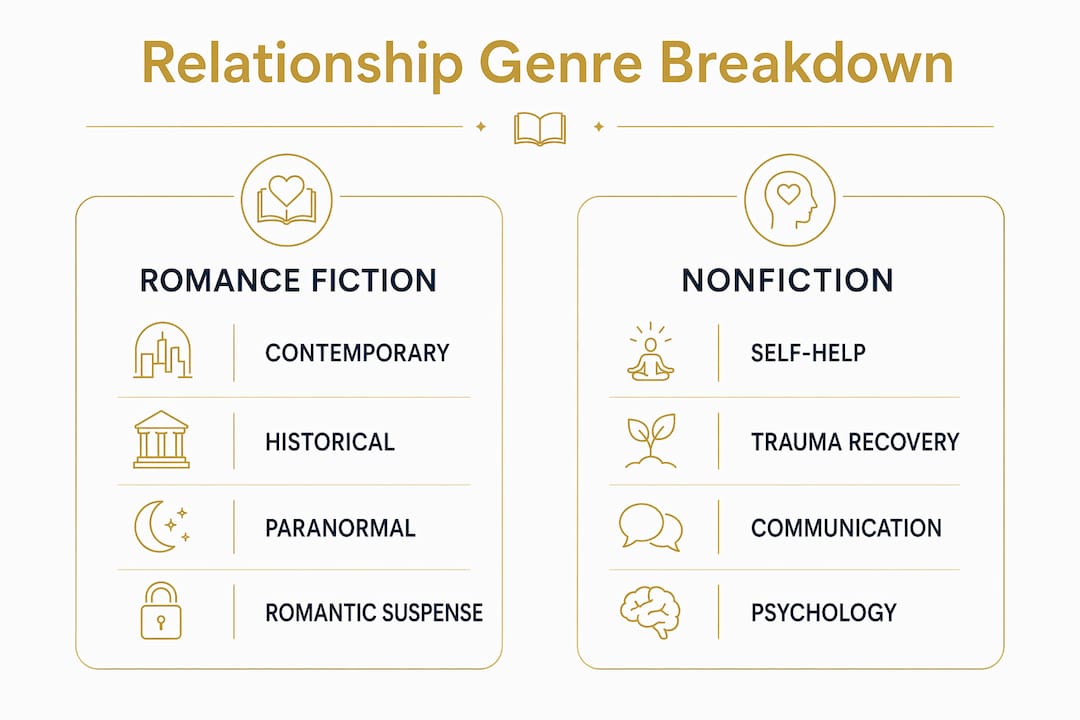
Romance subgenres all share the same structural requirements: central love story and satisfying ending. What changes is the setting, tone, and secondary plot elements. A paranormal romance and a contemporary romance are structurally identical in their genre requirements. The vampires or the office setting are window dressing.
Nonfiction categories differ more fundamentally from each other. A trauma recovery book and a communication skills book may share a shelf but serve very different reader needs. Choosing the wrong nonfiction category is one of the most common reasons readers feel a relationship book did not help them. Matching the category to your actual need matters more than choosing by author reputation or cover design.
Choosing the right relationship book starts with one honest question: are you seeking entertainment or practical guidance? The answer determines whether you are shopping in fiction or nonfiction, and that distinction narrows your options immediately.
For fiction readers, follow these steps:
For nonfiction readers, the selection process is different. Self-help books after divorce serve a different purpose than books on building communication skills in a healthy relationship. Identify whether you are in a healing phase or a growth phase. Healing-phase readers need trauma-informed content with structured exercises. Growth-phase readers benefit more from communication frameworks and emotional intelligence tools.
Pro Tip: For nonfiction relationship books, read the table of contents before buying. A book with chapter titles like “Understanding Your Attachment Style” and “Exercises for Rebuilding Trust” will serve you differently than one titled “10 Rules for a Happy Marriage.” The structure reveals the author’s assumptions about where you are starting from.
Readers dealing with toxic or harmful relationship dynamics benefit from titles that address specific patterns directly. Understanding why breakup books work from a psychological standpoint helps explain why targeted reading can accelerate emotional recovery in ways that general self-help cannot.
The relationship book genre divides cleanly into romance fiction, which requires a central love story and satisfying ending, and nonfiction relationship literature, which uses psychology and practical exercises to improve real-world connections.
| Point | Details |
|---|---|
| Two distinct branches | Romance fiction and nonfiction relationship books serve different goals and follow different structural rules. |
| Romance requires two elements | The love story must drive the plot, and the ending must be emotionally satisfying (HEA or HFN). |
| Nonfiction covers all relationships | Nonfiction titles address romantic, family, friendship, and workplace bonds using research-backed frameworks. |
| Subgenre matching matters | Choosing the right subgenre or nonfiction category determines whether a book actually meets your needs. |
| Trauma-informed nonfiction is distinct | Books with structured exercises for healing differ fundamentally from general communication or happiness guides. |
Most readers treat genre labels as rough suggestions. After years of reading and writing about relationship literature, I think that habit costs people real time and emotional energy. Picking up a book marketed as romance and finding a tragic ending is not just disappointing. It breaks the specific emotional contract you signed up for. And reading a general happiness guide when you actually need trauma-informed support is like treating a fracture with a bandage.
The relationship book genre is one of the most internally diverse categories in publishing. A paranormal romance by Nalini Singh and a trauma recovery workbook from Jessica Kingsley Publishers both technically qualify as relationship books. They share almost nothing else. The genre label is a starting point, not a destination.
What I find most encouraging about contemporary relationship literature is how much more inclusive it has become. Romance fiction now regularly centers LGBTQ+ couples, neurodivergent protagonists, and non-Western relationship structures. Nonfiction titles increasingly address polyamorous relationships, chosen family dynamics, and the relational impact of systemic trauma. That expansion makes the genre more useful and more honest about the actual range of human connection.
The readers who get the most from relationship books are the ones who know exactly what they are looking for before they start. Fiction readers who understand the HEA contract read with more pleasure. Nonfiction readers who match their category to their current emotional state get more practical benefit. Genre literacy is not an academic exercise. It is a reading skill that pays off every time you open a book.
— Robert
Smartreadshub specializes in relationship books that go beyond surface-level advice, focusing on the psychological patterns that keep people stuck in harmful dynamics.
If you are trying to understand controlling behavior, Smartreadshub’s guide to gaslighting and self-doubt explains exactly how this dynamic works and what books address it most effectively. For readers recognizing patterns of manipulation, the resource on subtle manipulation tactics offers evidence-backed insight into what to look for and how to respond. Smartreadshub curates book recommendations tied directly to these specific experiences, so you are never left with generic advice when you need targeted support.
The relationship book genre includes both romance fiction, where a love story drives the plot to a satisfying ending, and nonfiction books that offer practical guidance on improving human connections across all relationship types.
Romance fiction requires the romantic relationship to be the central plot engine with an HEA or HFN ending. A love story may feature romance as a subplot without meeting those structural requirements, as Writers in the Storm explains.
The main types include romance fiction subgenres (contemporary, historical, paranormal, romantic suspense) and nonfiction categories such as emotional intelligence, communication skills, trauma recovery, and attachment-focused guides.
Identify whether you need healing support or skill-building. Trauma-informed books with structured exercises suit readers processing past harm, while communication and emotional intelligence titles suit readers building healthier patterns in current relationships.
Yes. Nonfiction relationship books grounded in psychology and trauma recovery directly address patterns like manipulation, poor communication, and attachment wounds. Titles focused on toxic relationship dynamics provide both understanding and practical tools for change.