
Personal boundaries are defined as internal and external limits that mark where your responsibility ends and another person’s begins. Understanding how books explain personal boundaries gives you a psychological map for protecting your emotional, physical, and time resources. Drs. Henry Cloud and John Townsend introduced the “property line” metaphor in their foundational work, framing boundaries as the fence around your personal territory. Nedra Glover Tawwab built on that framework with neuroscience-backed exercises. Smartreadshub curates these insights specifically for readers navigating psychologically harmful relationships.
What are the different types of personal boundaries and how do books explain them?
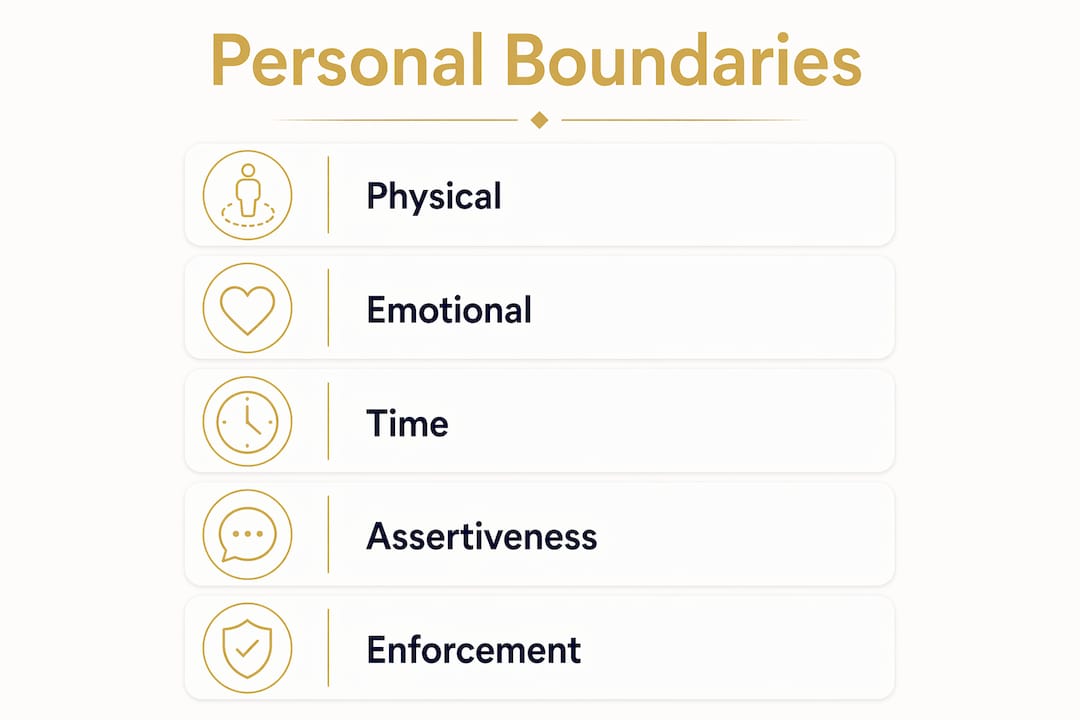
Psychological literature identifies three core boundary categories: physical, emotional, and time-related. Each type protects a different dimension of your self.
Physical boundaries govern your body, personal space, and possessions. They include your right to say no to touch, to control who enters your home, and to set limits on physical demands placed on you.

Emotional boundaries protect your feelings and mental energy. They prevent others from dumping their emotional problems onto you, dismissing your feelings, or manipulating your emotional responses. Readers who have experienced gaslighting or narcissistic behavior often find emotional boundaries the hardest to recognize and enforce.
Time boundaries protect your schedule and energy. They cover how much of your day you give to others, whether at work, in family obligations, or in friendships. Without time limits, people-pleasing behavior fills every gap.
Assertiveness is the key skill that holds all three boundary types in place. Assertive behavior balances your needs with others’ interests, which sustains stable relationships without requiring you to become aggressive or passive.
| Boundary type | What it protects | Common violation example |
|---|---|---|
| Physical | Body, space, possessions | Unwanted touch or invasion of privacy |
| Emotional | Feelings, mental energy | Guilt-tripping or emotional dumping |
| Time | Schedule, energy | Constant last-minute demands |
How do key psychology books explain setting and maintaining limits?
Building boundaries is a neurobiological process of rewiring the brain. That is not a metaphor. Repeated boundary violations create fear-based neural pathways. Books like Setting Boundaries That Stick by Nedra Glover Tawwab use writing prompts and structured exercises to shift those pathways toward intentional, values-driven responses.
The process books describe follows a clear sequence:
- Identify the violation. Notice where you feel resentment, exhaustion, or dread. These emotions are data, not weakness.
- Name your limit. Write it down in plain language. “I will not answer work calls after 7 p.m.” is a boundary. “I wish people would stop calling me late” is a wish.
- Communicate directly. State the boundary out loud, in person or in writing. Indirect expression fails because the other person can claim they never knew.
- Define your follow-through. A boundary without a consequence is a request. Decide in advance what you will do if the limit is crossed.
- Apply it consistently. Inconsistent enforcement teaches others the boundary is negotiable.
- Revisit and adjust. Needs change. Boundaries should be reviewed as relationships evolve.
The iterative nature of this process is a point Tawwab stresses throughout her work. Boundary-setting is not a one-time conversation. It is a practice applied across home, work, and social contexts over time.
Pro Tip: Write your boundary as an “if/then” statement before you say it out loud. “If you raise your voice, I will end the call.” This format forces clarity and removes ambiguity before the conversation starts.
Two obstacles appear in almost every book on this subject. The first is fear of refusal. Many readers worry that stating a limit will cost them a relationship. The second is people-pleasing, which psychology research links directly to boundary erosion. Both obstacles shrink when you practice stating small, low-stakes limits first and build confidence from there.
What are common misconceptions about personal boundaries?
The biggest misconception is that a boundary is a demand placed on another person. It is not. Boundaries focus on your own actions, not on controlling what someone else does. The correct structure is: “If you do X, I will do Y.” The other person can still do X. You simply decide in advance how you will respond.
“Boundaries are not about changing others. They are about preserving your autonomy and well-being, even when others disagree.” — Psychological framework summarized in Boundaries by Cloud and Townsend
A second misconception is that boundaries are walls. Healthy boundaries act as selective gates, not barriers. They allow genuine connection while protecting your core self. A wall keeps everyone out. A boundary lets the right people in on your terms.
A third misconception is that setting limits is selfish. Psychology literature is direct on this point: boundaries enable giving from love rather than from resentment or obligation. When you give without limits, you eventually have nothing left to give.
Common myths books consistently correct:
- “A boundary means I’m punishing the other person.” Boundaries are self-directed, not punitive.
- “If they loved me, they would just know.” Direct communication is required. Hints do not count.
- “I can set a boundary once and it’s done.” Consistent enforcement is what makes a boundary real.
- “Saying no damages relationships.” Saying yes when you mean no damages them faster.
Internal boundary violations, such as breaking promises to yourself or neglecting your own needs, receive significant attention in boundary literature. These self-directed failures are often the root cause of chronic people-pleasing in relationships.
How can you apply boundary lessons from books in everyday relationships?
Resentment signals a boundary violation. That feeling is your first practical tool. When you notice resentment building toward a person or situation, stop and ask: what limit of mine is being crossed here? That question replaces vague discomfort with a specific, addressable problem.
Pro Tip: Keep a one-week “resentment log.” Write down every moment you feel drained, used, or frustrated. Patterns will emerge within days, pointing directly to where your limits need to be stated.
Practical steps drawn from books on setting personal limits:
- In family relationships: State limits calmly and without apology. “I’m not available to talk after 9 p.m.” does not require explanation.
- At work: Protect your time by declining non-urgent requests outside your agreed hours. Frame it as a scheduling issue, not a personal rejection.
- In friendships: Recognize that a friend who consistently ignores your stated limits is not respecting you. Repeated violations after clear communication are a pattern worth examining through resources like Smartreadshub’s guides on relationship patterns and healing.
- With yourself: Honor commitments you make to your own rest, health, and goals. Self-neglect is a boundary violation too.
Failure to enforce limits persistently teaches others that your boundaries are optional. Follow-through does not require anger or punishment. It simply means doing what you said you would do. Over time, consistent responses build the credibility your limits need to hold.
Mutual respect and flexibility matter as well. Boundaries are not rigid rules applied without context. They are living agreements that reflect your current needs. Reviewing them regularly, especially after major life changes, keeps them relevant and fair to everyone involved. Readers interested in the science behind psychology books and their healing effects will find that the research strongly supports this iterative approach.
Key Takeaways
Books on personal boundaries consistently show that limits work only when they are clearly stated, consistently enforced, and focused on your own behavior rather than on controlling others.
| Point | Details |
|---|---|
| Boundaries protect three resources | Physical, emotional, and time limits each guard a different part of your well-being. |
| Assertiveness holds limits in place | Without assertive communication, boundaries collapse into people-pleasing and resentment. |
| Boundaries are self-directed | Effective limits follow the “if/then” structure and do not require others’ agreement to work. |
| Resentment is a signal | Persistent resentment points directly to a boundary that needs to be named and enforced. |
| Consistency is what makes limits real | Inconsistent enforcement teaches others that your boundaries are negotiable. |
What I’ve learned from years of reading about boundaries
Most people come to boundary-setting books after something breaks. A relationship implodes, a job becomes unbearable, or a family dynamic finally crosses a line that cannot be uncrossed. I have seen this pattern repeatedly in the literature and in the readers Smartreadshub serves. The books arrive as a response to pain, not as prevention.
What surprises readers most is the discovery that they were the ones enforcing the old rules. Not consciously. But every time they said yes when they meant no, every time they absorbed someone else’s anger without naming it, they were teaching the people around them exactly how to treat them. That realization is uncomfortable. It is also the most useful thing in any of these books.
The second thing I have noticed is that people give up too quickly. They state a limit once, it gets ignored, and they conclude that boundaries “don’t work for them.” What actually happened is that they stopped at step four of a six-step process. Persistence is not stubbornness. It is the mechanism by which limits become real.
The books that stick with readers, the ones that actually change behavior, are the ones that treat boundary-setting as a skill rather than a personality trait. Skills can be learned. They improve with practice. That framing removes the shame and replaces it with something workable.
— Robert
Smartreadshub’s resources for boundary-setting and healing
Readers who recognize themselves in this article often find that boundary violations in their relationships run deeper than a single conversation can fix.

Smartreadshub specializes in curated guides for readers dealing with manipulation, narcissistic behavior, and psychologically harmful relationships. If you are working through the aftermath of chronic boundary violations, the guide on healing after narcissistic abuse offers structured, evidence-backed steps for recovery. For readers who want to understand the patterns that made limits so hard to hold in the first place, the resource on unhealthy attachment books provides targeted reading recommendations. Smartreadshub’s content is built specifically for people who are ready to understand what happened and move forward with clarity.
FAQ
What is the definition of a personal boundary?
A personal boundary is an internal or external limit that defines where your responsibility ends and another person’s begins. Psychology literature describes boundaries as “property lines” that protect your emotional, physical, and time resources.
Are boundaries the same as ultimatums?
No. Boundaries focus on your own actions, not on controlling others. An ultimatum demands that someone else change their behavior. A boundary states what you will do in response to a situation, regardless of what the other person chooses.
How do you know when a boundary has been violated?
Resentment is the clearest signal. Drs. Henry Cloud and John Townsend identify persistent resentment as a warning that a limit is being crossed and needs to be named and enforced.
Can setting limits damage relationships?
Healthy boundaries protect relationships by enabling genuine connection without resentment or burnout. Limits that are communicated clearly and enforced consistently tend to build mutual respect over time rather than damage it.
How long does it take to build effective personal limits?
Boundary-setting is an iterative process, not a single event. Resources like Setting Boundaries That Stick by Nedra Glover Tawwab frame it as an ongoing practice that develops through repeated self-reflection and consistent application across different relationships and contexts.