
Online booksellers are digital retail platforms that connect readers directly to books through integrated catalog management, order processing, and supply chain logistics. Understanding how online booksellers work means looking at three core layers: the storefront readers see, the inventory systems behind it, and the fulfillment networks that deliver the product. Whether you are an aspiring author, an entrepreneur, or simply curious about the online retail space, the mechanics are more structured than most people realize. The business model of online booksellers depends on choices made early, from inventory sourcing to payment processing, and those choices shape every outcome downstream.
What business models do online booksellers use?
Online booksellers operate under four primary business models, each with distinct cost structures and profit implications. Choosing the right one is the single most consequential decision you will make when entering this market.
Print-on-Demand (POD) is the entry point for most independent sellers. POD delivers books within 2–5 business days with zero upfront inventory costs. That speed and low risk make it attractive, but the trade-off is real: POD yields lower per-unit margins compared to bulk purchasing, which compresses long-term profitability. You need to calculate your breakeven point before committing to this model at scale.
Dropshipping removes inventory entirely from your operation. A supplier holds the stock and ships directly to your customer when an order comes in. Your margin is the difference between your retail price and the supplier’s wholesale price. The risk is lower, but so is your control over shipping times and product quality.

Wholesale purchasing means buying books in bulk from publishers or distributors at a discount, then reselling them. Wholesale discounts for books typically range from 30% to 50%, and most major retailers require that stock be returnable. This model demands active inventory management and upfront capital, but it offers the strongest per-unit margins.
Direct-to-reader sales cut out the middleman entirely. You sell through your own website and keep the full margin minus payment processing fees. Standard payment gateway fees run 2.9% plus $0.30 per transaction, while some direct-sale platforms charge a flat annual fee instead. The flat-fee model benefits high-volume sellers; the per-transaction model suits those just starting out.
- POD: low risk, lower margins, fast setup
- Dropshipping: no inventory, limited control
- Wholesale: higher margins, capital required, returnability mandatory
- Direct sales: maximum margin, requires your own traffic and platform
Pro Tip: Run a breakeven analysis before choosing your model. Divide your fixed monthly costs by your average margin per book. That number tells you exactly how many books you need to sell each month to stay profitable.
How do online booksellers manage inventory and orders?
Inventory management is where most new online booksellers underestimate complexity. A catalog of even 500 titles requires systems, not spreadsheets.
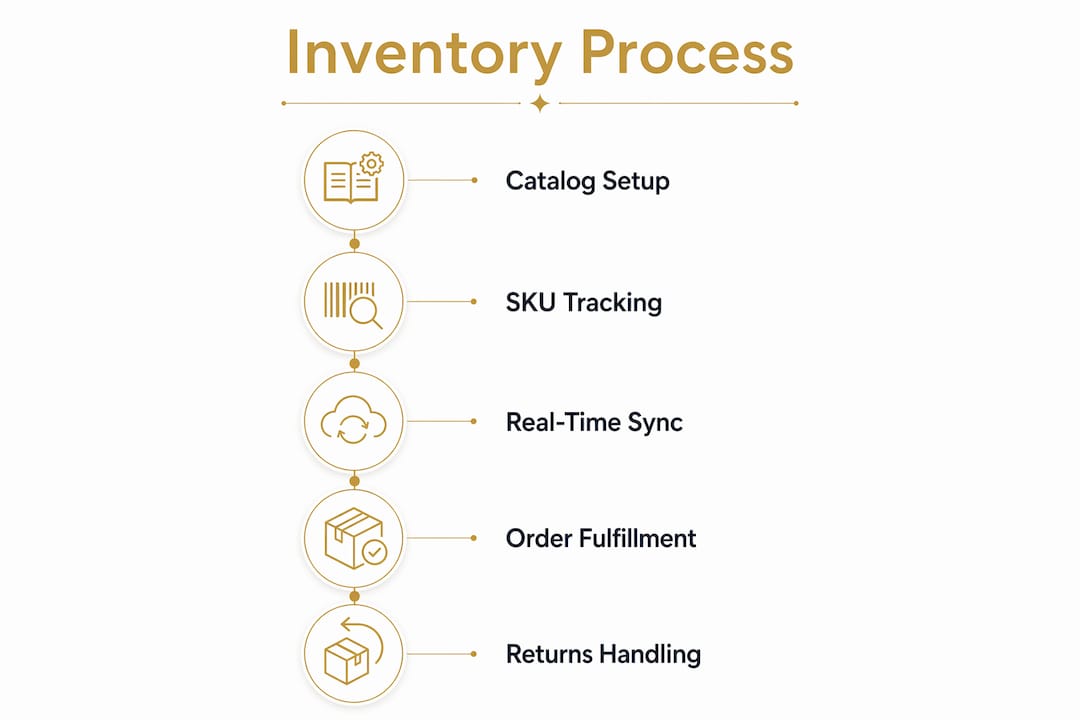
The foundation is SKU tracking and real-time inventory syncing across every sales channel. Without it, you risk overselling a title that is out of stock, which damages customer trust and triggers costly returns. If you sell the same book on your website and through a third-party marketplace simultaneously, both channels must reflect the same live inventory count.
Modern e-commerce platforms address this through modular system architecture. Modular design separates catalog, search, ordering, payment, and fulfillment into independent services. Each layer can be updated or replaced without breaking the others. That flexibility is what allows a small bookseller to scale from 100 to 10,000 titles without rebuilding their entire tech stack.
Here is the operational sequence most online booksellers follow:
- Catalog setup: Each title gets a unique SKU, metadata (title, author, ISBN, description), and pricing.
- Inventory sync: Stock levels connect in real time across all sales channels and the warehouse or POD supplier.
- Order capture: A customer places an order; the system confirms availability and charges payment.
- Fulfillment routing: The order routes to the correct fulfillment source, whether a warehouse, POD printer, or dropship supplier.
- Shipping and tracking: The customer receives a tracking number; the inventory count updates automatically.
Pro Tip: Integrate your point-of-sale system with your online platform from day one. Unified POS and online inventory prevents the most common scaling failure: selling a book in your physical store that your website still shows as available.
What are the wholesale distribution requirements for online booksellers?
Retail distribution is not automatic. Publishers and authors must actively meet specific requirements before a book appears in any major online retailer’s catalog.
The three non-negotiable conditions are availability, returnability, and discount threshold. Catalog inclusion requires metadata submission and approval. Simply publishing a book does not place it in front of buyers on retail platforms. You must submit accurate metadata, including title, author name, ISBN, description, and cover image, and wait for approval before the book becomes searchable.
Traditional publishers handle this process as part of their standard workflow. Indie authors and small sellers must manage it themselves, which is where many lose visibility. A book with incomplete or inaccurate metadata will not surface in search results, regardless of its quality.
| Requirement | Standard |
|---|---|
| Wholesale discount | 30%–50% off retail price |
| Returnability | Mandatory for most major retailers |
| Metadata submission | Required; approval is not guaranteed |
| ISBN | Required for catalog listing |
| Availability | Must be in stock or POD-eligible |
The discount requirement has a direct impact on your pricing strategy. If a retailer demands 50% off your retail price, and your production cost is $8 per book, you need a retail price high enough to cover both the discount and your margin. Many new sellers price too low and discover this problem only after their first wholesale order.
Niche curation is one way independent booksellers sidestep the pricing pressure of broad retail distribution. By focusing on a specific category, they attract buyers willing to pay full price directly, reducing dependence on wholesale channels entirely.
How does technology shape an online bookseller’s success?
Technology is not a background function in online bookselling. It is the primary competitive variable between sellers who grow and those who stall.
E-commerce platforms like Shopify provide integrated payment processing, inventory management, and marketing tools in a single system. That integration matters because fragmented tools create data gaps. When your payment processor does not talk to your inventory system, you are flying blind on profitability.
Book discovery technology is a growing differentiator. Advanced catalog search features, including vector search that matches reader intent rather than just keywords, improve the chance that a browser becomes a buyer. A reader searching for “books about rebuilding trust” should surface relevant titles even if none of those exact words appear in the title.
Customer data ownership is the most undervalued asset in online bookselling. Owning customer email data delivers higher conversion rates and marketing control than relying on third-party marketplace traffic. A marketplace can change its algorithm or fees overnight. Your email list cannot be taken from you.
The key technology decisions every online bookseller must make:
- E-commerce platform: Choose one that unifies inventory, payment, and marketing natively.
- Search and discovery: Prioritize platforms with strong catalog search, especially if your catalog exceeds 200 titles.
- Payment processing: Compare flat-fee versus per-transaction models against your projected monthly volume.
- Email capture: Build your list from the first sale. Offer a discount, a reading guide, or exclusive content in exchange for an email address.
- Analytics: Track conversion rate, average order value, and return rate by title to identify your most profitable inventory.
The role of independent bookstores in building loyal communities shows that technology alone is not enough. Readers return to stores, physical or digital, that feel curated and personal. Technology should serve that experience, not replace it.
Key Takeaways
Online booksellers succeed by combining the right business model with real-time inventory systems, compliant distribution practices, and direct customer relationships built on owned data.
| Point | Details |
|---|---|
| Business model choice | POD, dropshipping, wholesale, and direct sales each carry distinct margin and risk profiles. |
| Inventory syncing | Real-time SKU tracking across all channels prevents overselling and fulfillment errors. |
| Distribution requirements | Books need metadata approval, returnability, and a 30%–50% wholesale discount to enter major catalogs. |
| Technology stack | Unified platforms connecting payment, inventory, and marketing outperform fragmented tool sets. |
| Email list ownership | A direct customer email list is more valuable long-term than any third-party marketplace ranking. |
What I have learned from watching online booksellers succeed and fail
The pattern I see most often is this: sellers choose print-on-demand because it feels safe, then get frustrated when margins do not support growth. POD is a legitimate starting point, not a permanent strategy. The sellers who scale move to wholesale or hybrid models once they have validated demand for specific titles. They use POD to test, then switch to bulk purchasing for their top sellers.
The second mistake is ignoring niche focus. Competing broadly against large retail platforms on general titles is a losing position for an independent seller. The booksellers I have watched build real businesses all picked a lane. Self-help for specific audiences, regional fiction, books on psychology and healing, curated collections for particular communities. Specificity builds trust faster than breadth ever will.
The third issue is underestimating the email list. Sellers who rely entirely on marketplace traffic are renting their audience. One algorithm change, one fee increase, and their revenue drops overnight. The sellers who own their customer relationships through email are the ones still operating five years later. Building that list from day one is not optional. It is the business.
The technology piece is simpler than most people think. You do not need a custom platform. You need one that integrates inventory, payment, and customer data without requiring a developer every time you want to make a change. Start simple, stay unified, and add complexity only when a specific problem demands it.
Smartreadshub and the mindset behind building something that lasts
Building an online bookstore requires more than operational knowledge. It requires the kind of clarity and resilience that comes from understanding yourself and your readers deeply.

Smartreadshub curates books and resources focused on emotional intelligence, personal boundaries, and psychological resilience. These are the same qualities that separate entrepreneurs who persist through early setbacks from those who quit. If you are building a bookselling business around meaningful content, the psychology of healing and growth is worth understanding both for your own clarity and for connecting authentically with your readers. Smartreadshub also offers curated guidance on emotional patterns that affect how people make decisions, including the decisions your customers make about which books they trust and buy.
FAQ
How do online booksellers make money?
Online booksellers earn revenue through the margin between their purchase cost and retail price, minus payment processing fees and platform costs. The most profitable models combine wholesale purchasing for high-demand titles with direct-to-reader sales that bypass marketplace commissions.
What is print-on-demand and how does it work for booksellers?
Print-on-demand is a fulfillment model where books are printed individually after a customer places an order, with typical delivery in 2–5 business days and no upfront inventory cost. It reduces financial risk but produces lower per-unit margins than bulk purchasing.
Do online booksellers need to meet wholesale discount requirements?
Yes. Most major retail catalogs require a wholesale discount of 30%–50% off the retail price, along with returnable stock and approved metadata submission before a title becomes searchable.
What technology do online booksellers need to operate?
A functional online bookstore requires an e-commerce platform with integrated inventory management, a payment gateway, and catalog search capability. Real-time inventory syncing across all sales channels is critical to prevent overselling.
Why is an email list important for online booksellers?
An email list gives booksellers direct access to their customers without depending on third-party marketplace algorithms or fees. Owned customer data consistently delivers higher conversion rates and protects revenue when external platforms change their terms.