
Book recommendations are defined as trusted suggestions that guide women toward reading that supports personal growth, healing, and clearer thinking about relationships. The role of book recommendations for women goes far beyond pointing to a good read. Between 47% and 64% of readers rely on personal recommendations rather than bestseller lists or algorithms. That number tells you something important: women are not picking books at random. They are looking for guidance from sources they trust, and the right recommendation at the right moment can shift how a woman sees herself, her relationships, and her future.
Why the role of book recommendations for women outweighs algorithms
The most powerful book recommendation comes from someone who knows both the book and your life. Trust and personal context are the two factors that separate a recommendation that changes you from one you forget by Tuesday. An algorithm can scan your purchase history. It cannot know that you are three months out of a painful relationship and need something that speaks directly to that experience.
AI-based book suggestions favor popular authors and miss the depth required for niche women’s empowerment themes. That limitation matters because the books most likely to help you heal or grow are rarely the ones dominating bestseller charts. They live in specific genres: memoirs about surviving manipulation, psychology books on attachment, nonfiction guides to setting boundaries.

Social media is changing this dynamic, especially for younger readers. Among Gen Z respondents surveyed, 39 out of 72 reported that book content creators on platforms like TikTok and Instagram strongly influence what they add to their reading lists. That shift shows how trusted voices, even digital ones, carry more weight than impersonal recommendation engines.
Here is what separates a genuine recommendation from social signaling:
- Urgency. The person recommending the book cannot wait to tell you about it.
- Specificity. They explain exactly why it applies to your situation, not just why they liked it.
- Emotional charge. Genuine recommendations are often less polished and more emotionally direct than curated lists.
- Personal knowledge. The recommender understands your life context, not just your reading preferences.
- Relevance. The suggestion connects to something you are actively working through.
Pro Tip: When asking for a book recommendation, tell the person what you are dealing with right now, not just what genre you enjoy. That context is what turns a good suggestion into the right one.
How women’s book clubs multiply the impact of reading
Women’s reading groups function as ecosystems for personal growth and mental health. That is not a metaphor. Book clubs create structured social bonds that reduce isolation, build empathy, and give women a space to process difficult experiences through the lens of shared stories. The book is the entry point. The conversation is where the real growth happens.
Collective reflection deepens what you take from a book. Reading alone, you might notice a passage about gaslighting and feel recognized. In a group, another woman names the same experience from a different angle, and suddenly you understand it more fully. That layered understanding is what women’s reading communities consistently produce.
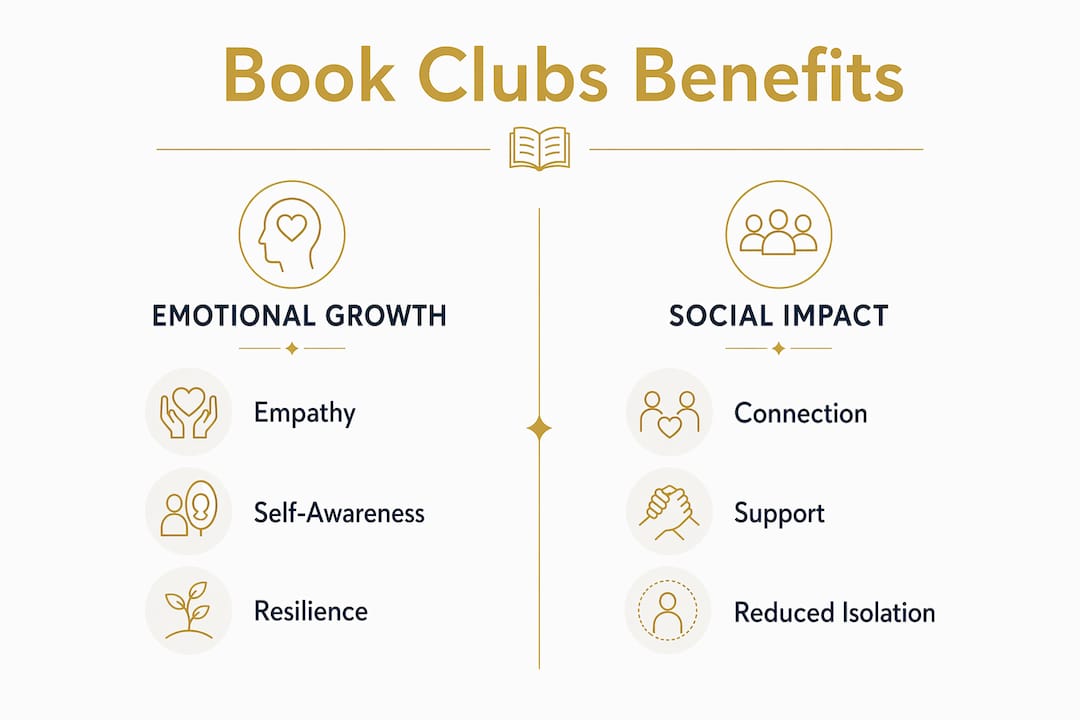
The choice of book matters enormously. Expert facilitation shifts book clubs away from default romance genres toward topics like boundary-setting, resilience, and emotional recovery. That shift is not about abandoning enjoyment. It is about using the club’s social energy to work through things that matter.
| Benefit | What women in clubs report |
|---|---|
| Reduced isolation | Regular connection with others who share similar experiences |
| Increased empathy | Exposure to perspectives different from their own |
| Emotional processing | Safe space to discuss difficult personal themes through books |
| Accountability | Motivation to finish books and apply their lessons |
| Practical insight | Shared strategies for applying what they read to real situations |
Pro Tip: If your book club keeps defaulting to the same genres, propose one nonfiction title per quarter focused on a specific life skill, such as boundary-setting or recovering from emotional harm. One purposeful pick can redirect the entire group’s energy.
What science says about reading and women’s personal growth
Reading shapes emotional intelligence and self-awareness in measurable ways. Women read more than men after age 10, with the largest gender gap in library usage appearing around age 35. That sustained engagement is not accidental. It reflects a genuine reliance on books as tools for understanding relationships, identity, and emotional experience.
Women read more fiction and advice-focused nonfiction than men, and that pattern connects directly to relational focus. Fiction builds the capacity to understand other people’s inner lives. Memoirs offer models for surviving and rebuilding after harm. Psychology and self-help books provide frameworks for recognizing patterns, whether in a partner’s behavior or your own responses. The science behind reading for women consistently points to these genres as tools for emotional development, not just entertainment.
The publishing industry, however, has not always served women readers well. Industry critics note that publishers often narrow women’s exposure by focusing on trending genres like romantasy while underserving the diverse nonfiction and literary fiction women actually read. That gap is exactly why trusted recommendations from real people and curated platforms matter so much.
| Book type | Primary empowerment benefit |
|---|---|
| Memoir and personal narrative | Builds perspective and reduces shame through shared experience |
| Psychology and self-help | Provides frameworks for recognizing harmful patterns |
| Literary fiction | Develops emotional intelligence and empathy |
| Boundary and communication guides | Delivers practical tools for healthier relationships |
| Healing and recovery nonfiction | Supports processing trauma and rebuilding self-worth |
How to use book recommendations to navigate relationships and build resilience
The most effective reading strategy is intentional. You do not need to read everything. You need to read the right thing at the right time, and that requires knowing what you are actually working through. Women navigating relationship patterns and healing get the most from books when they match the reading to a specific challenge rather than browsing broadly.
Memoirs and personal narratives are particularly powerful for relationship insight. When a writer describes recognizing manipulation in a partner, or learning to trust herself again after years of self-doubt, that story gives you a map. You see the terrain before you walk it. That is the practical value of narrative: it compresses years of experience into something you can absorb in a week.
Here is how to evaluate and apply a book recommendation effectively:
- Match the book to your current challenge. A book about narcissistic abuse is most useful when you are actively trying to understand that dynamic, not as general reading.
- Check the recommender’s context. Did they read it during a similar situation? Their experience shapes whether the recommendation fits yours.
- Use specific queries when searching. Searching “books on recovering from emotional manipulation” yields far better results than “books for women.” Precise queries produce more relevant suggestions even from digital tools.
- Read with a notebook nearby. Writing down what resonates moves insight from the page into your actual thinking.
- Discuss what you read. Sharing a book’s key ideas with one trusted person, or a group, reinforces what you learned and surfaces applications you might have missed alone.
A Reese Witherspoon book club endorsement can increase a book’s sales by 700%. That figure illustrates how much weight a trusted cultural voice carries. The same principle applies at a personal level: a recommendation from someone you respect, delivered with genuine urgency, carries more weight than any algorithm-generated list.
Key takeaways
Trusted book recommendations give women a direct path to the reading that supports healing, self-understanding, and stronger relationships, far more reliably than bestseller lists or algorithms.
| Point | Details |
|---|---|
| Trust drives impact | Recommendations work best when the source knows both the book and your personal situation. |
| Book clubs amplify growth | Collective reading builds empathy, reduces isolation, and deepens what you take from each book. |
| Women are sustained readers | Women’s stronger reading engagement, especially around age 35, reflects genuine reliance on books for growth. |
| Genre diversity matters | Memoirs, psychology books, and boundary guides each address different aspects of healing and empowerment. |
| Intentional selection wins | Matching a book to your current challenge produces more growth than reading broadly without direction. |
What I have learned about book recommendations and women’s growth
The most transformative book I ever received was not from a list. It came from a friend who handed it to me mid-conversation and said, “You need to read this now.” That urgency was the signal. She knew what I was going through, she knew the book, and she connected the two without hesitation.
What I have seen, working in this space, is that women often underestimate the value of that kind of recommendation. They scroll through lists, check ratings, and read summaries. All of that has its place. But the book that actually changes something tends to come from a person who cares enough to make the connection personal.
The other thing I have learned is that reading alone is only half the work. The women who get the most from empowering books are the ones who do something with what they read. They journal. They talk about it. They bring it to a group. They apply one idea from the book to a real situation in their life. That practice is what turns a good book into a genuine shift in how you see yourself and what you will accept.
My honest advice: be intentional. Know what you are working through. Ask people you trust for specific suggestions. And when you find a book that speaks to your situation, do not just finish it. Sit with it. The self-discovery books that matter most are the ones you return to.
— Robert
Smartreadshub: curated reads for women’s healing and growth
Smartreadshub was built specifically for women navigating the harder parts of relationships, including gaslighting, manipulation, and the slow work of rebuilding after emotional harm.
The curated book collections at Smartreadshub go beyond trending titles. Every recommendation is selected to address real relational challenges, from recognizing subtle manipulation tactics to rebuilding confidence after a painful ending. If you are looking for reading that meets you where you actually are, Smartreadshub is the place to start. The platform also covers foundational topics like what gaslighting is and why it causes self-doubt, giving you the context to understand what you have experienced before you even pick up a book.
FAQ
Why do book recommendations matter more than bestseller lists for women?
Personal recommendations come from someone who knows your situation, which makes them far more relevant than popularity-based rankings. Between 47% and 64% of readers rely on personal recommendations over bestsellers or algorithms.
How do women’s book clubs support personal growth?
Book clubs create structured social environments where women process shared experiences, build empathy, and reduce isolation through collective reflection. Expert-facilitated clubs that focus on practical themes like boundary-setting produce the strongest growth outcomes.
What types of books are most empowering for women in difficult relationships?
Memoirs, psychology books, and boundary-focused nonfiction consistently deliver the most direct support for women navigating manipulation, emotional harm, or relationship recovery. Matching the book type to your specific challenge produces better results than reading broadly.
How can I tell if a book recommendation is genuine?
Genuine recommendations are urgent, specific, and emotionally direct. The recommender explains exactly why the book applies to your situation, rather than offering a polished or generic endorsement.
Does AI help with finding empowering books for women?
AI tools work better for book discovery when you use precise, theme-specific queries rather than broad demographic searches. Searching for “books on recovering from narcissistic abuse” yields more relevant results than searching for general women’s reading lists.