
Emotional labor is defined as the ongoing effort to manage your own emotions and the emotions of others to maintain relationships and social harmony. Sociologist Arlie Hochschild first named this concept in 1983, originally describing it as workplace emotion regulation, but contemporary books have expanded it far beyond the office. Today, understanding emotional labor means recognizing the invisible, continuous work that sustains personal relationships. Books on emotional labor give this hidden effort a name, a shape, and a path forward.
How books explain emotional labor: types and categories
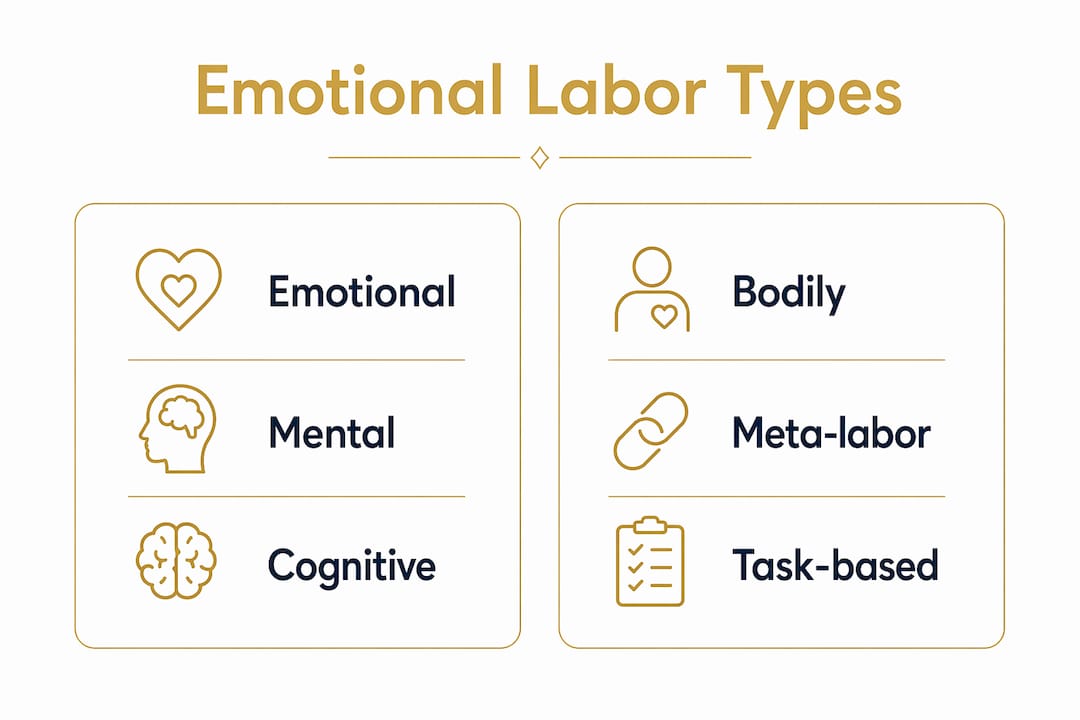
Books on emotional labor do not treat it as a single, uniform burden. They break it into distinct types, which is exactly why reading about it feels so clarifying.
Hochschild identified three core regulation strategies: cognitive (changing how you think about a situation), bodily (controlling physical responses like breathing or posture), and expressive (managing what emotions you show outwardly). These strategies describe the mechanics of emotional labor at the individual level. What they reveal is that emotional labor is not passive. It requires active, repeated mental effort.

Leah Ruppanner, PhD, expands this framework significantly in her 2026 book Drained. She identifies eight distinct types of mental and emotional loads: life organization, emotional support, relationship hygiene, magic making, dream building, individual upkeep, safety, and meta-care. Each category names something women have been doing silently for years. Ruppanner also introduces the Mental Load Audit, a practical tool for mapping which partner carries which tasks.
Books also draw a clear line between emotional labor and mental labor. Mental labor is cognitive and task-based, covering planning, budgeting, and scheduling. Emotional labor covers the relational and feeling-based work. Couples therapist Steven Reigns notes that these two types overlap in relationships but require different interventions to address. Recognizing the difference helps you identify which kind of exhaustion you are actually experiencing.
| Category | What it covers | Where it appears in literature |
|---|---|---|
| Emotional labor | Managing feelings, moods, and relational tone | Hochschild, Hackman, Ruppanner |
| Mental labor | Planning, organizing, tracking logistics | Ruppanner’s Mental Load Audit |
| Meta-care | Managing the management of others’ needs | Ruppanner’s Drained |
| Relationship hygiene | Maintaining connection, resolving conflict | Ruppanner’s eight-type framework |
What is the impact of emotional labor on women in relationships?
The psychological cost of unmanaged emotional labor is well documented in both research and books. Burnout is the most direct consequence. Studies on high-demand environments show that burnout mediates the relationship between emotional labor and the desire to leave a situation, with mediation proportions reaching as high as 53.26% to 54.90%. That figure applies to workplaces, but the same exhaustion pattern appears in relationships where one partner absorbs the majority of emotional work.
Rose Hackman, author of Emotional Labor (2026), argues that the burden is not random. She shows that gender, race, and class shape who is expected to perform emotional labor and how much. Women, and particularly women of color, face layered expectations that treat emotional labor as natural rather than skilled. Hackman’s core argument is that naming this as labor, not instinct, is the first step toward demanding shared responsibility.
One of the most damaging long-term effects is boundary erosion. University of Iowa experts warn that chronic self-regulation causes caregiving to shift into expected servitude. Once a person becomes labeled “the fixer” or “the listener” in a relationship, reversing that dynamic without significant change becomes very difficult. Books on emotional labor in literature return to this theme repeatedly because it resonates so deeply with readers’ lived experiences.
Emotional labor becomes dangerous not when it exists, but when it becomes invisible and one-sided. The moment one partner’s emotional work is treated as a personality trait rather than a contribution, the relationship’s power balance tips permanently.
Pro Tip: Keep a simple log for one week. Write down every time you manage someone else’s emotional state, anticipate a conflict, or soften your own reaction to protect the relationship. The pattern you see is your emotional labor load.
- Persistent fatigue that is not explained by physical activity
- Resentment that builds without a clear triggering event
- Feeling responsible for your partner’s mood or reactions
- Suppressing your own needs to maintain relational peace
- Difficulty identifying what you actually feel, separate from what others need
How can you manage and re-balance emotional labor in relationships?
Books on emotional labor do not stop at diagnosis. The best ones offer concrete frameworks for change. Ruppanner’s Mental Load Audit is the most practical starting point. It asks both partners to list every task they perform, emotional and logistical, and then assess who carries what. Seeing the imbalance written down removes the argument from the realm of feeling and puts it into fact.
Here is a sequence drawn from the frameworks authors recommend most consistently:
- Name the labor. Use Hochschild’s three categories (cognitive, bodily, expressive) to identify what kind of emotional work you are doing and when.
- Audit the load. Complete Ruppanner’s Mental Load Audit together with your partner. Assign each of her eight categories to whoever currently owns it.
- Address the ask problem. Research from Simply Psychology shows that the “ask problem” occurs when one partner must explicitly request emotional attunement, which itself becomes a form of meta-labor and increases resentment over time. The goal is spontaneous attunement, not managed awareness.
- Set boundaries through conversation, not withdrawal. Rose Hackman recommends claiming shared responsibility directly rather than quietly reducing your own labor. Withdrawal without dialogue creates new resentment.
- Seek professional support when needed. Steven Reigns notes that counseling helps couples balance mental and emotional labor in ways that self-directed conversations often cannot.
Pro Tip: When raising the topic of emotional labor with a partner, frame it as a shared problem to solve together, not an accusation. “I’ve been carrying X and I need us to share it” lands very differently than “you never help.”
One concept worth understanding is meta-labor. Meta-labor is the effort required to manage the process of managing emotional labor. When you have to track who is doing what, remind your partner to notice your needs, or coach them through emotional attunement, that tracking is itself labor. Books like Drained make clear that reducing meta-labor is as important as redistributing the original tasks.
How do book genres shape public understanding of emotional labor?
Different genres approach emotional labor themes in books from different angles, and each one offers something the others cannot.
- Sociological nonfiction (Hochschild’s The Managed Heart, Hackman’s Emotional Labor): These books provide structural analysis. They explain why emotional labor is distributed unequally across gender, race, and class lines. Readers gain a framework for understanding their experience as part of a larger social pattern, not a personal failing.
- Psychology and self-help (Ruppanner’s Drained, Simply Psychology resources): These books translate theory into tools. They give readers audits, checklists, and conversation frameworks. The focus is on what you can do differently starting now.
- Memoirs and narrative nonfiction: Personal narratives make emotional labor visible in a way that data cannot. When a writer describes the exact feeling of managing a partner’s mood while suppressing her own, readers recognize themselves. This recognition is often the first moment of real clarity.
- Relationship and couples therapy guides: These books address emotional labor within the specific context of partnership. They tend to include both partners’ perspectives and focus on negotiation rather than individual coping.
Each genre serves a different reader at a different stage. Sociological texts work best when you want to understand the system. Psychology books work best when you want to change your situation. Memoirs work best when you need to feel less alone. The narratives of emotional labor found across these genres collectively shift public understanding from “this is just how relationships work” to “this is a pattern worth examining.”
Emotional labor also appears in books focused on emotional recovery and empowerment for women. These texts connect the concept to broader themes of self-worth, boundary setting, and healing from psychologically harmful relationships. Smartreadshub curates exactly this kind of reading, with women’s mental health books that address emotional labor alongside gaslighting, narcissistic dynamics, and manipulation.
Key Takeaways
Books on emotional labor give readers the clearest, most usable framework for identifying, naming, and redistributing the invisible relational work that causes burnout and resentment.
| Point | Details |
|---|---|
| Emotional labor defined | Arlie Hochschild named it in 1983; books now apply it broadly to personal relationships. |
| Eight types identified | Leah Ruppanner’s framework names life organization, emotional support, and six other distinct loads. |
| Burnout is real | Research links unmanaged emotional labor to burnout mediation rates above 53%. |
| Boundary erosion is a risk | Chronic one-sided emotional labor shifts caregiving into expected servitude over time. |
| Genre matters | Sociological, psychological, and memoir genres each offer a different tool for understanding and change. |
Why books changed how I think about emotional labor
Most people who discover emotional labor do so through a moment of recognition, not a lecture. They read a passage and think, “That is exactly what I have been doing.” That moment is what books do better than any other medium.
What I have found, after reading across this genre for years, is that the biggest misconception people carry is that emotional labor is simply “being caring.” It is not. Caring is a feeling. Emotional labor is the work that caring requires when it is chronic, one-sided, and invisible. Books like Hackman’s Emotional Labor and Ruppanner’s Drained make that distinction with precision that a conversation rarely achieves.
The second thing books correct is the idea that recognizing emotional labor means refusing it. That is wrong, and it leads to a kind of emotional withdrawal that damages relationships further. The goal is shared responsibility, not abdication. Developmental emotional labor, genuinely investing in a loved one’s emotional growth, is valuable. The problem is when one person does all of it, all the time, without acknowledgment or reciprocity.
Reading diverse voices on this topic matters more than most people realize. A white woman’s experience of emotional labor in marriage differs from a Black woman’s experience in the same setting, because the social expectations layered onto each are different. Hackman’s structural analysis is essential reading for exactly this reason. It prevents the mistake of treating emotional labor as a purely personal problem with a purely personal solution.
Use what you read as a starting point for dialogue, not a verdict. Bring a concept from a book into a conversation with your partner. “I read something about the ‘ask problem’ and I think it describes what happens between us.” That kind of entry point is far less threatening than “you never notice what I need.” Books give you language. Language gives you leverage.
— Robert
What Smartreadshub offers readers exploring emotional labor
Emotional labor rarely exists in isolation. For many women, it appears alongside gaslighting, manipulation, and patterns of narcissistic behavior that make the burden even harder to name or address.

Smartreadshub brings together curated resources that connect emotional labor to the broader dynamics of psychologically harmful relationships. If you have recognized yourself in the patterns described here, the next step is understanding how those patterns connect to gaslighting and self-doubt or subtle manipulation tactics that often accompany chronic emotional labor. Smartreadshub also covers emotional dependency patterns that develop when one partner carries the relational load for too long. These resources are built for readers who want clarity, not just comfort.
FAQ
What is emotional labor in a relationship?
Emotional labor in a relationship is the ongoing effort to manage your own emotions and your partner’s emotional state to maintain harmony. Arlie Hochschild originally defined it in a workplace context, but it applies directly to personal relationships where one partner consistently absorbs more of this invisible work.
Why do women carry more emotional labor than men?
Rose Hackman’s research shows that gender, race, and class shape societal expectations about who performs emotional labor. Women are more often expected to manage relational tone and emotional needs, a pattern treated as natural rather than as skilled, compensable work.
How does emotional labor cause burnout?
Unmanaged emotional labor leads to burnout through chronic self-regulation and boundary erosion. Research shows burnout mediates the link between high emotional labor demands and the desire to exit a situation, with mediation rates above 53% in high-demand environments.
What is the “ask problem” in emotional labor?
The ask problem occurs when one partner must explicitly request emotional attunement from the other. That request itself becomes a form of meta-labor, and the fact that attunement had to be asked for reduces its value and increases resentment.
Which books best explain emotional labor for women in relationships?
Arlie Hochschild’s The Managed Heart, Rose Hackman’s Emotional Labor, and Leah Ruppanner’s Drained are the most cited and most practically useful. Each approaches the topic from a different angle: structural, sociological, and audit-based, respectively.