
Books for work-life balance are defined as titles that give professionals tested frameworks for managing career demands without sacrificing personal well-being. The best ones do more than inspire. They hand you a repeatable system. The 7 Habits of Highly Effective People has sold over 40 million copies worldwide, which signals how hungry professionals are for structured guidance. That demand has only grown as burnout rates climb and the line between work and personal time continues to blur.
Which books offer the most effective strategies for work-life balance?
The strongest books in this space share one trait: they replace vague advice with concrete methods. Here are the titles worth your time.
-
The 7 Habits of Highly Effective People by Stephen R. Covey builds a principle-centered foundation. The habit “Put First Things First” trains you to schedule priorities before urgency hijacks your day. “Sharpen the Saw” protects recovery time as a non-negotiable.
-
Deep Work by Cal Newport gives you a 4-rule method for reclaiming focus: Work Deeply, Embrace Boredom, Quit Social Media, and Drain the Shallows. Each rule targets a specific way digital noise erodes your capacity for meaningful output.
-
Slow Productivity by Cal Newport goes further. It argues that focusing on fewer tasks at higher quality prevents burnout and produces more sustainable results than piling on volume. This is the direct counter to hustle culture.
-
Having It All by Dr. Corinne Low delivers data-driven negotiation scripts built specifically for women navigating salary, boundaries, and career-family tradeoffs. The scripts are word-for-word, which removes the guesswork from high-stakes conversations.
-
Working Well by Nidhi Tewari introduces emotional attunement as the core skill for integrating work and personal life. Rather than strict compartmentalization, it teaches self-awareness and communication frameworks that reduce friction at both ends of your day.
Pro Tip: Read Deep Work and Slow Productivity as a pair. Deep Work shows you how to protect focus blocks; Slow Productivity shows you how to choose which blocks matter most.
These titles cover habit building, boundary setting, focus management, and emotional intelligence. Together, they address the full picture of what finding work-life harmony actually requires.

How to select the right work-life balance books for your needs
Not every book fits every professional. Choosing the wrong one wastes time and kills momentum. Use this process to narrow your list.
-
Name your specific pain point. Are you losing focus to digital distraction? Start with Deep Work. Are you drowning in invisible emotional labor at home? Drained by Leah Ruppanner identifies eight distinct types of mental load that cause fatigue beyond visible chores. Naming your problem first saves you from reading the wrong book.
-
Consider your career phase and gender. Women in mid-career face systemic barriers that general productivity books ignore. Having It All and the top books on women’s mental health address those gaps directly.
-
Match the book’s style to how you learn. Research-heavy readers do well with Having It All or Drained. Narrative learners connect faster with Designing Your New Work Life by Bill Burnett and Dave Evans, which uses design thinking to prototype small career changes rather than demanding a full overhaul.
-
Layer books intentionally. Start with one productivity framework, then add one emotional intelligence title. Reading The 7 Habits alongside Working Well gives you both the external structure and the internal awareness to make it stick.
Pro Tip: Before you buy anything, write one sentence describing your biggest work-life frustration. The book that speaks directly to that sentence is your starting point.
How to implement the principles from these books into everyday life
Reading is the easy part. Application is where most professionals stall. These steps close that gap.
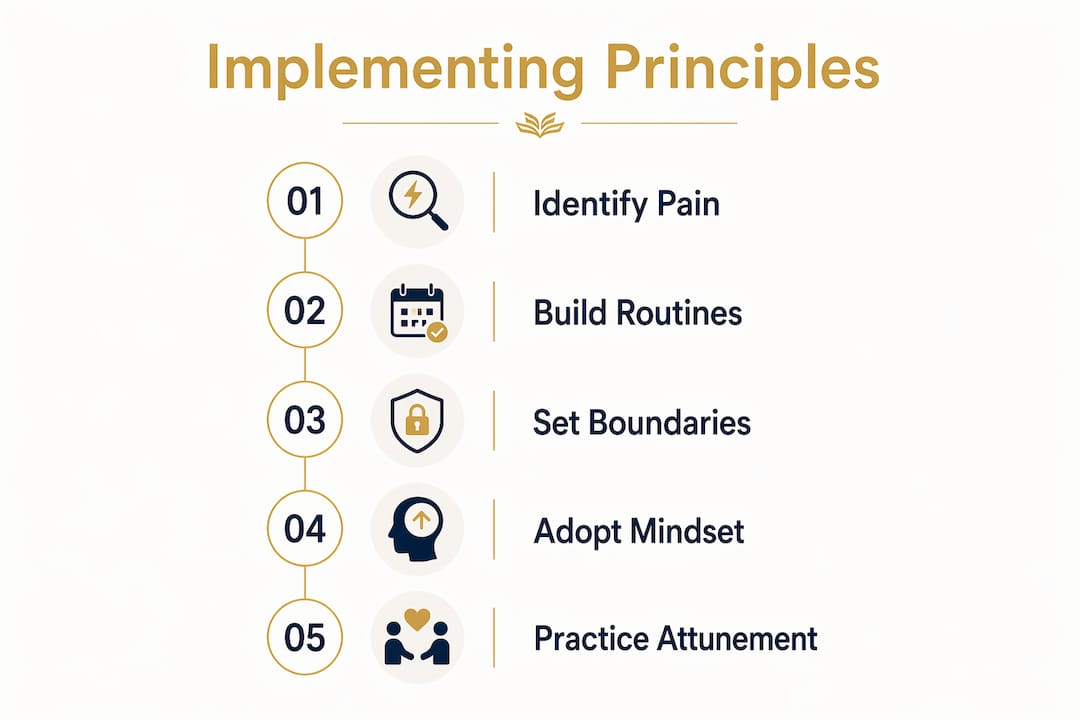
Build routines from specific habits
Start with Covey’s “Put First Things First.” Block your two most important tasks before 10:00 AM, before email or meetings consume your attention. This single habit shifts your day from reactive to intentional. Pair it with “Sharpen the Saw” by protecting at least one recovery activity per day, whether that is exercise, reading, or unstructured time.
Adopt the slow productivity mindset
Sustainable output comes from working at a natural pace and obsessing over quality rather than volume. Practically, this means cutting your active project list by a third. Fewer commitments allow deeper focus on what remains. Professionals who apply this report less end-of-day exhaustion and better quality work within the same hours.
Use negotiation scripts for boundary setting
Having It All provides ready-made language for conversations most professionals avoid. Use the salary negotiation scripts before your next review cycle. Use the boundary-setting frameworks when a manager or colleague consistently overloads your schedule. Scripts remove the emotional charge from these conversations and make the outcome more predictable.
Practice emotional attunement daily
Working Well recommends a brief self-check before transitions, such as moving from work mode to home mode. Ask yourself what emotional state you are carrying and whether it belongs in the next context. This two-minute practice reduces the spillover that makes evenings feel like an extension of the workday.
Common pitfalls to avoid
- Trying to apply every book at once. Pick one framework for 30 days before adding another.
- Treating mental load as a personal failing. Drained makes clear that invisible emotional labor is structural, not a character flaw.
- Skipping the audit step. Before changing behavior, map your current time and energy drains for one week.
- Expecting linear progress. Balance shifts with life stages, and your reading list should shift with it.
What are common misconceptions about work-life balance books?
Several myths reduce how much value professionals extract from these books. Recognizing them upfront saves frustration.
Myth 1: Busyness equals productivity. This is the most damaging belief in professional culture. Slow Productivity directly dismantles it by showing that working at a natural pace produces higher-quality results than constant acceleration. Busyness is a performance. Output is the actual measure.
Myth 2: Work-life balance means strict separation. The attunement model in Working Well rejects rigid compartmentalization. Emotional intelligence, not a hard wall between work and home, is what creates sustainable integration. Trying to keep the two completely separate often creates more anxiety than it resolves.
Myth 3: These books are just about personal effort. Having It All is explicit that women face systemic biases rather than a lack of ambition. Reading a productivity book and working harder will not fix a structurally biased workplace. Real balance requires both personal strategy and systemic awareness.
Myth 4: Mental load is just household chores. Drained identifies eight categories of mental load, including “magic making” and “dream building,” that go far beyond visible tasks. Underestimating this scope leads to burnout that no time-management system can fix alone.
“Real work-life balance requires confronting systemic corporate biases and not just harder personal work. Books that ignore this dimension give professionals only half the picture they need.”
The most effective readers treat these books as tools for personal growth and system redesign, not just motivational reading.
Key Takeaways
The most effective books for work-life balance combine productivity frameworks, emotional intelligence, and systemic awareness to produce lasting change rather than short-term motivation.
| Point | Details |
|---|---|
| Start with a specific pain point | Match your biggest frustration to the book that addresses it directly before buying anything else. |
| Pair productivity with emotional intelligence | Reading Deep Work alongside Working Well builds both external structure and internal awareness. |
| Apply one framework at a time | Implement one book’s core method for 30 days before layering in another to avoid overwhelm. |
| Recognize systemic barriers | Women especially need books like Having It All that address corporate bias, not just personal habits. |
| Audit mental load honestly | Invisible emotional labor has eight distinct categories; mapping them is the first step to reducing them. |
What I’ve learned from years of reading these books
The most honest thing I can say about work-life balance books is this: the ones that changed my thinking were not the ones with the most practical checklists. They were the ones that challenged a belief I had held without questioning it.
Slow Productivity did that for me. I had spent years treating a packed calendar as proof of value. Newport’s argument that fewer, higher-quality commitments produce better results felt almost radical the first time I read it. Then I tested it. The results were not subtle.
What I have also noticed is that most professionals, especially women, apply these books in isolation from the structural realities around them. They read The 7 Habits, build a morning routine, and then wonder why nothing changes when their workplace still rewards 60-hour weeks. Having It All is the book I wish more people read alongside the classic productivity titles. It names the system, not just the individual.
The emotional intelligence angle is the piece most productivity readers skip entirely. Working Well is not a soft add-on. It is the layer that makes everything else sustainable. Without self-awareness and attunement, even the best time-blocking system eventually collapses under emotional weight.
My honest recommendation: treat these books as a rotating toolkit, not a fixed formula. Your balance needs will change with your career stage, your relationships, and your health. The self-discovery process never really ends. The best readers I know revisit these titles every few years and find something different each time.
— Robert
Smartreadshub curated picks for work-life balance readers
Smartreadshub specializes in curated book recommendations for professionals navigating complex personal and career dynamics. The site goes beyond generic lists by connecting readers to titles that address emotional labor, boundary setting, and self-awareness in concrete terms.
For women professionals especially, the book recommendations for women section at Smartreadshub pairs productivity titles with emotional wellness reads that the mainstream lists miss. If you want a reading plan that accounts for both your career goals and your mental health, that resource is the right starting point. Smartreadshub also covers books by women authors whose frameworks are grounded in lived experience, not just theory.
FAQ
What are the best books for work-life balance?
The 7 Habits of Highly Effective People, Deep Work, Slow Productivity, Having It All, and Working Well are the most research-backed titles for professionals. Each addresses a different dimension of balance, from focus and habit building to emotional intelligence and systemic awareness.
Which books on work-life balance are best for women?
Having It All by Dr. Corinne Low is the strongest choice for women because it combines data-driven analysis with word-for-word negotiation scripts that address salary, boundaries, and career-family tradeoffs directly.
How do self-help books actually improve work-life balance?
Self-help books improve balance by replacing vague intentions with specific frameworks. Titles like Slow Productivity and Working Well give readers repeatable methods for managing workload and emotional energy rather than generic motivation.
What is the mental load, and which books address it?
Mental load is the invisible cognitive and emotional work of managing a household and relationships, including categories like “magic making” and “dream building” beyond visible chores. Drained by Leah Ruppanner identifies eight distinct types and offers strategies for redistributing them.
How long does it take to see results from these books?
Applying one framework consistently for 30 days produces noticeable changes in focus and energy. Design thinking approaches from Designing Your New Work Life recommend small prototypes rather than large overhauls, which means results can appear within weeks rather than months.