What attachment styles are and how books explain them
Attachment styles are stable behavioral patterns formed in early childhood through repeated interactions with caregivers. John Bowlby, the psychiatrist who first developed attachment theory in the 1960s, described attachment as any behavior that helps a person maintain closeness to a preferred individual. Mary Ainsworth later identified distinct infant patterns through her Strange Situation research, giving the field its foundational categories.
Books like Attached by Amir Levine, MD, and Rachel Heller, MA, translate this science into something immediately recognizable. They frame each style as an internal operating system: a set of predictions your nervous system makes about whether closeness is safe, whether others will show up, and how much threat to assign to ordinary relational friction.
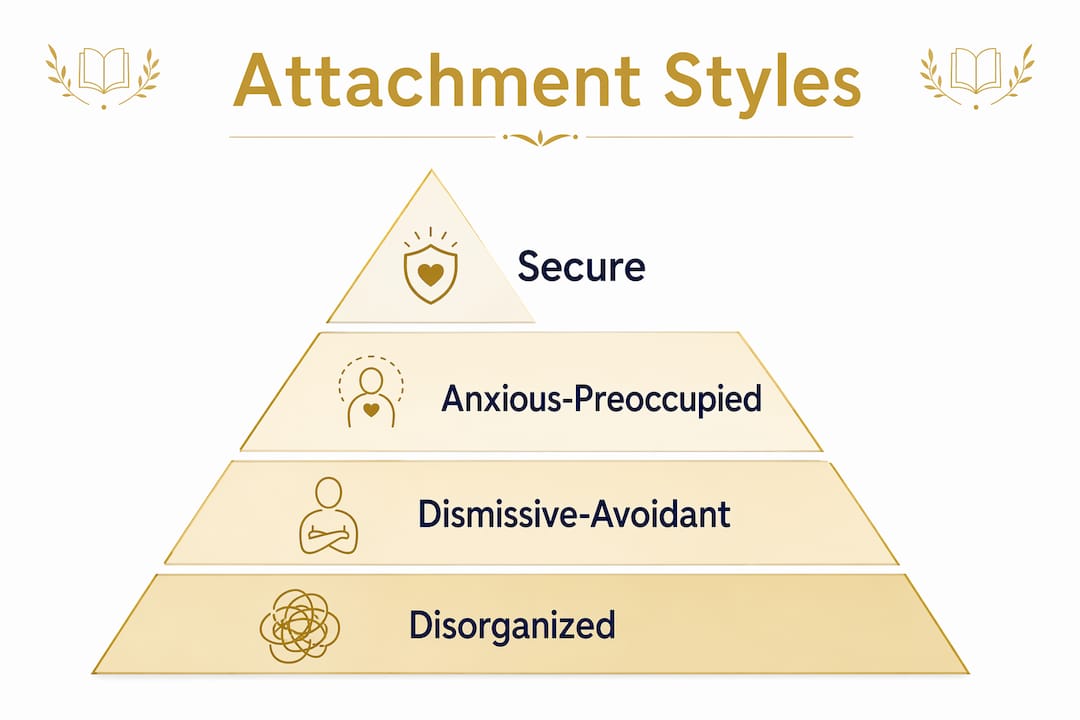
The four main styles, as explained across leading attachment books:
- Secure: Comfortable with intimacy and interdependence; able to seek support and offer it without losing a sense of self.
- Anxious-preoccupied: Hypervigilant to signs of distance; tends toward rumination and compulsive reassurance-seeking, rooted in inconsistent early caregiving.
- Dismissive-avoidant: Deactivates the attachment system; equates emotional need with weakness, developed in response to caregivers who consistently dismissed bids for closeness.
- Disorganized (fearful-avoidant): Simultaneously desires and fears closeness; often linked to caregiving that was frightening rather than simply absent or inconsistent.
Therapist Annie Wright emphasizes that these styles are adaptations, not character flaws. They were survival strategies that made sense in the environment where they formed. That reframe is one of the most consistent and useful things attachment books offer readers.
Common attachment style categories and their characteristics in literature
Books characterize each style through behavior patterns that readers recognize in themselves and in the people they love. The characteristics below reflect how accessible attachment literature typically presents each style:
- Secure: Moves toward others under stress rather than away; repairs conflict without catastrophizing; holds their own needs and a partner’s needs simultaneously.
- Anxious-preoccupied: Fear of abandonment drives constant monitoring of a partner’s emotional state; difficulty tolerating distance; tends to escalate when a partner withdraws.
- Dismissive-avoidant: Prioritizes self-sufficiency to the point of emotional unavailability; interprets a partner’s need for closeness as pressure or burden.
- Disorganized: Oscillates between craving connection and pulling away; often carries unresolved relational trauma.
One dynamic that books address with particular clarity is the anxious-avoidant trap: the anxious partner pursues, the avoidant partner withdraws, the pursuer escalates, and the distancer retreats further. Both are responding to the same underlying fear of disconnection, just in opposite directions. Most readers who have been in this pattern recognize it within the first few chapters of Attached.
Understanding attachment styles in literature also means seeing these patterns in fictional characters. Scholars have applied Bowlby’s framework to novels like Wuthering Heights, Jane Eyre, and The Tenant of Wildfell Hall, reading them as proto-attachment narratives that explored child-rearing and relational damage before formal theory existed.

How books use self-assessment tools and practical guidance to help readers
The self-assessment quiz is one of the most effective tools attachment books deploy. Attached includes one that many readers describe as the first time a framework actually fit their experience. How We Love, which has sold over 400,000 copies, uses a similar approach, pairing quizzes with guided reflection to help readers move from identification toward change.
What books offer beyond the quiz:
- Style identification: Naming your pattern reduces shame and creates a starting point for self-understanding.
- Behavioral mapping: Books walk readers through how each style shows up in conflict, intimacy, and communication.
- Partner recognition: Attached explicitly helps readers identify a partner’s style, not just their own.
- Practical strategies: Guidance on seeking secure partners, communicating needs directly, and tolerating closeness without panic.
The APA’s clinical overview of attachment science notes that quiz results are an illuminating first step, but deeper change requires understanding the mental models underneath the behaviors. Books that acknowledge this distinction, rather than promising transformation through self-knowledge alone, tend to be the most clinically honest.
Pro Tip: If a quiz result surprises you, sit with it before dismissing it. The styles that feel least like “you” are often the ones most worth examining.
The role of literary analysis in understanding attachment through fictional characters
Literary analysis offers something clinical writing rarely can: emotional immersion. When you read Heathcliff’s obsessive attachment in Wuthering Heights or Jane Eyre’s lifelong struggle with failed attachment figures, you feel the pattern before you name it. That felt recognition is what makes literature a powerful vehicle for understanding attachment dynamics.
Scholars use the term “proto-attachment narratives” for novels that explored attachment themes before Bowlby formalized the theory. The Brontë novels, for instance, examine the cyclical nature of damaged attachment across generations, the burden placed on parental figures, and the way institutional upbringings produce different developmental outcomes than family ones.
What literary analysis adds to attachment understanding:
- Indirect engagement: Readers process difficult relational patterns through characters before applying them to themselves.
- Reflective function: Narrative re-authoring, as described in research on Little Dorrit by Charles Dickens, fosters the capacity to understand one’s own mental states and those of others.
- Non-clinical access: Fiction reaches readers who would never pick up a psychology textbook.
- Generational perspective: Novels like Wuthering Heights show how attachment damage transmits across generations in ways that clinical case studies rarely capture with the same vividness.
Translating attachment theory into practical relationship insights and healing
Understanding your style is the beginning, not the destination. The books that do this translation well, including Attached, Hold Me Tight by Sue Johnson, and Diane Poole Heller’s Healing Your Attachment Wounds, move readers from recognition to the harder work of change.
Key practical insights from leading attachment authors:
- Earned security is real. Contemporary research confirms that attachment styles can shift through consistent, attuned, safe relational experiences, including therapy.
- Polyvagal Theory connects the body to the pattern. Stephen Porges, PhD, developed the framework explaining how the autonomic nervous system moves through states of safety, mobilization, and shutdown. Anxious attachment maps onto sympathetic activation; avoidant attachment onto dorsal vagal shutdown.
- The avoidant system lies. It says “pull back, protect your independence.” Earned security develops precisely by moving toward connection when that pull arises, and discovering that vulnerability doesn’t produce the dismissal the system predicts.
- Books alone don’t heal attachment wounds. They can name the pattern and reduce shame. The actual repair happens inside relationships, most reliably a therapeutic one.
For readers navigating toxic relationship patterns, understanding attachment is often the first coherent explanation for why certain dynamics feel so compulsive and so painful. That clarity, by itself, changes something.
Pro Tip: Levine and Heller’s advice to anxious attachers is counterintuitive but clinically sound: the absence of anxious activation with a secure partner isn’t a lack of chemistry. It’s what safety actually feels like when you’re not used to it.
Summary: how books explain attachment styles
Books on attachment theory work because they do three things at once: they name the pattern, they explain its origin without blame, and they point toward change. A quick recap:
- Attachment styles originate in early caregiver-child interactions and operate mostly below conscious awareness.
- The four categories (secure, anxious-preoccupied, dismissive-avoidant, disorganized) describe distinct nervous system strategies, not personality types.
- Self-assessment tools in books like Attached and How We Love give readers a starting point, though lasting change requires more than identification.
- Literary analysis, from the Brontë novels to Little Dorrit, shows attachment dynamics in lived emotional terms that clinical writing rarely matches.
- Earned security is achievable through safe, consistent relationships, and books like Diane Poole Heller’s The Power of Attachment describe what that actually looks and feels like.
How attachment theory developed, as told in books
Bowlby’s foundational work, published in his Attachment and Loss trilogy beginning in 1969, argued that human attachment is as biologically necessary as nutrition. The New York Times called it “the most complete examination of the implications of attachment and loss yet written.” Ainsworth’s Strange Situation experiments followed, producing the first empirical attachment categories.
Later researchers, including Phillip Shaver, PhD, at UC Davis, extended the framework into adult romantic relationships, demonstrating that the same three basic orientations active in infants appear in adult intimate bonds. Omri Gillath, Gery Karantzas, and R. Chris Fraley’s Adult Attachment brought this research into accessible form, using a question-and-answer format designed for readers new to the field. Mario Mikulincer and Phillip Shaver’s Attachment in Adulthood remains the definitive academic reference, covering emotion regulation, couple functioning, and organizational behavior through an attachment lens.
How different authors approach explaining attachment styles
Authors vary considerably in how they frame and deliver attachment theory, and the differences matter depending on what you need.
Levine and Heller (Attached) prioritize immediate practical recognition. Their goal is to help readers identify their own style and their partner’s style quickly, then make better relational choices. The book is direct, occasionally blunt, and clinically grounded without being inaccessible.
Sue Johnson (Hold Me Tight) organizes her framework around what she calls “demon dialogues,” the cyclical patterns distressed couples repeat. Her focus is the emotional bond itself rather than individual style categories, making her approach particularly useful for couples work.
Diane Poole Heller (Healing Your Attachment Wounds, The Power of Attachment) goes deeper into the parts of the psyche that developed in response to early relational wounding. She calls these the “four exiled selves,” the hyper-independent part, the hypervigilant part, and so on. Her framework is more somatic and trauma-informed than Levine and Heller’s.
The APA’s clinical text on attachment science draws a sharp line between evidence-based attachment interventions (mentalization-based therapy, attachment-based family therapy) and practices that have been erroneously labeled “attachment therapy.” That distinction matters for readers trying to evaluate what they’re reading.
Common misconceptions about attachment styles that books address
Books on attachment theory spend considerable effort correcting misunderstandings that circulate in popular culture.
The most persistent misconception is that attachment styles are fixed personality traits. They are not. They are nervous system adaptations, and they can change through consistent relational experience. Calling someone “just avoidant” as though it were a permanent character flaw misses the entire clinical picture.
A second misconception is that secure attachment means never feeling anxious or needing reassurance. Heller’s description of secure attachment is more useful: it’s a set of capacities, the ability to move toward others under stress, to repair ruptures without catastrophizing, and to hold your own needs and another’s simultaneously. Difficulty is still present. The difference is in how it’s handled.
Third, many readers assume that anxious attachment and codependency are the same thing. They overlap but are distinct. Anxious attachment is a nervous system orientation; codependency involves deriving self-worth from managing or rescuing another person. The compassionate self-awareness required to distinguish these patterns is itself a therapeutic skill.
How books address cultural variations in attachment styles
Most foundational attachment texts were developed in Western, primarily American and British, research contexts. Books that engage honestly with this limitation are more useful than those that don’t.
The APA’s clinical overview acknowledges that attachment theory has historically been mischaracterized as focusing solely on maternal influences, when in fact attachment figures across the lifespan include foster parents, peers, and romantic partners. That broader framing opens space for cultural variation in who counts as an attachment figure and how attachment behaviors are expressed.
Cultural norms around emotional expression, interdependence, and self-sufficiency shape how attachment styles manifest and how they’re perceived. What reads as healthy independence in one cultural context may read as avoidant withdrawal in another. Books that treat Western norms as universal tend to pathologize relational styles that are adaptive in collectivist or high-context cultures.
How books use case studies and real-life examples to illustrate attachment patterns
Case studies are where attachment theory stops being abstract. Attached uses composite client examples to show how anxious and avoidant styles play out in real dating and partnership scenarios. The APA’s clinical text includes case studies that bring clinical guidance to life, showing how internal working models and attachment scripts operate in therapy sessions.
Literary case studies work differently but often land harder. The analysis of Adeline Mowbray in Amelia Opie’s novel traces how an anxious-preoccupied attachment with a withholding mother shapes Adeline’s adult romantic style, where she takes on the dismissive-avoidant role with her lover Glenmurray. That reversal, where the anxious child becomes the avoidant adult, illustrates something clinical writing rarely captures: the way attachment patterns transform rather than simply repeat across relationships.
For readers who want books about unhealthy attachment grounded in real examples, the combination of clinical case studies and literary analysis offers the most complete picture of how these patterns actually operate.
Key Takeaways
Books explain attachment styles most effectively by combining research-backed definitions, self-assessment tools, and narrative examples that make abstract patterns personally recognizable.
| Point | Details |
|---|---|
| Four core styles | Secure, anxious-preoccupied, dismissive-avoidant, and disorganized styles each reflect distinct nervous system adaptations to early caregiving. |
| Styles are not fixed | Earned security develops through consistent, safe relational experiences, including therapy, even without a secure childhood. |
| Self-assessment is a starting point | Quizzes in books like Attached and How We Love identify patterns, but deeper change requires understanding underlying mental models. |
| Literary analysis adds emotional depth | Proto-attachment narratives like the Brontë novels illustrate attachment dynamics through character in ways clinical writing rarely matches. |
| Polyvagal Theory connects body to behavior | Anxious attachment maps to sympathetic activation; avoidant attachment to dorsal vagal shutdown, a framework translated into practical guidance in somatic attachment books. |
Smartreadshub curates books and resources for readers working through relational patterns, including attachment-driven dynamics. If you’re looking for psychology books that support healing, the Smartreadshub library is a good place to start.