
Strategic, trauma-informed reading genuinely rebuilds career ambition. A University of Sussex review found reading can cut stress levels by up to 68%, which preserves the cognitive bandwidth you need to plan, decide, and act. Leadership Explored frames reading as a measurable leadership competency, not a passive hobby. And Smartreadshub’s curated recovery reading plans are built specifically for people coming out of psychological abuse who want to rebuild professional momentum without retraumatizing themselves.
Your one action this hour: Pick one short chapter from any book in your home. Read it. Then write three ideas it sparked. That’s the whole template. You don’t need a plan yet. You need a first move.
- Reading lowers stress, freeing mental energy for career thinking
- Stories supply role models and identity scripts you can try on safely
- Synthesis habits (three ideas, written within 48 hours) convert reading into retained knowledge
- Curated, trauma-aware lists let you build momentum without accidental harm
Pro Tip: Start with books that use short chapters or labeled content warnings. If a passage destabilizes you, close the book, ground yourself with five slow breaths, and return only when you feel steady. Reading should feel like a door opening, not a wall closing in.
Table of Contents
- How do books influence career ambition? What the research shows
- Why reading rebuilds ambition: the psychological mechanisms
- Curated reading categories that support healing and career ambition
- How to build a trauma-informed reading practice this week
- How to turn reading into real career momentum
- When reading isn’t enough: red flags and where to get help
- Smartreadshub: curated reading plans for rebuilding ambition after abuse
- Key Takeaways
- Reading after abuse takes longer than the books suggest
- Useful sources and further reading
How do books influence career ambition? What the research shows
The evidence connecting reading to career outcomes is stronger than most people realize, and it runs across multiple disciplines.

| Study | Population | Key Finding |
|---|---|---|
| University of Sussex (2026) | Adult participants | Reading reduces stress by up to 68% |
| BCS70 Cohort (CLS/UCL) | UK teens followed to adulthood | Regular teen readers showed higher probability of professional/managerial roles |
| EDUCBA professional development summary | Working professionals | Rigorous readers report a salary premium |
The BCS70 cohort data is particularly striking. Among middle-class girls, those who read regularly at 16 had a notably higher probability of entering professional or managerial roles in adulthood compared to non-readers. That gap doesn’t close on its own. It compounds.
For someone recovering from psychological abuse, the stress-reduction finding matters most first. Chronic stress from toxic relationships shrinks the prefrontal cortex’s capacity for planning and goal-setting. Reading interrupts that cycle. Once stress drops, the other career benefits become accessible.
Why reading rebuilds ambition: the psychological mechanisms
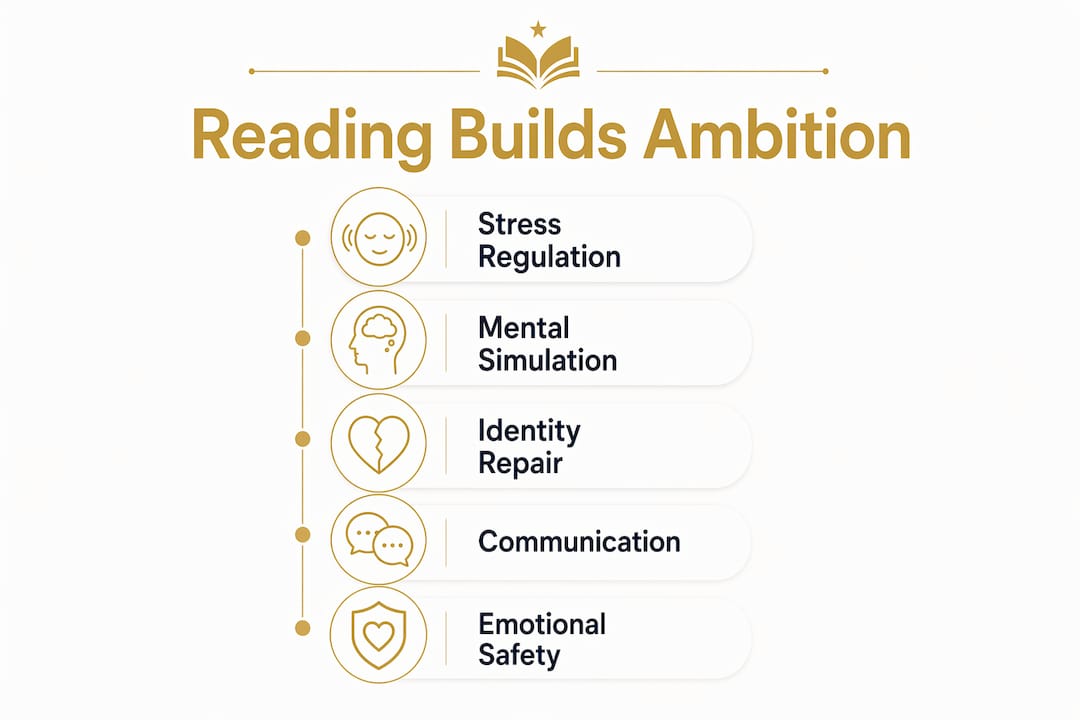
Stress regulation comes first. When you’re in survival mode after abuse, your brain isn’t wired for ambition. It’s wired for threat detection. Reading fiction or memoir for even 15–20 minutes shifts the nervous system out of that state, restoring the cognitive space where career thinking lives. The science behind reading’s anxiety effects confirms this isn’t metaphor. It’s neurological.
Mental simulation is the second mechanism. When you read about a character negotiating a raise, navigating a difficult boss, or leaving a bad situation, your brain rehearses those scenarios almost as if you lived them. A survivor who hasn’t felt safe enough to advocate for herself at work can practice that skill inside a story before trying it in real life.
Identity repair happens through narrative. Psychological abuse systematically dismantles your sense of who you are and what you deserve, as explored in The Architecture of Authority: Female Leaders & Quiet Luxury, which links non-reading behaviors to leadership presence. Memoirs and literary fiction offer what researchers call “narrative reauthoring” — you encounter characters who were diminished and rebuilt themselves, and your brain begins to map that arc onto your own story. A study on fictional narrative and career identity found that books, films, and series influence career identity through personal, cultural, and reflective pathways, with emotional transportation and character identification as the key drivers.
Vocabulary and communication skills signal competence. Abuse often silences people. Reading rebuilds the language to articulate your value, negotiate clearly, and present ideas with confidence. That’s not a soft benefit. It’s a career signal.
Pro Tip: When emotional safety is low, start with literary fiction rather than nonfiction about abuse or trauma. Fiction builds empathy and theory of mind at a safe distance. Once you feel steadier, layer in nonfiction on boundaries, negotiation, and career strategy.
Curated reading categories that support healing and career ambition
These categories are ordered by emotional safety, starting with the gentlest entry points.
1. Literary fiction for empathy and identity play
Fiction lets you inhabit other lives without risk. Molly Graham, former executive at Facebook and Google, reads mostly novels and credits that habit with helping her find authentic leadership rather than imitating what she thought leadership should look like. Best for: rebuilding a sense of self.
- The Nightingale by Kristin Hannah — resilience and identity under pressure; no graphic abuse content
- Educated by Tara Westover — memoir of self-determination; content note: family trauma
2. Emotional recovery and boundary skills
These books name what happened to you and give you language for it. That language is the first career tool. Smartreadshub’s emotional recovery after abuse guide pairs well with this category.
- Why Does He Do That? by Lundy Bancroft — best for understanding control dynamics; content note: descriptions of abuse
- Set Boundaries, Find Peace by Nedra Tawwab — best for boundary setting; accessible, short chapters
3. Self-discovery and identity rebuilding
- What Color Is Your Parachute? by Richard N. Bolles — best for practical career clarity; the self-assessment exercise maps transferable skills without requiring you to have your life together first
- Smartreadshub’s self-discovery books guide curates additional titles in this space
4. Leadership and decision-making
- The Startup of You by Reid Hoffman and Ben Casnocha — best for rebuilding professional confidence; frames your career as a living project you control
- Best for: practical negotiation skills and strategic thinking
5. Cognitive restoration and stress resilience
Short-chapter formats and audiobooks work well here. Books for working mothers includes titles optimized for low cognitive load and fragmented reading time.
How to build a trauma-informed reading practice this week
Weeks 1–2: Fifteen minutes a day, same time, same chair if possible. One chapter or 20 pages. No pressure to finish. The goal is the habit, not the book.
Weeks 3–6: Add the three-idea synthesis note. Within 48 hours of finishing a chapter, write three ideas it gave you. One sentence each. Top executives read 4–5 books a month and systematize synthesis — that’s the actual advantage, not the volume. Spaced repetition: re-read those three ideas one week later.
Weeks 7–12: Connect one idea per book to one career micro-action (see the next section). Track what you applied and what happened.
Timeline expectations:
- At 2 weeks: stress during reading sessions starts to drop; you’ll notice a small mental quiet after reading
- At 6 weeks: clearer thinking about career options; first micro-wins from applied ideas
- At 3 months: a visible shift in how you talk about your skills and what you want
Safety guidelines:
- If a book triggers distress, stop immediately. Ground yourself: name five things you can see, four you can touch
- Keep a therapist or trusted person in the loop about what you’re reading
- Use reading challenges to add structure without pressure
Pro Tip: Start each book with a targeted question: “What does this book tell me about negotiating for myself?” or “What does this character know about rebuilding after loss?” That question turns the table of contents into a roadmap and doubles retention.
How to turn reading into real career momentum
Reading without application is just comfort. One idea mapped to one micro-project is where career development through books actually happens.
- Identify one skill or mental model from your current book. Write it in one sentence.
- Design a micro-project lasting one to four weeks. Keep it small and completable.
- Share results in a safe space: a trusted colleague, a moderated online group, or a journal.
- Document the outcome: time spent, idea applied, feedback received, evidence of impact.
Three examples that work:
- Negotiation script practice (2 weeks): After reading a chapter on assertive communication, write and rehearse a script for one real conversation you’ve been avoiding.
- One-page framework memo (1 week): Apply a decision-making framework from a leadership book to a real problem at work. Write it up. Keep it.
- Side project demonstration (4 weeks): Use a skill from your reading to complete one small visible project — a short article, a volunteer task, a redesigned process.
Track these in a simple log. Over three months, that log becomes evidence of growth you can point to.
When reading isn’t enough: red flags and where to get help
Books help. They are not a substitute for professional care when these signs appear:
- Intrusive trauma symptoms that interrupt daily functioning
- Suicidal thoughts or self-harm urges
- Severe dissociation or inability to feel safe in your own body
- An unsafe living situation with an abusive partner still present
- Panic attacks triggered by reading that don’t resolve with grounding
US-based resources:
- National Domestic Violence Hotline: 1-800-799-7233 (24/7, free, confidential)
- Crisis Text Line: Text HOME to 741741
- SAMHSA National Helpline: 1-800-662-4357 (mental health and substance use)
- Therapy matching: Smartreadshub’s comparison of therapy platforms covers options including online therapy services suited to survivors
Reading works best as a complement to therapy, not a replacement. Bring your three-idea synthesis notes to sessions. A good therapist will use them.
This article is general information, not professional advice. For your specific situation, please consult a licensed mental health professional or contact the resources above.
Smartreadshub: curated reading plans for rebuilding ambition after abuse
Smartreadshub was built for exactly this moment. When you’re coming out of psychological abuse and trying to figure out who you are professionally, generic career advice lands wrong. You need reading lists that understand what gaslighting does to your sense of competence, what narcissistic abuse does to your ambition, and what it actually takes to rebuild both.
The site’s emotional recovery after abuse guide is the clearest starting point: it maps books to recovery stages so you’re not accidentally reading something destabilizing when you’re still fragile. The books that empower women readers guide goes further, connecting specific titles to career confidence and professional identity. You can also use the book recommendations guide to build a reading accountability circle with people who get it.
Pick one guide. Start one four-week plan. That’s the next step.
Key Takeaways
Strategic, trauma-informed reading reduces stress, repairs identity, and builds the mental models that convert directly into career momentum for survivors of psychological abuse.
| Point | Details |
|---|---|
| Reading cuts stress first | A University of Sussex review found reading reduces stress by up to 68%, restoring the cognitive space career planning requires. |
| Teen reading predicts adult careers | BCS70 cohort data shows regular readers at 16 had a notably higher probability of professional roles in adulthood. |
| Synthesis drives retention | Write three ideas within 48 hours of each chapter; re-read them one week later to lock in what you learned. |
| Fiction repairs identity safely | Literary fiction builds empathy and narrative identity at a safe distance before nonfiction career work begins. |
| Smartreadshub as next step | Smartreadshub’s trauma-informed reading guides map books to recovery stages so you build ambition without retraumatizing yourself. |
Reading after abuse takes longer than the books suggest
Most career-reading guides assume you’re starting from a neutral baseline. You’re not. Abuse leaves cognitive residue: self-doubt that sounds like your own voice, ambition that feels dangerous because wanting things made you a target. That’s not weakness. That’s a predictable response to sustained psychological harm.
Progress with reading after abuse is slower and less linear than any 12-week plan implies. Some weeks a single paragraph will feel like enough. Some books will need to be set down and returned to months later. That’s fine. The research on reading and occupational outcomes spans years, not weeks. You’re playing a long game, and the evidence says the long game pays off.
Start small. Write your three ideas. Come back tomorrow.
Useful sources and further reading
- University of Sussex — reading and stress reduction: The foundational study showing reading reduces stress by up to 68%; cited in 2026 summaries on cognitive restoration.
- CLS/UCL BCS70 cohort research: Long-term cohort data linking teen reading habits to professional and managerial career outcomes in adulthood.
- EDUCBA — professional reading and salary premium: Industry summary reporting up to a 25% salary premium for professionals with rigorous reading habits.
- Leadership Explored — “Reading is Leading”: Expert commentary framing reading as a measurable leadership competency across four mechanisms.
- Fictional Narrative and Career Identity (Academy of Management): Peer-reviewed study on how books and stories influence career identity through personal, cultural, and reflective pathways.
- Smartreadshub — Emotional Recovery After Abuse: Curated trauma-aware reading guide mapping books to recovery stages for survivors rebuilding confidence and career ambition.