Narrative therapy self-help books are guided workbooks, journals, and recovery reads that teach you to separate your identity from the stories abuse planted in your mind, then help you write a truer version. They are not clinical textbooks. The best first read for survivors of gaslighting or narcissistic abuse is one that starts with your strengths before asking you to revisit pain. Positivepsychology that re-authoring work can begin independently through guided journals and workbooks, provided you use scaffolding and stay safety-aware. Browse the Smartreadshub curated book list for vetted starting points.
Safety reminder: Pace yourself. If a prompt triggers dissociation, panic, or thoughts of self-harm, close the book and contact a licensed therapist or the 988 Suicide and Crisis Lifeline before continuing.
Key Takeaways
Narrative therapy self-help books give survivors a structured, evidence-supported way to separate their identity from the stories abuse installed, and the Smartreadshub curated list is the safest place to start.
| Point | Details |
|---|---|
| Best first format | Start with a guided journal or memoir before a deep workbook; build strengths first. |
| One safe exercise | Try the 10-minute externalizing script: name the belief, externalize it, trace its source. |
| When to pause | Stop any exercise if you experience dissociation, flashbacks, or thoughts of self-harm. |
| Realistic progress | Clearer self-talk and easier boundary-setting typically emerge within 8–12 weeks of consistent practice. |
| Smartreadshub starting point | The curated books page offers trauma-informed picks reviewed for pacing, exercises, and survivor fit. |
Table of Contents
- What do narrative therapy books actually do for survivors?
- When are these books safe, and when should you get professional help?
- How do you pick the right narrative therapy book for your stage?
- Smartreadshub starter picks: what to read first and why
- Three scaffolded narrative exercises you can try this week
- How to combine books with therapy, peer support, and safety planning
- What does progress actually look like over time?
- A note on how Smartreadshub chose these books
- Smartreadshub’s curated list: your next step
- Sources
What do narrative therapy books actually do for survivors?
Narrative therapy rests on one foundational idea: you are not the problem. The problem is the problem. For someone who has spent months or years being told their perceptions are wrong, that reframe alone can shift something. According to the Trauma Institute, narrative therapy externalizes problems so the person can re-author their life story and emphasize strengths and values.
In practice, these books guide you through four core moves:
- Externalizing: Naming the problem as a separate entity (“the self-doubt gaslighting built”) rather than a character flaw you own.
- Finding unique outcomes: Locating moments in your history that contradict the problem story, times you trusted yourself and were right.
- Re-authoring: Expanding those moments into a fuller, truer account of who you are.
- Meaning-making: Connecting your values and commitments to the new story so it holds under pressure.
Survivors of gaslighting, narcissistic abuse, and prolonged manipulation benefit most because scholarly reviews confirm that refocusing from “victim” to “survivor” is a documented therapeutic aim in abuse work, and these books are built around exactly that shift.
Understanding how gaslighting distorts your self-perception is often the first step before any re-authoring can stick.
When are these books safe, and when should you get professional help?
Healthline’s review of narrative approaches for trauma is clear: pacing matters. Researchers advise building scaffolding by focusing on strengths and resilience first, because confronting traumatic memories too early can intensify distress rather than relieve it.
Start with “landscape of action” exercises: what have you done, survived, chosen? Only after that foundation feels stable should you move toward reconstructing difficult events.
Stop and seek support if you notice:
- Dissociation (feeling detached from your body or surroundings during an exercise)
- Intrusive flashbacks that don’t settle within a few minutes of grounding
- Thoughts of self-harm or suicide
- Emotional flooding that lasts hours after closing the book
- A sense that the exercise is confirming the abuser’s narrative rather than challenging it
Simple safety plan you can copy:
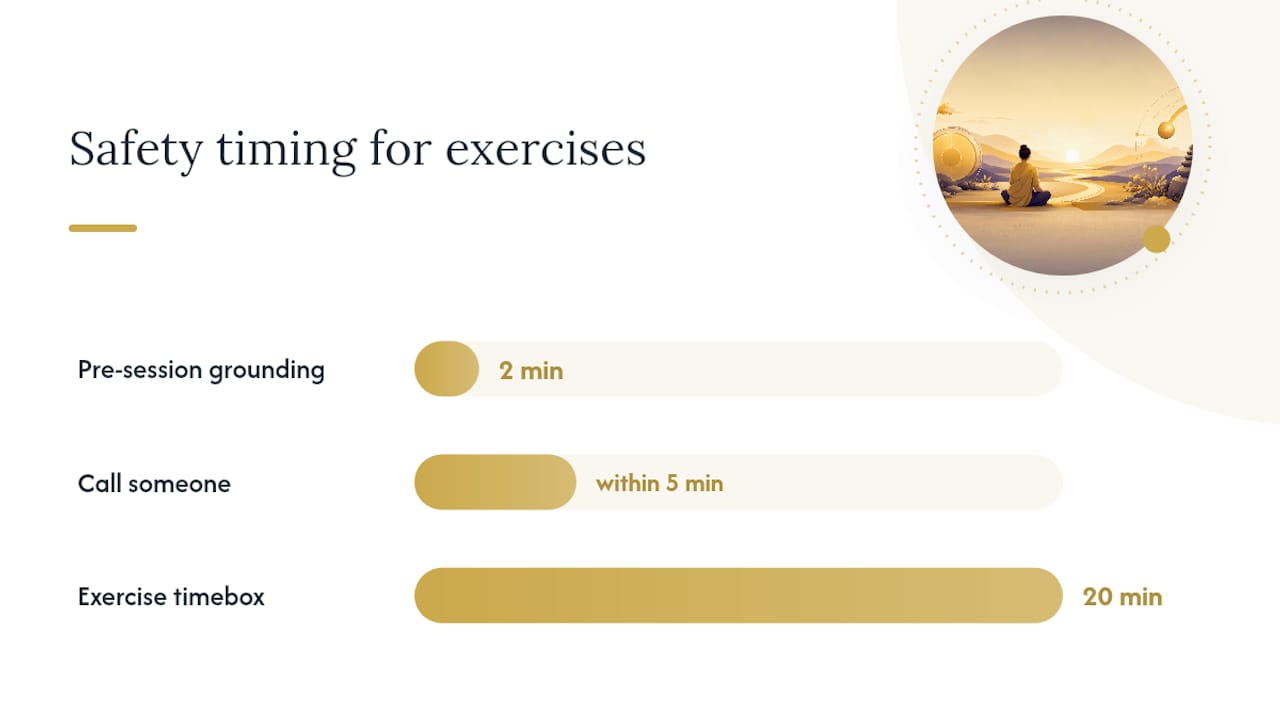
- Name one person you can call within five minutes (therapist, trusted friend, crisis line).
- Choose one grounding technique: 5-4-3-2-1 sensory check, cold water on wrists, or slow box breathing.
- Set a 20-minute timebox for any exercise. When the timer ends, stop, ground, and do something neutral before re-engaging.
- Keep the 988 Lifeline number saved in your phone.
Before each session: Spend two minutes naming three things you can see, hear, and feel. This brief grounding step reduces the chance that an exercise pulls you into overwhelm before you have a foothold.
How do you pick the right narrative therapy book for your stage?
Not every book suits every stage of recovery. A few questions cut through the noise fast.
Ask before you buy:
- Does the book use trauma-informed language, or does it push you to “forgive and move on” before you’re ready?
- Are exercises included, or is it theory-only? (Exercises matter for active re-authoring.)
- Does the author have relevant credentials or lived experience with abuse recovery?
- Is the reading level accessible without being condescending?
- Does the book include trigger warnings or pacing guidance?
Format checklist:
- Workbook: Best for structured, step-by-step practice. Good if you want prompts and space to write.
- Memoir: Best for validation and seeing a survivor’s arc. Lower demand, higher emotional resonance.
- Guided journal: Best for daily, low-intensity practice. Ideal early in recovery.
PositivePsychology.com notes that guided journals and workbooks are the most accessible entry point for independent re-authoring work. Avoid books that skip straight to deep trauma reconstruction without first building a strengths foundation.
Smartreadshub starter picks: what to read first and why
The Smartreadshub curated book list is selected specifically for survivors of gaslighting, narcissistic abuse, and manipulation. Each pick below is chosen for trauma-informed pacing, accessible language, and the presence of practical exercises.
- “It Didn’t Start with You” by Mark Wolynn: Explores inherited and relational trauma patterns. Gentle entry point. Try this: Write one sentence describing a belief about yourself you didn’t choose. Where did you first hear it?
- “The Body Keeps the Score” by Bessel van der Kolk: Explains how relational trauma lives in the body, not just the mind. Validating before it’s challenging. Try this: After reading one chapter, notice where in your body you feel tension and name it without judgment.
- “Why Does He Do That?” by Lundy Bancroft: Demystifies abuser thinking patterns. Cuts through self-blame fast. Try this: List two behaviors from the book that match your experience, then write: “This was his pattern, not my failure.”
- “Healing the Shame That Binds You” by John Bradshaw: Directly addresses the internalized shame that gaslighting installs. Try this: Write one thing you were shamed for that you now recognize as a normal human need.
- “Set Boundaries, Find Peace” by Nedra Tawwab: Practical and warm. Builds the boundary vocabulary that abuse erodes. Try this: Name one boundary you wish you had held. Write what you would say now.
Pro Tip: Start with the book that matches your current energy. If you’re exhausted, a memoir or guided journal asks less of you than a workbook. Save the deeper workbooks for when you have a stable hour and a grounding plan ready.
See how books explain relationship patterns for more on why structured reading accelerates recovery.
Three scaffolded narrative exercises you can try this week
PsychKit’s Story Weaver tool illustrates how core narrative steps, externalizing, finding unique outcomes, and re-authoring, can be adapted into short, safe practices.
Exercise 1: Externalizing (10 minutes)
- Ground yourself: take three slow breaths and name five things you can see.
- Write the name of a belief that feels stuck, for example, “I am too sensitive.”
- Give it an external name: “The Too-Sensitive Story.”
- Write two sentences describing where that story came from and who benefited from you believing it.
- Close with grounding: name one thing you can feel physically right now.
Exercise 2: Mapping influence (15 minutes)
- Draw a simple circle in the center of a page and write the problem story’s name inside it.
- Around the circle, write every source that fed that story: a person, a phrase, a repeated event.
- For each source, ask: “Did I choose this, or was it handed to me?”
- Circle the sources you did not choose. Notice how many there are.
Exercise 3: Micro re-authoring (15 minutes, scaffolded)
- Recall one moment, however small, when you acted from your own values despite pressure. Write it in two or three sentences.
- Ask: “What does this moment say about who I actually am?”
- Write one sentence that begins: “A truer story about me is…”
- If you feel overwhelmed at any point, stop, use your grounding technique, and return another day.
- Share your re-authoring sentence with a trusted person or therapist if you feel safe doing so.
- Narrative reclamation frameworks describe this process as truth retrieval followed by identity reorientation, a useful frame for understanding why even a two-sentence preferred story carries real weight.
Pro Tip: Keep a dedicated notebook for these exercises. Seeing your re-authoring sentences accumulate over weeks is its own form of evidence against the problem story.
How to combine books with therapy, peer support, and safety planning
Books work best as one layer, not the whole structure. Michael White’s Dulwich Centre work describes outsider-witness retellings, where trusted listeners reflect back what stood out to them in a survivor’s story, as a powerful way to restore agency and a sense of worth.

You can adapt this in a peer setting: share one re-authoring sentence with a trusted friend and ask them to reflect only on what strengths they heard, not to advise or fix. That simple structure is meaningfully different from venting.
Checklist for keeping book work aligned with your safety plan:
- Tell your therapist which book you’re working through and which exercises you’re trying.
- Never do a deep trauma-reconstruction exercise alone if you don’t have a grounding plan ready.
- If a peer group is your main support, agree on a “no advice” rule: listeners reflect strengths, not solutions.
- The Trauma Institute confirms that narrative work is most effective when integrated with other modalities rather than used alone for complex trauma.
What does progress actually look like over time?
Progress in narrative work is quiet and cumulative, not dramatic.
- Weeks 2–4: You start noticing when the problem story speaks. You can name it as external rather than automatically believing it.
- Weeks 4–8: Unique outcomes become easier to find. You catch yourself acting from your values and recognize it in the moment.
- Weeks 8–12: Self-talk shifts. Boundaries feel less like confrontation and more like information. Flashpoints decrease in frequency, though not necessarily in intensity yet.
Progress is not erased trauma. It is a growing library of evidence that the problem story was never the whole truth. Individual differences are real: some readers move faster, some slower, and deeper trauma work almost always benefits from a licensed, trauma-informed therapist alongside the books. Psychology-backed reading can accelerate this process, but it works best as a complement to professional support, not a replacement.
A note on how Smartreadshub chose these books
The picks on Smartreadshub are selected with one question in mind: does this book meet a survivor where she is, or does it ask too much too soon? Every title is reviewed for trauma-informed language, the presence of practical exercises, and whether it builds strengths before revisiting harm. Readers consistently report feeling seen and less alone after working through even one chapter of a well-chosen book. That outcome, clarity over confusion, matters more than any credential list.
For a deeper look at how narrative-style books support trauma recovery, the Caroline Strawson review on Smartreadshub shows exactly how one author’s approach translates into real recovery shifts.
Smartreadshub’s curated list: your next step

The Smartreadshub books page brings together survivor-focused reads, including narrative therapy guides, workbooks, and recovery memoirs, all reviewed for trauma-informed pacing and practical exercises. Every recommendation is chosen to help you move from confusion to clarity, at your own speed.
Smartreadshub earns a small affiliate commission when you purchase through links on the site, at no extra cost to you. Free articles, guides, and emotional recovery resources are available without any purchase. Head to the books page, pick one title that matches where you are right now, and start there.
Sources
- Positivepsychology
- Narrative therapy for trauma: How telling your story can help | Healthline
- Working with people who are suffering the consequences of multiple trauma — Michael White (Dulwich Centre)
- Psychkit
- Narrative therapy approaches for survivors of abuse (scholarly review) | CSUSB ScholarWorks
For deeper trauma work, please seek a licensed, trauma-informed therapist. This article provides general information and is not a substitute for professional mental health support.