
If you’re trying to make sense of what you feel after a gaslighting or narcissistic relationship, start with these four books: In the Dream House by Carmen Maria Machado (recognition), It’s Not You by Dr. Ramani Durvasula (validation and internal rebuilding), It’s My Life Now by Meg Kennedy Dugan and Roger Hock (skill-building), and Breaking Trauma Bonds by Shahida Arabi (anger and release). Each one maps to a different emotional stage, and together they cover the arc most survivors move through.
- In the Dream House names coercive patterns in real time. Start here if you’re still asking “was that actually abuse?”
- It’s Not You validates your experience and shifts focus to internal healing rather than waiting for acknowledgment that will never come.
- It’s My Life Now gives you structured exercises for rebuilding identity and safety. Best once you’ve moved past the shock phase.
- Breaking Trauma Bonds helps you understand why leaving felt impossible. Read this when anger starts surfacing.
Pro Tip: Before opening any of these, decide on a 15-minute reading limit per session. If you feel your chest tighten or your thoughts spiral, stop. Audio versions of Until She Barely Existed and In the Dream House let you pause instantly and are easier to pace.
Key Takeaways
Literature explains grief stages after abuse by giving survivors language, models, and skills they can use before, during, and after therapy.
| Point | Details |
|---|---|
| Start with recognition | In the Dream House is the clearest first read for survivors still asking whether what happened was abuse. |
| Match genre to stage | Memoir validates, fiction creates distance, therapeutic nonfiction builds skills — choose by what you need now. |
| Read in short sessions | A 15-minute limit with a grounding practice reduces re-traumatization risk for high-trigger titles. |
| Pair books with practice | Use journaling prompts and therapy check-ins after each session to convert reading into active recovery. |
| Smartreadshub’s curation | Every Smartreadshub pick is trauma-informed, clinician-endorsed, and flagged for trigger risk and reading approach. |
Table of Contents
- How does literature explain grief stages after narcissistic abuse?
- A staged reading plan matched to where you are right now
- Safe reading practices that protect you from re-traumatization
- How to fold reading into a real recovery plan
- What clinicians and survivors say about reading as recovery
- How Smartreadshub selects books for survivors
- A note on re-grieving and where to start
- Smartreadshub’s curated reading guide for survivors
- Sources
How does literature explain grief stages after narcissistic abuse?
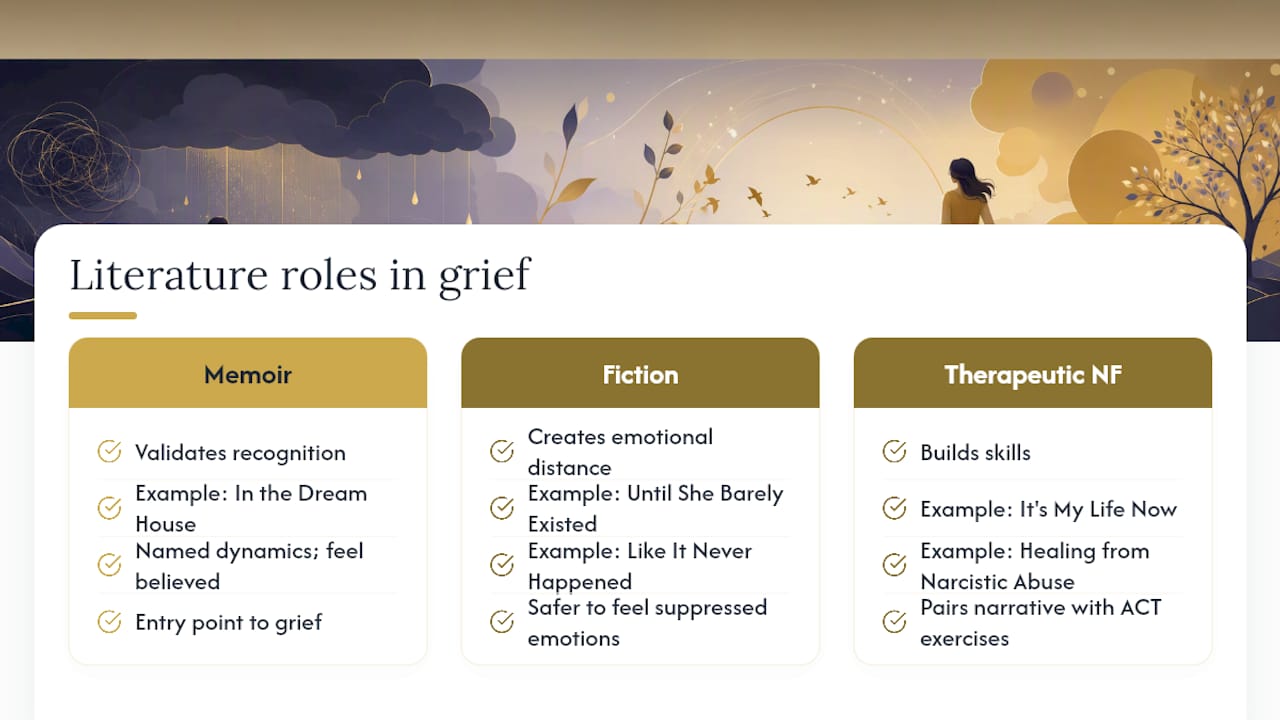
Memoir, fiction, and therapeutic nonfiction each do something different for survivors, and understanding that difference helps you choose what you actually need right now.
Memoir validates recognition. When a survivor author names a pattern you lived through, the effect is immediate: your experience stops being invisible. Carmen Maria Machado’s In the Dream House uses an inventive, chapter-by-chapter structure to dissect psychological abuse, and readers consistently report that seeing their own dynamics named in literary form is the first moment they feel believed. That recognition is the entry point to grief, not a detour from it.
Fiction creates emotional distance. Novels like Until She Barely Existed and Like It Never Happened let you watch a character experience what you experienced. That slight remove can make it safer to feel the emotions you’ve been suppressing. Literary analysis of grief in fiction shows that identification with a character often precedes the ability to feel grief about your own story.

Therapeutic nonfiction builds skills. Books like It’s My Life Now and Dr. Daksha Hirani Healing from Narcissistic Abuse pair narrative with exercises drawn from Acceptance and Commitment Therapy (ACT). They’re less about feeling understood and more about learning what to do next.
The emotional stages survivors typically pass through after gaslighting or narcissistic abuse don’t follow a clean sequence. Vanessa Reiser, a licensed therapist, describes recovery as non-linear, with many survivors cycling back through earlier stages as new information arrives. Literature mirrors this: a memoir that felt irrelevant at month two may hit differently at month six.
Pacing and narrative voice matter too. A slow, lyrical memoir allows you to sit with discomfort gradually. A direct, clinical tone in therapeutic nonfiction can feel grounding when emotions are running high. Knowing which register you need on a given day is part of choosing books for grief wisely.
A staged reading plan matched to where you are right now
Work through this in order if you’re unsure where to begin. Skip ahead if a stage doesn’t match your current emotional reality.
-
Early shock and recognition: In the Dream House by Carmen Maria Machado. The memoir’s structural inventiveness makes it easier to absorb than a linear account. Trigger risk: moderate to high for readers still in contact with an abuser. Recommended approach: short chapters only, audio version available.
-
Anger and naming the bond: Breaking Trauma Bonds with Narcissists and Psychopaths by Shahida Arabi. Practical tools for recognizing why the attachment formed and how to interrupt it. Trigger risk: moderate. Read in short sessions; journal after each chapter.
-
Mourning and identity loss: Until She Barely Existed (audiobook available on Audible). This novel dramatizes the slow erosion of self under narcissistic control. Trigger risk: high for readers in early mourning. Audio-first is strongly recommended; pause freely.
-
Mourning with family complexity: Like It Never Happened by Goodreads listing. Explores generational narcissism and caregiving grief. Useful if your abuse involved a parent or family system rather than a romantic partner.
-
Rebuilding and skill-building: It’s My Life Now by Meg Kennedy Dugan and Roger Hock. A workbook-style guide with exercises for restoring safety, esteem, and identity. Low trigger risk. Work through one exercise per week alongside therapy.
-
Rebuilding with clinical depth: Healing from Narcissistic Abuse by Dr. Daksha Hirani. Uses ACT and values-based exercises to move survivors from guilt and obligation toward a life they choose. Pair with a therapist who uses ACT or CBT.
-
Validation with reflection prompts: My Story of Gaslighting & Breaking Free from Narcissistic Abuse. Combines survivor narrative with practical checklists. Good for readers who want both emotional resonance and concrete exercises in one volume.
Survivor memoirs that include reflective prompts help readers combine narrative validation with concrete skill-building, which is why Smartreadshub prioritizes titles that do both. If you’re genuinely unsure where you are in the stages, start at step one regardless. Recognition almost always needs revisiting.
Safe reading practices that protect you from re-traumatization
Safety practices let you use these books without worsening symptoms. The goal is controlled exposure, not avoidance.
- Set a hard time limit. Fifteen minutes per session is enough for dense memoir. Use a timer.
- Audio first for high-trigger titles. Listening while doing something gentle (walking, folding laundry) keeps your nervous system from going fully into the material.
- Read excerpts, not chapters. For In the Dream House especially, one chapter at a time is sufficient. The book is designed to be read that way.
- Keep a grounding object nearby. Something textured you can hold when a passage lands hard.
When you feel triggered mid-read, use this sequence:
- Close the book or pause the audio immediately.
- Name five things you can see in the room.
- Write one sentence: “Right now I am safe because ___.”
- Wait ten minutes before deciding whether to continue.
Pro Tip: Keep a dedicated reading journal. After each session, write one sentence about what you recognized and one sentence about what felt unfamiliar. Over weeks, this map shows you which stage you’re actually in, not which one you think you should be in.
Pause reading and check in with a therapist if you notice sleep disruption, intrusive thoughts, or emotional numbness lasting more than two days after a session. Literature is a tool, not a substitute for clinical support. Understanding what gaslighting actually does to your sense of reality can help you contextualize what surfaces during reading.
How to fold reading into a real recovery plan
Literature works best alongside other practices, not instead of them. Here’s a simple weekly structure:
- Monday: Read for 15 minutes. Note one pattern you recognized.
- Wednesday: Bring that pattern to therapy or write about it in your journal using this prompt: “When this happened, I told myself ___. What I actually needed was ___.”
- Friday: Check in with a support person (friend, group, therapist). Share one sentence from what you read.
- Weekend: Rest. No assigned reading. Let the week’s material settle.
Paired practices that reinforce the reading:
- After Breaking Trauma Bonds: use Shahida Arabi’s trauma bonding framework to identify specific attachment patterns you’re working to interrupt.
- After It’s My Life Now: complete one workbook exercise per week and bring your written response to your next therapy session.
- After Healing from Narcissistic Abuse: try one ACT values exercise from Dr. Hirani’s book and write down three values you want to rebuild your life around.
Therapist-authored books that pair narrative with evidence-based exercises are effective complements to therapy for survivors, particularly when the exercises are used between sessions rather than as a replacement for them. For broader reading options beyond this list, Smartreadshub’s emotional recovery after abuse resource covers additional tools and practices.
What clinicians and survivors say about reading as recovery
Dr. Ramani Durvasula argues directly that survivors should stop waiting for the narcissist to acknowledge the abuse and instead build internal validation. That shift, from external to internal, is exactly what the best survivor memoirs model. Reading someone else name their experience and stop seeking the abuser’s confirmation is a form of vicarious practice.
“Waiting for the narcissist to validate your pain keeps you tethered to the relationship long after it ends. The books that help most are the ones that teach you to validate yourself.”
Paraphrased from Dr. Ramani Durvasula framework in It’s Not You
Clinician-authored titles like Vanessa Reiser’s Narcissistic Abuse catalog specific tactics — gaslighting, love bombing, hoovering — and make clear that recovery is non-linear. Seeing those tactics named in print, with clinical language attached, reduces the self-blame that keeps many survivors stuck in the mourning stage longer than necessary.
Survivor memoirs serve a different function. Books like My Story of Gaslighting & Breaking Free show readers that someone else completed the arc they’re currently in the middle of. That evidence of completion matters. It counters the common fear that the grief will never end.
- Memoir: validates experience, reduces isolation, models completion of the arc.
- Therapeutic nonfiction: names tactics, provides exercises, builds skills.
- Fiction: creates emotional distance, allows identification without direct exposure.
How Smartreadshub selects books for survivors
Smartreadshub applies four criteria to every title it recommends:
- Trauma-informed tone: the book does not minimize, pathologize, or blame the survivor.
- Survivor-centered voice: the author writes from lived experience or clinical work directly with survivors, not from abstract theory.
- Clinician endorsement or authorship: titles by Dr. Ramani, Dr. Daksha Hirani, Vanessa Reiser, and Shahida Arabi meet this standard.
- Trigger transparency: Smartreadshub flags trigger risk and recommends reading approaches for each title.
| Which stage | Genre | Tone | Best for | Trigger risk |
|---|---|---|---|---|
| Recognition | Memoir | Lyrical, inventive | Naming patterns | Moderate–high |
| Anger | Therapeutic nonfiction | Direct, practical | Breaking trauma bonds | Moderate |
| Mourning | Fiction | Immersive, slow-burn | Emotional identification | High |
| Rebuilding | Workbook | Clinical, structured | Skill-building, identity | Low |
For readers who want a broader curated list beyond this guide, Smartreadshub’s books about unhealthy attachment page covers additional titles organized by recovery need. You can also find grief-related ebook editions at accessible prices through Ebook-warehouse if print copies aren’t convenient.
A note on re-grieving and where to start
Recovery from gaslighting rarely moves in a straight line. You may finish In the Dream House feeling clear, then read something months later that sends you back to the recognition stage. That’s not failure. Vanessa Reiser describes this as re-grieving: when new information or perspective arrives, earlier stages resurface and need to be worked through again. Expecting linearity is one of the things that makes survivors feel like they’re doing recovery wrong.
If you genuinely don’t know where to start, pick up In the Dream House in audio form and listen to one chapter. Not because it’s the “right” first book for everyone, but because its short, self-contained chapters make it easy to stop without feeling like you’ve abandoned something. From there, your reaction will tell you what you need next.
Smartreadshub’s curated reading guide for survivors
Smartreadshub curates every title in this guide with one standard: it has to be safe enough to read alone at 11 PM and useful enough to bring to therapy the next morning. The picks here are trauma-informed, clinician-endorsed, and selected for survivors at specific emotional stages, not for a general grief audience.

If you’re ready to go deeper, Smartreadshub’s guide on how books explain toxic relationships and help you heal walks through the full reading framework with additional titles and stage-specific guidance. For a primer on the patterns these books address, start with Smartreadshub’s gaslighting explainer before your first reading session. Both pages are free, and both give you something concrete to bring to your next therapy appointment.
Sources
- Healing from Narcissistic Abuse by Dr Daksha Hirani | Hachette UK
- It’s My Life Now: Starting Over After an Abusive Relationship – 3rd Ed | Routledge
- In the Dream House | Serpent’s Tail
- Breaking Trauma Bonds with Narcissists and Psychopaths by Shahida Arabi | Hachette UK
- Narcissistic Abuse by Vanessa M. Reiser | Hachette Book Group