
If you want the fastest path to clarity, start with The Gaslight Effect by Dr. Robin Stern for validation, add Gaslighting Recovery for Women by Amelia Kelley, PhD, for structured exercises, and pick up Escaping Emotional Abuse by Beverly Engel if shame is what’s keeping you stuck. Those three cover the emotional, practical, and psychological ground most people need first. A full curated list, plus guidance on choosing what fits your stage of recovery, follows below.
TL;DR:
- Choose a starting point based on your immediate needs, such as memoirs for validation or workbooks for practical recovery exercises.
- Prioritize books written by credentialed authors with clear therapeutic frameworks and avoid those that assign blame or lack sourcing.
- Begin with validation first, then progress to skill-building workbooks, and only deepen your understanding with clinical guides if you feel ready.
- Practice exercises consistently in small daily doses and use journaling to record specific incidents, enhancing response skills and safety planning.
- Pair reading with practical tools like response scripts or record-keeping guides to turn knowledge into effective, real-world recovery steps.
Table of Contents
- Best Books on Gaslighting: The Curated List
- How Do You Choose the Right Gaslighting Book?
- Clinical Guides, Workbooks, Memoirs, and Fiction: What Each One Actually Offers
- What Order Should You Read Gaslighting Books In?
- How Do You Turn a Book Into Real Recovery Progress?
- Why Trust This List of Gaslighting Recovery Books
- A Note on Reading Your Way Through Recovery
- Where to Go After You’ve Picked a Book
- Sources
Best Books on Gaslighting: The Curated List
Every title here has been checked against therapist-authored resources, publisher credentials, and reader-curated lists like Bookshop, which leans heavily on practical workbooks and clinician-written guides. The picks below split into four categories: clinical and self-help, workbooks, memoirs, and fiction that illustrates the pattern from a safe distance.
Clinical and self-help guides
- The Gaslight Effect by Dr. Robin Stern (Harmony Books). This is the book that gave the modern recovery movement its vocabulary. Stern, a psychologist at Yale, walks through how gaslighting escalates in stages and helps readers decide which relationships can be repaired versus which need to end. Best for: someone who suspects gaslighting but hasn’t named it yet.
- Gaslighting Recovery for Women by Amelia Kelley, PhD (192 pages, paperback $17.99). Kelley structures the book as a three-part recovery program, mixing case examples of covert gaslighting with therapy-based exercises women can work through on their own. Best for: women who want a program, not just a diagnosis.
- The Verbally Abusive Relationship by Patricia Evans (expanded third edition, Simon & Schuster). Evans, a communication specialist, maps out levels of verbal abuse from subtle put-downs to open threats and gives sample scripts and action plans for responding in the moment. Best for: readers who need language for what’s happening to them right now.
- Escaping Emotional Abuse by Beverly Engel, LMFT (Citadel Press). Engel focuses on the shame that keeps people trapped in abusive dynamics, offering self-compassion techniques alongside concrete steps to leave. Best for: anyone whose biggest obstacle is not disbelief but guilt.
- Recommended Books on Gaslighting, a curated list compiled by Stephanie Sarkis, PhD, a mental health counselor who writes extensively on narcissistic abuse. Sarkis’s roundup cross-references clinical guides and memoirs, and it’s a useful second stop once you’ve read one primary title. Best for: readers who want a broader map of the field before committing to a second purchase.
Workbooks built for daily practice
Workbooks trade narrative for repetition. They ask you to write, not just read, and that distinction matters if you’re someone who absorbs information better through doing than through reading a case study. Kelley’s Gaslighting Recovery for Women doubles as both a self-help guide and a workbook, since its exercises are meant to be completed in sequence rather than skimmed. Several therapist-curated lists on Bookshop.org also surface standalone recovery journals designed to pair with a clinical guide, which is worth checking if you finish Kelley’s exercises and want more structured practice.
Memoirs for validation
Memoirs do something clinical books can’t: they let you see your own experience reflected in someone else’s timeline, written in first person, with all the confusion intact. Reader-tagged shelves on Goodreads’ gaslighting collection surface a rotating set of memoirs that survivors return to specifically because the authors don’t tidy up the mess before describing it. If you’re newly out of a manipulative relationship and still doubting your own memory, a memoir often lands harder than a workbook, because it answers the question “am I the only one this happened to?” before it tries to teach you anything.
Fiction that shows the pattern from a distance
Fiction earns a place on this list because unreliable narrators do something therapy books can’t: they let you practice spotting manipulation without the stakes being your own life. Watching a fictional character get gaslit by a partner or family member gives you rehearsal space, a chance to notice the tells (the deflection, the sudden memory “correction,” the subtle blame reversal) before you have to recognize them in your own relationship. The appeal of unreliable narrators in psychological thrillers isn’t just entertainment. It’s a low-stakes way to sharpen the same pattern recognition a clinical book teaches directly. Best for: readers who find nonfiction too clinical or too close to home to start with.
How Do You Choose the Right Gaslighting Book?
The right book depends less on how good the reviews are and more on where you are right now. Someone three days out of a blowup fight needs different language than someone six months into individual therapy. Use these criteria to narrow the field fast:
- Check the author’s credentials. Look for PhD, LCSW, or LMFT after the author’s name, or a clear clinical background. A book by a licensed therapist tends to ground its advice in an actual therapeutic framework rather than personal opinion.
- Decide if you want exercises or narrative. Workbooks demand active participation; memoirs ask only that you read. If you’re exhausted, start with narrative. If you’re ready to act, go for structure.
- Look for a stated framework. Books that reference specific therapy models, whether cognitive behavioral techniques, trauma-informed approaches, or internal family systems concepts, tend to offer more durable tools than books that rely on general encouragement.
- Scan for trigger warnings and pacing. A well-structured book tells you upfront when a chapter covers intense material, so you can pace your reading instead of getting blindsided.
- Watch for red flags. Avoid any book that shifts blame onto the reader for “attracting” abuse, makes unsourced claims about psychology, or encourages confronting a manipulative partner without a safety plan.
Pro Tip: If you’re not sure where to start, pick based on your immediate need rather than popularity. Need words for what’s happening? Grab a memoir. Need a plan? Grab a workbook. Need both? Alternate chapters between the two.
Clinical Guides, Workbooks, Memoirs, and Fiction: What Each One Actually Offers
Not every book on this topic does the same job, and knowing the difference saves you from buying three books that all say the same thing in different voices.
- Clinical and self-help guides lean on evidence-based techniques and often name-check specific therapy models. They’re written by licensed clinicians and tend to explain the “why” behind manipulation tactics before offering the “how” of recovery.
- Workbooks prioritize structured exercises and journaling prompts over long explanations. They’re built for readers who want to practice new responses, not just understand old ones.
- Memoirs offer validation through lived experience. They rarely give you a five-step plan, but they’re often the fastest way to feel less alone in the first weeks after leaving a manipulative dynamic.
- Fiction and psychological thrillers create emotional distance. Watching a character get manipulated lets you rehearse recognizing the pattern without reliving your own story directly.
What Order Should You Read Gaslighting Books In?
Reading order matters more than most people assume, mostly because starting with the wrong intensity level can make someone quit before the material actually helps.
- Start with validation and safety. Open with a memoir or The Gaslight Effect to confirm what you’re experiencing has a name, then pair it with a basic safety plan if you’re still in the relationship.
- Move to skills. Once you’ve named the pattern, shift to a workbook like Gaslighting Recovery for Women to build daily practices: journaling, reality checks, boundary scripts.
- Go deeper if you’re ready. Add a clinical guide such as Escaping Emotional Abuse or The Verbally Abusive Relationship for the psychological mechanics behind why the abuse happened.
If a chapter leaves you shaking, unable to sleep, or spiraling into self-blame for more than a day or two, that’s the signal to pause reading and bring the material to a therapist instead of pushing through alone.
How Do You Turn a Book Into Real Recovery Progress?
A book sitting on your nightstand doesn’t heal anything by itself. The exercises inside it do, but only if you actually run them.
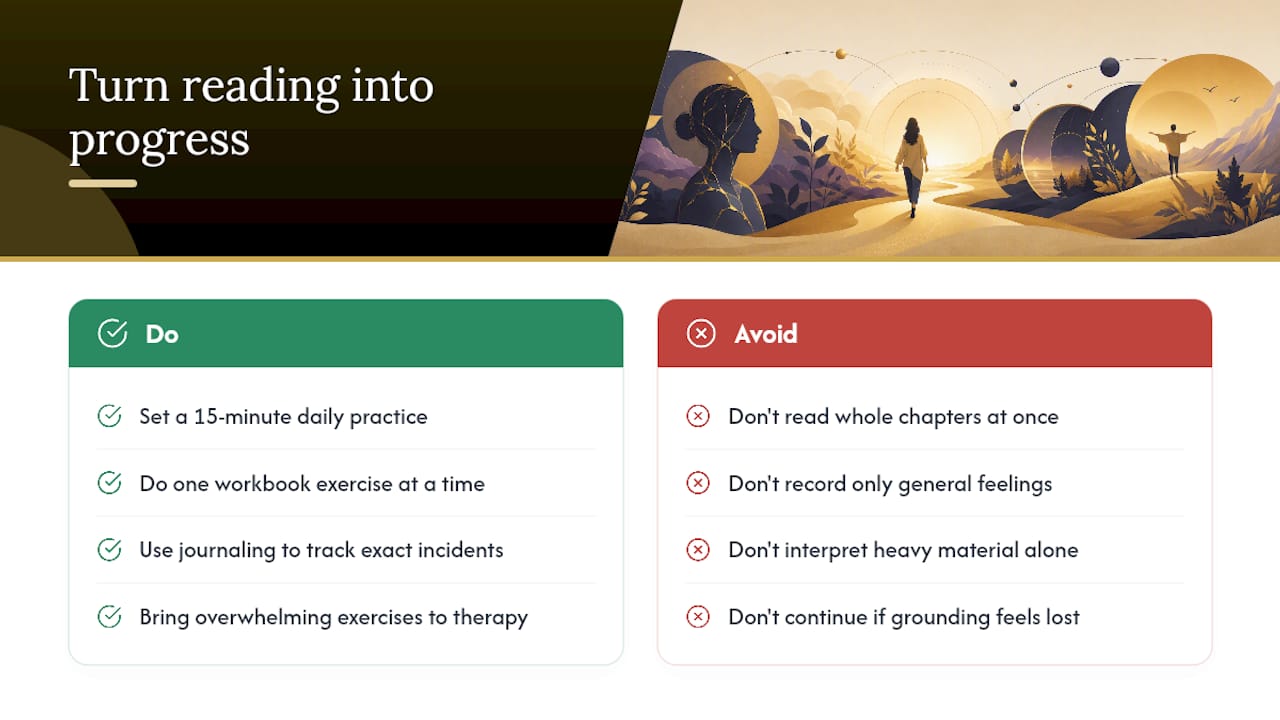
Set a small daily practice: fifteen minutes with a workbook prompt, not the whole chapter in one sitting. Kelley’s exercises, for instance, work best completed one at a time, with a day or two to sit with each insight before moving on. Use journaling prompts to track specific incidents rather than general feelings. Writing down exact phrases someone used, along with the date, builds the kind of record that helps you respond calmly instead of freezing the next time it happens. Memoirs work differently. Reading someone else’s recovery timeline gives you a comparison point, which helps reframe your own experience as a pattern rather than a personal failing. If a workbook exercise brings up something overwhelming, that’s worth bringing directly into a therapy session. A therapist can adapt the exercise to your specific situation instead of leaving you to interpret it alone. Set a timer if a chapter feels heavy, keep a support contact on hand, and stop reading the moment grounding starts to feel out of reach.
Why Trust This List of Gaslighting Recovery Books
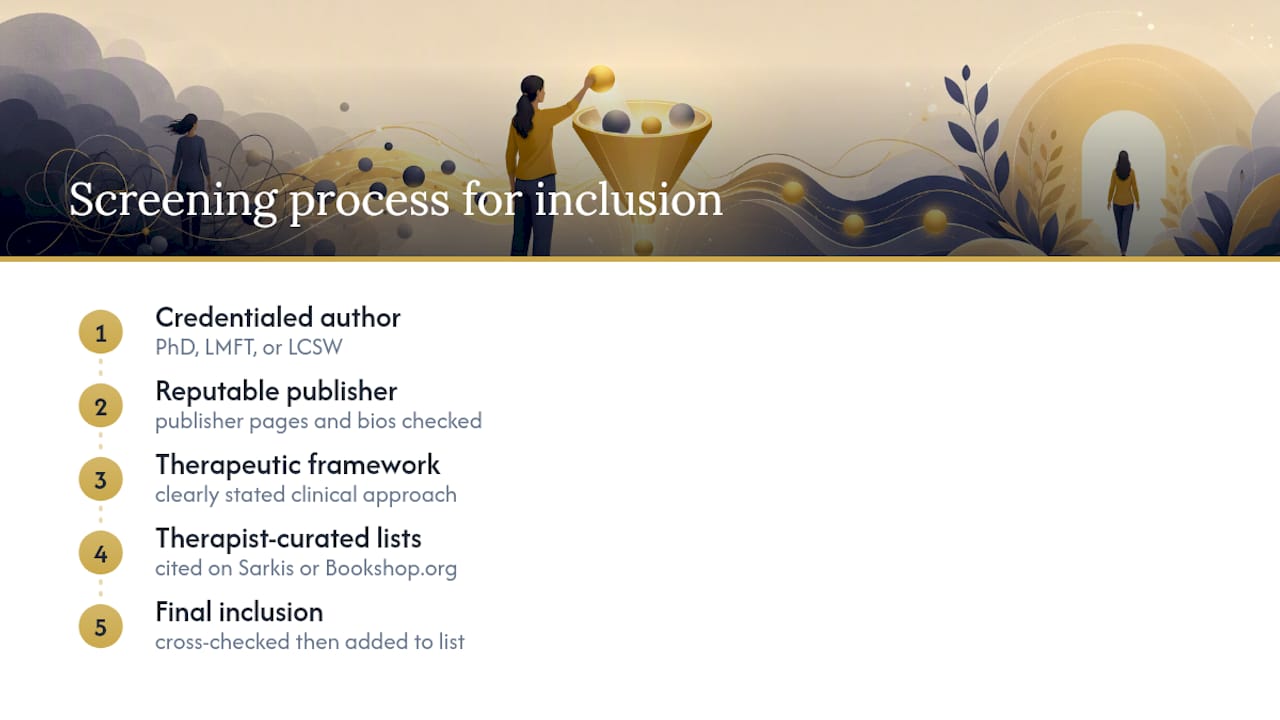
Every title here made the cut because it passed the same filter: a credentialed author (a PhD, LMFT, or LCSW), a reputable publisher, and either a clearly stated therapeutic framework or a track record of being cited on therapist-curated lists like Sarkis’s roundup and Bookshop.org’s collection. Publisher pages for author bios, edition details, and stated frameworks were cross-checked before including anything here.
Pair your reading with the site’s practical tools. A clinical guide pairs well with scripts for responding to gaslighting, while a memoir pairs naturally with a piece on why books help process emotional pain.
A Note on Reading Your Way Through Recovery
Curating this list meant asking a harder question than “is this book good?” It meant asking who each book actually helps and at what point in their recovery. Not every reader needs the same book first, and pretending otherwise does a disservice to people who are exhausted, scared, or still questioning their own memory of what happened.
Pace yourself. Reading three books in a week won’t get you further than reading one carefully and doing its exercises. And if a chapter brings up more than you can process alone, that’s not a failure. That’s information a therapist can use.
If you need something immediate before you’ve picked a book, start with what gaslighting actually looks like so you know what you’re working with.
— Robert
Where to Go After You’ve Picked a Book
Reading gives you language and validation. What you do between chapters is what actually shortens the recovery timeline, and that’s where a few related resources come in. If a workbook has you practicing responses out loud, pair it with scripts and delivery guidance for gaslighting conversations so you’re not improvising in a high-stakes moment. If you’re in the phase of documenting incidents for clarity or evidence, the gaslighting phrases and record-keeping guide gives you a structure that mirrors what most workbooks ask you to track anyway. And if this list only scratched the surface, the site’s broader roundup of emotional abuse books goes further into memoirs and clinical titles beyond gaslighting specifically.

A quick note on transparency: book links throughout this article may include affiliate partnerships with Amazon and other retailers, meaning a purchase through one of those links can earn a small commission at no extra cost to you. That never changes which books get recommended. If you’re still narrowing things down, check out the full toxic relationship behaviors breakdown to see how gaslighting fits into a wider pattern before you commit to your next read.
This article is general information, not a substitute for advice from a qualified doctor. Consult a qualified healthcare professional about your own circumstances before acting on anything here.