

When grief pulls you under or heartbreak makes everything feel impossible, reaching for a book might seem too simple to matter. But why books help emotional pain goes far deeper than distraction. Reading for 30 minutes produces measurable drops in heart rate and muscle tension comparable to yoga or meditation. This article breaks down the neuroscience, the psychology, and the real-world application behind literature as a healing tool so you can stop wondering whether reading actually helps and start using it with intention.
Table of Contents
- Key takeaways
- Why books help emotional pain: the brain science
- The psychology behind reading and emotional healing
- Genre matters: matching your book to your pain
- How to use books effectively for healing
- My honest take on reading as a healing tool
- Find your next book for emotional healing
- FAQ
Key takeaways
| Point | Details |
|---|---|
| Reading reduces physiological stress | Thirty minutes of reading lowers heart rate and muscle tension as effectively as yoga or meditation. |
| Fiction activates empathy pathways | Stories trigger mirror neurons, letting you process painful emotions safely from a distance. |
| Genre matters for healing | Poetry raises hope and lowers pain; fiction builds empathy; self-help provides structured emotional tools. |
| Active reading beats passive escape | Journaling after reading and joining discussion groups multiplies the emotional benefits significantly. |
| Reading supplements, not replaces, therapy | Books work best as part of a broader self-care plan, ideally alongside professional support when needed. |
Why books help emotional pain: the brain science
The body keeps score during grief and heartbreak. Cortisol spikes. Muscles clench. The nervous system stays locked in a low-grade threat state. What most people don’t realize is that reading physically interrupts that cycle. Stress levels drop within minutes of beginning a book, with measurable reductions in both heart rate and muscle tension occurring before the thirty-minute mark. That is not a metaphor for feeling better. That is a biological shift.
The mechanism behind this goes deeper than relaxation. Reading fiction activates mirror neurons, the same brain circuits that fire when you watch someone else stub their toe and instinctively wince. Fiction allows readers to experience another person’s pain empathically through these circuits, which means you’re processing real emotion without being directly threatened by it. The brain practices feeling without the cost of living it.
Poetry adds another layer entirely. Research on cancer patients found that verse raises hope scores and lowers reported pain intensity in clinical populations. Something about compressed language and rhythm hits neurological reward centers in ways prose does not. That’s not poetic license. That’s measurable neurobiological response.
“Reading pulls the brain out of rumination and into the present moment. That shift alone reduces the chronic stress-inflammation cycle that makes emotional pain feel permanent.”
Pro Tip: If you’re in acute emotional pain, start with poetry before fiction. A single poem takes two minutes and can shift your neurological state faster than settling into a novel.
| Type of response | Without reading | With 30 minutes of reading |
|---|---|---|
| Heart rate | Elevated during stress | Measurably reduced |
| Muscle tension | Increased under rumination | Decreased |
| Pain perception | Intensified | Lowered (especially with poetry) |
| Inflammatory stress markers | Higher | Reduced via mindfulness effect |
The psychology behind reading and emotional healing
Pain likes to loop. You replay the fight, the loss, the moment everything changed. That loop is called rumination, and it actively worsens depression and anxiety. Reading encourages mindfulness by pulling your attention into a narrative, which breaks the rumination cycle and lowers the inflammation linked to chronic psychological stress. It’s one of the most accessible mindfulness practices available, and it doesn’t require a cushion, a studio, or silence.

Fiction goes further by offering what psychologists call safe emotional simulation. When a character in a novel loses someone they love, you grieve alongside them. You feel the loss without it being your loss. Literature normalizes difficult emotions and helps release their psychological weight, a process known as collective catharsis. For people dealing with grief or heartbreak, this matters enormously. It confirms that what you’re feeling is human, not pathological.
The RAISE framework describes how reading fosters psychological flourishing through five dimensions:
- Reflection: Books prompt you to examine your own feelings against a character’s experience, creating self-awareness without self-criticism.
- Acquisition: You absorb new emotional vocabulary and coping frameworks naturally, often without realizing it.
- Immersion: Deep narrative engagement creates a focused, meditative state that quiets anxious thinking.
- Socialization: Shared reading or discussing books with others extends emotional processing into relational space.
- Expression: Reading inspires writing, talking, and articulating feelings that were previously stuck and wordless.
These aren’t separate benefits. They work together. A single well-chosen novel can move you through all five dimensions across a few reading sessions.
Pro Tip: After a chapter that stirs something in you, spend five minutes writing down what came up without editing yourself. That short practice turns passive reading into active emotional processing.
The emotional benefits of reading are especially strong when the content reflects your own experience. A 2023 study of nearly 20,000 adults across 15 countries found regular reading consistently linked to lower depression and reduced loneliness. Literature for emotional support is not a niche concept. It’s a globally replicated finding.
Genre matters: matching your book to your pain
Not every book serves every wound equally. Knowing which genre fits your emotional state is the difference between a reading experience that helps and one that leaves you more raw than when you started. Understanding the science behind psychological literature can help you make that match more precisely.
Poetry works best when pain feels too large and formless to name. The compression of verse gives language to experiences that resist it. Clinical evidence shows poetry uniquely raises hope and lowers pain, which makes it particularly suited to acute grief, illness-related distress, and emotional shock.
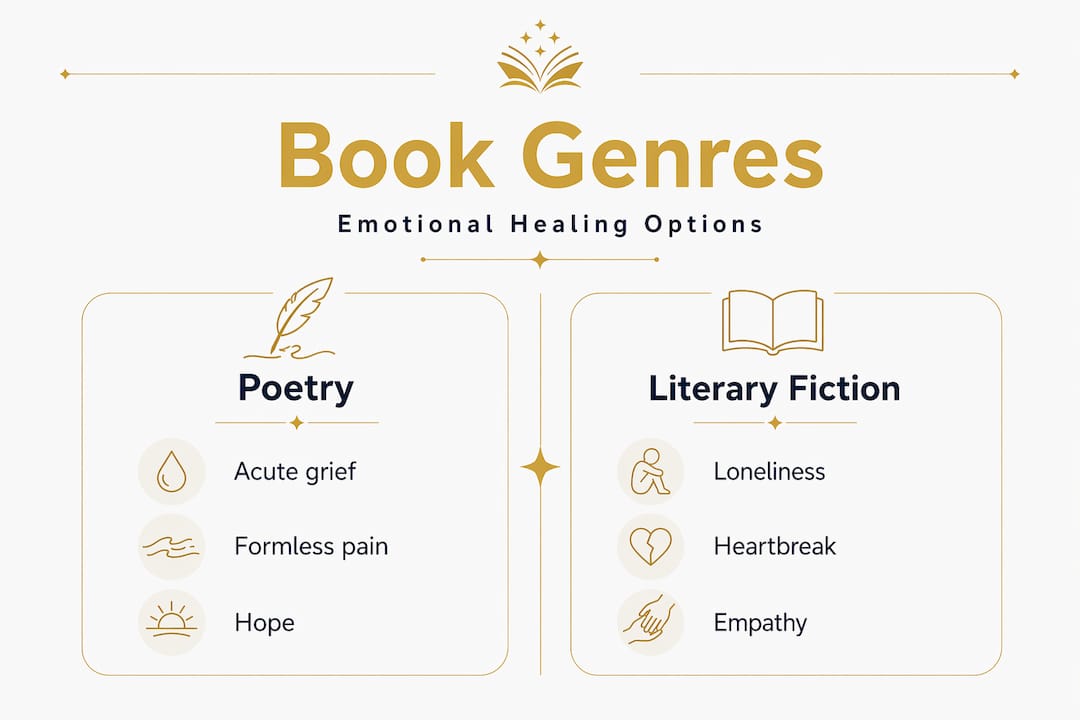
Literary fiction shines when you need to feel less alone. Stories about toxic relationships or loss let you process through character without confronting your own experience head-on. That sideways approach is kinder to a bruised psyche than direct confrontation.
Self-help books and workbooks serve a different function. They provide structure when emotions feel chaotic. Guided reflection tools move readers from passive pain to active self-regulation by providing frameworks, exercises, and prompts that translate insight into behavior change.
| Genre | Best emotional context | Primary benefit |
|---|---|---|
| Poetry | Acute grief, formless pain | Hope, neurobiological relief, language for the unspeakable |
| Literary fiction | Loneliness, heartbreak, trauma | Empathy, catharsis, emotional normalization |
| Self-help/workbooks | Anxiety, confusion, life transitions | Structure, self-regulation, applied coping skills |
| Memoir | Feeling misunderstood or isolated | Validation, perspective, shared humanity |
Shared reading adds a dimension that solitary reading cannot. Discussing books in groups, even informally, creates what researchers call relational containers for emotional healing. You’re not in therapy, but you’re not alone either. Book clubs built around emotionally resonant literature give people connection without clinical pressure, and that combination has measurable effects on depression and loneliness.
How to use books effectively for healing
Reading for emotional healing is most effective when it’s deliberate rather than random. A few principles make the difference between a book that genuinely shifts something and one that simply passes the time.
-
Choose based on emotional fit, not popularity. A bestseller has nothing to offer you if it doesn’t reflect your experience or interest. When in acute pain, choose books that mirror your situation at a slight remove. If you’re grieving, read grief memoirs or fiction about loss rather than how-to guides about moving on.
-
Read slowly and reflectively. Speed-reading is for information. Emotional healing requires you to pause when something lands. Reading mindfully means letting the text breathe and noticing your internal response.
-
Pair reading with journaling. The research on applying reading as an active toolkit is clear: guided reflection and written response significantly enhance emotional regulation outcomes. You don’t need much. Three sentences after each session is enough.
-
Use social reading when isolation is part of your pain. If loneliness compounds your grief or anxiety, join a book group or share what you’re reading with a trusted person. Shared reading builds connection that reinforces the emotional processing you’re doing privately.
-
Match intensity to capacity. On your hardest days, don’t force a difficult novel. Poetry, short stories, or an accessible memoir about resilience may fit your capacity better. The goal is engagement, not endurance.
Pro Tip: Build a short reading ritual around difficult moments. Even ten minutes of purposeful reading before bed signals to your nervous system that the day is closing safely. Over time, this becomes a reliable anchor point for emotional regulation.
Books for emotional healing work best when integrated with other support. If your pain involves trauma, chronic depression, or crisis-level distress, professional emotional support remains indispensable. Reading is a powerful supplement. It is not a replacement for clinical care.
My honest take on reading as a healing tool
I’ve spent years watching readers arrive at books from very different kinds of pain. Divorce, death, betrayal, the quiet accumulation of a life that no longer fits. What I’ve learned is that the people who get the most out of reading in those moments are not the ones who read the most. They’re the ones who read the right things at the right time and then do something with what they find.
What I’ve noticed is that passive reading, flipping through pages to avoid feelings rather than move through them, offers limited healing. You can burn through a novel in a weekend and feel no different. The shift happens when a sentence stops you cold, when you recognize yourself in a stranger’s story, and you sit with that recognition instead of rushing past it.
My contrarian view: self-help books are often underestimated by literary readers who see them as simplistic. Done well, a guided workbook can crack something open faster than a year of literary fiction. The structure gives pain a shape. Shapeless suffering is harder to heal than named, bounded suffering.
The social dimension of reading is the most overlooked element in every conversation about books and mental health. Reading alone in your corner is good. Bringing what you read into a conversation with one other person doubles what you get from it. The relational safety of shared reading isn’t a soft benefit. It’s a mechanism for healing that most people leave on the table.
— Robert
Find your next book for emotional healing
If you’re ready to put this into practice, Smartreadshub has curated collections built specifically for readers in the middle of hard moments.
The self-discovery books collection is a strong starting point if you’re working through identity loss or major life transition. For readers navigating grief or the specific weight of letting go, the emotional healing picks offer curated titles that match where you are right now. Each recommendation comes with context so you can make an informed choice rather than guessing. You don’t have to read your way out of pain blindly. Smartreadshub helps you choose with intention.
FAQ
Why do books help with emotional pain?
Books reduce physiological stress, activate empathy through mirror neurons, and create safe emotional simulations that let you process grief and pain without direct threat. Reading for 30 minutes produces measurable drops in heart rate and muscle tension.
What types of books are best for emotional healing?
Poetry works well for acute grief and formless pain, literary fiction helps with loneliness and heartbreak, and self-help workbooks provide structure during life transitions. Match the genre to your current emotional state rather than choosing by popularity.
Can reading replace therapy for emotional pain?
Reading is a proven supplement to emotional healing but not a replacement for professional care. Reading alone acts as an integrative practice that supports recovery alongside therapy, not instead of it.
How does fiction specifically help grief?
Fiction lets you experience loss through a character’s story, which normalizes grief and provides collective catharsis. Literature releases psychological burden by confirming that what you’re feeling is human and shared.
How can I make reading more effective for healing?
Read slowly, journal briefly after emotionally resonant passages, and share what you’re reading with someone you trust. Active reading with guided reflection produces significantly stronger emotional regulation outcomes than passive page-turning.