
If you’re a mother trying to make sense of a relationship that leaves you doubting your own memory, these books are where to start. The highest-impact reads for mothers navigating narcissistic or emotional abuse are:
- It’s Not You by Shahida Arabi — best for naming what’s happening while you’re still in it; contains descriptions of manipulation tactics that may be triggering
- Will I Ever Be Good Enough? by Karyl McBride — best for daughters of narcissistic mothers who are now parenting themselves; includes personal accounts that can be emotionally intense
- Psychopath Free by Jackson MacKenzie — best for rapid pattern recognition in a partner or parent; written in survivor voice, not clinical language
- The Body Keeps the Score by Bessel van der Kolk — best for understanding trauma’s physical effects; clinical and dense, but foundational for therapy-paired reading
- Adult Children of Emotionally Immature Parents by Lindsay C. Gibson — best for mothers whose own upbringing feeds current relationship patterns
- Whole Again by Jackson MacKenzie — best for early-to-mid recovery when you’re ready to rebuild a sense of self
Trigger note: Memoirs and survivor-voice books (Psychopath Free, It’s Not You) contain graphic accounts of manipulation and emotional violence. Read in short sessions and stop if you feel destabilized.
Pro Tip: Before you open any of these titles, check your device privacy. Clear your browser history or use a private tab. A library e-card gives you free access to most of these through apps like Libby with no purchase trail.
Table of Contents
- What are the best books for the motherhood journey through abuse?
- How do you pick the right book for where you are right now?
- How to read these books safely while still in an abusive relationship
- When is a book not enough? US resources for immediate help
- Smartreadshub curated reading packs for mothers recovering from abuse
- Key Takeaways
- Why a safety-first booklist matters more than a “best of” list
- Useful sources
What are the best books for the motherhood journey through abuse?
Books grouped by what you need right now do more work than an alphabetical list. Here’s how to read this section: find your current stage, pick one title, and pair it with at least one trusted person or professional.
Recognizing manipulation
It’s Not You by Shahida Arabi is the clearest entry point for a mother still inside a confusing relationship. Arabi is a researcher and survivor; the book names gaslighting, love-bombing, and projection in plain language, which is exactly what narcissistic abuse commonly involves. Trigger warning: detailed manipulation accounts.
Psychopath Free by Jackson MacKenzie is written survivor-to-survivor, not clinician-to-patient. It’s blunt, fast, and useful for mothers who keep second-guessing whether what happened was “really that bad.” Format: paperback, audiobook, widely available at public libraries.
Validation and memoir
Will I Ever Be Good Enough? by Karyl McBride, a licensed therapist, speaks directly to daughters raised by narcissistic mothers who now find themselves repeating or reacting against those patterns in their own parenting. It’s one of the few books that holds both roles at once: you as the child who was harmed, and you as the mother trying not to harm. Trigger warning: detailed childhood abuse accounts.
“Survivor memoirs and accounts can validate experience and help name patterns, but memoir content can be triggering and should be paired with guidance and trigger warnings.” — Psychology Today
Children of the Self-Absorbed by Nina W. Brown, a counseling professor, covers narcissistic parenting from an academic angle with less memoir content, making it a lower-trigger option for readers who want validation without graphic personal narrative.
Trauma recovery and workbooks
The Body Keeps the Score by Bessel van der Kolk, a psychiatrist and trauma researcher, explains why emotional abuse leaves physical marks. It’s clinical and long, but it’s the book most therapists point to when a client asks why they can’t “just move on.” Pair it with a trauma-informed clinician who works with modalities like IFS, EMDR, or Somatic Experiencing, all of which practitioners commonly use alongside reading-based recovery for postnatal depression linked to narcissistic abuse.

Whole Again by Jackson MacKenzie is shorter, more accessible, and focused on identity reconstruction after abuse. It works well after Psychopath Free when you’ve named the problem and need to rebuild.
Gaslighting Recovery for Women by Amelia Kelley, PhD, is a structured workbook grounded in DBT, mindfulness, and trauma-informed techniques. It’s the most exercise-heavy option on this list, which makes it particularly useful for skill-building when paired with therapy. Available in paperback; check your library’s digital catalog.
Parenting after abuse
Adult Children of Emotionally Immature Parents by Lindsay C. Gibson, a clinical psychologist, addresses the intergenerational pull directly. Research shows maternal pathological narcissism can predict maladaptive personality traits in children through mechanisms like psychological control and parentification. Gibson’s book helps mothers interrupt that chain. Understanding why unhealthy relationship patterns repeat in families is the first step toward changing them.
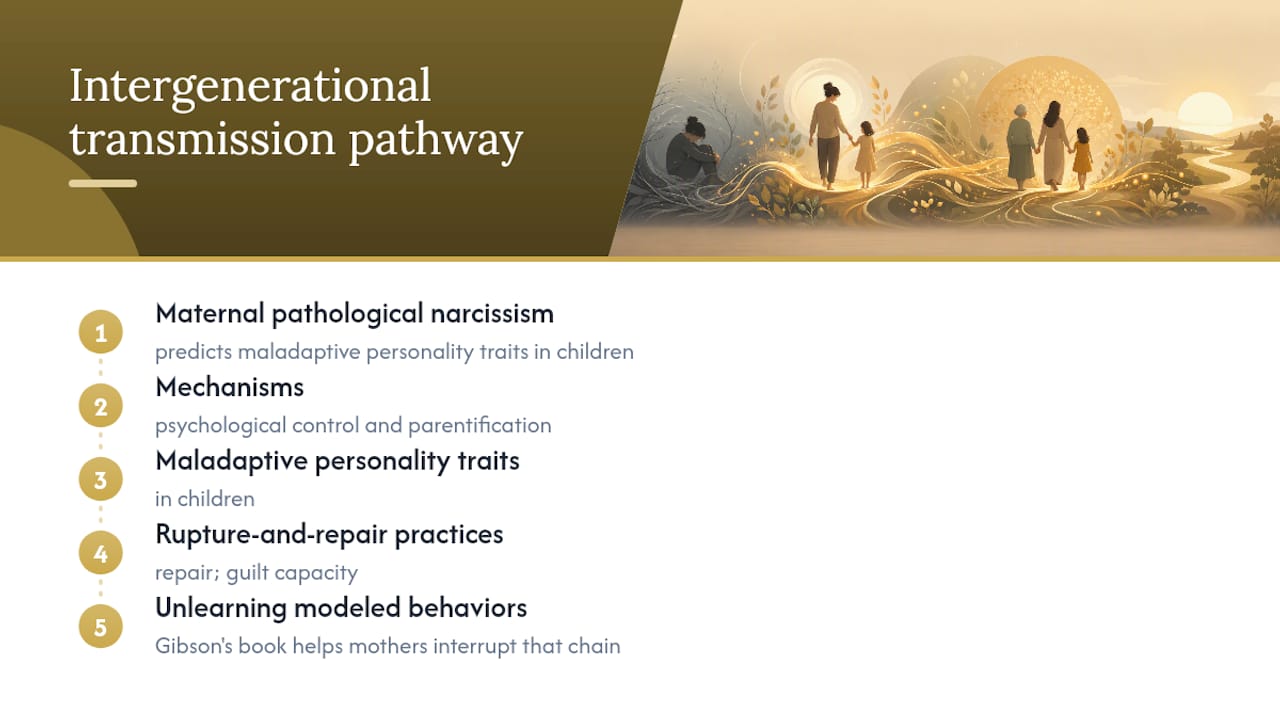
Parenting after narcissistic abuse requires unlearning modeled behaviors. Clinicians emphasize repair, guilt capacity, and rupture-and-repair practices over perfection. Gibson’s book, paired with McBride’s, gives mothers both the framework and the emotional language to do that work.
How do you pick the right book for where you are right now?
Start with your immediate goal: recognize what’s happening → validate your experience → plan for safety → process trauma → repair your parenting. That sequence maps directly to book types.
Decision path:
- Still unsure if it’s abuse? Start with It’s Not You or Psychopath Free.
- Need to feel less alone? Start with Will I Ever Be Good Enough? or Children of the Self-Absorbed.
- Ready to process trauma with a therapist? Add The Body Keeps the Score or Gaslighting Recovery for Women.
- Focused on your children’s wellbeing? Prioritize Adult Children of Emotionally Immature Parents.
Checklist for vetting any book:
- Author credentials listed (licensed clinician, researcher, or clearly identified survivor)
- Language is trauma-informed, not blame-shifting toward the victim
- Exercises or reflection prompts included, not just narrative
- Trigger warnings present or noted by reviewers
- Avoids “just leave” commands without safety context
Red flags to watch for in any title:
- Phrasing that questions whether you “allowed” the abuse
- Oversimplified exit advice with no safety planning
- Minimization of emotional abuse as less serious than physical abuse
- No mention of professional support alongside self-help
Therapists advise prioritizing the impact of behavior over the abuser’s intention — and a good book should do the same.
How to read these books safely while still in an abusive relationship
Books help most when paired with a safety plan and a trauma-informed clinician or peer support. Reading alone, without either, can accelerate clarity faster than your circumstances allow you to act on it.
Safety checklist before you start:
- Use a library copy, e-book through Libby, or audiobook with no purchase record at home
- Clear browser history after researching titles; use private browsing
- Store physical books at a trusted friend’s home or your workplace
- Read during windows when you won’t be interrupted or questioned
Five journal prompts to use after a reading session:
- What did I read today that I already knew but hadn’t named?
- What felt untrue or didn’t match my experience?
- What am I not ready to act on yet, and why?
- What would I tell a close friend if she described my situation to me?
- What is one small thing I can do this week to feel safer?
Who to tell: a trauma-informed therapist, one trusted friend outside the family system, or a hotline counselor. Avoid sharing with family members still close to the abusive person. Psychotherapists specifically caution that family members in denial can invalidate your experience and set back recovery.
Pro Tip: Before reading a memoir chapter, check the chapter title or a brief summary. If the content covers childhood sexual abuse, physical violence, or severe neglect, decide in advance whether today is the right day for it. Pacing is not avoidance — it’s self-protection.
When is a book not enough? US resources for immediate help
Seek professional help immediately if you or your children are in physical danger, if you’re having thoughts of suicide or self-harm, or if the abuse is escalating.
Crisis contacts:
- BBC Radio 4 – Woman’s Hour – ‘The behaviour is so harmful’: What to do if you have a narcissistic mother
- Talkspace — Narcissistic abuse
- BPS — Narcissism can have both a positive and negative impact on new mothers’ wellbeing, longitudinal study finds
- Springer — The harmful impact of pathological narcissism on interpersonal relationships (study on maternal narcissism and daughter outcomes)
- Springer — Study linking maternal vulnerable narcissism to child maladjustment
- Psychology Today — ‘Is my mother narcissist’ blog post (survivor perspective & signals)
- AlcoholFree.com — ‘Unmasking Postnatal Depression: Caroline Strawson’s Journey Through Narcissistic Abuse’ podcast
- Annie Wright — ‘Parenting After Narcissistic Abuse: Protecting Your Children’
- PenguinRandomHouse — Gaslighting Recovery for Women by Amelia Kelley, PhD
Finding a therapist who understands narcissistic abuse:
| Resource | What it offers |
|---|---|
| SAMHSA National Helpline | Free, confidential referrals to local mental health and treatment services |
| Psychology Today therapist finder | Filter by trauma, abuse, and sliding-scale fee |
| Open Path Collective | Reduced-cost sessions for individuals in financial need |
| Community mental health centers | Income-based sliding scale; often have trauma-specialized staff |
When interviewing a potential therapist, ask directly about their experience with narcissistic abuse and whether they take a client-led approach to decisions like no contact. A therapist who pushes reconciliation without your lead is not the right fit. Research on vulnerable narcissism and child maladjustment underscores why a clinician who understands these dynamics matters for mothers parenting through or after abuse.
Smartreadshub curated reading packs for mothers recovering from abuse
Smartreadshub has done the grouping work for you. Rather than building a reading list from scratch, you can access curated packs designed specifically for mothers navigating narcissistic or emotional abuse, each combining memoir, clinical guides, and workbooks selected to work together.
Each pack includes 3–5 titles organized by recovery stage, trigger notes for each book, a suggested reading sequence, and optional guided reflection prompts. Access is digital and discreet, with no physical packaging that could raise questions at home. Smartreadshub recommends pairing any pack with a trauma-aware clinician, particularly for the trauma-processing titles.
If you’re not sure where to start, the emotional invalidation signs resource is a useful first read before choosing a pack. For mothers who want to understand the full scope of what they’re dealing with, the guide to what gaslighting actually is clarifies the difference between confusion and manipulation. Browse the current packs and find the one matched to your stage at Smartreadshub.
Key Takeaways
The most effective reading plan for mothers recovering from narcissistic or emotional abuse pairs a validation book, a trauma-informed workbook, and a parenting-repair title with professional support and strict device privacy from the start.
| Point | Details |
|---|---|
| Match book to stage | Choose by goal: recognition, validation, trauma processing, or parenting repair — not by popularity. |
| Device privacy first | Use library e-books or private browsing before purchasing; a purchase trail can create risk. |
| Pair books with therapy | Reading accelerates insight; a trauma-informed clinician helps you act on it safely. |
| Call 988 in crisis | If you or your children are in danger or you’re having suicidal thoughts, call or text 988 immediately. |
| Smartreadshub curated packs | Pre-grouped by recovery stage with trigger notes and pacing guidance, available digitally at Smartreadshub. |
Why a safety-first booklist matters more than a “best of” list
Most “best books for mothers” lists are built around inspiration and growth. That framing misses the point entirely for a mother whose daily reality involves manipulation tactics designed to make her doubt her own perception. For her, the wrong book at the wrong moment, read without privacy precautions or support, can do real harm. It can accelerate awareness faster than her circumstances allow her to act, or it can confirm fears she has no safe outlet to process.
That’s why Smartreadshub’s approach to curated reading starts with safety, not inspiration. The books on this list were chosen because they are trauma-informed, credentialed, and honest about what reading alone cannot fix. A list that skips trigger warnings, ignores device privacy, or omits crisis resources isn’t a reading guide for a mother in this situation. It’s a list built for someone else.
Useful sources
- 988 Suicide & Crisis Lifeline: Call or text 988 for immediate crisis support, including emotional abuse and suicidal ideation.
- SAMHSA National Helpline: Free, confidential referrals to mental health and substance use treatment services across the US.
- Talkspace — Narcissistic Abuse: Clinical overview of narcissistic abuse tactics and therapy recommendations; useful for understanding what books are addressing.
- Psychology Today — Therapist Finder: Filter by trauma, abuse specialty, and sliding-scale fees to find a clinician who fits your situation.
- BPS — Narcissism and Maternal Wellbeing: Research on how different narcissism types affect new mothers differently; supports book choices that address parenting-specific dynamics.
- Springer — Maternal Narcissism and Daughter Outcomes: Academic study on how pathological narcissism transmits across generations; academic context for parenting-repair reading.
- Springer — Vulnerable Narcissism and Child Maladjustment: Research linking maternal vulnerable narcissism to child outcomes; supports the case for parenting-focused books.
- Annie Wright — Parenting After Narcissistic Abuse: Practitioner guide on cycle-breaking parenting strategies; pairs directly with the parenting-repair book group above.
- Penguin Random House — Gaslighting Recovery for Women: Publisher listing for Amelia Kelley’s DBT-grounded workbook; useful for readers who want a structured, exercise-based recovery program.
This article is general information, not professional advice. If you are in danger or experiencing a mental health crisis, contact 988 or your local emergency services. Confirm current resources and treatment options with a qualified clinician.