
Pick one short workbook, not a stack of theory. Start “The Assertiveness Workbook” or a similar practical guide, then run one daily “I” statement exercise for seven days. Curated lists point you to titles that pair with free scripts, and the fastest gains come from practicing a single clear boundary statement, not from reading five books cover to cover.
TL;DR:
- The most effective boundary books are often workbooks with practical scripts rather than purely theoretical guides.
- Choosing the right book depends on your specific needs, such as speed of practice, depth of understanding, or familiarity with boundaries.
- Practicing boundaries through daily “I” statements and rehearsing scripts over a week accelerates genuine behavior change.
- Consistent, calm restatement of boundaries and periodic check-ins increase their stability throughout a relationship.
- Pairing reading with practice tools like scripts and responses yields faster confidence and clearer understanding of your limits.
Table of Contents
- Best Books on Boundaries in Dating: What Each One Actually Fixes
- How to Choose the Right Book for Your Dating Situation
- The Boundary Types Every Book Eventually Covers
- A 7-Day Plan to Start Practicing Boundaries This Week
- Where the Idea of Dating Boundaries Actually Comes From
- The Mistakes Books Warn About Most Often
- How Boundaries Change the Actual Relationship, Not Just Your Comfort
- Comparing the Popular Approaches: Workbook, Therapy Guide, or Primer
- Keeping Boundaries Intact After the First Few Weeks
- Why Smart Reads Hub Curates These Books the Way It Does
- How You Can Practice This Week
- Sources
Best Books on Boundaries in Dating: What Each One Actually Fixes
Most boundary books fall into one of three camps: workbooks that hand you scripts, therapy-based guides that explain the psychology first, or accessible primers written for someone who has never used the word “boundary” in a sentence out loud. Picking the wrong camp for your situation is why so many people buy a book, read forty pages, and never open it again.
Here is a curated shortlist, organized by what each title solves rather than by publication date or bestseller rank.
- A hands-on assertiveness workbook. Best for readers who want scripts over theory. Covers communication and emotional boundaries directly. Start with the chapter on refusal phrases and practice the fill-in-the-blank sentence starters before your next date.
- A short primer on personal limits for daters. Best for someone brand new to the concept who needs a plain-English definition before anything else. Covers emotional and time boundaries. Read the first two chapters, then stop and write down three boundaries you already have but have never said aloud.
- A therapy-rooted guide to codependency and limits. Best for readers who notice they say yes when they mean no. Covers emotional boundaries and self-neglect patterns. Use the self-assessment quiz near the start before jumping into later chapters.
- A guide focused on attachment style and dating pace. Best for people repeating the same relationship pattern with different partners. Covers physical and time boundaries tied to attachment anxiety. Skip to the chapter matching your attachment style first.
- A practical script book for hard conversations. Best for readers who freeze up mid conversation and need exact phrasing. Covers communication boundaries almost exclusively. Copy three scripts into your phone notes before your next tense text exchange.
- A workbook on digital habits and modern dating. Best for anyone whose relationship stress is mostly about texting speed, social media, or location sharing. Covers digital boundaries specifically. The exercise on response time expectations is worth doing solo before you discuss it with a partner.
- A guide on boundaries after narcissistic or manipulative relationships. Best for readers recovering from a partner who ignored limits entirely. Covers emotional and communication boundaries with a recovery lens. If this describes your situation, boundaries with narcissists covers what actually works when the standard scripts fail.
- A broader relationship self-help pick with a boundaries chapter. Best for readers who want boundary guidance folded into general relationship skills rather than as a standalone focus. Covers most boundary types lightly. Read this after a dedicated boundary title, not instead of one.
A best books on setting boundaries for healthier relationships resource breaks down several of these picks in more depth, including which chapters to prioritize if you only have a weekend to read.
Pro Tip: Read the introduction and the last chapter first. Most boundary books put their summary exercises at the end, and skimming those before the main text tells you fast whether the book’s exercises match how you actually learn.
How to Choose the Right Book for Your Dating Situation
The wrong book is not a bad book. It is a mismatch between what you need and how the author teaches it. Someone recovering from a manipulative ex needs a different structure than someone who has simply never dated with confidence before.
Run through these six questions before buying anything:
- Who is the intended reader? A book written for married couples handles boundaries differently than one written for early dating stages.
- Is the tone clinical or conversational? Therapy-based books explain mechanisms; primers just tell you what to say.
- Does it include exercises, or only explanation? A book with zero worksheets is a lecture, not a training manual.
- Does it warn about triggering content? Some boundary books use case studies involving abuse that can be hard to read if you are still processing a similar experience.
- Does it fit your cultural or religious context? Some guides assume a dating framework that will not match your family expectations or community norms.
- Can you finish one chapter in under 20 minutes? If not, you likely will not finish the book at all.
A quick checklist for comparing two finalists side by side:
- Which one has more concrete scripts versus abstract advice?
- Which one names your specific boundary type as a problem (digital, physical, time, communication)?
- Which one has a shorter chapter length, matching your actual reading habits?
- Which one avoids graphic trauma narratives if that matters to you right now?
- Which one includes a self-assessment before jumping to solutions?
- Which one has exercises you could realistically do today, not “someday”?
Watch for two warning signs. First, books that are purely prescriptive, telling you exactly what your boundaries should be rather than helping you identify your own, tend to produce compliance instead of confidence. Second, books with no practical exercises at all leave you with vocabulary but no muscle memory. How books explain personal boundaries in relationships walks through how format differences between workbooks and narrative guides affect what actually sticks.
The Boundary Types Every Book Eventually Covers
Nearly every credible guide on this topic breaks boundaries into the same handful of categories, even when the language differs slightly from book to book.
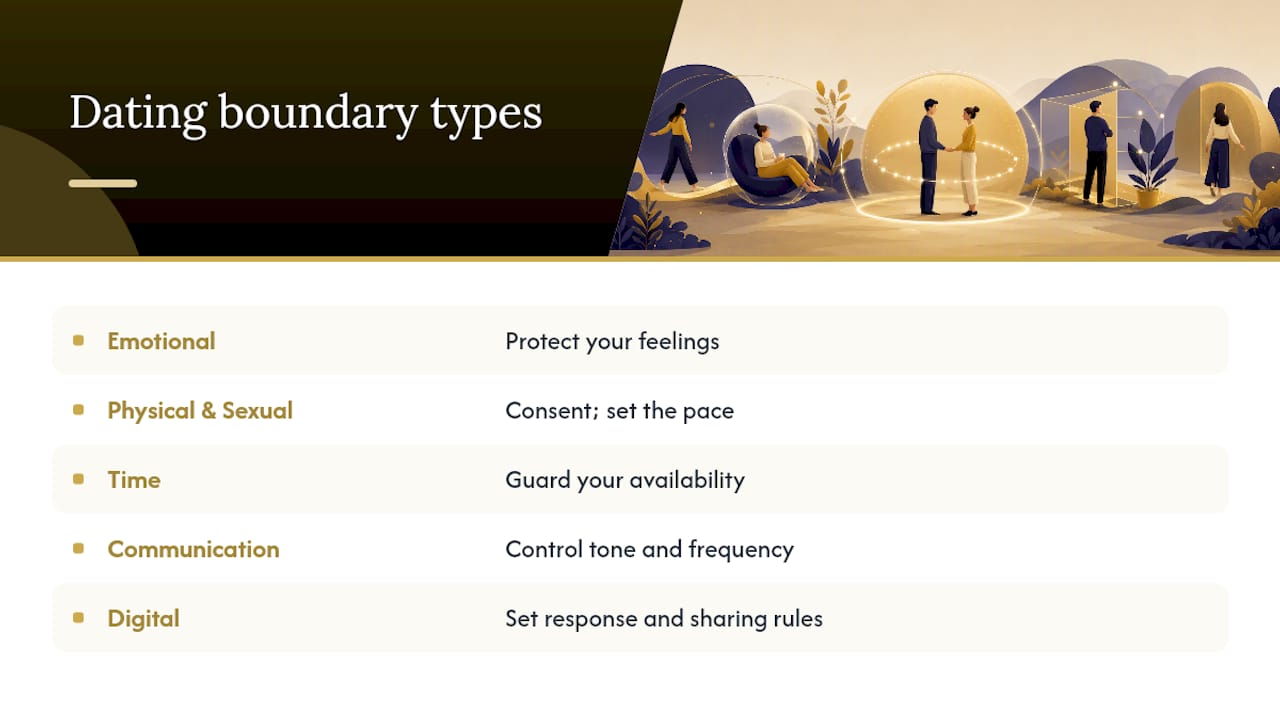
Emotional boundaries protect your right to your own feelings without absorbing a partner’s mood swings or guilt trips. In dating, this looks like saying “I need space to process this before responding” instead of immediately soothing someone’s frustration.
Physical and sexual boundaries cover pace, consent, and comfort with touch. A common early-dating example: “I’m not ready for that yet, and I’ll let you know when I am.”
Time boundaries protect your availability. Saying “I keep my weekday evenings for myself most weeks” is a time boundary, not a rejection.
Communication boundaries govern tone, frequency, and content of conversations, including refusing to engage during an argument fueled by insults.
Digital boundaries are newer territory that most classic relationship books never addressed, but current guides now cover response-time expectations, social media tagging, and location sharing explicitly, according to a breakdown of early dating boundary types.
University extension guidance recommends introducing boundaries early using clear “I” statements specifically to prevent the resentment and self-neglect that build when people wait until they are already frustrated. HelpGuide’s reviewed 2026 overview backs the same point with therapist-aligned scripts for delivering a boundary calmly rather than as an ultimatum.
How someone responds to a boundary tells you more than almost anything else they say on a first month of dates. A partner who asks a clarifying question and adjusts is showing you compatibility. One who argues, sulks, or mocks the request is showing you the relationship’s ceiling early, before you have invested months in finding out the hard way.
A 7-Day Plan to Start Practicing Boundaries This Week
Reading about boundaries and living them are two different skills, and the gap between them closes fastest with short, repeated rehearsal rather than one long study session.
Three scripts worth memorizing before you need them:
- On pace of intimacy: “I like where this is going, and I want to take physical steps at a pace that feels steady for me. Right now that means slowing down.”
- On texting frequency: “I’m not always quick to text back during the day. It’s not about interest, it’s just how I manage my time.”
- On meeting friends or family: “I’d rather wait a few more weeks before meeting your friends. I want to feel solid in this first.”
A simple week-long structure to build the habit:
- Day 1: Write down one boundary you have never said out loud to a partner.
- Day 2: Practice saying it in the mirror using an “I” statement.
- Day 3: Text a low-stakes version of it to a friend for feedback.
- Day 4: Use it in a real conversation, even a small one.
- Day 5: Journal how the other person responded.
- Day 6: Adjust the wording if it landed as harsh or unclear.
- Day 7: Repeat the boundary in a new context to confirm it holds.
Dating coaches and therapists consistently recommend introducing boundaries gradually and only enforcing ones you genuinely intend to uphold, since an empty threat teaches a partner that your limits are negotiable. If a partner escalates instead of adjusting after a calm restatement, that is a signal to pause the relationship’s pace, not to argue harder. Therapist guidance on dating boundaries suggests pairing this kind of book-based practice with actual therapist support when the pattern involves someone who repeatedly ignores stated limits.
Pro Tip: Say your boundary once, calmly, and stop talking. Most people undercut a boundary by immediately over-explaining or apologizing for it, which signals to the other person that it is up for debate.
Where the Idea of Dating Boundaries Actually Comes From
The word “boundaries” barely existed in popular dating advice before the 1990s, when it migrated out of family therapy literature into mainstream self-help. Before that, dating advice columns mostly framed limits as etiquette (what a “nice” person does or does not do) rather than as something tied to a person’s own psychological needs.
That shift matters because older dating norms often treated one partner’s comfort as the default and the other’s as something to negotiate around it. Traditional courtship scripts, especially in mid-20th-century American culture, assigned rigid roles by gender: who initiates, who pays, who sets the pace physically. Boundary language reframed all of that as an individual choice rather than a fixed social script.
Cultural context still shapes how boundary conversations land today. In some family and religious traditions, direct verbal boundary-setting can read as confrontational rather than healthy, which is part of why some books now build in guidance for communicating limits within collectivist or faith-based dating norms rather than assuming a one-size-fits-all Western therapy framework. Digital dating added another layer entirely: apps compressed the timeline for intimacy decisions, which is why so many current books spend entire chapters on boundaries that simply did not exist for earlier generations, like response-time expectations and location sharing.
The Mistakes Books Warn About Most Often
The single most common mistake boundary books flag is waiting too long to state a limit, then delivering it as an ultimatum once resentment has already built. By the time frustration boils over, the boundary sounds like a punishment instead of a preference, and the other person reacts defensively instead of adjusting.
A close second: apologizing while stating the boundary. Phrases like “I’m sorry, but I just don’t really like texting that much” dilute the message so much that many partners miss the boundary entirely.
Books also flag inconsistency as a silent boundary-killer. Stating a limit once and then abandoning it under pressure, especially early in a relationship, teaches a partner that the boundary was negotiable all along. This is different from healthy flexibility. Genuine flexibility means adjusting the boundary deliberately after reflection; inconsistency means abandoning it in the moment because holding it felt uncomfortable.
Another recurring mistake is confusing a boundary with a demand about someone else’s behavior. “You need to text me back within an hour” is a demand about the other person. “I feel disconnected when I don’t hear back for a full day, so I’ll probably follow up” is a boundary about your own actions. Books that skip this distinction tend to leave readers issuing ultimatums rather than clarifying their own limits, which usually escalates conflict rather than resolving it.
How Boundaries Change the Actual Relationship, Not Just Your Comfort
Healthy boundaries change the information available in a relationship. Once you state a limit clearly, you get real data about compatibility instead of guessing based on vague unease. A partner’s reaction to a stated boundary, whether curiosity, defensiveness, or quiet withdrawal, tells you something a hundred pleasant dates cannot.

Boundaries also shift the emotional load inside the relationship itself. Without them, one partner often absorbs the discomfort of unstated needs while the other assumes everything is fine. That asymmetry tends to surface later as resentment, not as a clean breakup conversation, which is part of why so many relationships end abruptly after months of apparent calm.
On the personal growth side, the act of identifying a boundary forces a kind of self-clarity most people skip in early dating. You cannot state a limit you have not consciously named, so the exercise itself, separate from whether the other person respects it, builds a clearer sense of your own priorities. That clarity tends to carry into other relationships, including friendships and work, once someone has practiced it in a romantic context.
Comparing the Popular Approaches: Workbook, Therapy Guide, or Primer
Workbook-style boundary books win on speed to practice. You open a chapter, fill in a worksheet, and have a usable script within twenty minutes. Their weakness is depth: they rarely explain why a particular boundary matters psychologically, which can make the exercises feel mechanical if you are the kind of reader who needs the “why” before the “how.”
Therapy-rooted guides win on depth and pattern recognition, especially for readers repeating the same relationship dynamic across multiple partners. Their tradeoff is pace: these books ask for more reflection time before you get to anything you can say out loud on a date this weekend.
Accessible primers split the difference reasonably well for total beginners, offering plain definitions and a handful of scripts without much psychological framework. Their limitation shows up for readers who already know the basics; a primer often feels repetitive to someone who has read even one prior book on the subject.
None of these formats is objectively superior. The right pick depends on whether you need speed, depth, or a starting vocabulary, which explains why lists are sometimes organized by use case rather than by star rating alone.
Keeping Boundaries Intact After the First Few Weeks
Boundaries set in week two of dating tend to get tested around week six or seven, once comfort has replaced novelty and a partner starts pushing gently against limits that felt firm at first. This is normal, not a sign the relationship is failing, but it does require a plan rather than hoping the boundary holds on its own.
The most reliable maintenance strategy from boundary-focused books is the calm restatement: repeating the original boundary in the same words, without escalating tone, every time it gets tested. Escalating tone teaches a partner that pushing harder gets a bigger reaction, which paradoxically makes boundaries less stable over time, not more.
Books also recommend periodic boundary check-ins, brief conversations every few weeks where both partners name one thing that is working and one thing that needs adjusting. This keeps boundaries from calcifying into rigid rules that no longer fit as the relationship evolves.
If a boundary gets violated repeatedly despite calm restatement, most guides recommend a pause rather than continued negotiation, since repeated violation after a clear ask usually signals unwillingness rather than misunderstanding. That is also the point where professional support, not another book, becomes the more useful next step.
Why Smart Reads Hub Curates These Books the Way It Does
An approach to curating boundary books starts from a simple filter: does this title give the reader something to say by the end of the chapter, or just something to understand? Books that pass that filter make the list; books that only explain theory get folded into broader recommendation guides instead, like the self-help books for relationships roundup.
The filter comes from observing how readers use these resources. The pattern that shows up again and again is that people who pair one short workbook with a daily rehearsal habit report faster confidence gains than people who read three books back to back without practicing anything in between, a finding consistent with research on pairing reading with structured practice.
Readers who have used curated lists alongside practice scripts often describe a specific kind of relief: the moment a vague, uncomfortable feeling about a partner’s behavior finally has language attached to it. That shift from confusion to clarity is usually what people are actually searching for when they type “boundaries in dating books” into a search bar.
— Robert
How You Can Practice This Week
A book gives you the concept. This resource offers exact sentences to say tonight. That is the practical gap between reading about boundaries and actually holding one during a tense conversation, and it pairs curated book picks with ready-to-use practice tools instead of leaving you to draft your own scripts from scratch.

Two tools bridge that gap directly. Rehearse Calm Scripts, Delivery, and Safety to Respond to Gaslighting gives you exact phrasing and delivery guidance for boundary conversations that tend to go sideways, the kind most workbooks only describe in the abstract. The 30 Gaslighting Phrases, Short Responses reference works alongside any boundary book’s exercises, giving you a short response ready before you need it rather than scrambling mid-conversation. Both are built to complement the exercises in the books above, not replace them. Start with one book from the list, open the calm scripts page, and rehearse a single response before your next date this week.
Sources
A few sources shaped the practical guidance throughout this piece and are worth reading directly for more depth.
- Setting Healthy Boundaries in Relationships | HelpGuide
- Healthy love starts with boundaries – A simple guide to sharing your needs | USU
- How to Set Healthy Boundaries in Dating | David Wygant
- Boundaries for dating – Danielle Sethi Therapy