
The core difference is motive and empathy: a narcissist manipulates to protect a fragile ego and stay admired, while a sociopath disregards other people’s rights to get what they want, often without much emotional pull either way. If someone in your life feels dangerous, unpredictable, or threatening, treat safety as the priority over correctly labeling their diagnosis. Naming the pattern still helps you decide how to respond.
TL;DR:
- Narcissists typically manipulate to protect their ego and seek admiration, often reacting intensely to criticism or status threats.
- Sociopaths usually disregard others’ rights and engage in more impulsive, calculated behaviors aimed at personal gain or control.
- Empathy differs: narcissists recognize emotional cues but lack emotional feeling, while sociopaths generally have broad empathy deficits.
- Traits of both can coexist, increasing the danger level because of combined ego-driven and disregard-based motives.
- Safety measures include documenting incidents, involving professionals early, and prioritizing physical protection over diagnosis.
Table of Contents
- Narcissist vs. Sociopath: A Quick Comparison
- What NPD and ASPD Actually Mean in Diagnostic Terms
- Empathy, Motive, and Emotional Reactions Compared
- Narcissist Behaviors vs. Sociopath Behaviors in Real Relationships
- Can Someone Be Both a Narcissist and a Sociopath?
- How to Protect Yourself and Where to Find Help
- Smart Reads Hub’s Take on Recovery After This Kind of Relationship
- Why This Comparison Matters More Than Getting the Label Exactly Right
- Ready to Understand Your Situation More Clearly?
- Sources
- FAQ
Narcissist vs. Sociopath: A Quick Comparison
The fastest way to separate these two patterns is to look at what drives the behavior, not just the behavior itself. Both can lie, manipulate, and hurt the people close to them, but the engine underneath is different, and that difference shapes what you can realistically expect from them.
| Trait | Narcissist (NPD traits) | Sociopath (ASPD traits) |
|---|---|---|
| Primary driver | Admiration, status, ego protection | Personal gain, control, disregard for rules |
| Empathy profile | Often reads emotions accurately but lacks the emotional feeling component | Blunted empathy across the board, both reading and feeling |
| Behavior organization | Reactive, especially to criticism or perceived slights | Ranges from impulsive and chaotic to calculated and predatory |
| Relationship pattern | Idealize then devalue; needs an audience | Uses people, moves on quickly, shallow attachments |
| Legal or violence risk | Lower on average, escalates around humiliation | Higher on average, includes rule breaking and aggression |
| When to worry most | Public embarrassment or loss of status triggers rage | Any sign of deceit for gain, cruelty, or repeated law-breaking |
These are behavioral tendencies, not a checklist for diagnosing anyone. A licensed clinician is the only one qualified to apply an actual diagnosis, and even then it takes a full clinical interview.
What NPD and ASPD Actually Mean in Diagnostic Terms
“Narcissist” and “sociopath” are everyday labels. The clinical terms behind them are narcissistic personality disorder (NPD) and antisocial personality disorder (ASPD), and they come from the DSM-5, the diagnostic manual used by mental health professionals in the United States.
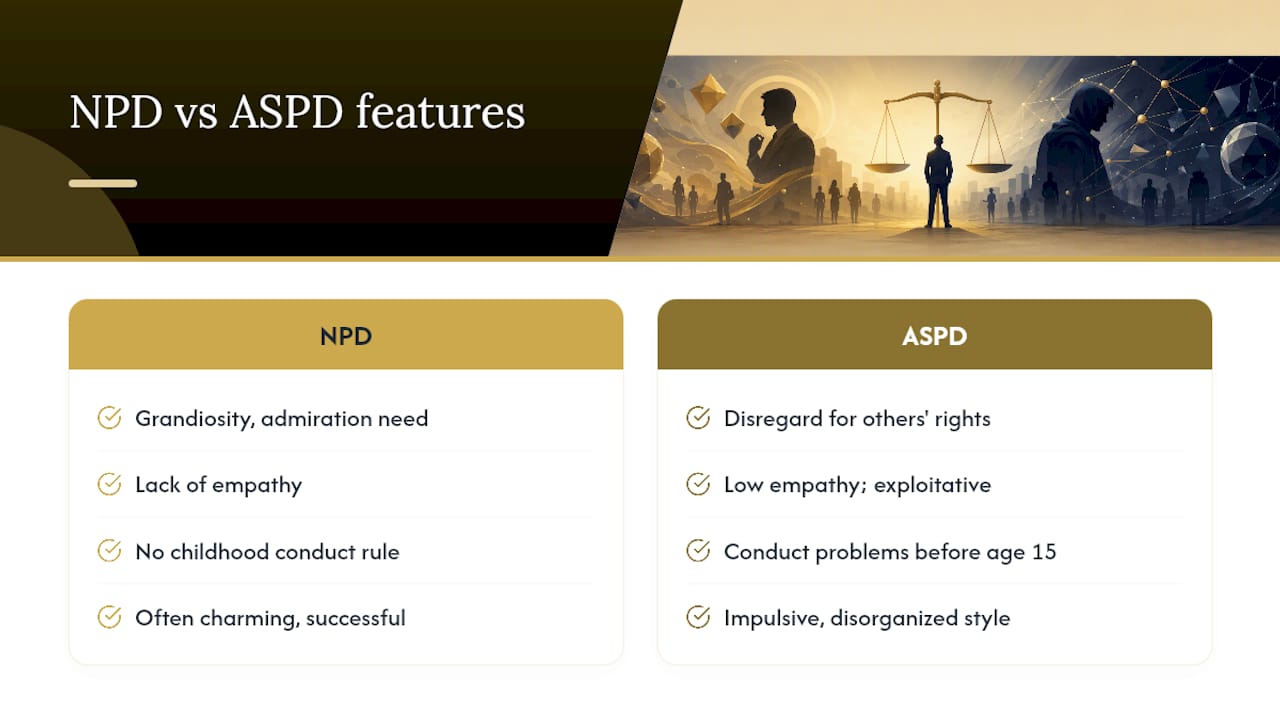
The American Psychiatric Association describes NPD as a pervasive pattern of grandiosity, a constant need for admiration, and a lack of empathy that shows up across relationships and situations, not just once or twice under stress. People with NPD often look successful and charming on the surface. The disorder tends to reveal itself through fragility: criticism, being ignored, or losing status can trigger outsized anger or withdrawal.
ASPD is a different animal. Mayo Clinic defines it as a pervasive pattern of disregarding and violating other people’s rights, and diagnosis typically requires evidence of conduct problems before age 15, such as lying, stealing, aggression, or rule-breaking that started well before adulthood. “Sociopath” isn’t itself a diagnostic term. It’s the popular label most often applied to ASPD, particularly the more impulsive, disorganized presentations of it.
Here’s where things get genuinely confusing for laypeople: neither “narcissist” nor “sociopath” appears in the DSM-5 by name. Clinicians diagnose NPD or ASPD based on specific criteria met over time, not on a vibe or a bad breakup story. If you’re trying to understand someone’s behavior, the diagnostic label matters less than the Cluster B personality disorders framework these conditions share, and how that framework separates them by empathy type and motive.
Empathy, Motive, and Emotional Reactions Compared
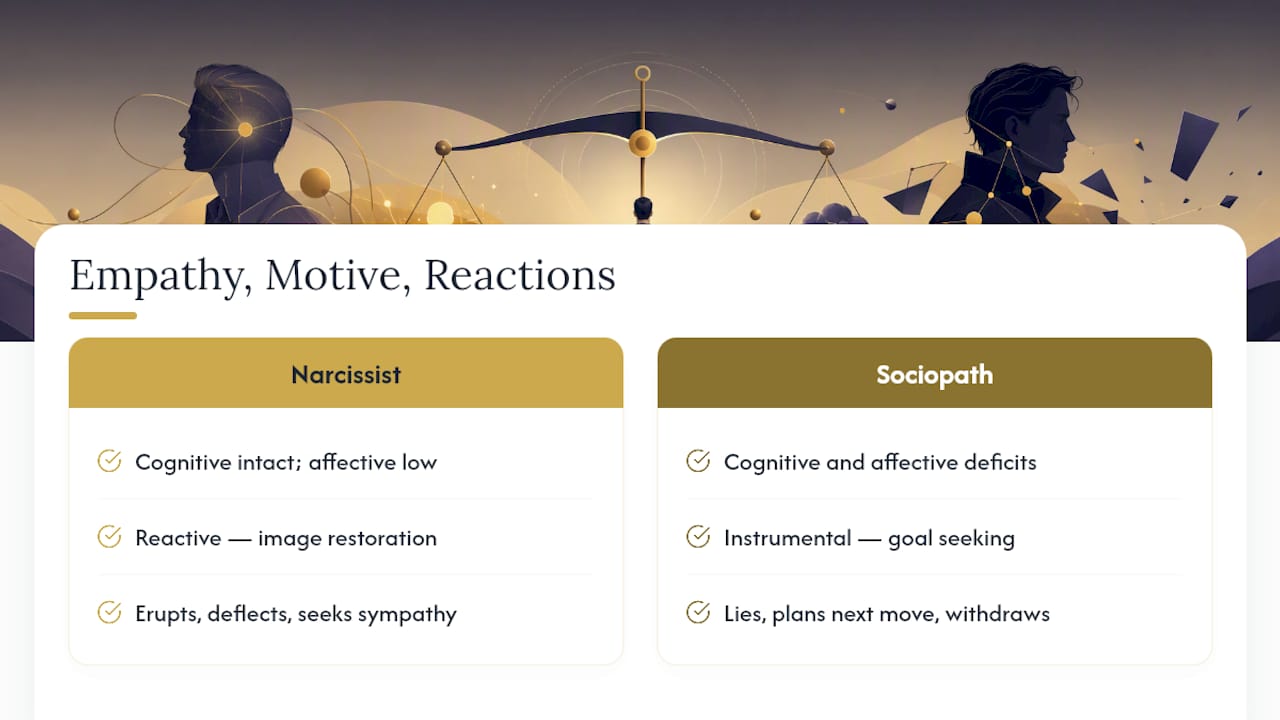
Empathy isn’t one thing. Psychologists split it into cognitive empathy, the ability to recognize what someone else is feeling, and affective empathy, actually feeling something in response. That split explains a lot of the confusion survivors describe when they say, “He knew exactly what would hurt me.”
Narcissists frequently retain cognitive empathy while losing affective empathy. According to Simply Psychology, a narcissist can read your emotional state with real accuracy and use that read instrumentally, to charm, to manipulate, or to know precisely which comment will land hardest. What’s largely absent is the felt response that would normally stop them from doing it.
People with strong sociopathic traits tend to show broader empathy deficits, both cognitive and affective, according to Cluster B reviews. They may not track your emotional state closely at all, because it isn’t relevant to what they want.
Motive is the other tell. A narcissist’s aggression is usually reactive: something threatened their image, and they’re restoring it. A sociopath’s aggression is instrumental far more often: it serves a concrete goal, whether that’s money, control, or simply avoiding consequences. Watch what happens after confrontation. A narcissist facing exposure tends to erupt, deflect blame, or demand sympathy. A sociopath facing exposure tends to lie smoothly, calculate the next move, or vanish if the relationship stops being useful.
Narcissist Behaviors vs. Sociopath Behaviors in Real Relationships
Narcissistic personality traits often appear as behaviors aimed at gaining admiration or control, including gaslighting, public criticism, explosive reactions to perceived slights, and a frequent need for validation or attention.
Sociopathic behavior often includes calculated lying for personal gain, impulsive aggression, repeated rule-breaking starting early in life, and shallow or transactional relationships
A narcissist might say, “You’re so ungrateful after everything I’ve done for you,” when their status feels threatened. A sociopath is more likely to say nothing revealing at all, then quietly do whatever benefits them anyway. If you notice escalating threats, isolation from friends and family, or actual violence from either type, that’s not a personality quirk. That’s a safety issue.
Pro Tip: Track patterns, not incidents. One bad night doesn’t confirm a personality disorder, but a repeated cycle, idealize, devalue, discard, or manipulate, exploit, disappear, tells you far more than any single fight ever will. You can find concrete examples of these cycles in narcissistic abuse tactics and how they typically unfold over time.
Can Someone Be Both a Narcissist and a Sociopath?
Yes, and this is where practical safety planning matters more than getting the label exactly right. Personality disorders commonly overlap. Peer-reviewed work on antisocial presentations shows that ASPD itself isn’t one fixed profile. It ranges from impulsive, chaotic “sociopathic” behavior to more controlled, predatory patterns closer to what’s popularly called psychopathy.
Someone can meet criteria for both NPD and ASPD, and that combination tends to raise risk rather than average it out. A person driven by both ego protection and genuine disregard for others’ rights can be more dangerous than either trait alone, because the grandiosity supplies justification while the disregard removes the brakes.
Peer-reviewed literature on personality disorder heterogeneity backs up something survivors already sense: behavioral organization over time, reactive versus impulsive versus calculated, tells you more than any single label. If you’re living with or exposed to someone showing traits of both, don’t wait for a clean diagnostic answer before protecting yourself.
How to Protect Yourself and Where to Find Help
Safety comes first, always, before analysis. If you feel physically threatened, get somewhere safe and contact emergency services or a domestic violence hotline immediately. The Hotline’s safety planning guide walks through building a concrete plan, including a safe exit route, emergency contacts, and a place to go.
Once you’re safe, a few concrete steps make a real difference:
- Document everything. Save texts, emails, and voicemails. Write down dates, what happened, and who else was present.
- Loop in a professional early. A therapist experienced in abusive relationship dynamics can help you separate your reactions from the manipulation itself.
- Involve law enforcement or medical care when warranted. Threats, physical harm, or stalking are not something to “wait and see” about.
- Set boundaries you can actually enforce. Vague boundaries invite testing; specific, consequence-backed ones hold up better.
Treatment realities differ sharply between the two conditions. NPD sometimes responds to long-term therapy, particularly when the person experiences enough consequences to stay motivated, though genuine change is slow and inconsistent. The APA notes that ASPD often carries a challenging prognosis because individuals with these traits rarely seek voluntary treatment and may engage minimally if treated. Neither disorder disappears because someone apologizes convincingly once.
Smart Reads Hub’s Take on Recovery After This Kind of Relationship
The recovery approach pairs professional therapy with curated books, scripts, and recovery guides that translate clinical patterns into plain language survivors can actually use. Reading alone won’t replace treatment, but it fills the gaps between sessions and gives you language for what happened. Our signs of a narcissistic relationship guide is a good place to start recognizing your own experience in concrete terms.
Why This Comparison Matters More Than Getting the Label Exactly Right
Here’s what I think most articles on this topic get backwards: they treat “narcissist vs. sociopath” like a trivia question, when survivors don’t need a perfect diagnosis. They need a working read on whether someone is likely to escalate. Watch behavior over time, not vocabulary. A person who erupts over criticism but never breaks the law behaves very differently from one who lies calmly and breaks promises without a flicker of guilt. Trust that pattern more than any label, get professional support if you can, and treat your own safety as the thing that’s actually non-negotiable here.
— Robert
Ready to Understand Your Situation More Clearly?
If you’re piecing together what happened in a relationship with someone who showed narcissistic or sociopathic traits, a therapist’s office isn’t the only place to start making sense of it. Smartreadshub built its resource library specifically for this gap, the space between “something felt wrong” and “I understand what happened and what to do next.” Our guides translate clinical patterns into practical recognition tools you can use today, without needing a diagnosis in hand first.

Start with Why Psychology Books Aid Healing, which lays out the research behind why reading works as a recovery tool alongside therapy. Then read 9 Signs of a Narcissistic Relationship to match specific patterns you may have lived through. If accountability and self-blame are tangled up in your recovery, The Pursuit Counseling’s breakdown of accountability vs. self-blame is worth reading alongside our guides. Pick one resource and start there today.
This article is general information, not a substitute for advice from a qualified doctor. Consult a qualified healthcare professional about your own circumstances before acting on anything here.
Sources
- What Is narcissistic personality disorder | APA
- Antisocial personality disorder – Symptoms and causes | Mayo Clinic
- Cluster B personality disorders (NCBI Bookshelf)
FAQ
What Are the Signs of Sociopathy?
Common signs include disregard for others’ rights, impulsive or aggressive behavior, repeated lying for personal gain, a pattern of rule breaking going back to adolescence, and shallow or manipulative relationships, per Mayo Clinic’s ASPD criteria.
What Are the Signs a Male Partner Might Be Narcissistic?
Watch for a constant need for admiration, explosive reactions to criticism, public put-downs meant to reassert status, and a pattern of idealizing you early on before devaluing you later, consistent with DSM-5 narcissism criteria.
Is Narcissism or Sociopathy Worse?
Neither is uniformly “worse,” but ASPD generally carries a higher average risk of legal trouble, aggression, and physical harm, while NPD’s damage tends to concentrate more in emotional manipulation and status-driven conflict, according to Verywell Mind’s comparison.
Are Narcissists the Same as Sociopaths?
No. Narcissists usually retain cognitive empathy and are driven by admiration and ego protection, while people with sociopathic traits show broader empathy deficits and disregard others’ rights for personal gain, though the two can overlap in the same person.
Can a Person Be Both a Narcissist and a Sociopath?
Yes, personality disorders commonly co-occur, and someone meeting criteria for both NPD and ASPD often presents a higher combined risk than either pattern alone.