
Yes, trust can be rebuilt after abuse, but it starts with safety, not forgiveness. The first move is a small promise you make and keep to yourself, not a conversation with anyone who hurt you. Therapy often speeds this up. There is no fixed timeline for any of it.
TL;DR:
- Rebuilding trust requires consistent, small acts of self-commitment that provide verifiable proof of your reliability to restore self-confidence.
- Trust in others is rebuilt through observing sustained behavioral change over weeks, not through promises or conversations during ongoing harmful behavior.
- Professional therapy can accelerate healing, especially EMDR, CBT, and attachment-focused approaches, but progress varies based on individual circumstances and safety factors.
- Major internal signs of healing include fewer rumination spirals and better boundary enforcement, while outside signs involve calmer conflicts and more reliable repairs in relationships.
- Small experiments, like setting tiny boundaries and tracking kept promises, are more effective at restoring trust than waiting for certainty or perfect conditions.
Table of Contents
- What does rebuilding trust after abuse actually require?
- How do you rebuild trust in yourself first?
- How do you know when someone else has earned your trust back?
- When should you bring in professional support?
- What does progress actually look like month to month?
- A note on what actually moves the needle
- Where to go next for structured support
- Where to find more support
- Sources
What does rebuilding trust after abuse actually require?
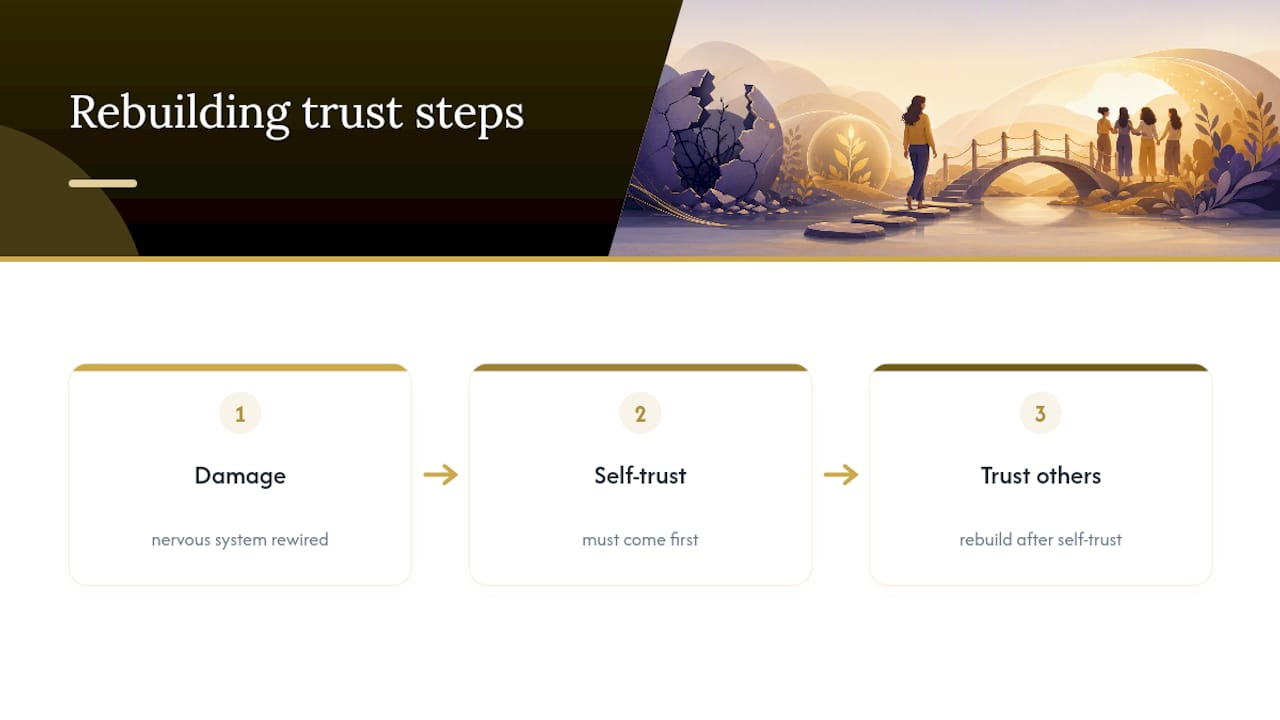
Rebuilding trust after abuse requires two separate repairs happening at once: trust in yourself and trust in other people. Most survivors focus on the second and skip the first, which is backward. Self-trust has to come first, because it’s the thing abuse damaged most directly.
Abuse rewires how your nervous system reads threat. Hypervigilance, emotional numbness, and a jumpy startle response aren’t personality flaws. They’re documented features of post-traumatic stress, and they explain why a safe person’s raised voice can trigger the same alarm as an abuser’s. Your brain isn’t malfunctioning. It’s doing exactly what it learned to do to keep you alive.
Gaslighting adds a second layer of damage. When someone repeatedly tells you your perceptions are wrong, you stop trusting your own read on reality, not just theirs. That’s why so many survivors describe feeling detached even inside relationships that are genuinely safe, struggling to know who to let close. DomesticShelters documents this pattern often.
The caution you feel isn’t a character defect. It’s an adaptive response that outlived its usefulness, and understanding that difference matters more than any single technique for overcoming it.
How do you rebuild trust in yourself first?
Self-trust rebuilds the same way muscle does: through repeated, small, verifiable proof. Not grand declarations. Kept promises.
Start absurdly small. Tell yourself you’ll drink a glass of water by 9 a.m., and do it. Tell yourself you’ll leave a text unanswered for an hour instead of replying in a panic, and do that too. Each kept promise is data your brain can use to update its model of you as reliable, which is exactly what constant self-doubt erodes.
A few practices that build this systematically:
- Keep a short journal logging one promise made and one kept each day, even trivial ones
- Practice grounding exercises (naming five things you can see, four you can hear) when anxiety spikes
- Set one boundary this week, small enough to be realistic, and hold it without renegotiating
- Notice and write down moments you trusted your own read on a situation and it turned out accurate
Boundaries are proof, not just protection. Saying no to a low-stakes request and sticking with it teaches your body that your word means something again.
Pro Tip: Pick a boundary so small it feels almost silly, like leaving a group chat notification on read overnight. The goal isn’t the boundary itself. It’s collecting evidence that you follow through on what you decide.
Chronic stress physically affects the brain systems tied to mood and memory, so protective practices like sleep, movement, and grounding aren’t optional extras. They’re part of the repair work. For more on separating from old patterns while you do this, how to detach emotionally walks through the mechanics.
How do you know when someone else has earned your trust back?
Trust with other people, whether that’s a partner, a parent, or a friend, gets rebuilt through observation, not conversation. Words are cheap. Behavior over time is the only currency that counts.
- Confirm the harm has fully stopped. No vulnerability, disclosure, or reconciliation conversation should happen while harmful behavior is ongoing. This is non-negotiable, and understanding the cycle of violence helps explain why apologies during an active cycle rarely hold.
- Test with low-risk disclosures first. Share something mildly vulnerable, not your deepest wound, and watch what happens to it. Does it get used against you later? Mocked? Respected?
- Ask for repairs, not promises. A person serious about change fixes what they broke without being managed through it every time. Trauma-informed clinicians generally treat consistent repair behavior, not verbal reassurance, as the real evidence of accountability.
- Track pattern change across weeks, not days. One good week means nothing. Consistency across a season means something.
Watch for these signals that mean it’s time to step back, not lean in:
- Promises repeat without any visible behavior change behind them
- Your low-risk disclosure gets weaponized in a future argument
- Accountability turns into a performance aimed at an audience, not private, consistent change
- You feel obligated to manage their emotions about their own harmful behavior
Behavioral experiments like these work because they replace abstract hope with concrete, observable evidence, which is more effective at rebuilding relational confidence than simply deciding to try harder. If you’re unsure whether what you’re seeing is genuine change or manipulation, 7 Trauma Bonding Signs breaks down the difference.
When should you bring in professional support?
Therapy helps most when self-guided tools stall, especially for regulating a nervous system stuck in high alert. Several approaches show up consistently in trauma-informed practice:
- EMDR reprocesses traumatic memories that fuel hypervigilance and avoidance, and is a widely used, established trauma-focused therapy
- CBT targets the thought patterns that keep self-doubt running on a loop
- Attachment-based therapy addresses how early or repeated relational trauma shapes present-day trust
- Couples therapy can support repair work, but only after harmful behavior has stopped completely
Look for clinicians listing trauma-informed training; many now offer remote sessions. If you’re in crisis, 988 connects you to the Suicide & Crisis Lifeline by call or text, 24/7, free.
What does progress actually look like month to month?
There’s no fixed timeline here, and anyone promising one is selling something. Progress shows up in specific, trackable signs instead.
Early markers tend to be internal: fewer spirals of rumination, a kept promise that surprises you, a boundary held without guilt. Later markers move outward, into relationships. You notice calmer conflict resolution, consistent repairs from people around you, less bracing for impact in ordinary conversations.
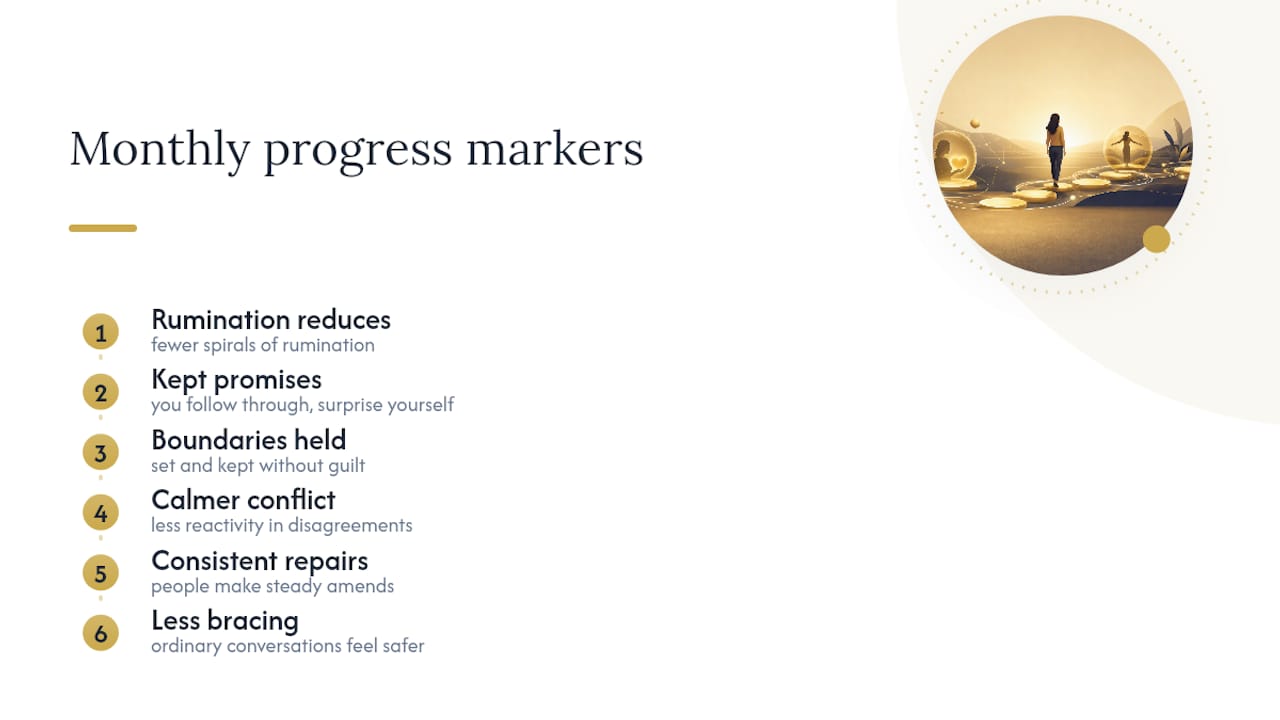
If those signs stall or reverse for weeks at a time, that’s a cue to reassess safety, not push harder. Signs you are healing offers a concrete checklist for tracking this without guessing.
A note on what actually moves the needle
Grief over this kind of loss doesn’t move in a straight line, and anyone telling you it should hasn’t lived it. Some weeks you’ll feel steady. Others, a small thing will knock you flat, and that’s not a setback undoing your progress. It’s how repair actually works.
What I’ve noticed reading through the research on this topic is that the survivors who move forward fastest aren’t the ones with the most willpower. They’re the ones running small experiments, testing a boundary, tracking a kept promise, noticing a calm conversation, instead of waiting for certainty before they act. Certainty comes after the evidence, not before it.
If you’re stuck, run one small experiment this week. If you’re in crisis, call or text 988 now. Everything else can wait for the next step.
— Robert
Where to go next for structured support
Therapy does the deep rewiring work, but a lot of survivors want something to read between sessions that puts language to what they’re feeling. That’s the gap Smartreadshub fills: curated, evidence-grounded resource guides built specifically around gaslighting, manipulation, and trust repair, rather than generic self-help.

A few pages worth starting with: Signs you are healing for tracking your own progress, How to detach emotionally for boundary mechanics, and Understanding Attachment Styles and Toxic Relationship Patterns for the “why” behind your reactions. If gaslighting is part of your history, What Is Gaslighting? Why You Start Doubting Yourself is a solid place to start untangling it. None of this replaces a trauma-informed clinician, but it gives you language and structure to use in the gaps between sessions, at 2 a.m. when your therapist’s office is closed and you just need to understand what’s happening in your own head.
Where to find more support
- SAMHSA — 988 FAQs: call or text 988 for free, 24/7 crisis support
- NIMH — PTSD: background on trauma’s effect on the nervous system
- NBCC — Building Trust After Trauma: counselor guidance on pacing and accountability
- The Therapy Canvas — Intersectionality in Counseling: finding trauma-informed, culturally responsive clinicians
This article is general information, not a substitute for advice from a qualified doctor. Consult a qualified healthcare professional about your own circumstances before acting on anything here.
Sources
- SAMHSA — 988 FAQs
- NIMH — Post-traumatic stress disorder (PTSD)
- Harvard Health — Protect your brain from stress
- DomesticShelters — Ask Amanda: Why can’t I trust a new person?