
Productivity books can be a practical tool and a source of validation for women recovering from difficult relationships — but only when chosen and applied thoughtfully. The right book delivers concrete tactics for rebuilding routines, reclaiming time, and setting boundaries. It will not fix systemic barriers or undo relational harm on its own. Smartreadshub curates lists specifically for this reality, focusing on trauma-informed titles that meet women where they actually are, not where productivity culture assumes they should be.
Table of Contents
- How do productivity books actually help women?
- What productivity books cannot fix — and why that matters
- How to choose productivity books that actually fit your life
- How to apply productivity advice safely after a harmful relationship
- What reading categories does Smartreadshub curate for women?
- Reading as community: how books connect women to lasting support
- Key Takeaways
- Why Smartreadshub curates lists this way
- Smartreadshub’s curated lists are ready when you are
- Useful sources and further reading
How do productivity books actually help women?
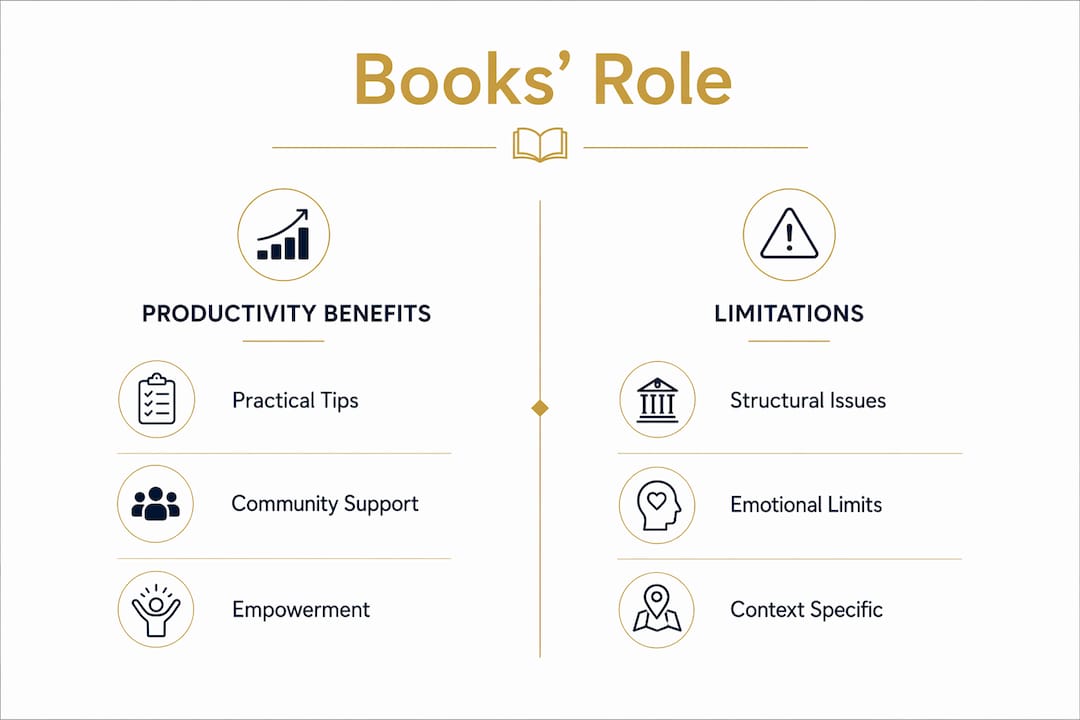
The role of productivity books for women goes beyond time-blocking tips. At their best, these books deliver two things at once: practical tools and psychological grounding.
On the practical side, women gain:
- Realistic batching strategies that work around caregiving interruptions
- Low-friction habit frameworks that don’t require two uninterrupted hours at dawn
- Prioritization methods that account for emotional labor, not just task lists
- Scripts and frameworks for saying no and protecting focused time
The psychological payoff is just as real. Qualitative research on self-help readers found that women are more likely than men to finish books, take notes, and implement what they read. That active engagement matters. Reading a book that names your experience — the double shift, the mental load, the exhaustion of managing everyone else’s needs — can feel like the first honest conversation you’ve had about your own life in months.
Statistic to know: A Fast Company analysis found that a large majority of best-selling productivity titles are written by men, many of whom reference a partner handling household logistics. Women’s productivity literature is catching up, but the authorship gap still shapes what advice gets amplified.
Books also function as a stepping stone. Many women move from reading alone to joining a book group, then to a peer support network. That progression from page to community is one of the most underrated benefits of how books empower women readers.
What productivity books cannot fix — and why that matters
Books can’t dismantle the structural conditions that make women’s lives harder. That’s not a criticism of the genre; it’s a boundary worth naming clearly.
Research on gendered assumptions in productivity literature shows that popular routines — long deep-work blocks, 5 AM wake-ups, rigid time-boxing — assume uninterrupted schedules and domestic outsourcing that most women simply don’t have. Following this advice rigidly can produce shame and burnout, not results.
There’s also a documented risk called the “fix the women” fallacy. When books frame systemic and relational problems as personal deficits, they shift blame onto the reader. Scholarly analysis of career self-help for women notes that even widely praised titles can reinforce an individual-blame frame that ignores structural barriers entirely.
Books that promise to “fix” your productivity without acknowledging caregiving, trauma, or systemic inequality are not neutral tools. They carry assumptions — and those assumptions can do real harm when applied uncritically after a harmful relationship.
Pro Tip: When previewing a book, flip to any chapter on morning routines or deep work. If the author never mentions children, chronic illness, or interrupted schedules, the advice was written for someone else’s life. That’s useful information before you invest your time.
For women rebuilding after abuse or manipulation, the stakes are higher. Advice that pathologizes caring behaviors — treating empathy or flexibility as productivity failures — can mirror the same distorted framing a harmful partner used. Recognizing that pattern is part of why books address burnout in women differently than generic productivity content does.

How to choose productivity books that actually fit your life
Pick by criteria, not by bestseller rank. A book that topped the charts in 2019 may have been written for a 35-year-old man with a stay-at-home spouse and no chronic health concerns.
Use this checklist before committing:
- Practical fit: Does the advice work with interrupted schedules, not against them?
- Author perspective: Has the author lived caregiving responsibilities, or do they assume outsourcing?
- Evidence base: Are recommendations grounded in research, or just personal anecdote scaled to universal advice?
- Representation: Does the book include women of color, single mothers, or women with disabilities — or does it default to one narrow experience?
- Trauma sensitivity: Does the author acknowledge that stress and relational harm affect focus and energy? Or does the book treat all readers as starting from a neutral baseline?
- Format and accessibility: Is there an audio version, a short-format edition, or a library copy? Accessibility matters, especially when finances are tight after leaving a harmful relationship.
Red flags to watch: rigid “non-negotiable” morning routines, advice that assumes you can hire help, and broad promises to transform your entire life in 30 days.
How to apply productivity advice safely after a harmful relationship
Apply book advice incrementally, with supports already in place. That’s the single most important rule for women coming out of psychologically harmful relationships.
After relational trauma, your nervous system is not calibrated for high-intensity change. Jumping straight into a demanding new routine — even a well-designed one — can feel like another set of rules imposed from outside. Start with micro-experiments instead: one small habit, tested for a week, in a low-stakes context.
Pro Tip: Before adopting any new routine from a book, write one sentence in a journal: “What would this look like on my hardest day?” If the answer is “impossible,” scale it down until it isn’t. The version that survives your hardest day is the version worth keeping.
Boundary-setting chapters deserve special attention. Books on setting boundaries without guilt can be genuinely useful, but practice the scripts in low-risk situations first — with a friend, in writing, or in a therapy session — before using them in high-stakes conversations. Pair reading with a therapist or peer group when possible. A book can name what happened to you; a trained professional helps you process it safely.
Know when to pause. If a chapter triggers a strong emotional response, that’s information, not failure. Set the book down, note what came up, and bring it to your next support session.
What reading categories does Smartreadshub curate for women?
Start with the category that matches your most pressing need right now. Categories are easier to scan than single-title lists, and they help you avoid wasting time on books that weren’t written for your situation.
Smartreadshub maintains curated lists across these areas:
- Books for working mothers: Realistic schedule design, energy management, and guilt-free prioritization for women managing careers and caregiving simultaneously.
- Books on setting boundaries: Clear scripts, safety planning frameworks, and boundary-work tools grounded in relational psychology.
- Books for single women thriving: Identity rebuilding, financial independence, and routines designed for one-person households.
- Books for emotional recovery after a breakup: Titles focused on grief, self-reclamation, and rebuilding trust in yourself.
- Best books on women’s mental health: Titles that address anxiety, trauma responses, and the psychological aftermath of harmful relationships.
- Books for work-life balance: Practical picks for women managing professional demands alongside personal recovery.
Smartreadshub’s curation method rests on three criteria:
- Trauma-informed selection: Every title is screened for advice that could retraumatize or pathologize normal stress responses.
- Representation check: Priority goes to authors who reflect caregiving realities and diverse lived experiences, including books by women authors writing from inside the experiences they describe.
- Evidence and lived-experience signals: Lists favor titles backed by research or by authors with documented professional expertise in the relevant area.
Pick one category, choose the shortest-format entry available, and try one micro-practice from the first chapter before moving on.
Reading as community: how books connect women to lasting support
Reading is rarely just a private act for women. Ethnographic research on self-help reading found that women’s book groups function as sources of social authority and identity, not just information exchange. The book is often the entry point; the community is what sustains change.
Shared reading creates a basis for social interaction and mutual support that solitary self-improvement rarely achieves on its own.
Practical ways to make that happen: join or start a small group of three to five people reading the same title, pair your reading with a weekly check-in call with one trusted friend, or look for moderated online forums tied to trauma-informed facilitators. Resources like Teneisha E. Coleman’s agent-of-change work offer identity-shift frameworks that complement what you’re reading.
Keep groups safe by agreeing on basic ground rules upfront: opt-outs are always allowed, trigger warnings precede difficult chapters, and no one is required to share more than they’re comfortable with. Smartreadshub’s guide to sharing book recommendations walks through how to structure these conversations so they stay supportive rather than overwhelming.
Key Takeaways
Productivity books work best for women when chosen by criteria and applied incrementally — especially during recovery from harmful relationships.
| Point | Details |
|---|---|
| Books offer two benefits | Practical tactics (routines, prioritization) and psychological validation work together when the right book is chosen. |
| Authorship bias is real | Most bestselling productivity titles are written by men and assume domestic outsourcing — screen for this before investing time. |
| “Fix the women” framing harms | Books that treat systemic or relational problems as personal deficits can deepen self-blame after abuse. |
| Apply advice incrementally | After relational trauma, test one micro-habit at a time in low-risk contexts before scaling any new routine. |
| Smartreadshub curates by need | Trauma-informed lists for working mothers, boundary-setting, and recovery give women a safer starting point than bestseller charts. |
Why Smartreadshub curates lists this way
Most productivity curation ignores the reader’s emotional starting point. That’s the gap Smartreadshub was built to close.
The site’s recommendations prioritize boundary-setting and recovery-focused reading because those are the categories where generic lists fail women most badly. A title that works for someone in a stable, supportive environment can actively harm someone still processing manipulation or gaslighting. Representation matters for the same reason: advice written from inside a caregiving reality lands differently than advice written around it.
The site’s values are straightforward: safety first, then representation, then micro-practices a reader can actually try this week. Every list is built with those three filters applied before a title makes the cut. That’s not a marketing position; it’s the only approach that makes sense when your readers are rebuilding their lives, not just their calendars.
Smartreadshub’s curated lists are ready when you are
The categories above aren’t theoretical. Smartreadshub has built them out into specific, screened reading lists you can use today.
Start with the list that matches your situation right now. If you’re rebuilding after a harmful relationship, the emotional recovery after abuse guide is the clearest entry point — it’s organized by recovery stage, not by title popularity. If boundary-setting is the immediate priority, the best books on setting boundaries list includes short-format and audio options so you can start without a large time commitment. Every list links to the real role of book recommendations for women, which explains how to use curated lists as a recovery tool rather than a reading assignment. Pick one category, choose one book, try one practice. That’s the whole next step.
Useful sources and further reading
The sources below back the claims in this article and point toward deeper reading on each subtopic. Use them to verify, explore, or bring to a therapy session as conversation starters.
- Gendered assumptions in productivity literature (PMC) — Research on how popular productivity advice fails women with caregiving responsibilities; use this to understand why rigid routines backfire.
- Why we should stop trying to “fix women” (ANU) — Academic paper on the “fix the women” fallacy and how individual-focused advice obscures structural barriers.
- Self-help career books for women (Academy of Management Perspectives) — Scholarly analysis of why career self-help is popular and where it reinforces individual blame.
- Productivity books and gender bias (Fast Company) — Accessible analysis of authorship bias in bestselling productivity titles.
- Gender differences in self-help reading — Study showing women engage more actively with self-help content and are more likely to implement advice.
- Self-help as women’s popular culture (Participations) — Ethnographic research on how women’s book groups build community and social identity, not just individual improvement.
- Smartreadshub: emotional recovery after abuse — Curated recovery-stage reading list; start here if you’re in early recovery.
- Smartreadshub: best books on setting boundaries — Screened titles for boundary work, including short-format and audio options.
- Smartreadshub: why psychology books aid healing — Science-backed framing for using books as part of a broader recovery plan.
This article is general information, not professional advice. For support with trauma, abuse recovery, or mental health, consult a licensed therapist or counselor who can address your specific situation.