

The end of a relationship is one of the most disorienting experiences a person can go through. It scrambles your sense of identity, your daily routine, and your vision of the future simultaneously. Many people instinctively reach for motivational books, hoping those pages will quiet the noise. But the role of motivational books in breakups is more nuanced than “read this, feel better.” This article unpacks what these books actually do for you, where they fall short, and how to use them in ways that create real, lasting change rather than just temporary comfort.
Table of Contents
- Key takeaways
- Why breakups hurt so much
- The role of motivational books in breakups
- How to choose and use these books effectively
- Books that take meaningfully different approaches
- My honest take on reading through heartbreak
- Where to go from here
- FAQ
Key takeaways
| Point | Details |
|---|---|
| Books restructure, not fix | Motivational books help reshape thought patterns and emotional responses, they do not erase pain. |
| Journaling multiplies results | Active journaling alongside reading converts insight into genuine psychological change. |
| Avoid the fantasy trap | Feeling inspired by a book without acting on it can actually reduce your motivation to heal. |
| Choose empowerment over closure | Books focused on self-validation outperform those promising resolution through your ex. |
| Match the book to the phase | Your needs at week two differ from your needs at month six. Select books accordingly. |
Why breakups hurt so much
Before a book can help you, it helps to understand what you are actually dealing with. Breakups do not just cause sadness. They disrupt a cluster of core psychological needs including autonomy, competence, dignity, and meaning after loss. That is not a metaphor. That is a measurable collapse in your psychological architecture.
At the biological level, the brain treats attachment loss like a threat to survival. The brainstem generates the same withdrawal signals that accompany physical dependency. You crave contact with your ex not because you are weak, but because neurological withdrawal is running the show beneath conscious thought. The craving, the rumination, the checking of their social media at midnight. That is your nervous system, not your personality.
“The emotional ‘void’ post-breakup is neurological withdrawal. Books cannot fix biology but provide the context to endure it.” (Psychology Today)
Understanding this resets your expectations entirely. Motivational reading for emotional healing was never meant to stop biological pain. It was meant to give you a cognitive framework for surviving it with your self-worth intact. That is a smaller promise, but it is an honest one.
The role of motivational books in breakups
Here is what most people get wrong about self-help books after breakups. They treat reading like a cure. Pick up the right book and the pain lifts. What actually happens is both more modest and more powerful.
Motivational literature works by giving you frameworks for pattern recognition. When you read about anxious attachment styles, you are not just learning a theory. You are seeing your own relationship history in print, often for the first time without shame. That recognition alone can reduce depression and loneliness in measurable ways. A study of 19,821 adults across 15 countries confirmed that consistent reading of mind-stimulating books correlates with better mental health outcomes.
But there is a real risk hiding inside that comfort. A 2013 study published in Psychological Science identified what researchers call the positive fantasy effect: the emotional reward of engaging with motivational content can substitute for actual behavioral change. Reading feels like progress. Sometimes it is not. You can finish three self-help books in two weeks and be no closer to healing if you have not acted on a single page.
The books that provide the most benefit during healing do several specific things:
- They create a way to sit with pain rather than rush past it, giving you permission to feel what you feel without catastrophizing it
- They help you identify dysfunctional relationship patterns without assigning blame to yourself or your ex
- They offer structured exercises that move insight from your head into your behavior
- They model emotional regulation by showing you how others have navigated the same terrain without losing themselves
Pro Tip: Read with a pen in hand. Underline what stings. That physical discomfort is pointing directly at the pattern you need to examine.
The science on this is clear. Journaling alongside reading converts passive consumption into real psychological change. Without that active step, the book stays in your hands instead of getting into your behavior.

How to choose and use these books effectively
Not every self-help book after a breakup deserves your time and attention. The field is full of books that promise closure, quick fixes, and “10 steps to getting over them.” Those are the ones to skip.
Here is a practical method for selecting the right books for breakup recovery and using them well.
- Look for self-validation over closure. Books that redirect your power back to yourself are the ones worth reading. Najwa Zebian’s framework, for example, argues that reclaiming personal power requires abandoning the expectation that your ex holds the key to your healing. That orientation shifts the entire direction of your recovery.
- Choose books with exercises, not just ideas. A book with journaling prompts or multi-phase recovery structures forces you to do the work rather than just absorb the inspiration. Structured recovery programs that use 3-phase emotional processes with specific tools consistently outperform books offering only general advice.
- Match the book to where you actually are. At week two, you need compassion and permission to grieve. At month four, you need identity rebuilding and pattern recognition. Picking a book designed for momentum when you are still in acute grief will leave you feeling like a failure.
- Read slowly and specifically. Read one chapter, then put the book down and write for ten minutes. Ask yourself: where do I see this in my own story? Speed reading through a self-help book defeats the purpose entirely.
- Use books alongside other support. Motivational literature is a tool, not a therapist. It works best when paired with journaling, physical movement, and real human connection. Rebuilding emotional regulation outside the relationship requires small, consistent steps that no single book can fully provide.
Pro Tip: Before you buy, read the table of contents and the introduction. If the author promises you will “move on fast” or “win your confidence back,” set it down. That framing will work against you.
You can also explore the best books for letting go for curated recommendations organized by emotional phase of recovery.
Books that take meaningfully different approaches
The healing through motivational literature space is not monolithic. Different books offer genuinely different frameworks, and understanding those differences helps you pick strategically rather than just grabbing whatever has the most five-star reviews.
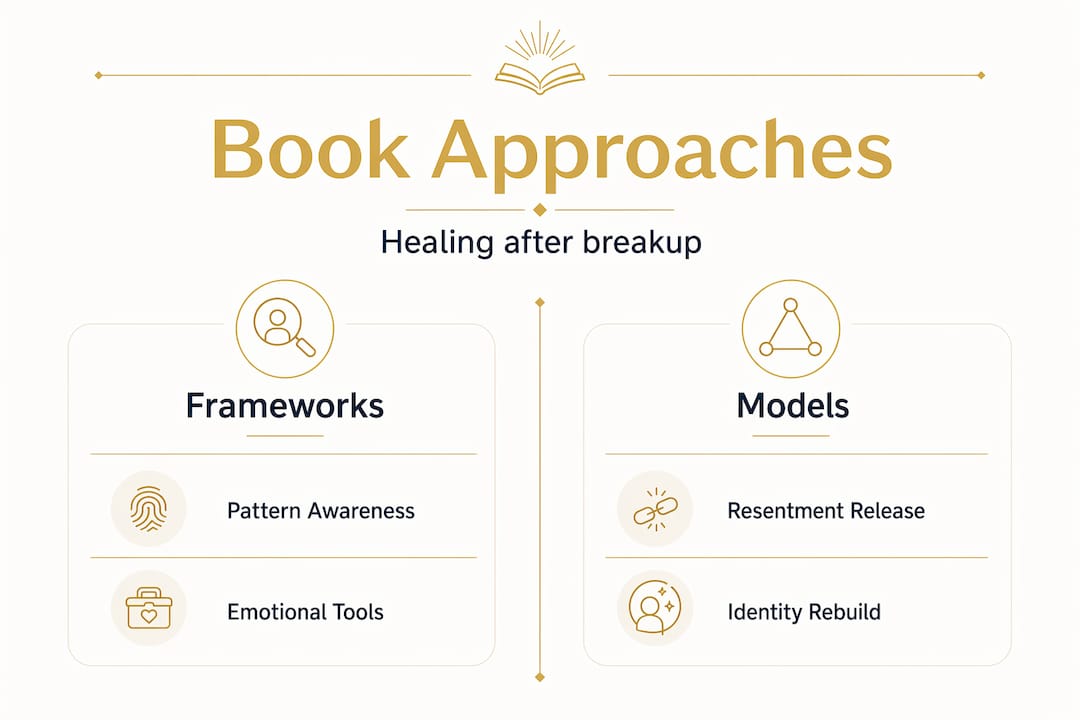
| Book approach | Emotional focus | Best for |
|---|---|---|
| Conscious uncoupling model | Releasing resentment and co-creating dignified endings | People processing mutual or amicable separations |
| Self-compassion frameworks | Quieting the inner critic and replacing shame with understanding | Anyone caught in a loop of self-blame or “what did I do wrong” |
| Emotional freedom / EFT-based books | Releasing stored emotional charge from the body | Those experiencing physical symptoms of grief like insomnia or anxiety |
| Meaning-making and identity rebuilding | Reconstructing who you are without the relationship | People past the acute grief phase ready to rebuild |
| Tough-love direct guides | Cutting through denial and taking decisive action | People who prefer directness over gentle processing |
| Mindfulness-based compassion guides | Staying present with pain without being consumed by it | Those with a tendency to suppress emotions or stay busy to avoid feeling |
The inspiration during heartbreak you need at week one looks very different from what serves you at month three. A mindfulness-based compassion guide might feel insulting when you are furious. A tough-love guide might feel cruel when you are still devastated. Timing matters as much as content.
Books like Echoes and Awakenings focus specifically on reclaiming voice after toxic foundations, which is particularly relevant if your relationship involved patterns of control or emotional suppression. The books that help with relationships are the ones that show you your own patterns, not just the other person’s behavior.
You can also read more about how psychology-backed approaches work in recovery with this science-backed guide from Smartreadshub.
My honest take on reading through heartbreak
I will say something that most motivational reading content glosses over: the first few books I read after a painful breakup made me feel temporarily amazing and changed almost nothing. I was reading as escape. The pages felt like progress. They were not.
What shifted was simple. I started treating each chapter as a prompt, not a conclusion. When a book named a pattern I recognized in myself, I stopped reading and wrote about it. Not polished journaling. Messy, honest writing that I would never show anyone. That is where the real work happened. The book pointed. The writing moved.
What I have come to believe about the impact of motivational books is this: they are most powerful when you are willing to be confronted by them. When you read with the question “where is this true about me?” rather than “how do I get over them?” The orientation changes everything.
I also think the biology piece matters more than most self-help authors admit. The pain of withdrawal after a relationship loss is not a thinking problem. No book fixes that directly. What books did for me was give the pain context. Sitting with discomfort became easier when I understood why it was there. That is not a small thing.
The role of self-improvement books in recovery is not to make you someone new. It is to help you recognize who you were before the relationship defined you. That distinction took me longer to understand than I would like to admit.
— Robert
Where to go from here
If you have read this far, you are taking your healing seriously. That matters. Smartreadshub curates carefully selected books for exactly this kind of moment: the ones that go deeper than “love yourself” platitudes and actually hand you tools.
Browse the self-discovery books category on Smartreadshub to find titles organized around rebuilding identity and reclaiming agency after a relationship ends. For readers specifically looking for books on processing grief and releasing what no longer serves them, the curated letting go collection offers recommendations matched to different stages of the healing process. Every title featured has been evaluated for depth, practical application, and emotional honesty. Not a single “bounce back in 30 days” promise in the bunch.
FAQ
What is the role of motivational books in breakups?
Motivational books help breakup recovery by providing frameworks for emotional regulation, pattern recognition, and identity rebuilding. They do not eliminate pain but give you cognitive tools to process it and begin moving forward.
Can reading self-help books after a breakup actually help?
Yes, research shows consistent reading is linked to reduced depression and loneliness. Results improve significantly when reading is paired with active journaling and self-reflection rather than passive consumption.
How do I avoid the positive fantasy effect when reading motivational books?
Act on each chapter before moving to the next. Write about what you recognized, what you resisted, and what you want to change. The positive fantasy effect weakens when reading is tied to specific behavioral steps.
What should I look for in the best books for breakup recovery?
Prioritize books with exercises and journaling prompts over inspirational narratives alone. Look for titles that focus on reclaiming personal power rather than seeking closure from your former partner.
When is the best time to start reading motivational books after a breakup?
You can start at any point, but match the book type to your emotional state. Compassion-focused books work best in early acute grief. Identity rebuilding and pattern-recognition books serve you better once the initial shock has passed.