

Book discovery is one of those terms you encounter constantly in reading circles, yet its meaning rarely gets explained properly. If you’ve wondered what does book discovery mean beyond a vague sense of “finding books,” you’re not alone. The concept spans everything from AI-powered recommendation engines and library platforms to BookTok communities and reading retreats. It’s more layered than simple search, and far more personal than marketing. This article breaks down the book discovery definition clearly, shows you how it works across different contexts, and gives you practical ways to make it work for you.
Table of Contents
- Key takeaways
- What book discovery means: definition and scope
- How AI and technology are transforming book discovery
- Social and community book discovery, especially for women
- Genuine discovery vs. algorithmic echo chambers
- Practical ways to improve your book discovery
- My take on what book discovery really means
- Find books worth discovering at Smartreadshub
- FAQ
Key takeaways
| Point | Details |
|---|---|
| Discovery vs. search | Book discovery is about being introduced to books you didn’t know to look for, not just finding titles you already know. |
| AI is changing the process | Tools now analyze themes, mood, and context to recommend books, moving well beyond basic keyword matching. |
| Community drives discovery | Social reading groups and platforms, especially among women readers, create layered exposure that algorithms alone cannot replicate. |
| Elaboration isn’t discovery | Algorithms often reinforce what you already like; genuine discovery reorganizes your thinking and expands your taste. |
| Layered exposure works | Encountering the same book through multiple channels over time is one of the most reliable paths to a meaningful find. |
What book discovery means: definition and scope
The book discovery definition is straightforward at its core: it is the process by which a reader encounters and becomes interested in a book they did not previously know or seek out. That distinguishes it sharply from search. When you search, you already know what you want. Discovery happens in the space before that. It’s the moment a title crosses your path through a recommendation, a shelf display, a social media post, or a friend’s conversation.
But the meaning of book discovery expands depending on context. There are at least four distinct settings where it plays out differently.
- Retail discovery happens on bookseller platforms and e-commerce sites, where algorithms surface titles based on purchase history or browsing behavior. Think of the “customers also bought” section on a major online bookstore.
- Library and academic discovery involves tools that search across hundreds of databases simultaneously. UMass Amherst’s discovery tool searches across 600+ databases at multiple institutions, allowing researchers to filter by discipline, format, and source in a single interface.
- Social discovery happens when readers encounter books through other people. Book clubs, reading communities on social media, literary podcasts, and events all fall here.
- Platform-based discovery refers to dedicated services built specifically to connect readers with titles. A book discovery platform focuses on reader-specific ecosystems using human insight and thematic connections, rather than pure retail sales algorithms.
What makes book discovery different from marketing is intent and direction. Marketing pushes a book toward any available reader. Discovery pulls the right reader toward the right book, often without either party planning for it. That’s the gap discovery tools and communities are trying to close.
How AI and technology are transforming book discovery

The technological shift in how readers discover books has accelerated sharply. The old model relied on keyword searches, genre tags, and bestseller lists. The new model uses artificial intelligence to analyze themes, emotional tone, narrative structure, and even reader mood.
Here’s how that shift breaks down in practice:
- Conversational recommendations. Instead of typing “mystery novels,” readers can now describe a feeling or situation. AI processes that input and surfaces books matching the underlying theme, not just the genre label.
- Library AI kiosks. AI-powered kiosks in 250+ libraries from startups like Flybook offer personalized recommendations based on reader mood, age, gender, and stated interests in real time.
- Semantic content analysis. Platforms like Yes24 and Kyobo Book Centre in South Korea use AI to analyze full text, not just jacket descriptions, to find thematic connections between books.
- Reading companionship tools. Millie’s Library integrated an AI chatbot that lets users ask about metaphors and themes in books, deepening engagement with texts rather than simply pointing readers to the next purchase.
- Semantic SEO for authors. Publishers now structure titles, abstracts, and metadata so AI can understand the relationships between ideas, not just detect keywords. AI-driven discoverability requires clear titles, abstracts, and structured content to help AI match books to readers accurately.
The goal of all these tools is deeper engagement, not just higher sales volume. There is, however, real resistance within parts of the publishing industry to AI-based text analysis, particularly around concerns about copyright and the use of full texts for training data. That tension is ongoing and worth watching.
Pro Tip: When using any AI recommendation tool, describe your current mood or a specific situation you’re in rather than a genre. You’ll get far more interesting and accurate suggestions.
Social and community book discovery, especially for women
If you want to understand what book discovery is for women in 2026, look at who’s actually buying and talking about books. Women dominate the book-buying market and have built an entire ecosystem of social and experiential discovery that no algorithm can fully replicate.
Consider what that ecosystem looks like today:
- BookTok and social media. Short video content has introduced millions of readers to titles they would never have found through traditional retail channels. The format rewards emotional resonance and personal story, which is exactly how discovery works at its best.
- Reading retreats. The Ladies Who Lit Book Club grew to nearly 35,000 TikTok followers by 2026 and organizes travel-based reading events that blend social experience with literary discovery.
- Celebrity and curated book clubs. These function as high-trust recommendation systems, where the curator’s identity and taste act as a filter that saves readers time while introducing them to books they’d likely love.
- In-person community events. Local book clubs and literary festivals create discovery through conversation, debate, and the simple act of watching someone else get excited about a title.
The social dimension of discovery is what creates layered exposure. You hear about a book once from a friend, see it mentioned on a podcast, spot it in a reading retreat post, and finally buy it three months later. That accumulation is what turns a recommendation into an actual read.
There’s an important caveat here though. The publishing industry’s attention to women readers has a real downside. Treating algorithmic trends as audience census data risks narrowing diverse reading tastes into whatever genre is trending on BookTok right now. Women actually read across a far wider range of genres and subjects than any single trend suggests.
Pro Tip: If you find your reading list is full of the same type of book, deliberately follow a reader or community whose taste is adjacent to yours but clearly different. That friction is where real discovery happens.
Genuine discovery vs. algorithmic echo chambers
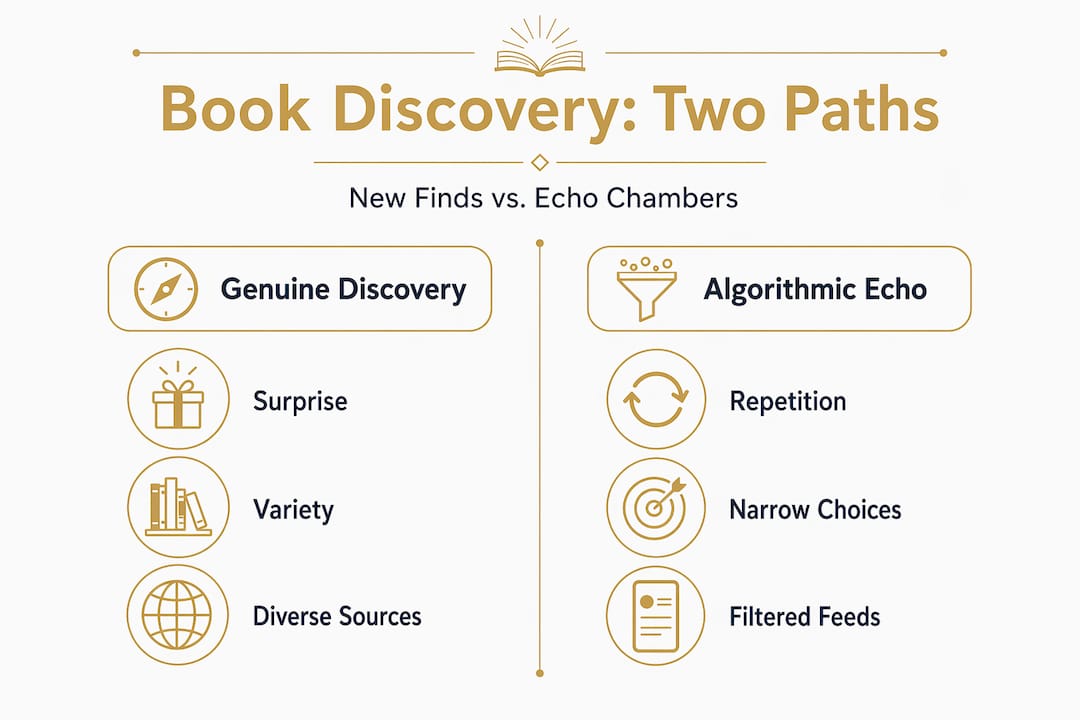
This is where the book discovery conversation gets genuinely interesting. There is a meaningful difference between elaboration and discovery, and most readers don’t realize they’re getting the former when they think they’re getting the latter.
Elaboration means getting more of what you already like. An algorithm learns your past behavior and feeds you similar content. You finish a thriller, and the platform surfaces six more thrillers. That’s useful, but it isn’t discovery. It’s a refinement loop.
“True discovery reorganizes your thinking. It doesn’t just add to your existing shelf. It changes the way you read everything else.”
Algorithms tend to reinforce existing consumption patterns, limiting the kind of transformative reading experiences that genuinely shift a reader’s perspective. That’s the central problem with treating recommendation engines as discovery engines. They’re optimized for engagement, and the fastest path to engagement is familiarity.
True discovery has a few defining characteristics:
- It introduces you to a book that sits outside your usual pattern.
- It shifts your understanding of a subject, a feeling, or a type of story.
- It often arrives through an unexpected channel, a stranger’s recommendation, a physical bookshop display, or a reading retreat conversation.
- It tends to stick. Books that genuinely surprise you are the ones you remember and recommend for years.
Layered discovery is the practical mechanism behind many of these moments. Final buying decisions typically result from multiple subtle exposures rather than a single ad or recommendation. You don’t discover a book in one moment. You accumulate it over time, across different channels, until it becomes inevitable. Understanding this is genuinely useful for any reader who wants to discover more and better books.
Practical ways to improve your book discovery
Knowing the book discovery process intellectually is one thing. Building habits that actually surface great books is another. Here’s how to improve your own discovery experience in concrete ways:
- Use conversational queries with AI tools. Instead of browsing by genre, describe what you’re going through emotionally or intellectually. Ask something like “I want a book that makes me rethink how I make decisions.” That kind of input gets far better results from modern recommendation systems.
- Join a reading community outside your usual circle. If you read primarily fiction, find a group that focuses on narrative nonfiction. The cross-pollination is where discovery accelerates. Explore self-discovery books for growth as a starting point for broadening your thematic range.
- Track the layered exposure pattern. When you notice a book appearing in three or more unrelated places, treat that as a signal. That convergence rarely happens by accident.
- Use library academic discovery tools for deep dives. If you’re researching a subject seriously, a single academic discovery interface that searches across hundreds of databases beats hours of separate searching.
- Follow author and publisher platforms directly. These offer recommendations grounded in the actual context of a book’s creation, which is a form of insider discovery most readers overlook.
- Deliberately break your own pattern once a month. Pick a book based purely on a recommendation from someone whose taste you respect but rarely match. That discomfort is often exactly where the best reads hide.
My take on what book discovery really means
I’ve spent years paying attention to how I actually find the books that matter most to me, and the honest answer is almost never through a recommendation algorithm. The books that shifted my thinking, the ones I press into other people’s hands, came through conversations, random shelf browsing, and the kind of layered exposure you don’t notice until you look back.
What concerns me about the current moment is that we’re calling algorithmic elaboration “discovery” and accepting the substitution too easily. When a platform suggests six books that are essentially variations on what you just read, that’s not discovery. That’s a holding pattern.
I’ve also noticed that the social discovery happening in women’s reading communities, the retreats, the TikTok communities, the deeply personal book club conversations, is producing far more genuine discovery than most technology platforms. There’s something about human curation at that intimate scale that algorithms genuinely cannot replicate yet. Psychology books that aid healing rarely show up in a recommendation engine cold. They arrive through a friend saying “this one changed how I think about my own mind.”
The books that find you through treating trends as audience census data aren’t discovering you. They’re targeting you. There’s a difference worth protecting.
My practical advice: stay curious about the edges of your reading identity. The books worth discovering are rarely at the center of your comfort zone.
— Robert
Find books worth discovering at Smartreadshub
Knowing what book discovery means is only the beginning. The harder part is building a reading life where genuinely surprising, meaningful books keep showing up.
Smartreadshub curates books across themes that matter most to real readers. Whether you’re exploring books for mental clarity, looking for titles that support emotional growth, or ready to explore the full book catalog, the site is built to surface books worth your time. No inflated bestseller lists, no genre-of-the-month recycling. Smartreadshub works the way discovery should: by connecting you to books that actually fit where you are right now.
FAQ
What is book discovery in simple terms?
Book discovery is the process by which a reader encounters a book they didn’t already know to look for. It differs from search in that it introduces rather than retrieves.
What is a book discovery platform?
A book discovery platform is a service built specifically to help readers find new titles through personalized recommendations, curated lists, and community input, rather than through standard retail browsing or keyword search.
What is book discovery for women?
Book discovery for women describes the social and experiential channels through which women find books, including book clubs, reading retreats, BookTok, and curated communities. Ladies Who Lit is one prominent example of this community-driven model.
How does AI change the book discovery process?
AI shifts discovery from keyword-based browsing to thematic and contextual analysis. Tools now match books to readers based on mood, narrative structure, and stated needs, not just genre tags.
Why does true book discovery matter?
Genuine discovery expands your reading taste and introduces perspectives outside your existing patterns. Algorithms tend to reinforce what you already like; real discovery, through community, layered exposure, or unexpected channels, is what produces the books you remember for years.