

Emotional intelligence reading is the practice of using engagement with texts to develop and strengthen emotional intelligence (EI), the ability to perceive, use, understand, and manage emotions across four measurable cognitive branches. This skill sits at the intersection of literacy and psychology, and it has real consequences for how you navigate relationships, process conflict, and understand yourself. Researchers like Peter Salovey and John Mayer formalized the ability model of EI, while Daniel Goleman’s mixed model and the Six Seconds framework each offer practical entry points for developing these skills. Neuroscience confirms that EI is not fixed at birth. Your brain’s neuroplasticity means that reading, practiced with intention, can literally rewire how you regulate emotion.
What is emotional intelligence reading and its core components?
Understanding emotional intelligence reading starts with the four cognitive branches that define the ability model. Each branch describes a distinct skill you exercise every time you read with emotional awareness.
- Perceiving emotions accurately: You identify feelings in yourself and in the characters or voices you encounter in a text. A narrator’s grief, a character’s suppressed anger, or the tension between two people in a scene all require you to read emotional signals correctly.
- Using emotions to guide thought: Emotions influence attention and memory. When a passage moves you, that emotional charge directs your focus and deepens comprehension. Readers who engage emotionally retain more and think more critically about what they read.
- Understanding emotional dynamics: This branch involves recognizing how emotions shift, combine, and cause consequences within a narrative. Watching a character’s shame spiral into rage, for example, teaches you to recognize that same sequence in real life.
- Managing emotions: Reading emotionally difficult material, whether a character’s trauma or a difficult relationship dynamic, requires you to stay present without shutting down. That tolerance is the same skill you need to manage your own emotional responses in relationships.
Pro Tip: When you finish a chapter, pause and name the dominant emotion you felt. This single habit activates all four branches simultaneously and accelerates your emotional vocabulary faster than passive reading alone.
These four branches are not abstract. They map directly onto the emotional intelligence skills you use every day: reading a partner’s mood, staying calm during a difficult conversation, or recognizing when your own emotional state is distorting your judgment.

How does reading fiction boost empathy and emotional intelligence?
Fiction is a social simulation. When you read a novel, your brain processes the emotional experiences of characters as if they were partially your own. Fiction reading strengthens emotional comprehension, critical thinking, and empathy across multiple studies. That finding matters because empathy is not just a feeling. It is a trainable cognitive skill.
“Reading fiction is one of the most accessible and evidence-backed methods for developing the empathy and perspective-taking skills that define high emotional intelligence.” — Worldreader research summary
The neurological mechanism is neuroplasticity. Practicing EI exercises strengthens neural pathways supporting emotional regulation and decision-making, and fiction reading qualifies as exactly that kind of exercise. Each time you inhabit a character’s perspective, you build and reinforce the neural architecture for empathy. The effect compounds with consistent reading habits over months and years.
Not all reading produces the same results. Fiction and nonfiction engage your emotional brain differently.
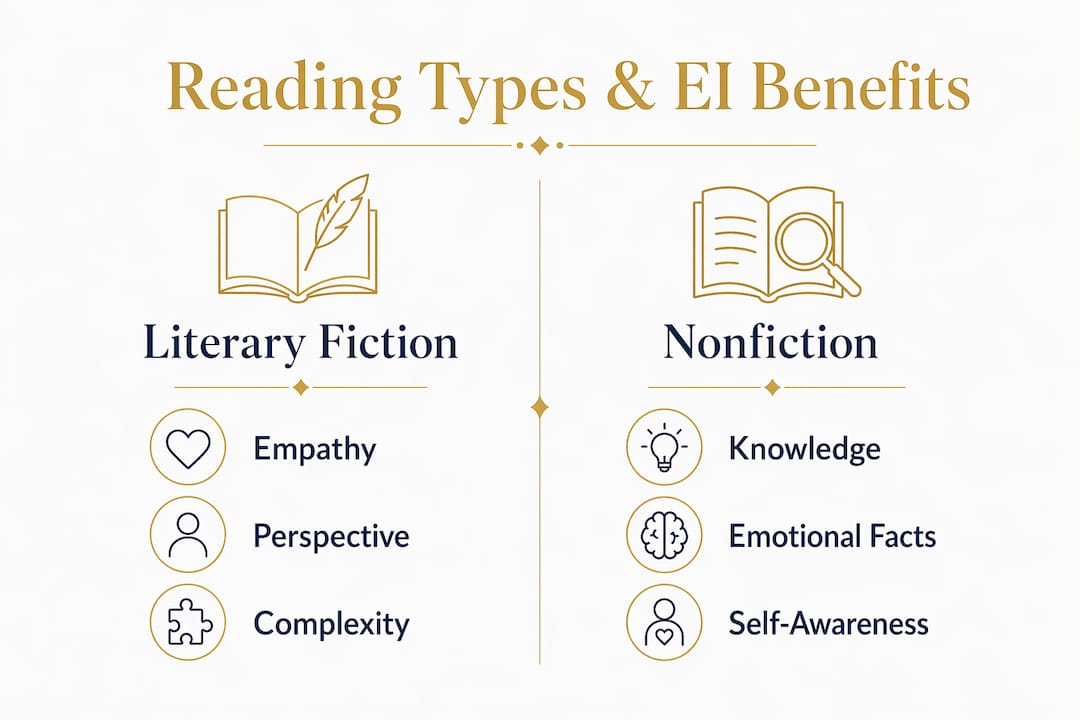
| Reading type | Primary EI benefit | Mechanism |
|---|---|---|
| Literary fiction | Empathy, perspective-taking, emotional recognition | Inhabiting complex characters with ambiguous motivations |
| Genre fiction | Emotional regulation, tension tolerance | Sustained engagement with high-stakes emotional scenarios |
| Narrative nonfiction | Self-awareness, contextual understanding | Connecting real human experiences to your own emotional patterns |
| Self-help nonfiction | Self-regulation, motivation | Direct instruction on EI frameworks and behavioral strategies |
Literary fiction produces the strongest gains in empathy because its characters resist simple interpretation. You cannot read a character like Anna Karenina or Atticus Finch on autopilot. Their contradictions force you to hold multiple emotional truths at once, which is precisely what high EI requires in real relationships.
What are the main emotional intelligence models relevant to reading’s impact?
Three models dominate the field, and each one frames what emotional intelligence reading develops in a slightly different way.
The ability model (Salovey and Mayer) treats EI as cognitive skills testable with performance tasks, not personality traits. This model fits neatly with reading because reading is itself a cognitive performance. Every time you accurately identify a character’s emotional state or predict how a relationship will unfold, you are demonstrating measurable EI ability.
Goleman’s mixed model identifies five core emotional competencies: self-awareness, self-regulation, motivation, empathy, and social skills. Reading develops all five, but it is especially powerful for self-awareness and empathy. Seeing your own emotional patterns reflected in a character’s behavior is one of the fastest routes to honest self-recognition.
The Six Seconds model organizes EI development into three practical steps: Know Yourself, Choose Yourself, and Give Yourself. Used by over 500,000 people worldwide, this framework emphasizes daily practice over abstract theory. Reading fits naturally into the “Know Yourself” phase, where you build the self-awareness that makes the other two steps possible.
| Model | Core focus | How reading supports it |
|---|---|---|
| Ability model (Salovey and Mayer) | EI as measurable cognitive skill | Reading trains perception, understanding, and management of emotions |
| Goleman’s mixed model | Five personal and social competencies | Fiction builds empathy and self-awareness directly |
| Six Seconds model | Three-step daily EI practice | Reading anchors the “Know Yourself” phase with consistent reflection |
Understanding which model resonates with you matters because ability and mixed models support different types of personal development. If you want measurable skill growth, the ability model gives you the clearest benchmarks. If you want practical relationship improvement, Goleman’s competencies offer a more direct map.
How to improve emotional intelligence through reading every day
The importance of emotional intelligence is clearest when you see how deliberately you can build it. These strategies move reading from passive entertainment to active EI training.
-
Journal your emotional reactions. After reading, write down what you felt and what triggered it. Reflection is the mechanism that moves you from reactive patterns to intentional emotional management. Three sentences after each reading session is enough to start building that habit.
-
Choose emotionally rich and diverse material. Seek out fiction that features characters whose emotional lives differ significantly from your own. Reading across cultures, genders, and life circumstances expands your emotional reference library and reduces the blind spots that cause relational friction.
-
Practice perspective-taking questions. While reading, ask yourself: “What does this character need that they are not saying?” and “What would I feel in this situation, and why does it differ from what they feel?” These questions activate the empathy circuits that transfer directly to real conversations.
-
Use reading for self-regulation practice. When a passage triggers a strong emotional reaction, stay with it rather than skipping ahead. High EI requires engaging honestly with uncomfortable emotions rather than suppressing them. Fiction gives you a low-stakes environment to practice exactly that.
-
Conduct a simple emotional intelligence assessment on yourself. After finishing a book, rate how well you perceived the characters’ emotions, how accurately you predicted their behavior, and how your own emotional state shifted. This informal self-scoring mirrors the structure of formal EI assessments and builds metacognitive awareness over time.
Pro Tip: Pair your reading with the science behind books and emotional pain to understand exactly why certain narratives hit harder than others. That understanding itself is an EI skill.
Emotional intelligence is a learnable skill, and the brain’s neuroplasticity means the gains from consistent reading practice accumulate in measurable ways. You are not born with a fixed capacity for empathy or self-awareness. You build it, one intentional reading session at a time.
Key takeaways
Emotional intelligence reading is a trainable cognitive practice that builds empathy, self-awareness, and emotional regulation through structured engagement with texts.
| Point | Details |
|---|---|
| EI reading has four branches | Perceiving, using, understanding, and managing emotions are all exercised through active reading. |
| Fiction outperforms nonfiction for empathy | Literary fiction forces perspective-taking with complex characters, producing the strongest EI gains. |
| Three models frame EI differently | Salovey and Mayer, Goleman, and Six Seconds each offer distinct tools for measuring and building EI. |
| Journaling accelerates EI growth | Writing emotional reactions after reading converts passive exposure into active skill development. |
| EI is neuroplastic and learnable | Consistent reading practice strengthens the neural pathways that govern emotional regulation and empathy. |
Why I think most people underestimate what reading actually does to your emotional brain
I spent years recommending books to people recovering from toxic relationships, and the pattern I kept seeing surprised me. The readers who made the fastest relational progress were not the ones who read the most self-help. They were the ones who read emotionally demanding fiction alongside it.
The reason, I now believe, is that self-help tells you what to feel and how to respond. Fiction makes you practice feeling. There is a difference between knowing that gaslighting erodes self-trust and reading a character who cannot tell whether her own memories are real. The second experience lands in your body differently. It builds the kind of emotional recognition that you can actually use in a real conversation.
The uncomfortable truth I have learned is that most people approach reading as information transfer. They want the lesson extracted cleanly, without the emotional friction. But that friction is the training. Skipping it is like reading about exercise and expecting to get stronger.
The other thing I would push back on is the idea that you need a formal emotional intelligence assessment before you start. You do not. The self-discovery process through reading is itself a form of ongoing assessment. Every time you notice your own reaction to a character’s choice, you are gathering data about your emotional patterns. That data is more honest than most questionnaires.
Start with one emotionally demanding novel. Stay with the discomfort when it arrives. Write three sentences about what you felt. That is the whole practice, and it works.
— Robert
Books and resources that build emotional intelligence at Smartreadshub

Smartreadshub curates reading lists specifically for people working through the emotional aftermath of difficult relationships. The site’s selections are grounded in the same EI frameworks covered in this article, and they are chosen because they produce genuine emotional insight, not just comfort. If you are ready to put emotional intelligence reading into practice, the books that explain relationship patterns section is the most direct starting point. For those recovering from a breakup or emotional betrayal, the emotional recovery reading list combines narrative fiction with evidence-backed nonfiction to rebuild self-awareness from the ground up.
FAQ
What is emotional intelligence reading in simple terms?
Emotional intelligence reading is the practice of using texts to develop your ability to perceive, understand, and manage emotions. It treats reading as an active exercise in empathy and self-awareness rather than passive information intake.
Does reading fiction actually improve emotional intelligence?
Yes. Multiple studies confirm that fiction reading strengthens empathy and emotional comprehension by placing readers inside the perspectives of complex characters. Literary fiction produces the strongest results because its characters resist simple emotional interpretation.
How does an emotional intelligence assessment relate to reading?
A formal EI assessment measures your current ability across the four cognitive branches: perceiving, using, understanding, and managing emotions. Reading with reflection functions as an informal, ongoing version of that same assessment by revealing your emotional patterns in real time.
Can reading help with emotional intelligence in relationships?
Reading builds the empathy and self-regulation skills that directly improve relational dynamics. True emotional intelligence promotes trust and honest connection, and fiction reading is one of the most consistent ways to develop those capacities outside of therapy.
How long does it take to improve emotional intelligence through reading?
Neuroscience research shows that EI skills strengthen neural pathways through repeated practice, similar to physical training. Readers who journal emotional reactions and choose emotionally rich material typically notice measurable shifts in empathy and self-awareness within several weeks of consistent practice.