
The emotional memoir genre is a form of literary nonfiction in which an author transforms personal memory into a thematic narrative driven by emotional truth. Unlike a diary or a simple record of events, this genre uses the tools of storytelling, including scene construction, reconstructed dialogue, and emotional pacing, to make one person’s experience resonate with every reader. Books like Mary Karr’s The Liar’s Club and Roxane Gay’s Hunger show what the genre does at its best: they turn private pain into shared understanding. The standard term used by editors and writing programs is simply “memoir,” but the emotional memoir label captures the genre’s defining quality. Emotional truth is the engine, not chronology.
The emotional memoir genre is defined as a thematic, first-person nonfiction narrative that prioritizes the author’s inner emotional experience over a complete factual record of events. This is the clearest way to separate it from related forms. A memoir does not try to document everything. It selects, shapes, and interprets.
Memoir operates on a narrow lens, focusing on a singular theme or period, with every scene supporting a controlling idea. Scenes that do not serve that central question get cut, regardless of how dramatic they were in real life. That discipline is what gives the genre its power.
Emotional truth is the industry standard in memoir writing. This means the author’s felt experience of events takes precedence over exact chronological accuracy. A conversation may be reconstructed from memory rather than transcribed verbatim. The emotional reality of that conversation, however, must be honest.
The genre also carries a clear structural expectation. A full-length memoir runs 50,000–60,000 words, while a personal essay on the same subject might be 500–5,000 words. That length difference reflects the depth of psychological and emotional excavation the genre demands.
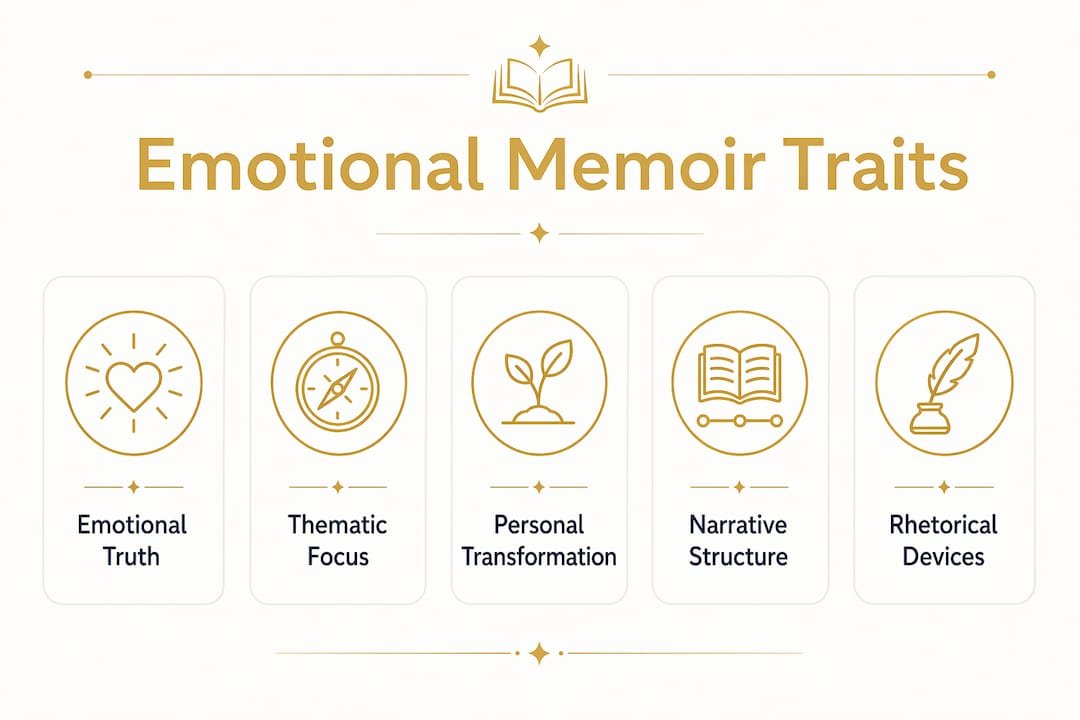
Emotional memoirs share a set of recognizable features that separate them from other nonfiction forms. Knowing these characteristics helps both readers and writers understand what the genre promises and what it requires.
Pro Tip: Read the first and last chapters of any memoir you admire and ask: how did the author change? If you can name that shift clearly, the memoir’s controlling idea is working.
Emotional memoirs also use rhetorical devices that amplify feeling. Rhetorical questions, exclamations, and inversions are genre-forming tools that create a multidimensional communicative space between author and reader. These are not decorative. They are structural.
The three genres share a first-person perspective and real events, but they serve different purposes and operate by different rules. Confusing them leads to manuscripts that fall between categories and satisfy neither editors nor readers.
An autobiography covers an entire life, usually in chronological order. It answers the question: what happened to this person? An emotional memoir covers a period, a theme, or a transformation. It answers the question: what did this experience mean, and how did it change me? The difference in scope is also a difference in emotional depth.
A personal essay is shorter and more essayistic. It explores an idea through personal experience but does not build the sustained narrative arc that a memoir requires. An essay might examine one afternoon. A memoir examines how that afternoon connects to a decade of choices.
| Feature | Emotional Memoir | Autobiography | Personal Essay |
|---|---|---|---|
| Scope | Thematic or period-focused | Entire life | Single idea or event |
| Length | 50,000–60,000 words | 80,000+ words | 500–5,000 words |
| Structure | Narrative arc with transformation | Chronological | Exploratory, essayistic |
| Emotional depth | Central and defining | Variable | High but brief |
| Factual standard | Emotional truth | Factual accuracy | Emotional truth |
| Purpose | Meaning-making, empathy | Record, legacy | Reflection, argument |
The table makes one thing clear: emotional memoir is the genre most deliberately built around feeling. Autobiography records. Personal essays reflect. Emotional memoir transforms.
Emotional memoirs return to a set of universal human experiences that readers recognize across vastly different lives. Common memoir themes include transformation, healing, self-discovery, conflict, and trauma. These are not arbitrary choices. They are the experiences that most demand the kind of meaning-making that memoir provides.
Thematic coherence is what separates a memoir from a collection of memories. Every scene must earn its place by advancing the central question. A memoir about addiction that includes a chapter on a childhood vacation must show how that vacation connects to the addiction. If it does not, the chapter does not belong.
Pro Tip: Before drafting, write one sentence that completes this prompt: “This memoir is about how I learned that…” That sentence is your controlling idea. Test every scene against it.
Reading emotional memoirs also has a measurable effect on readers. Research on why books help emotional pain shows that narrative empathy, the experience of inhabiting another person’s perspective, actively reduces feelings of isolation. Memoir is particularly effective at this because the author is real.
Writing an emotional memoir requires more than remembering clearly. It requires shaping memory into narrative with intention and craft. These are the techniques that separate published memoirs from private journals.
Master the double vision. The double vision technique means writing as two selves simultaneously: the experiencing self who lived through the events, and the writing self who now understands what they meant. The experiencing self provides immediacy. The writing self provides meaning. Both are necessary.
Select scenes ruthlessly. Every scene must serve the controlling idea. A scene that is emotionally vivid but thematically irrelevant weakens the book. Cut it, or find the angle that connects it to the central question.
Use multisensory detail. Abstract emotion does not move readers. Concrete sensory detail does. The smell of a hospital room, the sound of a door closing, the weight of a phone in your hand: these details make the reader present in the scene.
Manage emotional pacing deliberately. Emotional pacing through shifts in narrative distance is the technique that controls reader tension. Move closer to raw emotion in climactic scenes. Pull back into reflection afterward. This rhythm prevents reader exhaustion and keeps the narrative moving.
Treat writing as somatic work. Writing memoir often produces physical symptoms like exhaustion, anxiety, and physical tension when revisiting traumatic memories. Practices like breathwork, movement, and scheduled rest are not optional self-care. They are part of the writing process.
Reconstruct dialogue honestly. You cannot remember conversations verbatim from years ago. Reconstructed dialogue is acceptable in memoir, but it must reflect the emotional truth of what was said. Inventing words to make yourself look better is a breach of the genre’s contract with the reader.
The goal of every technique is the same: to make the personal universal, so that readers find meaning in the author’s specific experience. A memoir about one woman’s escape from a controlling relationship becomes a mirror for every reader who has ever felt trapped. That is the genre’s highest achievement.
Emotional memoir is the nonfiction genre most deliberately built around emotional truth, thematic focus, and the transformation of personal experience into universal meaning.
| Point | Details |
|---|---|
| Core definition | Emotional memoir prioritizes emotional truth and thematic focus over chronological completeness. |
| Narrow lens principle | Every scene must serve the controlling idea; unrelated content weakens the narrative. |
| Double vision technique | Balancing the experiencing self and the writing self creates the narrative distance needed for transformation. |
| Genre distinctions | Memoir differs from autobiography in scope and from personal essays in length and sustained narrative arc. |
| Somatic writing demands | Revisiting trauma in memoir writing produces real physical effects; structured self-care is part of the craft. |
The emotional memoir genre gets underestimated. Readers sometimes treat it as a lesser form, somewhere between therapy and literature. That framing misses what the genre actually does.
A memoir is not a public diary. Memoir is an argumentative narrative that explores a central question through personal history. The best ones make a case, not just a confession. When Tara Westover writes about her education, she is arguing something about knowledge, family, and identity. The personal experience is the evidence, not the point.
What I find most striking, after reading hundreds of these books, is how the genre rewards vulnerability in a way that no other nonfiction form does. The author has to be willing to look bad, to be wrong, to show the reader the moments they are least proud of. That honesty is what creates the connection that readers describe as feeling seen. It is not accidental. It is a craft choice.
The genre also does something quietly radical for readers dealing with their own difficult experiences. Reading about emotional manipulation in relationships or surviving psychological harm feels less isolating when you have read a memoir that names the same experience in precise, human terms. The author’s specificity becomes your permission to name your own experience. That is a form of healing that no self-help book achieves in quite the same way.
— Robert
Smartreadshub focuses on books that help readers understand and recover from psychologically difficult experiences, and emotional memoirs sit at the center of that mission.

Women authors have produced some of the most powerful emotional memoirs in the genre, from Mary Karr to Roxane Gay to Tara Westover. Smartreadshub’s curated guide to women authors makes it easier to find memoirs that speak directly to experiences of manipulation, resilience, and self-recovery. For readers working through their own emotional history, the site also offers a focused guide on self-discovery books for growth that pairs well with memoir reading. Both resources are built for readers who want books that do real work, not just comfort.
Autobiography covers an entire life in chronological order, while memoir focuses on a specific theme or period and prioritizes emotional truth over factual completeness. The key difference is scope and purpose.
A full-length memoir runs 50,000–60,000 words, which is significantly shorter than most autobiographies and much longer than personal essays.
An emotional memoir uses literary techniques like double vision, emotional pacing, and multisensory detail to transform personal experience into a narrative that generates empathy and meaning for readers beyond the author’s own life.
Yes. Reconstructed dialogue is an accepted memoir tool, provided it remains truthful to the emotional reality of the original conversation. Inventing dialogue to misrepresent events breaks the genre’s ethical contract.
Healing, trauma, self-discovery, grief, and identity are the most common themes. These subjects demand the sustained, thematic narrative that memoir provides, which is why they recur across the genre’s most celebrated titles.