
Co-dependency is defined as a pattern of excessive emotional reliance on another person, where one’s sense of self becomes organized around another’s needs, moods, or dysfunction. The term entered mainstream awareness through foundational self-help texts like Codependent No More by Melody Beattie and Facing Codependence by Pia Mellody, both of which shaped how millions understand this relational pattern. Co-dependency is not a formal clinical diagnosis in the DSM, but it is a well-recognized behavioral pattern with deep roots in family trauma and attachment. Understanding what co-dependency means through books gives readers a structured, compassionate framework for recognizing it in their own lives. Smartreadshub curates literature specifically designed to help readers work through these patterns and reclaim their emotional identity.
What does co-dependency mean in books?
Co-dependency, as defined across leading self-help books, describes learned behaviors where a person becomes so focused on another’s needs that they lose sight of their own. Pia Mellody’s Facing Codependence, which has sold over 750,000 copies, frames it as a set of dysfunctional patterns rooted in childhood experiences of conditional love. Melody Beattie’s Codependent No More, a text that has shaped understanding for over 35 years, describes it as confusing love with rescue. These books agree on one core point: co-dependency is learned, not innate, which means it can be unlearned.
The term “codependency” is the standard clinical and literary label you will see across all major texts. Some older books used “co-dependency” with a hyphen, but both spellings refer to the same pattern. What matters more than spelling is the shared definition: a relational dynamic where one person’s emotional wellbeing depends almost entirely on another person’s state or approval.

What are the common signs and behavioral patterns of co-dependency?
Books on co-dependency identify a consistent cluster of signs that show up across relationship types. Recognizing these patterns is the first step toward changing them.
- Difficulty saying no. Codependency signs include an inability to refuse unreasonable requests, driven by fear of rejection or conflict.
- Emotional caretaking. Codependent individuals take responsibility for managing other people’s feelings, often at the cost of their own emotional needs.
- Poor boundaries. The line between self and other becomes blurred, making it hard to know where one person’s needs end and another’s begin.
- Low self-worth tied to approval. Self-esteem depends on being needed, praised, or validated by the other person.
- Fear of abandonment. Relationships feel fragile, so the codependent person works constantly to maintain them, even when those relationships are harmful.
Co-dependency extends beyond addiction relationships. It appears in friendships, family systems, and workplaces wherever one person takes on excessive responsibility for another’s emotional state. This is a key insight from The New Codependency by Melody Beattie: the pattern is relational, not substance-specific.
Pro Tip: Keep a journal for one week and note every time you say yes when you wanted to say no. The pattern that emerges is more revealing than any quiz.
How do key books explain the origins and causes of co-dependency?
The best co-dependency self-help books trace the pattern back to early childhood environments. The causes are not random. They follow a recognizable developmental path.
- Conditional love in the family of origin. Children who received love only when they performed, achieved, or suppressed their own needs learned that love must be earned. This is a central theme in Facing Codependence.
- Emotional unpredictability at home. When a parent was volatile, absent, or struggling with addiction, children learned to monitor that parent’s moods constantly. This hypervigilance becomes the template for adult relationships.
- Attachment as a survival mechanism. Codependency functions as an adaptive response to unreliable caregiving. Children anticipate needs and suppress their own to maintain connection and safety. That adaptation made sense then. It causes harm in adult relationships.
- Lack of earned security. Healthy attachment develops when a child experiences consistent, responsive caregiving. Without that foundation, adults seek external validation to fill the gap that was never filled in childhood.
The attachment-focused view is particularly useful because it removes blame. Codependency is an adaptive response to an unreliable environment, not a character flaw. That reframe is what makes books like Facing Codependence so powerful for readers who have spent years feeling ashamed of their relational patterns.
What recovery methods do co-dependency self-help books recommend?
Recovery from co-dependency is a gradual process, not a single event. Books on the subject consistently point to several overlapping approaches.
- Co-Dependents Anonymous (CoDA). This 12-step program applies the structure of Alcoholics Anonymous to relational patterns. It provides community, accountability, and a framework for shifting self-worth from external validation to internal identity.
- Attachment-focused therapy. This therapeutic approach addresses the childhood roots of codependency by building a secure relationship with a therapist, which then becomes a model for healthier relationships outside therapy.
- Psychodynamic therapy. This method examines how unconscious patterns from the past drive present behavior. It is particularly effective for readers who recognize the family-of-origin roots described in books like Facing Codependence.
- Boundary setting as a daily practice. Codependency For Dummies emphasizes that boundary setting is not a one-time decision but a skill built through repeated, uncomfortable practice.
- Tolerating discomfort. Recovery requires learning to sit with anxiety, guilt, or fear without immediately acting to relieve another person’s distress. This is one of the hardest skills to build and one of the most important.
A critical insight from Codependent No More is that healing starts by recognizing the power to change only oneself. Trying to fix or control another person is the engine of codependency. Redirecting that energy inward is where recovery begins.
Pro Tip: When you feel the urge to fix someone else’s problem, pause and ask: “What do I actually need right now?” That question alone begins to shift the pattern.
Recovery also means avoiding the opposite extreme. Healthy recovery is not hyper-independence. It is cultivating genuine interdependence, where two people support each other without losing themselves in the process. Books on unhealthy attachment patterns can help readers understand this distinction in more depth.
How do leading books distinguish healthy caregiving from codependent behavior?
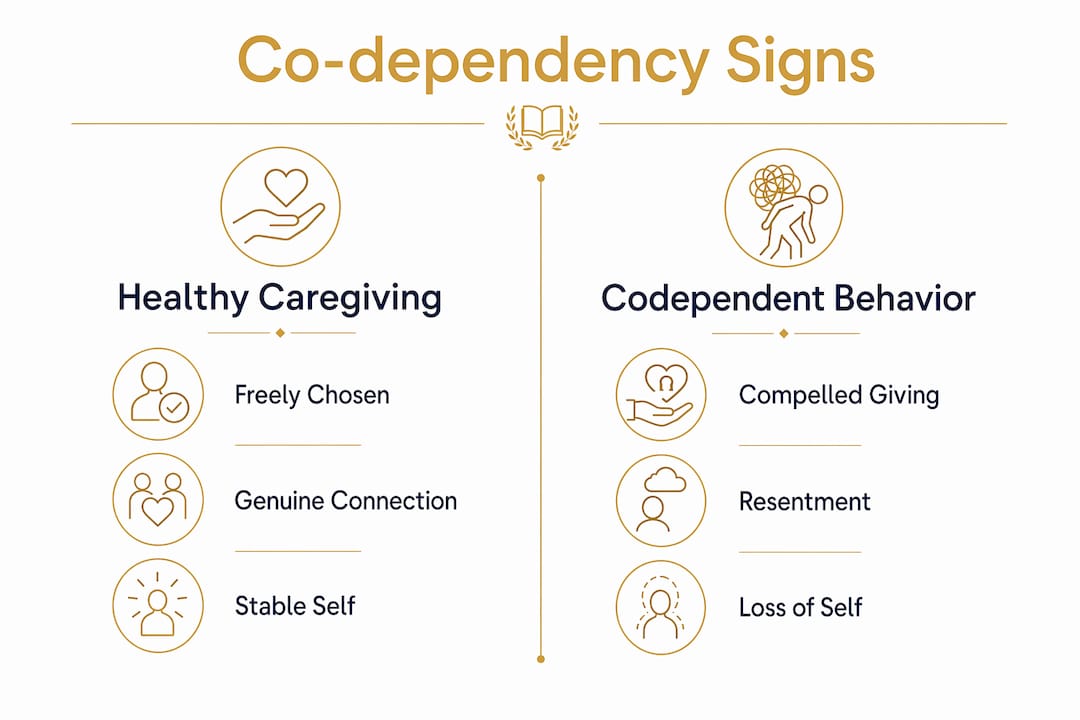
This is where many readers get stuck. Caring about others is not codependency. The difference lies in what happens inside the person doing the caring.
| Healthy caregiving | Codependent caretaking |
|---|---|
| Giving feels freely chosen | Giving feels compelled or obligatory |
| Boundaries remain intact | Boundaries dissolve to meet the other’s needs |
| Self-identity stays stable | Identity organizes around the other person |
| Mutual respect guides the relationship | One person carries most of the emotional weight |
| Resentment is rare | Resentment builds after giving |
Resentment after giving is one of the clearest signals that caregiving has crossed into codependency. Healthy care does not leave the giver feeling depleted, invisible, or bitter. When it does, the giving was driven by fear or obligation, not genuine choice.
The New Codependency addresses a common misconception directly: codependency is not the same as being loving or devoted. The problem is not the caring itself. The problem is self-erasure in the process. Readers who explore toxic relationship patterns through literature often find this distinction is the single most clarifying concept in their recovery.
Maintaining a stable sense of self inside a relationship is not selfishness. It is the foundation of genuine connection. Books consistently argue that two people with clear identities create healthier relationships than two people who have merged into one.
What are the best and most influential books on co-dependency?
The literature on co-dependency is rich, and different books serve different needs. Here are the most significant titles and what each one offers.
- Codependent No More by Melody Beattie (1986). This is the book that introduced the term to a mass audience. It has sold millions of copies and remains the starting point for most readers. Beattie’s central argument is that detachment from another’s behavior, combined with self-care, is the path forward.
- Facing Codependence by Pia Mellody. Mellody’s framework is more clinical and structured than Beattie’s. She identifies five core symptoms and traces each one to specific childhood experiences. With over 750,000 copies sold, it remains essential reading for anyone who wants to understand the family-of-origin roots of the pattern.
- Codependency For Dummies. This text takes a practical, step-by-step approach. It covers family origin, self-esteem, and emotional health in accessible language, making it ideal for readers who want concrete exercises alongside conceptual understanding.
- The New Codependency by Melody Beattie. Written decades after her first book, this updates the conversation to include relationships beyond addiction, addressing how codependency shows up in modern friendships, family systems, and workplaces.
These books complement each other. Codependent No More provides the emotional entry point. Facing Codependence provides the structural framework. Codependency For Dummies provides the practical tools. Reading them in sequence gives a layered understanding that no single book can offer alone.
Key Takeaways
Co-dependency is a learned relational pattern rooted in childhood attachment wounds, and the most effective path to recovery runs through self-awareness, boundary practice, and a shift from external to internal validation.
| Point | Details |
|---|---|
| Co-dependency is learned behavior | It develops from conditional love and emotional unpredictability in childhood, not from personal weakness. |
| Signs appear across all relationship types | Poor boundaries, fear of abandonment, and emotional caretaking show up in friendships, families, and workplaces. |
| Recovery requires internal focus | Shifting energy from fixing others to understanding oneself is the core of every major recovery approach. |
| Resentment signals codependency | Feeling depleted or bitter after giving is a reliable indicator that caregiving has crossed into self-erasure. |
| Books serve different recovery needs | Codependent No More offers emotional entry, Facing Codependence provides structure, and Codependency For Dummies delivers practical tools. |
Why books on co-dependency changed how I think about relationships
I spent years assuming that caring deeply about someone was always a virtue. Reading Codependent No More for the first time was genuinely disorienting. Beattie does not celebrate self-sacrifice. She names it as a problem, and that naming felt almost confrontational the first time I encountered it.
What shifted for me was the attachment framing. Once I understood that codependency is an adaptive survival strategy, not a moral failing, the shame around it dissolved. That reframe is not soft or permissive. It is accurate. And accuracy is what makes change possible.
The books I return to most are the ones that refuse to flatten the concept. Facing Codependence is demanding reading. Mellody does not let you off the hook with vague reassurances. She asks you to trace specific behaviors back to specific experiences, and that specificity is where the real work happens.
My honest observation after years of reading in this space: most people who struggle with codependency do not need more information. They need permission to prioritize themselves without guilt. The best books give that permission clearly and without apology. The readers who make the most progress are the ones who read actively, meaning they stop, reflect, and apply what they read before moving to the next chapter.
— Robert
Smartreadshub: curated books for your recovery path
Readers working through co-dependency patterns need more than a single book recommendation. They need a curated path through the literature, one that matches where they are in their recovery.

Smartreadshub brings together expert-selected titles on emotional health, relational patterns, and psychological recovery. Whether you are reading your first book on the subject or looking for what comes after Codependent No More, the site connects you with the right next read. Explore resources on emotional recovery after abuse and find self-help books for healing that match your specific situation. Smartreadshub also covers the real role of self-discovery books for readers ready to go deeper.
FAQ
What is the clinical definition of co-dependency?
Co-dependency is not a formal DSM diagnosis but a recognized relational pattern involving excessive emotional reliance on another person, poor boundaries, and self-worth tied to external approval. It overlaps with anxious attachment and people-pleasing behaviors.
Which book is best for first understanding co-dependency?
Codependent No More by Melody Beattie is the standard starting point. It has sold millions of copies since 1986 and remains the most widely recommended introduction to the concept.
Can co-dependency appear outside of addiction relationships?
Co-dependency extends to friendships, family systems, and workplaces, not just relationships involving substance use. Any dynamic where one person takes excessive responsibility for another’s emotional state can be codependent.
How do books recommend recovering from co-dependency?
Leading texts recommend a combination of 12-step programs like CoDA, attachment-focused or psychodynamic therapy, daily boundary practice, and learning to tolerate discomfort without immediately acting to relieve another person’s distress.
Is co-dependency a personal flaw or a learned pattern?
Co-dependency is a learned adaptation to unreliable or conditional caregiving in childhood. It is not a defect but a survival strategy that outlives its usefulness. Recovery focuses on building healthier patterns, not correcting a character flaw.