
Books for anger processing are defined as structured, evidence-based resources that use therapeutic frameworks like Cognitive Behavioral Therapy (CBT) and Dialectical Behavior Therapy (DBT) to help readers understand, regulate, and redirect intense emotions. These are not passive reads. The best titles combine psychological insight with hands-on exercises, journaling prompts, and self-assessment tools that build real skills over time. Whether you’re navigating a difficult relationship, recovering from emotional harm, or simply trying to stop reacting in ways you regret, the right book can serve as a practical guide to lasting change. Smartreadshub curates exactly these kinds of resources for readers facing emotional complexity.
What makes books for anger processing actually effective?
Not every self-help book on anger delivers results. The ones that do share a specific set of features that separate insight from real change.
Evidence-based therapeutic frameworks are the foundation. CBT and DBT are the two most widely used approaches in top anger management books. CBT targets the thought patterns that fuel anger. DBT adds mindfulness and acceptance skills that help you tolerate distress without acting on it. A book that blends both gives you a balanced toolkit.

Self-assessment tools matter more than most readers expect. Anger intensity scales that categorize emotions from minor frustration to full rage let you track your own patterns over time. That kind of self-monitoring turns vague awareness into measurable progress.
The format of the book also shapes how much you get from it. Key features to look for include:
- Write-in workbook format: Active journaling and exercises produce better emotional regulation outcomes than passive reading alone. Writing forces you to process, not just absorb.
- Step-by-step exercises: Structured activities build skills progressively rather than overwhelming you with theory.
- Journaling prompts: These guide reflection on specific triggers, reactions, and patterns you might otherwise miss.
- Physiological awareness training: The best books teach you to read your own body. Tension in your jaw, heat in your chest, a racing heart are all early signals that anger is escalating.
- Structured timelines: Many effective workbooks use a 12-week program format that builds skills systematically rather than leaving you to figure out pacing on your own.
Pro Tip: Before buying any anger management book, flip to the back third. If there are no exercises, no reflection prompts, and no self-assessment tools, it’s a theory book. Theory alone rarely changes behavior.
How to use anger management books for lasting emotional healing
Owning the right book is step one. Using it well is where most readers fall short.
The single biggest mistake is treating these books like novels. You read a chapter, feel understood, and move on. Real change requires a different approach. Here is a structure that works:
- Set a fixed schedule. Commit to two or three sessions per week, not just when you feel angry. Consistency builds the neural pathways that make regulation automatic over time.
- Complete every exercise before moving forward. Skipping exercises because they feel uncomfortable is exactly when they matter most. Discomfort signals a real trigger worth examining.
- Pair reading with a dedicated journal. Keep a separate notebook for your responses. Writing by hand slows your thinking and forces more honest reflection than typing.
- Integrate rituals into your daily routine. Therapeutic rituals and purposeful narratives bridge the gap between understanding anger and actually changing how you respond to it. A five-minute morning check-in or an evening reflection practice turns book insights into lived habits.
- Use the book alongside professional support when possible. Anger management books work best as supplements to therapy, not replacements. A counselor can help you adapt exercises to your specific history and emotional patterns.
The 12-week program structure used by many workbooks exists for a reason. It prevents the common trap of rushing through content without letting skills settle. Treat the timeline as a commitment, not a suggestion.
Pro Tip: If you find yourself reading the same chapter twice without completing the exercises, stop reading. Do the exercise first, even imperfectly. Progress comes from doing, not re-reading.
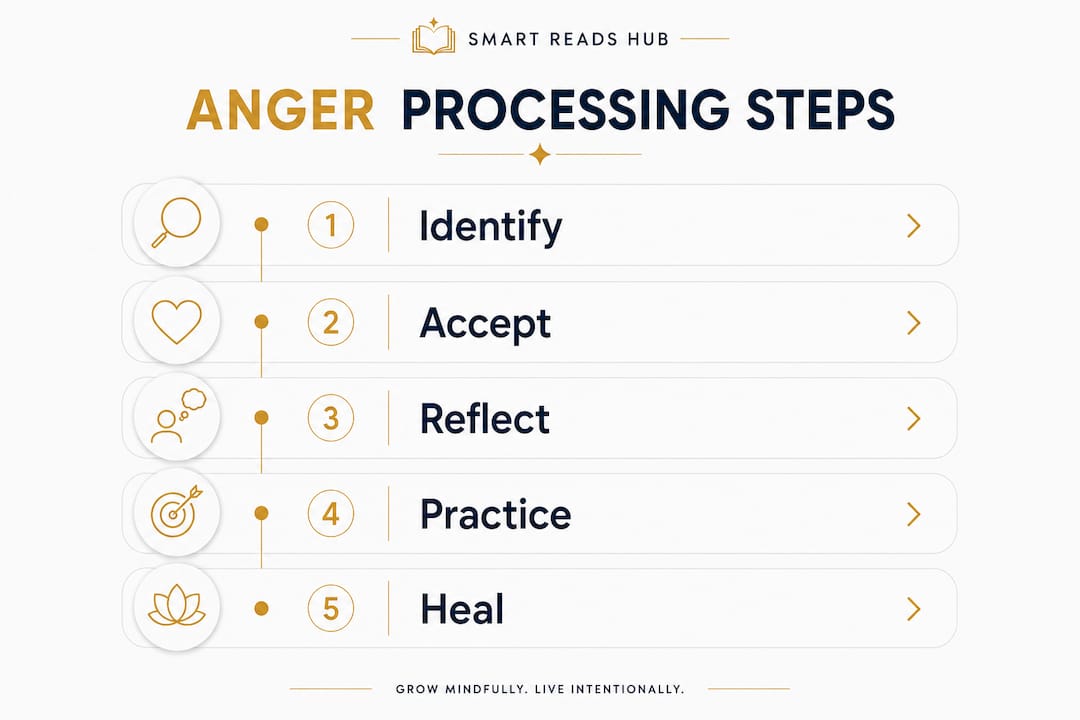
One more pitfall worth naming: trying to manage anger entirely in isolation. Books provide science-backed tools for emotional pain, but they work best when you have at least one person in your life who knows you are doing this work.
What therapeutic approaches do top anger books use?
Understanding the methods inside these books helps you choose the right one and use it more effectively.
| Approach | Core Focus | What It Looks Like in a Book |
|---|---|---|
| Cognitive Behavioral Therapy (CBT) | Identifying and reframing distorted thoughts that trigger anger | Thought records, belief-challenging exercises, behavioral experiments |
| Dialectical Behavior Therapy (DBT) | Mindfulness, emotional acceptance, and distress tolerance | Mindfulness scripts, TIPP skills, radical acceptance exercises |
| Physiological awareness | Reading body signals as early anger warnings | Body scan exercises, sensation mapping, trigger identification |
| Narrative and ritual | Building purposeful stories and daily practices around healing | Reflection prompts, ritual design, meaning-making exercises |
CBT works by showing you that anger is rarely about the event itself. It is about the story you tell yourself about that event. A book using CBT will walk you through identifying automatic thoughts, testing whether they are accurate, and replacing them with more grounded interpretations.
DBT adds a layer that CBT alone sometimes misses: acceptance. The fusion of CBT and DBT offers a balanced approach of acceptance and change that is critical for managing intense emotions like anger. You learn to sit with discomfort without acting on it, which is a skill that takes practice but pays off significantly in relationships.
Comprehensive anger guides that span several hundred pages go deeper than symptom management. They cover the physiology of anger, the fight-or-flight response, and how chronic stress primes your nervous system to overreact. That background context makes the exercises feel less arbitrary and more grounded in how your body actually works.
Physical sensation monitoring is one of the most underused tools in anger regulation. Body awareness helps you detect early signs of anger escalation before the emotion reaches a point where rational thinking shuts down. Books that include body-based exercises give you an earlier intervention window.
How do anger books help with difficult relationships and emotional challenges?
Anger rarely exists in isolation. For most readers, it is tangled up with anxiety, grief, fear, or the accumulated weight of a difficult relationship. The best books on emotional regulation recognize this.
Addressing root causes like anxiety, stress, and fear shifts the focus from symptom control to genuine understanding. When you know why you get angry, not just that you do, you gain real leverage over your reactions.
Books that support readers in difficult relationships tend to do several things well:
- They identify relational triggers. Exercises help you map which specific dynamics, words, or behaviors activate your anger response. That specificity is far more useful than generic advice to “stay calm.”
- They build communication skills. Many workbooks include scripts and frameworks for expressing anger without escalating conflict. These tools are especially useful when relationship patterns are deeply ingrained and hard to break.
- They address the body’s role in relational anger. When you’ve been in a psychologically harmful relationship, your nervous system learns to stay on high alert. Books that include physiological grounding exercises help reset that baseline.
- They use narrative to build resilience. Healing through narrative, ritual, and purpose forms a triad approach that builds resilience beyond symptom control. Telling a coherent story about your experience reduces its emotional charge over time.
- They use validated therapeutic content. When anger is rooted in deep emotional pain, books grounded in CBT and DBT provide a safer framework than generic positivity-focused titles.
For readers dealing with toxic or manipulative relationships, books that explain toxic relationship dynamics alongside anger regulation tools offer a more complete picture of what you are actually responding to.
Key Takeaways
The most effective books for anger processing combine CBT and DBT frameworks with write-in exercises, physiological awareness training, and structured timelines to produce lasting emotional regulation skills.
| Point | Details |
|---|---|
| Choose evidence-based formats | Look for books grounded in CBT and DBT with write-in exercises, not theory-only reads. |
| Use structured timelines | A 12-week program format builds skills systematically and prevents rushing through content. |
| Monitor physical signals | Body awareness exercises help you catch anger early, before rational thinking shuts down. |
| Address root causes | Books that target anxiety, stress, and fear produce more lasting results than symptom-only approaches. |
| Combine books with support | Use workbooks alongside therapy or journaling for the best outcomes, not as a standalone fix. |
Why I think most people underestimate what these books can do
People often pick up an anger management book expecting a list of breathing techniques. What they find, if they choose well, is something closer to a structured therapy program they can run at their own pace.
The readers I’ve seen get the most from these books are the ones who treat the write-in exercises as non-negotiable. There is something about putting pen to paper on a prompt like “describe the last time you felt rage and what you told yourself in that moment” that surfaces things a passive read never would. The workbook format is not a gimmick. It is the mechanism.
What surprises people most is the ritual component. Books like Why We Suffer and How We Heal by Suzan Song make the case that insight alone does not heal. You need a practice, something you do repeatedly, that anchors the new understanding in your daily life. That idea sounds abstract until you actually try it, and then it becomes obvious.
My honest recommendation: if you are dealing with anger that is tied to a difficult or harmful relationship, do not start with a generic anger management title. Start with a book that addresses the relational context first. Understanding what you are actually responding to changes everything about how you regulate it. Smartreadshub’s curated guides on emotional recovery after abuse are a good place to orient yourself before choosing a workbook.
And if you can, work with a therapist alongside the book. Not because the book is insufficient, but because a good therapist will help you apply the exercises to your specific situation in ways a general workbook cannot anticipate.
— Robert
Smartreadshub’s curated guides for anger and emotional healing
Choosing the right book from hundreds of options is genuinely hard, especially when you are already dealing with emotional stress. Smartreadshub does that filtering work for you.
The site’s curated reading lists focus specifically on books that address anger, emotional regulation, and the psychological complexity of difficult relationships. Every recommendation is selected for its therapeutic grounding and practical value, not just popularity. Whether you are looking for a structured workbook, a narrative-driven guide, or a title that addresses anger within the context of harmful relationships, Smartreadshub’s book recommendations for women and broader emotional healing guides give you a vetted starting point. You get expert-verified selections matched to where you actually are, not a generic bestseller list.
FAQ
What are the best therapeutic approaches in anger processing books?
CBT and DBT are the two most widely used frameworks in effective anger management books. CBT reframes distorted thoughts that trigger anger, while DBT adds mindfulness and distress tolerance skills.
How long does it take to see results from anger management books?
Many structured workbooks use a 12-week program format designed to build emotional regulation skills systematically. Consistent practice with exercises, not just reading, drives the results.
Can anger processing books help with relationship problems?
Yes. Books that address root causes like anxiety and relational triggers help readers improve communication and reduce conflict. They are especially useful when paired with resources that explain the dynamics of difficult or toxic relationships.
What is the difference between a self-help book and an anger workbook?
A self-help book primarily delivers insight and theory. A workbook includes write-in exercises, journaling prompts, and self-assessment tools that translate insight into behavioral change through active engagement.
Do I need therapy if I am using an anger management book?
Books work best as supplements to professional therapy, not replacements. A counselor can adapt exercises to your personal history and help you apply them more precisely to your specific emotional patterns.