
Sadness, anger, relief, confusion, loneliness, guilt, shame, anxiety, nostalgia, and eventual acceptance are the ten emotions nearly everyone cycles through after a breakup, often in a matter of days, not months. None of these feelings arrive in order, and most people feel two or three at once, sometimes contradicting each other in the same hour.
Right now, before anything else, try this:
- Ground yourself physically. Splash cold water on your face, step outside, or name five things you can see. Panic spikes fade faster than they feel like they will.
- Reach out to one person. Not a group chat. One trusted friend or family member who can just listen.
- Remove the immediate triggers. Mute or unfollow your ex for now. You can decide later if that’s permanent.
These feelings are common, and they usually follow a grief-like arc rather than a straight downhill slide. That’s not a coincidence: losing a partner activates the same attachment distress response the brain generates for any major attachment loss, which is why even a breakup you initiated can still flatten you.
Table of Contents
- What Are the Most Common Types of Post-Breakup Emotions?
- What Stages Do People Go Through After a Breakup?
- Why Do Breakups Trigger Such Intense Emotions?
- How Long Do Post-Breakup Feelings Usually Last?
- What Actually Helps You Cope With These Emotions?
- Should You Seek Professional Help for Breakup Emotions?
- What Are the Signs You’re Actually Healing?
- Do Emotions Hit Immediately or Show Up Later?
- How Does Your Personality Shape the Way You Grieve a Breakup?
- Does It Matter If the Breakup Was Mutual or Sudden?
- How Do Culture and Society Shape Breakup Grief?
- Why Does Reflecting on the Breakup Actually Help You Heal?
- Where Can You Find Support for Deeper Emotional Recovery?
- Where Should You Go for More Support and Information?
- Frequently Asked Questions
- Sources
What Are the Most Common Types of Post-Breakup Emotions?
Some of these will hit you hard. Others might barely register. That’s normal. Here’s what each one tends to look like in real life.
- Sadness. The heaviness that makes getting out of bed feel like a chore. Shows up as crying jags, low appetite, or just staring at your phone for an hour.
- Intense longing. A physical pull toward your ex, sometimes stronger than the sadness itself. You reread old texts or replay a specific memory on loop.
- Anger or resentment. Irritability that spills onto people who had nothing to do with the breakup. You rehearse arguments you’ll never actually have.
- Relief. Especially common after a draining or one-sided relationship. Feels like exhaling after holding your breath for months.
- Confusion. Struggling to pin down what even happened or whether you made the right call. You ask friends to relitigate the whole relationship.
- Loneliness. Not just missing your ex, but missing the built-in plans, the shared inside jokes, the person who knew your day.
- Guilt. Especially sharp if you were the one who ended things. You replay moments where you think you failed the other person.
- Shame. Different from guilt: this is about how the breakup makes you see yourself, not just what you did.
- Anxiety. Racing thoughts about the future, sleep disruption, or a tight chest when your phone buzzes.
- Nostalgia. The good memories resurfacing, sometimes stronger than the bad ones, which can trick you into idealizing the relationship.
- Numbness or flatness. Feeling strangely nothing at all, particularly right after a sudden split.
Pro Tip: Feeling relief and guilt in the same breath isn’t a contradiction, it’s the most common combination people report after ending a difficult relationship. Sitting with both instead of picking one to suppress speeds up the sorting process.
What Stages Do People Go Through After a Breakup?
Most people reach for the classic five stages when trying to make sense of what they’re feeling: denial, anger, bargaining, depression, and acceptance. A shorter seven-stage version breaks this down further, adding shock, protest, and reflection as distinct phases, but the underlying idea is the same. A relationship’s end represents the loss of a shared future, and the stages of grief framework exists because that loss behaves like any other bereavement.
Here’s the catch almost nobody tells you: these stages aren’t a staircase. They’re closer to tide patterns. You don’t walk from denial to acceptance and stay there. You get pulled back out by an anniversary, a song, a mutual friend’s Instagram story, and suddenly you’re back in anger or sadness for a day or two before the water recedes again.
Think of it less like climbing a ladder and more like waves hitting a shore during a receding tide. Each wave still reaches the sand, but with less force and less water each time. The overall trend is forward, even when any single wave feels like a setback.
Shock and denial
This is the numbness phase, and it often shows up first, especially after a sudden or unexpected split. You go through the motions of your day almost on autopilot. Some people describe it as watching their own life from outside their body. This isn’t avoidance or weakness. It’s a protective dissociative response that keeps overwhelming input from flooding your system all at once.
Anger and protest
Once the numbness wears off, anger tends to surface, sometimes directed at your ex, sometimes at yourself, sometimes at circumstances that had nothing to do with either of you. This stage can also include a “protest” instinct: the urge to reach out, explain yourself, or try to reverse the breakup. It’s uncomfortable, but it’s also a sign your system hasn’t fully accepted the loss yet, which is a normal part of processing it.

Bargaining
Bargaining looks like mental replays: “If I had just done X differently…” or “Maybe if we take a break instead of a full breakup…” You might find yourself drafting texts you never send, negotiating scenarios in your head that would undo the outcome. This stage tends to overlap heavily with anxiety.
Acute grief and depression
This is usually the heaviest stretch. Sleep and appetite take a hit. Motivation for basic tasks disappears. Crying spells can come without warning. This isn’t a character flaw or a sign you’re handling things badly. It’s the same physiological grief response the body produces after any significant loss, and for many people it’s the longest stage of the entire process.

Acceptance and growth
Acceptance doesn’t mean you stop caring or that every memory stops stinging. It means the breakup no longer runs your day. You can think about your ex without your chest tightening. You start reinvesting energy into your own routines, interests, and relationships. Growth often follows close behind, once you start rebuilding your own identity instead of defining yourself by the relationship you lost.
Here’s how the non-linear pattern actually plays out for most people:
- Week one: shock and numbness dominate, punctuated by sudden crying.
- Week three: anger flares, especially if you see your ex moving on visibly.
- Month two: a good stretch of feeling “fine,” followed by a bad week triggered by a shared friend’s wedding invite.
- Month four: bargaining resurfaces briefly around what would have been an anniversary.
- Month six: acceptance holds steady for longer stretches, interrupted less often and less intensely.
That back-and-forth is the rule, not the exception. If you found yourself in acceptance in March and then flat on your back with sadness in May, you haven’t relapsed. You hit a wave.
Why Do Breakups Trigger Such Intense Emotions?
The short answer: your brain treats a breakup the way it treats any major attachment loss, and that triggers a cascade of stress hormones and grief responses your conscious mind doesn’t get to override.
Human attachment systems evolved to keep us bonded to the people who kept us safe, which is why losing an attachment figure can produce panic, abandonment fear, and a sense of hopelessness, even when you know logically that the breakup was the right call. That mismatch between what you know and what you feel is one of the most disorienting parts of the entire process.
The grief comparison isn’t just a metaphor, either. Heartbreak can produce physical symptoms that mirror bereavement: disrupted sleep, changes in immune function, and a real risk of channeling that grief into unhelpful coping behaviors like overworking, drinking more, or jumping into a rebound relationship too fast, according to Psyche’s guide to breakup grief. The numbness that shows up right after a sudden split is also doing real work: it’s a buffering mechanism that keeps your nervous system from being flooded all at once.
The pain of a breakup isn’t a sign something is wrong with you. It’s your attachment system doing exactly what it evolved to do when a bond is severed.
Pro Tip: Keep a one-line daily log: mood (1 to 10), sleep hours, and one word for the dominant emotion. After two weeks, look back. Most people are surprised to see the trend is downward in intensity even when individual days still feel brutal. If the trend is flat or worsening after several weeks, that’s a signal to bring in professional support.
Many adults report that a breakup is one of the most stressful events of their adult life, a figure consistent with how closely grief researchers now treat romantic loss alongside bereavement.
How Long Do Post-Breakup Feelings Usually Last?
There’s no fixed timeline, and anyone who gives you an exact number of weeks is guessing. What does exist is a pattern most people recognize in hindsight, even if it didn’t feel predictable while they were in it.
- First 72 hours: Shock, numbness, or the opposite: a flood of tears and panic. Sleep and appetite are often the first casualties.
- First month: The waves start. Good days followed by bad days with no obvious trigger. Anger and bargaining tend to peak here.
- Three months: Intensity usually starts dropping, though specific triggers (a birthday, a mutual event) can still knock you back hard for a day or two.
- Six to twelve months: Most people report the waves are shorter and further apart. Full recovery timelines vary enormously based on relationship length, attachment style, and how the breakup happened.
Certain moments reliably reopen the wound: anniversaries, seeing your ex’s new relationship on social media, or even starting to date someone new yourself (which can trigger unexpected grief for the old relationship). Limiting how often you check your ex’s social media is one of the simplest ways to shorten how often those waves hit.
Pro Tip: If you know an anniversary or shared holiday is coming, plan something specific for that day in advance rather than leaving it open. A scheduled dinner with a friend or a solo trip you’ve already booked gives your mind somewhere to land instead of spiraling.
What Actually Helps You Cope With These Emotions?
The strategies that work best combine acceptance of what you’re feeling, structured activity to counter avoidance, real social contact, and clear boundaries around your ex. None of these require you to feel better before you start doing them.
- Use a grounding technique when panic spikes. Try the 3-3-3 method: name three things you see, three things you hear, and move three parts of your body. It takes under a minute and interrupts a spiral before it builds.
- Set explicit no-contact rules if you need distance. Decide the rule in advance (“no texting, no checking their profile for 30 days”) rather than deciding in the moment when you’re most likely to break it.
- Reactivate your social life deliberately. Isolation makes every emotion louder. Text one friend today: “Can we grab coffee this week? Going through a breakup and could use the company.”
- Journal without editing yourself. Expressive writing has real research support for lowering physiological stress markers and interrupting rumination, particularly when you write freely instead of trying to sound composed.
- Protect sleep and appetite first. These are usually the first things to slip and the hardest to recover once they’re badly disrupted. A consistent bedtime matters more right now than it usually would.
- Know when to distract and when to reflect. Distraction (a workout, a movie, time with friends) is useful for getting through an acute wave. Reflection (journaling, therapy, reading) is better once the wave has passed and you can actually process what came up.
- Read with intention, not as an escape. Structured, curated material on attachment and recovery can give you language for what you’re feeling and a framework for what to do next, which is part of why resources like Smart Reads Hub’s guide to detaching emotionally exist: not to replace therapy, but to give you something concrete to act on between sessions or on your own.
A quick script if you’re not sure what to say when reaching out: “Hey, I’m having a rough week with the breakup. Would it help you if I just vented for ten minutes, or would you rather we do something to get my mind off it?” Giving the other person a choice makes it easier for them to actually show up for you.
Pro Tip: The 3-3-3 grounding exercise pairs well with a two-minute behavioral activation habit: pick one tiny task you’ve been avoiding (making the bed, replying to one email) and do just that one thing. Momentum matters more than the size of the task.
Should You Seek Professional Help for Breakup Emotions?
Get professional support if you notice persistent, severe symptoms or any safety concerns, including an inability to function day to day or thoughts of self-harm. Sadness, anger, and even weeks of low motivation are normal. What isn’t normal is when those symptoms don’t budge or start interfering with your ability to work, eat, or care for yourself.
Watch for these red flags:
- Pervasive hopelessness that doesn’t lift for weeks at a time.
- Inability to get out of bed, go to work, or maintain basic hygiene.
- Thoughts of self-harm or feeling like life isn’t worth continuing.
- Escalating use of alcohol or other substances to numb the pain.
If you or someone you know is in crisis, the 988 Suicide and Crisis Lifeline is available by call or text in the United States, and The Hotline offers support specifically around relationship-related crises and safety planning. When contacting a therapist for the first time, a simple script works: “I’m dealing with a difficult breakup and I think I need support beyond what friends and family can give. Do you have availability, and do you work with grief or relationship loss?” When searching for a therapist, check for licensure, a stated specialty in relationships or grief, and whether they offer a sliding scale if cost is a concern.
What Are the Signs You’re Actually Healing?
Progress after a breakup shows up in small, specific changes rather than one dramatic turning point. Fewer daily tears, the ability to think about your ex without a physical jolt of pain, and a return to hobbies you’d dropped are all real markers, even when they feel too small to count.
Near-term signs worth noticing:
- You go a full day without checking your ex’s social media.
- A trigger (a song, a place) causes a smaller reaction than it did a month ago.
- You make plans with friends without forcing yourself.
Longer-term signs:
- You’ve built a new routine that isn’t a copy of your old life with your ex.
- You can talk about the relationship without it derailing your mood for the rest of the day.
- You notice interest in dating again or genuine contentment being alone, without anxiety driving either choice.
A useful weekly journaling prompt: “How did I handle a trigger this week, and what would I do differently next time?” Progress here is rarely a straight line. Expect good weeks followed by a rough one, and treat the rough week as data, not failure.
Do Emotions Hit Immediately or Show Up Later?
Some people feel everything within the first hour: crying, anger, panic, all at once. Others feel almost nothing for days, then get blindsided by grief a week or two later when the initial shock wears off. Both patterns are normal, and they often depend on how the breakup happened.
Immediate reactions tend to be intense but short-lived: acute panic, a flood of tears, or that dissociative numbness described earlier. These reactions are the nervous system’s first response to sudden loss, and they usually shift within days.
Delayed reactions are trickier because they can catch you off guard. You might go back to work, function fine for a week, and then suddenly feel the full weight of it once the adrenaline of the breakup itself has worn off. This is especially common after breakups where you had to stay composed in the moment (a public conversation, a shared living situation you had to navigate carefully).
Neither timeline is a better or worse way to grieve. What matters more is whether the emotion eventually gets processed rather than permanently avoided. Someone who feels nothing for a month and then breaks down isn’t behind someone who cried immediately. They’re just on a different clock. The risk with delayed responses is mistaking the calm for being over it, then being blindsided when grief arrives weeks later without an obvious trigger.
How Does Your Personality Shape the Way You Grieve a Breakup?
Attachment style is one of the strongest predictors of how a breakup will feel and how long it will linger. People with an anxious attachment style often experience more intense longing, more urges to reach out or check on their ex, and a harder time tolerating the uncertainty of no contact. People with an avoidant attachment style may report less visible distress at first, sometimes mistaking that calm for being fine, only to have delayed emotions surface weeks later.
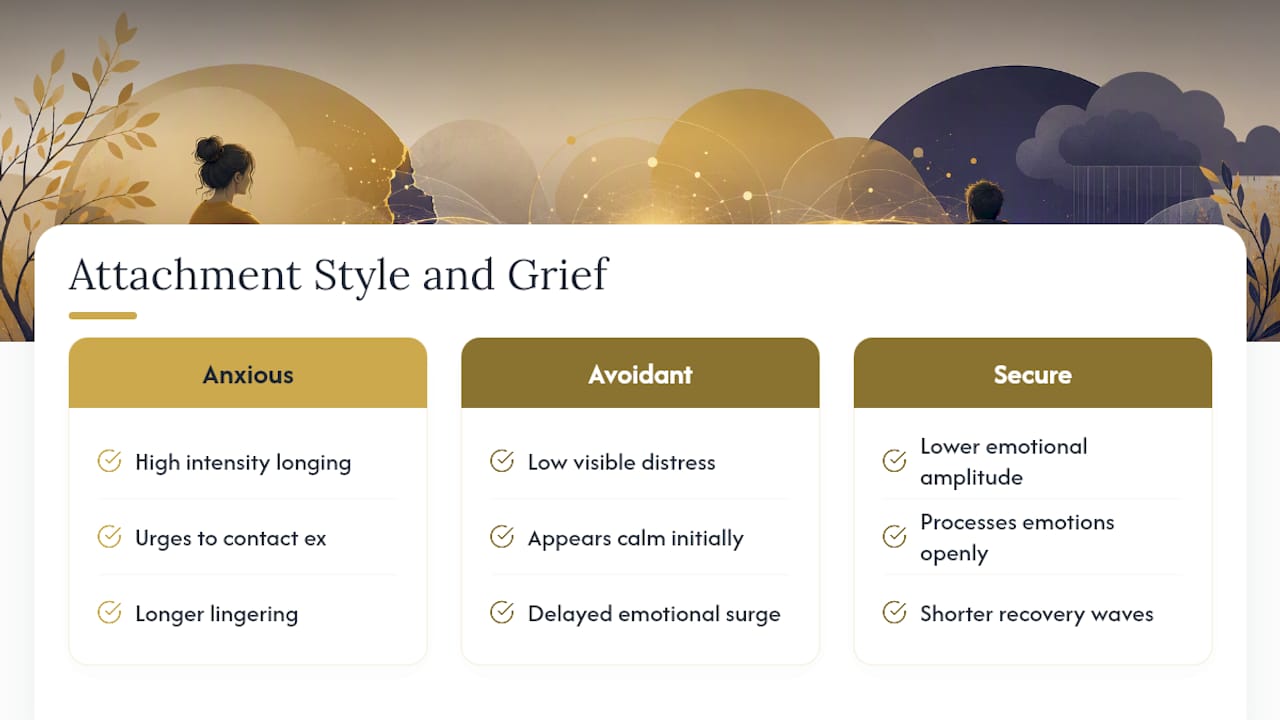
Securely attached people tend to move through the stages with less amplitude. They still grieve, but the waves are generally shorter and the bargaining or protest phase is less pronounced.
Personality traits matter too. Someone high in rumination tendencies is more likely to get stuck replaying the relationship, which can prolong the bargaining and anger stages. Someone with a strong existing support network and a habit of processing emotions openly, rather than suppressing them, tends to show stronger recovery outcomes over time. None of these patterns are fixed. Attachment style influences the shape of your grief, not your ceiling for healing, and that distinction matters if you’ve ever felt like your reaction was “too much” or “not enough” compared to someone else’s breakup.
Does It Matter If the Breakup Was Mutual or Sudden?
A mutual, well-communicated breakup and a sudden, forced one produce genuinely different emotional profiles, even though both count as real losses.
Mutual breakups tend to skip or shorten the shock and denial stage since both people saw it coming. Grief still arrives, often centered more on sadness and nostalgia than anger, since there’s less to be angry about when both sides agreed the relationship had run its course.
Sudden or one-sided breakups, especially if you didn’t see it coming or if it happened by text or through a third party, tend to produce a much sharper shock response, more numbness initially, and a longer bargaining phase. The lack of closure or explanation feeds the “what happened” confusion that keeps people stuck replaying the relationship for answers they may never get.
Breakups involving betrayal (infidelity, deception) add another layer entirely: shame and trust damage on top of standard grief, which is part of why some of these situations edge closer to trauma responses than typical breakup grief. If a relationship involved patterns of control or manipulation before it ended, that adds complexity worth naming directly. Recognizing trauma bonding dynamics can explain why leaving, or even feeling relief after leaving, still comes wrapped in guilt or an unexpected pull back toward the relationship.
How Do Culture and Society Shape Breakup Grief?
Not everyone is allowed to grieve a breakup the same way, and that’s largely dictated by the culture and social circle around them. Some cultures treat breakup grief with the same seriousness as bereavement, giving people space and time to withdraw. Others treat it as something to “get over” quickly, especially for men, who are often subtly discouraged from expressing sadness and instead funnel emotions into anger or withdrawal.
Gender norms play a visible role here. Men are frequently socialized to suppress sadness, which can push that grief into physical symptoms, irritability, or overwork instead of open processing. Women may face pressure to appear composed or “not bitter” after a breakup, which can suppress legitimate anger and push it into guilt or self-blame instead.
Social media adds a modern layer that didn’t exist for previous generations: public relationship status changes, mutual friends who “pick sides,” and the constant possibility of seeing your ex’s new life unfold in real time. That visibility can stretch out the timeline of recovery simply because the triggers never fully go away.
Family and community expectations matter too. In tighter-knit cultural or religious communities, a breakup can carry additional weight tied to family approval or long-term relationship expectations, adding social grief on top of personal grief. None of this changes what you’re allowed to feel. It just explains why two people can go through similar breakups and experience very different amounts of permission to actually process it.
Why Does Reflecting on the Breakup Actually Help You Heal?
Making sense of what happened, rather than just waiting for time to pass, is one of the most consistent differences between people who recover well and people who stay stuck. Meaning-making isn’t about deciding the breakup was “for the best” on day three. It’s a slower process of understanding what the relationship taught you and what you want differently going forward.
Treating your emotions as information rather than as problems to eliminate is part of this. Observing a wave of sadness or anger without judging yourself for having it makes that wave move through faster than suppressing it does, and it reduces the odds of that unprocessed grief resurfacing later as chronic rumination or avoidance.
Journaling, therapy, and even structured reading all serve the same underlying function: they give your brain a way to organize a chaotic experience into something coherent. That’s part of why recovery tends to track less with “getting back to who you were” and more with actively building a new relationship with your own habits, thoughts, and preferences. The goal was never to erase the relationship. It’s to understand it well enough that it stops running the show.
What the emotional curve actually looks like from the inside
A month after a hard breakup, you can feel almost normal for four straight days and then get flattened on the fifth by nothing more than a song in a grocery store. That’s not a step backward. It’s the wave pattern doing exactly what it does. A small victory, like getting through a friend’s engagement party without spiraling, doesn’t erase the bad days that came before it, but it counts. It’s proof the trend is moving, even when any single day feels stuck.
Setbacks are part of the process, not evidence that the process has failed. If you had a good stretch and then a rough week, that’s cumulative healing at work, not a relapse. The coping strategies and recovery signs covered above are what turn that cumulative process into something you’re actively steering rather than just surviving.
Where Can You Find Support for Deeper Emotional Recovery?
Curated reading gives structure to the meaning-making process, turning scattered feelings into language you can actually use and act on.

If you’re past the acute crisis stage and looking for something to help you process what happened at your own pace, Smart Reads Hub built its entire library around exactly this kind of recovery work. A few places to start:
- Books for breakup healing for readers who want a structured, page-by-page approach to processing loss.
- Books about loneliness after a split if isolation is the emotion hitting hardest right now.
- Books to rebuild confidence after a breakup for when shame or self-doubt is the bigger obstacle than sadness itself.
If the breakup involved patterns of control or confusion that went beyond typical relationship friction, it’s worth reading about toxic relationship behaviors to understand what you actually experienced. For readers who prefer to buy a physical copy right away rather than browse reviews first, Revive Your Relationships is available as an immediate download. None of this replaces a therapist if you’re dealing with severe symptoms. Reading works best as a companion to your own reflection, not a substitute for professional care when you need it. Browse the guides above, pick the one that matches what you’re feeling most right now, and start there.
Recovery from a breakup depends on recognizing which specific emotions you’re feeling and matching each one to a concrete coping response rather than waiting for time alone to fix it.
| Point | Details |
|---|---|
| Emotions overlap, they don’t queue | Relief and guilt, or sadness and anger, commonly show up together, not in sequence. |
| Stages move in waves, not lines | Expect the classic grief stages to resurface around triggers even after you’ve reached acceptance. |
| Numbness is protective, not broken | Early dissociation after a sudden breakup is your brain buffering overwhelming input, not a warning sign on its own. |
| Know the real red flags | Persistent hopelessness, inability to function, or self-harm thoughts mean it’s time to contact a professional or the 988 Lifeline. |
| Structured reading supports the process | Curated resources like those at Smart Reads Hub give you frameworks for meaning-making alongside therapy or self-reflection. |
Where Should You Go for More Support and Information?
A few sources are worth bookmarking if you want to go deeper than this article or need direct support beyond self-help.
- Cleveland Clinic’s guide to the stages of grief after a breakup for a clinical breakdown of the grief framework.
- HelpGuide’s coping strategies for breakup and divorce for practical, step-by-step recovery tips.
- Psychology Today on attachment distress and breakups for the science behind why breakups hurt so much.
- 988 Suicide and Crisis Lifeline and The Hotline for immediate, U.S.-based crisis support.
When choosing a therapist, look for a stated specialty in relationships or grief, verify their license through your state’s licensing board, and ask directly about cost or sliding-scale availability before your first session. Clinical sites like these are the right place for medical or mental health support, while resources built for reflection and identity rebuilding, including Smart Reads Hub’s book guides, work well as a companion to that care rather than a replacement for it.
Frequently Asked Questions
Is it normal to feel relieved after a breakup instead of sad?
Yes. Relief is one of the most common post-breakup emotions, especially after a draining, mismatched, or one-sided relationship. Feeling relieved doesn’t mean the relationship didn’t matter or that you’re heartless. It often means part of you recognized the mismatch long before you acted on it.
How long do post-breakup emotions typically last?
There’s no universal timeline. Most people notice the sharpest intensity in the first month, with waves of grief continuing to surface for several months, gradually shrinking in frequency and intensity. Relationship length, attachment style, and how the breakup happened all shift that timeline significantly.
Can you feel multiple breakup emotions at the same time?
Yes, and it’s actually the norm rather than the exception. Relief and guilt, sadness and anger, or nostalgia and resentment frequently show up together. That mix reflects the real complexity of losing someone, not confusion about how you should feel.
What’s the difference between normal breakup sadness and depression?
Normal sadness usually fluctuates and gradually loosens its grip over weeks. Clinical depression tends to be more persistent, doesn’t lift even on good days, and often includes an inability to function, pervasive hopelessness, or thoughts of self-harm. If those symptoms show up, professional support is the right next step, not more time alone.
Why do I still feel upset months after the breakup?
Triggers like anniversaries, mutual friends, or seeing your ex move on can reopen grief long after you thought you’d moved past it. This is the “waves” pattern at work, and a wave months later doesn’t erase the progress you’ve made since the breakup happened.
Should I read self-help books or see a therapist for breakup recovery?
They serve different purposes and work well together. Books and curated reading lists help you make sense of your feelings and give you frameworks for reflection, while a therapist can address deeper patterns, trauma, or symptoms that go beyond what reading alone can resolve.
Sources
- How to Get Over a Breakup — Psychology Today
- The stages of grief after a breakup — Cleveland Clinic
- Coping with a Breakup or Divorce — HelpGuide
- Psychological stages of breakup healing and recovery — Simply Psychology